Alternate Beneficiaries in a Will: How to Name a Back-Up
General information, not legal advice.
On this page
- TL;DR
- What an alternate beneficiary is
- Why a back-up matters more than most people expect
- When your alternate inherits
- How to name an alternate beneficiary
- Can you name more than one beneficiary or alternate?
- A worked example
- Super is not always covered by your will
- State and territory differences
- When to see a lawyer
- Keep your back-ups up to date
- Making it easy with WillBuddy
- FAQ
- Sources
- Recommended

Quick answer
An alternate beneficiary is the back-up person in your will. They receive a gift only if the first person you named can't take it, usually because that person has died before you. Naming one takes a single extra line per gift. It stops a gap in your will from sending your assets somewhere you never planned. You can draft that line free in WillBuddy, read the whole will, and only pay once you're happy with it.
This is general information, not legal advice.
TL;DR
- An alternate beneficiary (also called a substitute or back-up beneficiary) inherits a gift if your first choice dies before you or can't accept it.
- Without one, a gift can lapse. In NSW, a lapsed specific gift usually falls into the rest of your estate, and if the gift of the rest of your estate fails with no back-up, it can fall to the intestacy rules.
- You can name more than one beneficiary per gift, and you can name alternates for each gift or for the whole estate.
- Super is usually not controlled by your will. Check your nomination with your fund as well.
- Rules differ by state and territory. See a lawyer for blended families, a business or trust, assets overseas, or a likely contest.
What an alternate beneficiary is
A beneficiary is anyone who receives something under your will. It might be your partner, your children, a sibling, a friend or a charity.
An alternate beneficiary sits behind them in the queue. Your will says, in effect, "I leave my house to my partner. If my partner has died before me, I leave it to my children in equal shares." The partner is the first beneficiary. The children are the alternates.
You might see other names for the same idea:
- substitute beneficiary
- contingent beneficiary
- gift over
- back-up beneficiary
The wording in a will can differ, but the job is the same: say who takes the gift when the first choice can't.
Why a back-up matters more than most people expect
Most people write a will thinking about today. Your partner is alive. Your children are young. Your sister is healthy. Then life moves on, and a will that was fine at 35 has a hole in it at 60.
The risk is simple. If a person named in your will dies before you, the gift to them usually can't go to them. If you haven't said what happens next, the law decides for you.
That can lead to results you wouldn't choose. A gift meant for one child might spill into the pool shared by everyone else. Or it might end up with relatives you rarely see.
Two things that can go wrong
The gift lapses. To lapse means to fail. In NSW, a specific gift to someone who has died before you generally lapses and passes under the residuary clause, unless your will says otherwise. The residuary clause is the part of your will that deals with everything left after specific gifts, debts and costs. There is an exception in NSW: if the person who died was your child or other descendant and they left children or other descendants who outlive you by 30 days, section 41 of the Succession Act 2006 (NSW) generally passes the gift to them instead, unless your will says otherwise.
The residue has no back-up. In NSW, section 42 of the same Act is designed to stop a failed share of the residue going to the intestacy rules where other parts of the residue still take effect. But if the whole residue fails, for example because the only person you left it to died before you, you named no back-up and no rule like section 41 applies, it passes under the intestacy rules. Intestacy rules are the fixed formula each state uses when there is no valid will, or no valid will for part of an estate. You don't get a say in that formula.
Other states and territories have their own lapse and substitution rules. They aren't identical to NSW. So the safest approach is to say it in your will, in plain words, rather than rely on a default.
The 30-day rule in NSW
Sometimes two people die close together. NSW has a rule for that. Under section 35 of the Succession Act 2006 (NSW), a gift to a person who dies within 30 days after you takes effect as if they died before you. The will can switch this off or change the 30 days to a longer or shorter period.
If you live in NSW, that means your alternate could inherit even where your first choice outlived you by a few days. Think about whether that suits your family. Other states have their own survivorship rules, so check yours.
When your alternate inherits
Your alternate takes the gift when the condition you set is met. The most common conditions are:
- The first beneficiary dies before you.
- The first beneficiary dies within a set time after you (for example, 30 days).
- The first beneficiary cannot or will not accept the gift.
A good will states the condition clearly. "If my partner does not survive me" is plain and easy to apply. Vague phrases like "if something happens to them" invite arguments.
If you want your alternate to inherit when the first person simply doesn't outlive you by a set time, say so, and say how long. Don't leave it to chance.
How to name an alternate beneficiary
This is the practical bit. Work through your will one gift at a time.
Step 1: List every gift
Write down what you are leaving and to whom. Split it into:
- Specific gifts: a named item or amount, such as a car, a ring or $10,000.
- The residue: everything else, which is often the bulk of your estate.
The wording of specific gifts matters. Our guide to wording fixes for specific gifts shows how small changes keep a gift from failing.
Step 2: Choose a back-up for each
Ask the same question for every gift: "If this person can't take it, who should?"
You don't need a different alternate each time. Many people choose one back-up for the whole estate. A common set-up is:
- first choice: your partner
- alternates: your children, in equal shares
- if a child has died, that child's share goes to their own children
The last line is useful. It deals with a grandchild's claim before it arises.
Step 3: Say how the alternates share
If you name more than one alternate, say how they split the gift. Equal shares are common. Say "equally" in the will, or give a percentage for each.
Also say what happens if one of the alternates is gone too. Should their share go to the others, or to their own children? Pick one and write it down.
Step 4: Add a final back-up
Every chain needs an end. Name a last beneficiary, such as a sibling, a friend or a charity, who takes if everyone before them is unable to. Without that final name, the leftover share can fall back to the intestacy rules.
Step 5: Think about children under 18
If your alternate is a minor, they can't simply be handed a large sum. Their share is usually held until they reach an age you choose, and someone has to manage it in the meantime. Our guide for parents on minor children, guardians and trusts in wills covers how that works. This is also where you name the guardian who would raise your children.
Step 6: Sign it properly
A will must be signed and witnessed to be valid, and the rules for witnesses differ a little by state and territory. Print it, sign it with the witnesses present, and keep it safe. A great set of back-up names does nothing if the will isn't signed correctly.
Can you name more than one beneficiary or alternate?
Yes. A will can name as many beneficiaries as you like for a gift. It can leave a house to two siblings as equal owners, split the residue among four children, or give a charity a fixed percentage.
The same goes for alternates. You can name several, and you can name different alternates for different gifts.
A few tips keep it clean:
- Use full names and, where it helps, the relationship ("my sister, Jane Citizen").
- Give shares as fractions or percentages that add up to the whole.
- Say whether the alternates take equally or in set proportions.
- Keep the structure as simple as you can. The more layers you add, the more room there is for error.
A worked example
Sam is a single parent in Queensland with two children, Ava (12) and Leo (9). Sam wants the whole estate to go to the children, with a trusted brother, Tom, looking after it until they are older.
Sam's will might say:
- Residue to Ava and Leo in equal shares.
- If either child dies before Sam, that child's share goes to the other child.
- If both children die before Sam, the estate goes to Tom.
- Any share held for a child under 18 is kept for them until they reach the age Sam chose.
Without the second and third lines, a share could fall into a gap. With them, every outcome has an answer. This example is made up to show the structure and isn't a recommendation for your family.
Super is not always covered by your will
This catches many people out. Your super usually isn't part of your estate in the same way as your house or savings. It is paid by your fund's trustee, and what you have nominated matters a great deal.
The ATO says that with a binding nomination, the fund can pay your nominated dependants or your executor. With a non-binding nomination, or none at all, the trustee may use discretion. That can include paying your dependants or paying your executor so the money is shared out under your will.
So a back-up beneficiary in your will won't automatically apply to your super. To line the two up:
- Check which type of nomination you have with your fund.
- If it suits you, nominate your executor so the super flows through your will.
- Review it often, as many nominations need renewing.
Our guides explain this in more depth: super and your will and binding death benefit nominations. Self-managed super funds have extra rules. The ATO's ruling SMSFD 2008/3 says a nomination isn't binding to the extent it names someone who can't receive a benefit under the operating standards. If you have an SMSF, get advice on it.
State and territory differences
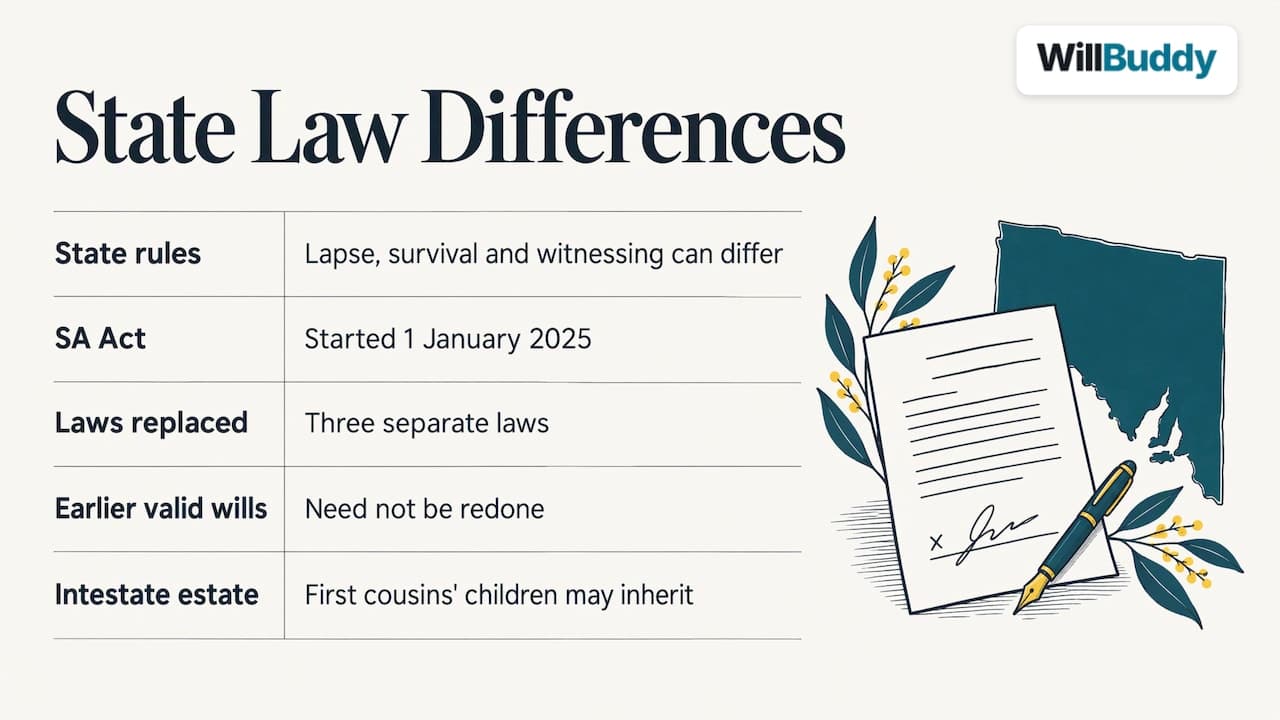
Wills law is made by each state and territory. The core idea of an alternate beneficiary is the same everywhere, but lapse rules, survivorship periods and witnessing rules can differ.
The rules also change. South Australia is a recent example. The Succession Act 2023 (SA) started on 1 January 2025 and replaced three separate laws. Valid wills made before then don't need to be redone. The same factsheet notes that, where someone dies with no close family, children of first cousins may now inherit an intestate estate.
That is a good reason to name your own back-ups. Intestacy formulas change, and they don't know your family.
When you draft a will in WillBuddy, it is drafted for the law of your state or territory. Signing it correctly in front of witnesses is what makes it valid.
When to see a lawyer
An online will suits many people with a straightforward family and straightforward assets. Speak to a lawyer if any of these apply:
- You have a blended family, such as children from earlier relationships and a new partner.
- You own a business or are setting up a trust.
- You hold assets overseas.
- You think someone is likely to contest your will.
In these cases, a gap or an unclear back-up can cause real disputes. Professional advice is worth it.
Keep your back-ups up to date
Back-ups only work if they are still the right people. Review your will when:
- you have a child or a grandchild
- you separate, marry or divorce
- someone you named dies
- you buy or sell a major asset
- someone you named moves overseas or falls out with the family
Our estate planning checklist sets out a simple review routine. It's also worth checking that your executor is still the right choice, and our guide to choosing a will executor can help.
Making it easy with WillBuddy
WillBuddy asks you plain questions one at a time and drafts a will for your state or territory. You can name your guardians and executors, set out who receives what, and exclude anyone you don't want to benefit. You read every word of the will free before you pay.
Life changes, so the will can too. An annual subscription includes up to 50 AI-assisted edits a year, which is handy when a beneficiary dies, a child is born or you simply change your mind. You print the will and sign it with witnesses. Your personal data is encrypted and never sold. See the Annual Access plan and price for current details.
FAQ
What is the difference between a beneficiary and an alternate beneficiary?
A beneficiary is the person you want to receive a gift. An alternate beneficiary is the back-up who receives it only if the first person can't. You name both in the same clause of your will.
What happens if I don't name an alternate?
The gift may lapse. In NSW, a lapsed specific gift generally falls into the residue. A failed share of the residue usually passes to the other residue beneficiaries, but if the whole residue fails with no back-up, it can fall to the intestacy rules. Other states and territories have their own rules, so naming an alternate is the safer path.
Can I name two people as beneficiaries of the same gift?
Yes. You can split a gift between two or more people. State their shares clearly, such as equal shares or set percentages, and say what happens if one of them can't take their share.
Does my alternate beneficiary also get my super?
Not automatically. Super is usually paid under your fund's nomination, not your will. The ATO explains that a binding nomination directs the trustee, so check your nomination with your fund as well as your will.
Sources
Show the 4 sources
- Succession Act 2006 (NSW), NSW Legislation
- Superannuation death benefits, Australian Taxation Office
- SMSFD 2008/3, Australian Taxation Office legal database
- The new Succession Act factsheet, Legal Services Commission of South Australia
Start your will free at willbuddy.com.au and read it before you pay.
Recommended
For the one who gets things sorted
Now write yours, with your family's names in it
Plain questions about your family, one at a time, and WillBuddy drafts a will for your state. Until you sign one, the law in your state or territory decides who gets what. Read every word free, with no card. You pay only if you want to print it.
Start my will freeLast updated 19 November 2026.
This article is general information only and is not legal advice. It is our best interpretation of the law as at 19 November 2026. WillBuddy is not a law firm, and it never replaces advice from a lawyer or solicitor. Laws change and differ between states and territories, so for your own circumstances, please get legal advice.