Are Wills Public Record in Australia? What Others Can See
General information, not legal advice.
On this page
- TL;DR
- What "public record" means for a will
- Who can see a will before probate
- After probate: how to search by state
- What the public can and cannot see
- How to find out if someone left a will
- What happens if the original will is lost
- Does a copy of a will count?
- Why this matters when you write your will
- How WillBuddy fits in
- FAQ
- Sources
- Recommended
Quick answer
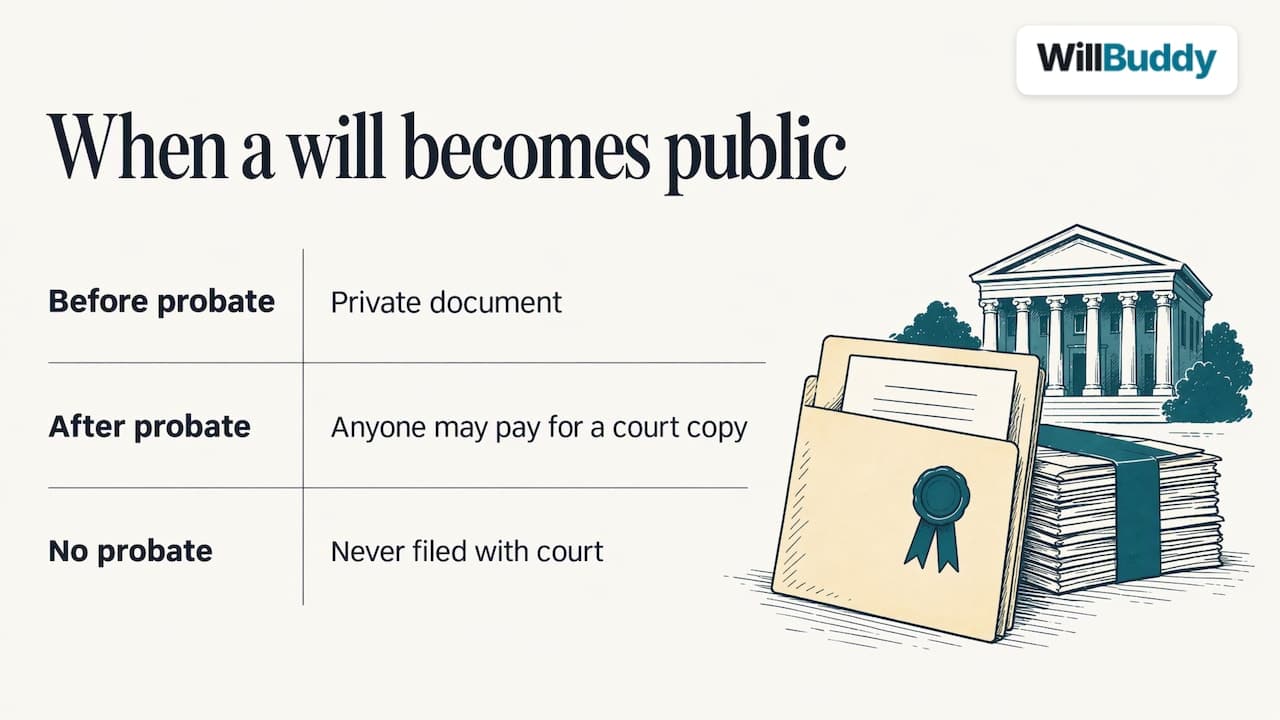
Mostly yes, but only after a certain point. While you are alive, your will is private. After you die, it stays private until a court grants probate. Once probate is granted, the will generally becomes a public document that people can search for and copy for a fee. The detail differs by state, so this guide names the state wherever the rule changes.
If you are a parent writing your first will, this matters. Your will names your children's guardians, your executor and who gets what. You can't hide those choices from the public after probate. But you can decide what goes in the will itself, and what goes somewhere more private.
This is general information only, not legal advice.
TL;DR
- While you are alive, nobody has a legal right to read your will. In South Australia, that is stated outright.
- After death and before probate, the will is still not public. In several states the law lists who may see it, such as people named in the will, a spouse, children and, in some states, creditors.
- After probate, the will is a public document. Anyone can apply for a copy from the court, usually for a fee.
- Keep private details, such as detailed funeral wishes or a list of passwords, out of the will. Use a separate note.
- If the original is lost, a court may still grant probate on a copy or on other evidence. This is a job for a lawyer.
What "public record" means for a will
A will is a private document that only takes effect when you die. Most estates then need a court order called a grant of probate. It confirms the will is valid and gives your executor the legal authority to deal with your assets. You can read more in our probate process guide.
When the executor applies, the original will is filed with the court. Once probate is granted, it stops being private. The Supreme Court of NSW says that once a will is admitted to probate it is a public document, and anybody may apply to the court for a copy if they pay the fee. Victoria, Queensland and South Australia work the same way, as set out below.
So "public" does not mean posted online for anyone to browse. It means a stranger can ask the court for a copy and get it.
Not every estate goes to probate. Some small estates don't need it, for example when assets pass outside the will or are held jointly. If probate is never granted, the will is never filed with a court. Our guide on whether probate is required in Australia explains when you do need it.
Who can see a will before probate
After someone dies, but before probate, the will is not public yet. Still, in several states the law gives certain people a right to see it.
New South Wales. Section 54 of the Succession Act 2006 (NSW) requires whoever holds the will to let specified people inspect it or be given a copy, at their own expense.
Victoria. Section 50 of the Wills Act 1997 (Vic) requires whoever holds the will to let certain people view it. These include:
- people named in the will, or named in an earlier will
- a spouse or domestic partner
- parents, guardians and children of the person who died
- people who would inherit if there were no will
- creditors
Victoria Legal Aid adds a parent or guardian of a child under 18 who is mentioned in the will.
South Australia. From 1 January 2025, section 48 of the Succession Act 2023 (SA) requires whoever holds a deceased person's will to let a defined list of people view and copy it. The list includes people named in the will, people named as a beneficiary in an earlier will, a surviving spouse or domestic partner, children and step-children, a former spouse or partner in some cases, parents and guardians, and anyone who managed the person's estate under a guardianship order just before they died. The Supreme Court can also allow someone outside the list to view it, if satisfied that they may have a claim against the estate, that they have a proper interest in the matter, and that viewing the will is appropriate.
For a parent, one point stands out. If you name a guardian for your children in your will, that person may be among those who can ask to see it. Tell them where the will is kept.
After probate: how to search by state
Once probate is granted, the search options open up. Here is how it looks in the states the research covers.
| State | What you can do | Cost and limits |
|---|---|---|
| NSW | Apply to the Supreme Court for a copy. The Court holds probate records from 1990 to the present. State Archives holds earlier ones. | Fee applies. Archives catalogue covers 1800 to 1976 files. Some records are unavailable because of sensitivity or fragility. |
| Victoria | Search Supreme Court probate records. Older records sit with Public Record Office Victoria. | Fees apply for searching files after a grant. |
| Queensland | Search the Online Services Portal, for example by name, file number, application type or filing date. | Basic details are free to view. Seeing or copying a document costs a fee. |
| South Australia | Search for a probate grant on the CourtSA portal. | A copy of the grant can be downloaded free. It does not include the statement of assets and liabilities. |
| Western Australia | Request a copy from the Supreme Court. | From 1 July 2026: $2.80 per page for a copy, a $31.10 certification fee and a $68.00 search fee. |
Fees in courts are usually reviewed each year, so check the court's page for the current amount before you apply.
Old wills and family history
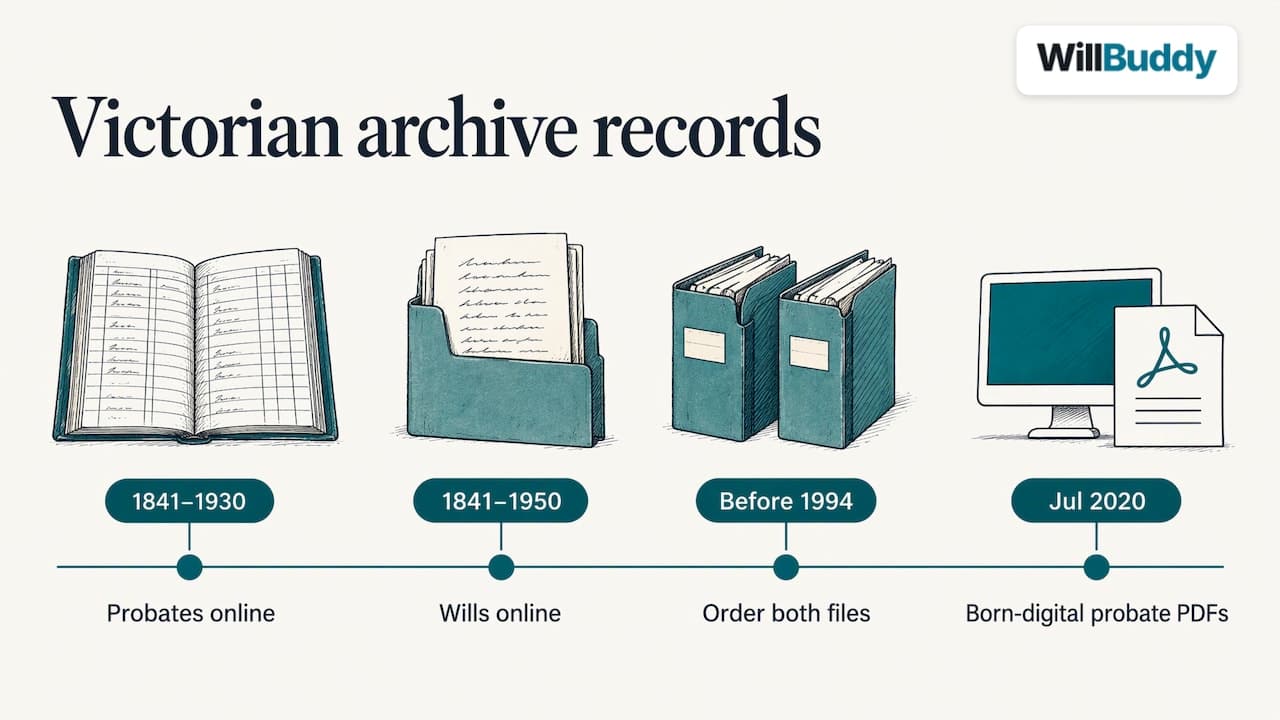
If you are tracing a relative, the records are often with state archives. Public Record Office Victoria says wills from 1841 to 1950 and probates from 1841 to 1930 can be viewed online. Since July 2020, Victorian probate records have been digital only, with no paper file. Before 1994, wills were not placed in the probate file, so you must order both.
What the public can and cannot see
A court copy of a will shows what the will says. That usually means:
- the full name of the person who died
- who the executor is
- who receives gifts and the residue (what is left after specific gifts)
- who is named as guardian of any minor children
- any other instructions written into the will
A will does not usually include a full list of the person's assets. Other papers on the court file can, and who may see them differs by state:
- In NSW, the court releases the inventory of property only to executors, administrators, residuary beneficiaries and people who have started a family provision claim.
- In South Australia, a copy of the grant leaves out the statement of assets and liabilities.
- In Victoria, the probate file includes an inventory of assets and liabilities, and the public can search a file for a fee once probate is granted.
The will itself may also mention specific property, such as a house or a car, if it is gifted by name.
That is why it pays to think about what you put in the will.
Keep private matters out of the will
Because the will can be copied by anyone after probate, consider this:
- Funeral wishes. Wills are often read after the funeral has happened. A short separate note to your family works better. It also avoids putting personal detail into a public document.
- Account numbers and passwords. Never put these in a will. Keep a separate, secure list for your executor.
- Reasons for leaving someone out. If you exclude a person, you can say so in the will, but keep the wording short and factual. Long explanations become public too.
- Personal messages. Write letters for your children rather than putting private words in the will.
Some parents use a testamentary trust to manage what their children inherit. It is a trust created by your will that starts after you die. It does not make your plans private: its terms are written in the will, and the will that creates the trust still goes through probate. This area is complex, so read about testamentary trusts in Australia and talk to a lawyer.
How to find out if someone left a will
Maybe you are an executor, a family member or a creditor, and you don't know if a will exists. Try these steps in order.
- Check the home. Look through the deceased's papers, safe, filing cabinet and desk.
- Ask the bank, the accountant and any solicitor the person used. Legal Aid NSW suggests asking the person's lawyer, bank, accountant or financial adviser, NSW Trustee and Guardian and the Supreme Court of NSW.
- Search the court records in the state where the person lived, using the table above. A grant of probate may already exist.
- Ask a public trustee, where one holds wills. In NSW, the NSW Trustee and Guardian database can be searched. It only holds wills made in NSW, and you need the date of birth and date of death. Service NSW says eligible requesters include people named in the will or an earlier will, certain relatives, people who would inherit without a will, and people with a claim against the estate. You also need a death certificate.
There is no single national register of wills in Australia. That is why a will can be so hard to find. Read our guide on keeping your will findable so your own family is never left searching.
What happens if the original will is lost
This is a common worry, and it is a legal problem that usually needs a lawyer.
If no will can be found at all, the estate may be handled as if there were no will. Service NSW says that if a will cannot be located, an application must be made to the Supreme Court for Letters of Administration. That is the court order used when there is no valid will to act on.
If you have a copy but not the original, the answer is not always "no". Courts have accepted copies in some cases. In South Australia, for example, In the Estate of Elizabeth Seabrooke [2023] SASC 122 admitted to probate a PDF copy of a will that had been made and signed on an iPad. The signed copy given to the will-maker could not be found among her papers after she died.
Still, a copy is not automatically accepted. The court wants evidence that the original was properly signed and witnessed, what happened to it, and that the will-maker did not destroy it to cancel it. If a will that was last kept by the will-maker cannot be found, the law may presume they destroyed it on purpose. That is why courts ask for searches and evidence. If you are in this position, see a lawyer.
How to avoid the problem
You can make life easier for your executor:
- Keep the signed original in one safe place, and tell your executor where it is.
- Store a clear copy or scan as well.
- Don't staple, mark or write on the signed pages.
- Update the will and tell your executor when you move it.
Does a copy of a will count?
For your own records, a copy is useful. For probate, the court normally wants the original. A photocopy you made yesterday is not a second signed will. If you sign a new version, it needs its own witnesses. See our guide to who can witness a will in Australia for the rules by state.
A "certified copy" is different. It is a copy of a will on court file that the court has stamped as a true copy. After probate, the court keeps the original will. The Supreme Court of NSW says it retains the original and the supporting documents. Executors usually show banks and the land titles office the grant of probate as proof of their authority. In NSW, a certified copy of the grant (called an exemplification) includes the will. In Western Australia, as shown above, the court charges per page plus a certification fee.
Why this matters when you write your will
Two things follow for a parent or any adult who hasn't made a will.
Write it knowing it may be read. Plain, short wording helps. Name your guardians, your executor and your gifts clearly. Leave out anything you wouldn't want a stranger to read.
Keep it safe and current. A will that is lost, outdated or hard to find causes the problems above. Life changes through a new baby, a move, a separation or a new asset, and the will should change with it.
Some situations are better handled with a lawyer. Get legal advice if you have a blended family, a business or a trust, assets overseas, or a likely contest from someone who may challenge the will.
How WillBuddy fits in
WillBuddy asks plain questions one at a time and drafts a will for your state or territory. You read every word for free before you pay. Then you print it and sign it with witnesses. Your will is stored encrypted in Australia while your plan is active, and we never sell your data.
An annual plan lets you make up to 50 AI-assisted edits a year, so you can update your will when your family changes. See the Annual Access plan for the current price. If you want the basics first, read our 8 steps to a valid will in Australia.
If you are in a specific state, our state guides cover New South Wales, Victoria, Queensland and South Australia.
FAQ
Can anyone see a will after death?
Not straight away. Before probate, only certain people can ask to see it, such as those named in the will, close family and creditors. After probate, the will is a public document. Anyone can apply to the court for a copy and pay the fee.
Can I read someone's will while they are alive?
No, not as of right. In South Australia, the Law Handbook says no one is legally entitled to view or copy a will while the person is alive. Only the person who made the will can choose to show it.
Is a copy of a will valid in Australia?
A copy is not automatically valid for probate. Courts have allowed copies in some cases, but they want evidence about the original and about what happened to it. If you only have a copy, get legal advice before you apply.
What if the original will is lost?
Search the home, the bank and any solicitor first, then check court records. If it can't be found, the court may need to be asked for Letters of Administration, or to accept a copy. A lawyer can guide you through that application.
Does probate make my bank balance public?
The will itself is public after probate. A will does not usually list every asset, but the list of assets filed with the court is treated differently by state. In NSW, the court releases the inventory of property only to executors, administrators, residuary beneficiaries and family provision claimants. In South Australia, a copy of the grant leaves out the statement of assets and liabilities. In Victoria, the public can search the probate file, which includes an inventory of assets and liabilities, for a fee. Specific gifts you name in the will are still visible.
Sources
Show the 15 sources
- Getting copies and access, Supreme Court of NSW
- Succession Act 2006 (NSW) s 54
- Wills Act 1997 (Vic)
- Challenging a Will, Victoria Legal Aid
- General frequently asked questions, Courts SA
- Getting a copy of a will, SA Law Handbook (Succession Act 2023 (SA) s 48)
- Searches for wills and probate, Queensland Courts
- Wills and probates, Public Record Office Victoria
- Searching probate records, Supreme Court of Victoria
- Probate Forms and Fees, Supreme Court of Western Australia
- Make a deceased will enquiry, Service NSW
- Find out if we hold a Will made in NSW, NSW Government
- Searching for the will, Legal Aid NSW
- In the Estate of Elizabeth Seabrooke [2023] SASC 122
- Testamentary trusts in Australia
Start your will free at willbuddy.com.au and read it before you pay.
Recommended
For the one who gets things sorted
Now write yours, with your family's names in it
Plain questions about your family, one at a time, and WillBuddy drafts a will for your state. Until you sign one, the law in your state or territory decides who gets what. Read every word free, with no card. You pay only if you want to print it.
Start my will freeLast updated 19 November 2026.
This article is general information only and is not legal advice. It is our best interpretation of the law as at 19 November 2026. WillBuddy is not a law firm, and it never replaces advice from a lawyer or solicitor. Laws change and differ between states and territories, so for your own circumstances, please get legal advice.