Estate planning checklist for Australians: renew super in 3 years
General information, not legal advice.
On this page
- Quick master checklist: your printable to-do list
- Wills: how to make a valid will and what to include
- Enduring power of attorney: who to appoint and how it works
- Advance care directives and appointing a substitute decision-maker
- Superannuation: binding death benefit nominations and practical steps
- Trusts and testamentary trusts: a quick guide and when to seek help
- Inventory: assets, accounts and your digital estate
- Executor duties: the immediate first steps after a death
- When to review and update your estate plan
- How WillBuddy can help you draft and keep a will up to date
- Tax implications of estate planning
- How to minimise estate taxes
- Beneficiary designations beyond superannuation
- Charitable giving and philanthropy in estate planning
- How to handle debts and liabilities in your estate
- Start drafting your will for free today
- FAQ
- Sources
- Recommended

Quick answer
Use this checklist to get your will, powers of attorney and super nominations in order. Start today by locating an existing will or drafting one for your state, then tell your chosen executor exactly where it is kept. Wills law differs by state, so check the formalities that apply where you live before you sign anything.
In short
- A valid Australian will must be in writing, signed, and witnessed by two people present together; choose witnesses who receive nothing under it, and check your state's rules.
- Binding superannuation nominations often expire after three years, so confirm the fund’s rules, eligible recipients, and renewal date directly with the fund.
- An enduring power of attorney covers financial and legal decisions, while an advance care directive covers medical preferences; use your state’s forms and share copies.
- Keep an inventory of assets, debts, accounts, and passwords for your executor, and review estate documents every five years or after major life changes.
- Get legal or tax advice for blended families, businesses, trusts, overseas assets, or likely disputes, where drafting and tax outcomes depend on individual circumstances.
Quick master checklist: your printable to-do list
Print this list and tick off each item as you go. None of it needs to happen in one sitting, but every item eventually needs an owner and a date.
- Make or update your will: draft one that names an executor, guardians for children, and how you want your estate split.
- Choose your executor and guardians: confirm they're willing before you name them.
- Set up an enduring power of attorney: covers financial and legal decisions if you lose capacity. State forms vary.
- Make an advance care directive: documents your medical wishes and names a substitute decision-maker.
- Complete a binding death benefit nomination: through your super fund, separate from your will.
- List your assets, accounts and passwords: include property, shares, insurance and digital accounts.
- Store originals somewhere safe: and tell your executor exactly where.
- Set a review reminder: every five years or after a major life event.
Some of these need a state-specific form (enduring power of attorney, advance care directives) while others, like super nominations, go through your fund rather than a government office.
Wills: how to make a valid will and what to include
A will is only valid in Australia if it meets a few firm rules. According to the State Library of New South Wales, a will must be in writing and signed by the will-maker in front of two witnesses who are present at the same time and who then sign it too. What happens if a witness also inherits under the will depends on the state: in NSW the gift to that witness can fail unless an exception applies, while in Victoria it does not. Choosing two witnesses who receive nothing under the will avoids the question everywhere. Our guide to will witnessing requirements walks through the signing process step by step.
Beyond the legal minimum, a solid will usually covers:
- Your chosen executor, plus a backup in case the first can't act
- Guardians for any children under 18
- Specific gifts (property, jewellery, sentimental items) to named people
- A residuary clause covering everything not specifically gifted
- Funeral wishes, so your family isn't guessing
- A testamentary trust clause, where that suits your family's circumstances
Pro Tip: Sign your will with both witnesses in the room at the same time, using the same pen, so there's no question later about when or how it was executed.
Formal requirements shift from state to state, particularly around witnessing and what happens if a will is informally made. Our state-specific will requirements guide covers the details for your jurisdiction.
Get legal advice rather than relying on a checklist alone if you have a blended family, a business or trust structure, assets overseas, or you expect someone might contest the will.
Enduring power of attorney: who to appoint and how it works
An enduring power of attorney lets someone you trust make financial and legal decisions on your behalf if you can't make them yourself, whether that's temporary or permanent. It's a different document from an advance care directive, which deals with medical and lifestyle decisions rather than money and property.
Choosing the right attorney matters more than people expect. MoneySmart notes that you should choose someone you trust to act in your best interests, since they may look after your bank accounts, pay your bills and even sell your home. Look for someone organised, trustworthy and willing to take the role seriously.
- Name a backup attorney in case your first choice can't act when needed
- Check your state's witnessing or registration requirements before signing
- Give copies to your bank and other financial institutions once it's active
- Review the appointment periodically, especially after a falling-out or a move interstate
- Revoke and replace it in writing if your circumstances or relationships change
Our enduring power of attorney guide has the state-by-state forms and steps.
Advance care directives and appointing a substitute decision-maker
An advance care directive sets out your healthcare preferences and names a substitute decision-maker for situations where you can't speak for yourself. According to the Australian Government Department of Health, you don't need a lawyer to make one, and you should sign and date it. Some states add more: in Victoria, for example, it must be witnessed by two adults, one of them a registered medical practitioner. Use your own state's form and follow its signing steps.
- Give copies to your GP, your nominated substitute decision-maker and your local hospital
- Talk the document through with your GP so your treating team understands the context behind it
- Upload a copy to My Health Record if you have one, so it's accessible in an emergency
- Update it whenever your health circumstances or preferences change
This is a separate document from your enduring power of attorney: one covers money and legal matters, the other covers your body and medical care.
Superannuation: binding death benefit nominations and practical steps
Your super doesn't automatically follow your will. It's governed by the nomination you've lodged with your fund, which makes this one of the most commonly missed items on an estate plan.
MoneySmart explains that a lapsing binding nomination expires after three years unless you renew it, while some funds also offer non-lapsing binding nominations that don't expire. Non-binding nominations only guide the fund's trustee rather than binding their decision.
This means a lapsing nomination made long ago may no longer bind the fund when it matters most.
- Contact your fund directly to check whether your nomination is binding or non-binding
- Confirm you've nominated your legal personal representative or an eligible dependant
- Set a calendar reminder to review or renew the nomination before it lapses
- Check whether your fund requires its own specific form rather than accepting a general instruction
Our guide to binding death benefit nominations and how super interacts with your will covers this in more depth.
Trusts and testamentary trusts: a quick guide and when to seek help
A testamentary trust is a trust created by your will, usually to hold assets for beneficiaries rather than handing everything over outright. Families often use them to protect an inheritance for young children, manage tax more carefully for adult beneficiaries, or shield assets from a beneficiary's creditors or a relationship breakdown.
Trusts add ongoing administration and sometimes tax complexity, since someone has to act as trustee and manage the trust's affairs for as long as it runs.
- List any trusts you already have an interest in, as trustee or beneficiary
- Think through who could act as trustee if you set one up in your will
- Get legal or accounting advice before adding trust clauses, since the drafting and tax consequences are easy to get wrong
Inventory: assets, accounts and your digital estate
Your executor can only manage what they know about. Keep a separate, current list of assets and liabilities rather than folding it into the will itself, so you can update it without changing your will.
Cover:
- Bank accounts, property, shares, superannuation, insurance policies and business interests
- Outstanding debts: mortgages, loans and credit cards
- Digital accounts, passwords, cloud storage and social media, ideally through a password manager rather than written in the will
Pro Tip: Keep this inventory somewhere your executor can find it, and tell them directly where the original will and the inventory are stored.
Executor duties: the immediate first steps after a death
An executor's early decisions set the tone for everything that follows.
- Locate the original signed will and confirm who the named executor is.
- Notify immediate family, the deceased's GP, and relevant institutions like banks and super funds.
- Preserve the estate's assets: secure property, redirect mail, stop unnecessary payments.
- Contact super funds and insurers to begin death benefit and claims processes.
- Apply for probate if banks, the land titles office or other asset holders ask for it, which is common when there is real estate or a large account in the deceased's sole name, and bring in a solicitor if anything looks contested or unclear.
- Keep detailed records of every decision and payment made on the estate's behalf.
When to review and update your estate plan
An estate plan isn't a one-off job. The South Australian Public Trustee suggests reviewing your will every five years, and making a new one sooner if your circumstances change.
- Review after marriage, separation or divorce
- Review after the birth of a child or grandchild
- Review after buying or selling significant assets, or moving interstate
- Keep dated versions of each document so it's clear which is current
If you hold assets overseas, get specialist advice, since Australian wills and powers of attorney don't always operate cleanly across borders.
How WillBuddy can help you draft and keep a will up to date
We built our platform to make this whole process less daunting. We ask plain questions one at a time, draft a will matched to your state's rules, and let you read every single word for free before you pay anything.
- We ask straightforward questions about your family, assets and wishes, one step at a time
- We draft a will that follows your state's specific requirements
- We let you read the completed document in full before any payment is required
- You print the final will and sign it with your own witnesses
- Our service includes the ability to make multiple edits so your will can keep pace with life changes
- We take care to keep your personal information secure and private
For blended families, business or trust structures, overseas assets, or a will likely to be contested, speak with a solicitor instead.
Tax implications of estate planning
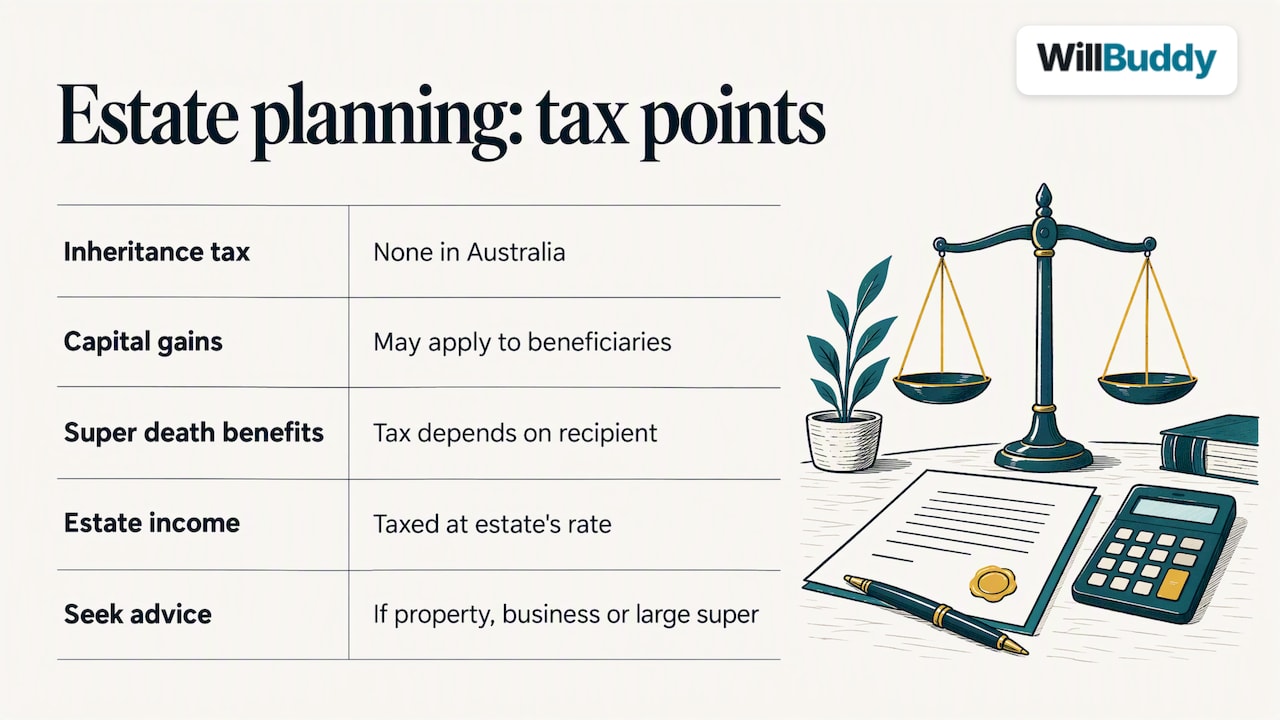
Australia doesn't have a general inheritance tax or estate tax, which surprises a lot of people planning their first will. That doesn't mean an estate plan is tax-free territory.
Capital gains tax can apply when assets like investment property or shares are eventually sold by beneficiaries, depending on when and how they were acquired. Superannuation death benefits can also attract tax depending on who receives them: payments to a spouse or dependent child are generally treated differently to payments to an independent adult child, which is part of why checking your nomination details matters.
Income earned by the estate itself, such as rent or dividends received before assets are distributed, can be taxed in the estate's hands during administration, and the executor may need to lodge tax returns for the estate. None of this is a reason to delay organising your will and nominations. It's a reason to involve an accountant or solicitor when your estate includes investment property, a business, or a large super balance, since the tax outcome can differ significantly depending on how assets are structured and who ultimately receives them.
How to minimise estate taxes
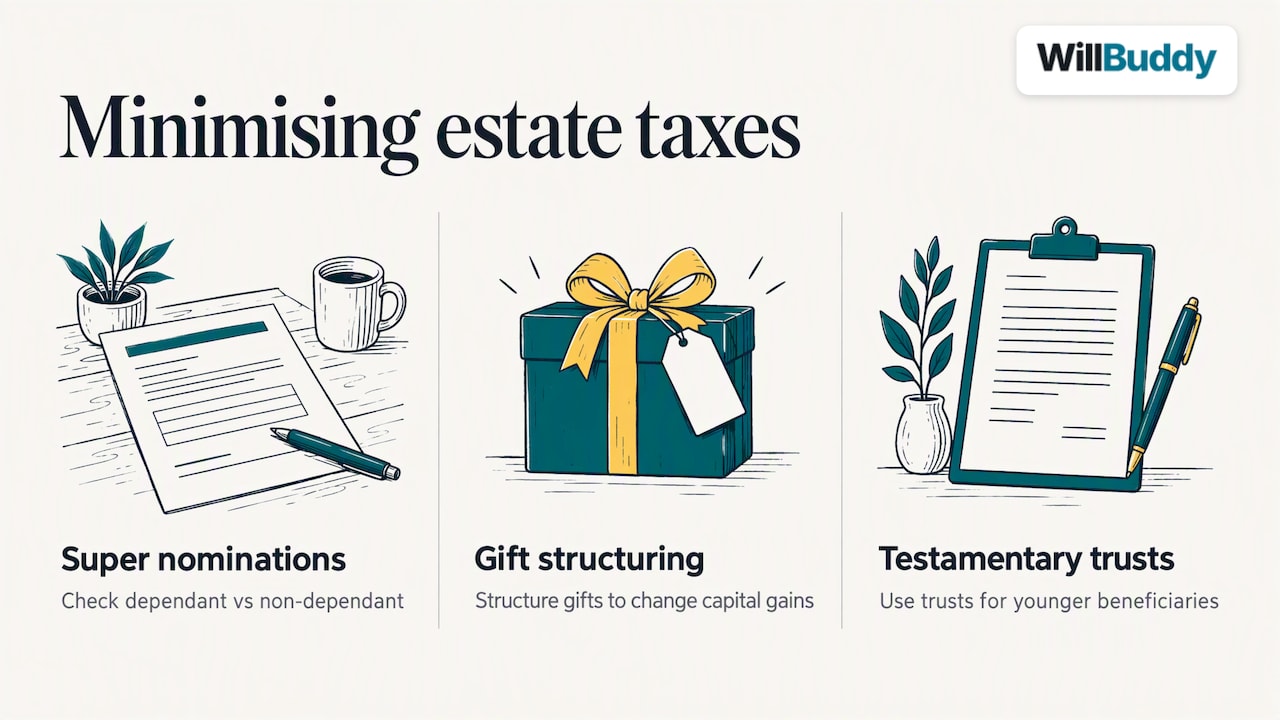
Because Australia has no general inheritance tax, most of the planning here is really about managing capital gains tax and super death benefit tax, not avoiding a broad estate tax.
A few practical levers come up often. Checking who's nominated on your super (a dependant versus a non-dependant can change the tax treatment of a death benefit considerably) is one of the simplest. Structuring specific gifts carefully, rather than leaving everything to be sold and distributed as cash, can also affect capital gains outcomes for beneficiaries. Testamentary trusts, covered earlier, are sometimes used because income distributed to younger beneficiaries through a trust can be taxed more favourably than a direct gift.
None of these strategies belong in a DIY checklist once they get complex. If significant assets, a business or multiple beneficiaries with different tax positions are involved, an accountant who understands deceased estates is worth the conversation before you finalise anything.
Beneficiary designations beyond superannuation
Super isn't the only asset that can bypass your will entirely. Insurance held inside a super fund is usually paid out with your super, so it follows your super nomination. A life insurance policy held outside super may have its own nominated beneficiary, and if so that nomination generally controls who receives the payout regardless of what your will says.
The same logic applies to some jointly held bank accounts and jointly owned property, which can pass directly to a surviving co-owner rather than through your estate. It's worth listing every policy and account with its own beneficiary or ownership structure alongside your main asset inventory, so nothing contradicts your will by accident. If you want a life insurance payout to go somewhere different from what's currently nominated, you generally need to contact the insurer directly and update the nomination form, the same way you would with a super fund.
Charitable giving and philanthropy in estate planning
A will can include a gift to a charity, either as a fixed amount, a percentage of the estate, or whatever remains after other gifts are distributed. Charitable bequests are usually written into the residuary clause or as a specific gift, and most major charities publish suggested wording for exactly this purpose.
Some people prefer to set up an ongoing structure, like a sub-fund within a public ancillary fund, if they want charitable giving to continue over time rather than as a single bequest. That level of structure usually calls for advice from an accountant or solicitor, since ongoing philanthropic structures carry their own administration and reporting requirements. For a straightforward one-off gift to a cause you care about, naming the charity and the amount or percentage in your will is generally enough.
How to handle debts and liabilities in your estate
Debts don't disappear when someone dies. They're generally paid out of the estate before anything is distributed to beneficiaries, which is one reason a complete asset and liability inventory matters so much.
Mortgages, personal loans, credit cards and any outstanding bills are typically settled by the executor using estate funds, in a set order of priority, before beneficiaries receive their gifts. If debts exceed what the estate is worth, beneficiaries generally aren't personally liable for the shortfall, though the details can depend on how an asset is jointly held or guaranteed. Jointly held debts, such as a mortgage with a surviving partner, often pass to the surviving co-borrower rather than becoming an estate debt at all.
This is exactly why your inventory should list debts alongside assets, not just what you own. An executor managing an estate with no clear picture of liabilities risks distributing funds that should have gone to creditors first.
Start drafting your will for free today
We let you draft a complete, state-specific will by answering plain questions one at a time, and you can read every word before you pay a cent.

Once you're happy with it, our annual subscription is $39 a year and covers secure storage of your will while your plan is active and up to 50 AI-assisted edits a year, so your will can keep up with life changes. Print it and sign with two witnesses once you're ready. If your situation involves a business, overseas assets or a likely contested estate, speak with a solicitor first. Start your will free at Willbuddy and read it before you pay.
This article is general information, not a substitute for advice from a qualified lawyer. Consult a qualified legal professional about your own circumstances before acting on anything here.
FAQ
How do I write a simple will in Australia?
A simple will needs to be in writing, signed by you, and witnessed by two people present at the same time. Choose witnesses who receive nothing under the will. It should name an executor, any guardians for children, and how you want your assets distributed. Online platforms can guide you through the questions step by step before you print and sign.
What is the most common inheritance mistake?
Letting a super death benefit nomination lapse is one of the most common oversights, since lapsing binding nominations expire after three years unless renewed, according to MoneySmart. Another frequent mistake is using a beneficiary as a witness to the will, which in some states, including NSW, can cost them their gift.
What is a trust?
A trust is an arrangement where a trustee holds and manages assets on behalf of named beneficiaries, rather than those assets passing to them directly. In a will, this is usually set up as a testamentary trust, often used to protect an inheritance for children or manage tax outcomes for beneficiaries.
What are the steps in the estate planning process?
The core steps are making or updating your will, appointing an executor and any guardians, setting up an enduring power of attorney, making an advance care directive, checking your superannuation nomination, and listing your assets and debts for your executor. Reviewing the whole plan every five years, or after a major life event, keeps it current.
Can I make my will online in Australia?
Yes. Services like WillBuddy let you answer plain questions about your family and assets, generate a will matched to your state's requirements, and read the full document free before paying anything. You still need to print it and sign it in front of two witnesses: following your state's signing and witnessing rules is what makes it valid.
Sources
Show the 2 sources
Recommended
For the one who gets things sorted
Now write yours, with your family's names in it
Plain questions about your family, one at a time, and WillBuddy drafts a will for your state. Until you sign one, the law in your state or territory decides who gets what. Read every word free, with no card. You pay only if you want to print it.
Start my will freeLast updated 8 October 2026.
This article is general information only and is not legal advice. It is our best interpretation of the law as at 8 October 2026. WillBuddy is not a law firm, and it never replaces advice from a lawyer or solicitor. Laws change and differ between states and territories, so for your own circumstances, please get legal advice.