Second Marriage Will: What Happens to Your Old Will
General information, not legal advice.
On this page
- TL;DR
- What marriage does to your existing will
- Making a will for the marriage you are planning
- What to put in a second-marriage will
- Divorce and separation are different from marriage
- Super and other assets that a will may not control
- Mutual wills: a word of caution
- Why a second-marriage will should be reviewed
- How to make a new will after remarrying
- Where WillBuddy fits
- FAQ
- Sources
- Recommended

Quick answer
If you marry again, your existing will may be cancelled. In most Australian states and territories, marriage automatically revokes (cancels) a will made before it, unless the will was made with that marriage in mind. So the safest move is to make a new will once you know you are marrying, and keep it up to date after. With WillBuddy you answer plain questions one at a time, and it drafts a will for your state. You can read every word free before you pay.
This is general information only, not legal advice.
TL;DR
- Marriage generally cancels an earlier will in Australia, unless that will was made in contemplation of the marriage. The exact wording differs by state.
- Divorce usually cancels gifts to a former spouse (in Western Australia, the whole will). Separation alone does not.
- A new will should name guardians for your children, an executor, and who gets what, now that your family has changed.
- Super and jointly owned property often sit outside your will, so check them too.
- If you have a blended family, a business or trust, overseas assets or expect a contest, see a lawyer.
What marriage does to your existing will
Many people assume a will stays put until they change it. Marriage is the big exception.
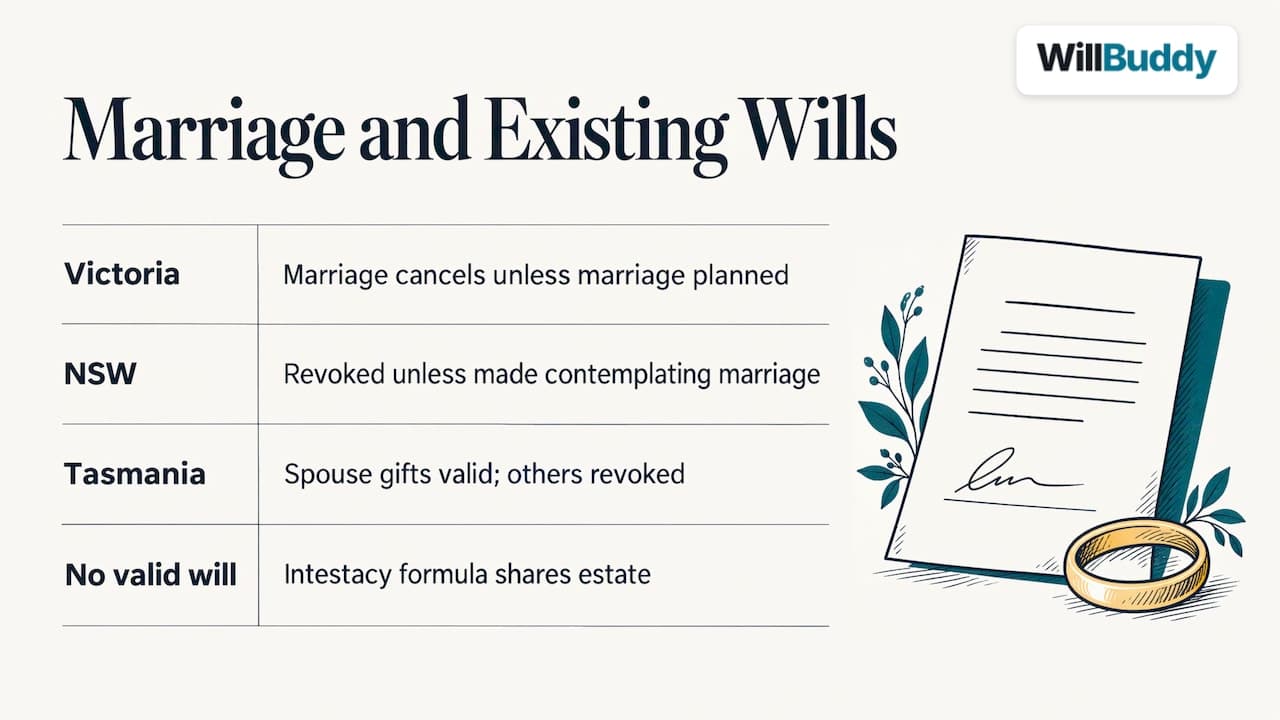
In Victoria, Victoria Legal Aid states that marrying or remarrying automatically cancels your will unless the will clearly shows you were planning that marriage when you made it. Under section 13 of the Wills Act 1997 (Vic), the will does not have to say so in words, but saying so is the clearest proof. Victoria Legal Aid also advises making a new will after marriage, divorce or separation.
In New South Wales, the State Library of NSW explains that a will is automatically revoked when the will-maker marries, unless it was made in contemplation of marriage. That can be a particular marriage, whether or not the will says so, or marriage in general if the will says so (section 12 of the Succession Act 2006 (NSW)).
In Tasmania, the Public Trustee says your existing will is revoked on marriage unless made in contemplation of it (section 16 of the Wills Act 2008 (Tas)). Gifts to your spouse remain valid, but gifts to children or others do not. If you do not update your will, intestacy rules (the government formula that applies when there is no valid will) decide how the rest of your estate is shared.
That last point matters most for a second marriage. Your children from your first relationship could lose their place in your will overnight, and a formula could decide what they get.
The same idea, different wording by state
The core rule is similar everywhere. The details are not. Here is how each state and territory puts it.
| State or territory | Rule on marriage | Where it comes from |
|---|---|---|
| Victoria | Marriage revokes a will unless made in contemplation of that marriage, whether or not the will says so. A will made while engaged to the person you later marry is not revoked, even if it does not mention them. | Wills Act 1997 (Vic) s 13, explained by LawHub |
| Queensland | Marriage revokes a will unless made in contemplation of it. Gifts to, and executor, trustee or guardian appointments of, the person you are married to at death are not revoked. | Succession Act 1981 (Qld) s 14, explained by the Queensland Law Handbook |
| South Australia | Marriage, or starting a registered relationship, revokes a will unless the will says it was made in contemplation of it. | Succession Act 2023 (SA) s 18 |
| New South Wales | Marriage revokes a will unless made in contemplation of that marriage (the will need not say so) or of marriage in general (the will must say so). Gifts to the person you are married to at death are not revoked. | Succession Act 2006 (NSW) s 12, explained by the State Library of NSW |
| Tasmania | Marriage, or registering a deed of relationship, revokes a will unless made in contemplation of it. Provisions for your spouse stay valid. | Wills Act 2008 (Tas) s 16, Public Trustee Tasmania |
| Western Australia | Marriage revokes a will unless made in contemplation of that marriage. The will can say so, or other evidence can show it. | Wills Act 1970 (WA) s 14 |
| Australian Capital Territory | Marriage, a civil union or a civil partnership revokes a will unless the will says it was made in contemplation of it. | Wills Act 1968 (ACT) s 20 |
| Northern Territory | Marriage revokes a will unless made in contemplation of that marriage (the will need not say so) or of marriage in general (the will must say so). Gifts to your spouse, and naming them executor or trustee, are not revoked. | Wills Act 2000 (NT) s 14 |
In Victoria, section 13 also saves some parts of a pre-marriage will even when the rest is cancelled: a gift to your spouse, and their appointment as executor, trustee or guardian. If you want more detail for your state or territory, read our state-by-state guide for blended families.
South Australia changed its law recently. The Succession Act 2023 (SA) came into force on 1 January 2025. It also covers relationships, not just marriage: a registered relationship counts, and ending one is dealt with in section 19.
Making a will for the marriage you are planning
You can write a will now that survives the wedding. The will must be made in contemplation of the marriage. In South Australia and the ACT, the will itself must say so. Elsewhere, saying so clearly is still the safest way to show it.
In Victoria, LawHub explains that a will made while you are engaged to the person you later marry is not revoked, even if your spouse is not mentioned in it.
There are two sensible ways to go:
- Make a new will after the wedding. This is the simplest. It also lets you reflect your life as it actually is.
- Make a will before the wedding that states it is made in contemplation of marriage to a named person. Wording and rules differ by state, so use your state's version of the rule, not a general one.
Either way, do not leave it to chance. A wedding is a busy time. A will you meant to redo can easily slip to "next month".
What to put in a second-marriage will
A will in a second marriage has a harder job than a first-time will. It has to look after a new partner, and it often has to look after children who are not your partner's too. Work through these in order.
1. Who looks after your children
If you are a parent of minor children, naming a guardian is often the first thing people want to get right. A guardian is the person you want to raise your children if you both die. In a second marriage, think about:
- Whether the other parent is alive and involved. Their role may affect what you can decide.
- Whether your children from different relationships should stay together.
- Who you would trust with both the children and their money, and whether that is one person or two.
Write your wishes down in your will. It is the place the people looking after your estate will check first.
2. Who carries out your will
Your executor is the person who collects your assets, pays debts and hands out gifts. In a second marriage, a new spouse is a common choice. But think hard if your spouse and your children do not get along. Some people name a spouse and an adult child together. Others name a trusted friend.
Name a backup too, in case your first choice cannot act.
3. Who gets what
This is where second marriages get tricky. Common questions:
- Should your spouse get the home outright, or the right to live in it for life, with the home then passing to your children?
- Should your children get a set gift now, or only after your spouse has died?
- Do you want to leave someone out, such as a former partner?
A plain will can handle gifts of money, items, a share of the estate, pets and funeral wishes. A will can also state that someone is deliberately excluded. If you want a stepchild or a former spouse treated in a particular way, say so clearly.
For worked examples, see our blended family checklist and the key strategies for blended families.
4. Backup plans
What happens if your spouse dies before you? What if a child does? A good will has a "gift over": a second choice for each main gift. Without one, a gift can fail. A failed gift usually falls into the rest of your estate, and if the gift of the rest fails too, that part may pass under the intestacy formula.
Divorce and separation are different from marriage
People often mix these up. Marrying cancels a will. Separating does not.
Victoria Legal Aid notes that separation alone does not revoke a will. A former partner can still benefit unless you make a new one. That is a risk if you have separated but not yet divorced, or if you have a will from a previous relationship that you never changed.
Divorce is handled differently. In Queensland, section 15 of the Succession Act 1981 means divorce revokes provisions in favour of the former spouse. One exception is an appointment as trustee of property left on trust for beneficiaries that include that former spouse's children. In Victoria, under section 14 of the Wills Act 1997, the will is generally read as if a former spouse had died before you. In South Australia, section 19 of the Succession Act 2023 revokes gifts to a former spouse or registered partner, and their appointment as executor, unless the will makes clear it should not. Western Australia goes further: under section 14A of the Wills Act 1970 (WA), divorce revokes the whole will, unless the will or other evidence shows you intended otherwise.
If you are also separating from a previous partner, read our guide on how divorce and separation affect your will.
Super and other assets that a will may not control
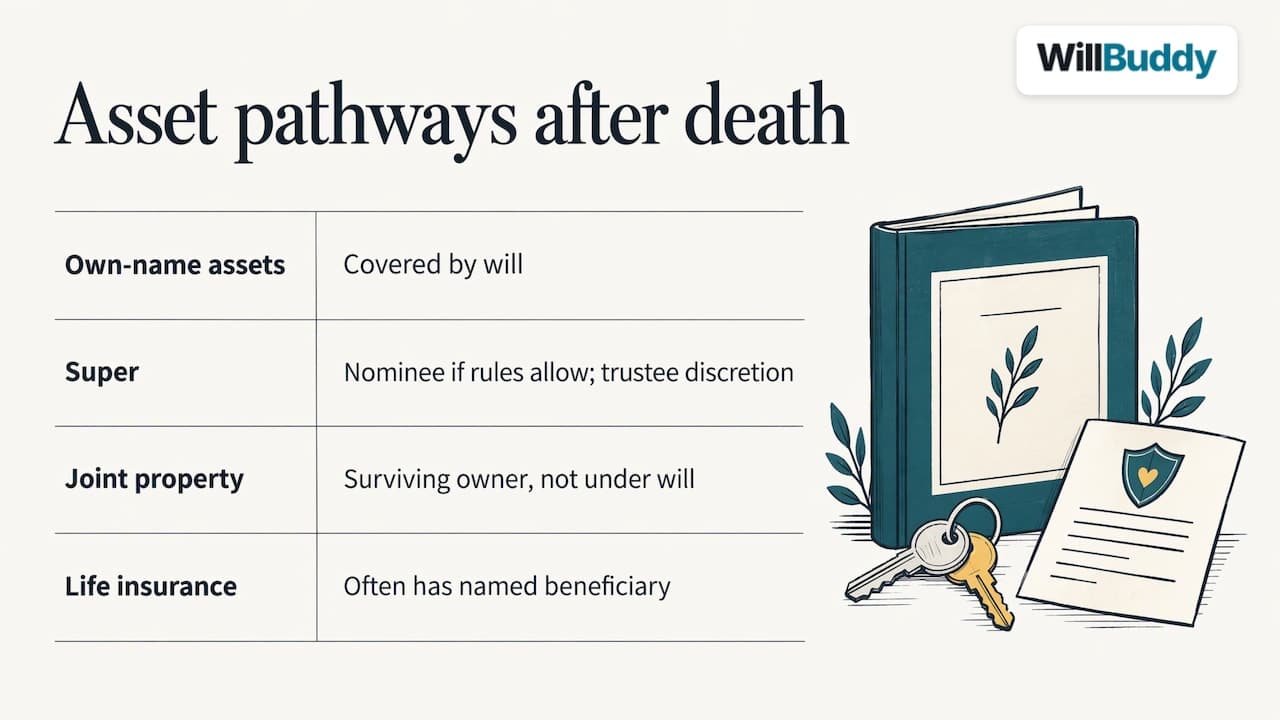
A will covers what you own in your own name. It does not always cover everything, and this surprises many people after remarrying.
Super. The ATO says that when a person dies, in most cases their fund pays the super death benefit to their nominated beneficiary, if the fund rules allow a nomination. A binding nomination can name dependants and/or your legal personal representative (your executor). With a non-binding nomination, or none, the fund trustee may use discretion about who is paid. So an old nomination naming a former partner could still matter, whatever your new will says. Check your fund after you marry. If you want to see how super and tax interact for your family, there is a guide on tax on super death benefits.
Jointly owned property. Assets held as joint tenants usually pass to the surviving owner, not under your will. If you buy a home with your new spouse, find out how it is held and what that means for your children.
Life insurance. Policies often have their own named beneficiary. Check that it still says what you want.
A will is only one part of the picture. It works best when your will, super and property all say the same thing.
Mutual wills: a word of caution
Some couples with children from earlier relationships hear about mutual wills. These are matching wills where each partner agrees not to change theirs later. A paper by the President of the Australian Law Reform Commission notes the doctrine is over two centuries old and has proved adaptable to modern step-families. Because mutual wills operate as a trust, they lack flexibility when families change.
That is a serious commitment, and a legal one. If you are thinking about it, speak to a lawyer first. The same applies if you have a blended family with complex wishes, a business or trust, assets overseas, or you think someone is likely to contest your will.
Why a second-marriage will should be reviewed
A will made in a hurry can leave gaps. These are the usual ones:
- An old will is still in force after you have separated. It may still name your former partner.
- No new will after the wedding. The old one may have been cancelled, so the formula may apply.
- Guardians not updated. Your first choice may no longer fit.
- Gifts not matched to assets. If your home is a big part of your estate, a gift of cash may not be possible.
- Super not updated. The nomination may still name someone from your past.
The fix is not complicated. It is about doing it, then checking it again when life changes.
How to make a new will after remarrying
- List what you own. Include your home, savings, super, car, shares and anything with sentimental value.
- List who matters. Your spouse, your children, stepchildren, and anyone else you want to include or leave out.
- Choose guardians and executors. Pick backups for both.
- Decide on gifts. Keep the wording plain and specific.
- Draft the will for your state. The rules on revocation, witnesses and gifts differ.
- Read every line. Make sure it says what you meant.
- Print and sign it with witnesses. A will generally needs to be signed in front of witnesses. Check your state's rules on who can witness. A person who is a beneficiary should not usually be a witness.
- Store it safely and tell your executor where it is.
- Review it after any big change. That includes births, deaths, separation and a new home.
On step 6, a good rule is to check whether your will could be read two ways. A will is for the people who will rely on it when you are gone.
On step 7, if the signing is not done properly, the will may not be valid. Follow the witnessing rules for your state or territory.
Where WillBuddy fits
WillBuddy is built for the straightforward case. You answer plain questions, one at a time. It drafts a will for your state or territory. You can name guardians for your children, choose executors, set out gifts, record funeral wishes, look after pets and exclude people. You can read the whole will free before you pay, then print it and sign it with witnesses.
The Annual Access plan lets you make up to 50 AI-assisted edits a year, so you can update your will as your family changes. Your data is encrypted and is not sold. You can see the plan on our pricing page.

If your situation is more complex, such as a blended family with competing claims, a trust or business, overseas assets or a likely contest, get legal advice as well. Those are the cases where a lawyer's input is worth having.
FAQ
Does my old will still work if I remarry?
Usually not. In most Australian states and territories, marriage cancels an earlier will unless it was made in contemplation of that marriage. Rules differ slightly, so check your own state. The safest step is to make a new will after the wedding.
Does separation cancel my will?
No. Victoria Legal Aid says separation alone does not revoke a will. A former partner can still benefit under your old will until you make a new one. Divorce usually removes gifts to a former spouse, but you should still update your will.
What happens if I marry again and have no new will?
If your old will is cancelled and you make no new one, intestacy rules decide who gets your estate. In Tasmania, the Public Trustee says the government's rules decide how the rest of your estate is shared. That may not match what you want for your children.
Do I need a will for my kids if I remarry?
If you have children under 18, a will is the place to name who you want to look after them. It is also where you set out what they will receive. It is worth doing even if your spouse is also their parent.
Is my super covered by my will?
Not always. Super usually goes to your nominated beneficiary under the fund's rules, so check your nomination after you remarry. The ATO explains the difference between binding and non-binding nominations.
Sources
Show the 13 sources
- Changing a Will, Victoria Legal Aid
- Marriage, divorce and Wills, LawHub (Victorian Law Foundation)
- Does getting married or divorced affect my Will? Public Trustee Tasmania
- Changes to a Will, Queensland Law Handbook
- Succession Act 2023 (SA)
- Wills Act 2008 (Tas)
- Wills Act 1970 (WA)
- Wills Act 1968 (ACT)
- Wills Act 2000 (NT)
- Changing or revoking a will, State Library of NSW
- Superannuation death benefits, Australian Taxation Office
- Mutual Wills: An Ancient Doctrine with Modern Teeth, Australian Law Reform Commission
- Tax on super death benefits
Start your will free at willbuddy.com.au and read it before you pay.
Recommended
For the one who gets things sorted
Now write yours, with your family's names in it
Plain questions about your family, one at a time, and WillBuddy drafts a will for your state. Until you sign one, the law in your state or territory decides who gets what. Read every word free, with no card. You pay only if you want to print it.
Start my will freeLast updated 13 November 2026.
This article is general information only and is not legal advice. It is our best interpretation of the law as at 13 November 2026. WillBuddy is not a law firm, and it never replaces advice from a lawyer or solicitor. Laws change and differ between states and territories, so for your own circumstances, please get legal advice.