Backup Executor in a Will: How to Name One in Australia
General information, not legal advice.
On this page
- TL;DR
- What a backup executor does
- Why one name is rarely enough
- When the backup actually steps in
- Who to choose as your backup
- Joint or separate: how your executors act together
- How to word the backup clause
- Talk to your backup first
- State and territory differences to keep in mind
- What if things go wrong later
- Keep your backup choice current
- FAQ
- Sources
- Recommended

Quick answer
A backup executor is the person you name in your will to take over if your first-choice executor dies, refuses the job or can't do it. Naming one is simple. Getting the wording right is the part that matters. If the clause doesn't match what actually happens, your family may still end up asking a court for help.
This guide explains what a backup (also called alternate or substitute) executor does, who to choose, how to word the clause and where Australian states differ. It is general information only, not legal advice.
TL;DR
- A backup executor takes over if your first executor dies, renounces or can't act. Courts follow the wording of your will, so the triggers must be spelled out.
- Some wills only allow a substitute if the first executor has died. NSW court guidance warns about this gap, so cover "unwilling or unable" as well.
- Pick someone over 18, trusted, organised and willing. Ask them first, and tell them where your will is kept.
- A beneficiary can be an executor, and a family member can be a good one, but being related is not enough.
- Blended families, a business or trust, overseas assets or a likely contest are all reasons to see a lawyer.
What a backup executor does
An executor is the person named in your will to deal with your estate after you die. They collect your assets, pay your debts and hand out what is left under your will. The NSW Supreme Court describes it as a role with real duties: collecting assets, keeping proper accounts, preserving what you left and distributing it in line with the will and the law.
A backup executor holds the same powers, but only once the first person drops out. Think of it as a spare key. You hope nobody needs it. If the main key is lost, you are glad it exists.
The South Australian Law Handbook notes that a will can appoint several executors to work together, or appoint a back-up to act if the preferred executor is unable, unwilling or dies before you do.
You may see other names for the same idea:
- Alternate executor
- Substitute executor
- Executor in the alternative
They all describe a second-choice person who steps up when the first can't.
Why one name is rarely enough
People often name a single executor, usually a spouse or partner. That works until it doesn't. Your partner may die at the same time as you, may be too unwell to act, or may simply not want the work.
The South Australian Law Handbook says it is usually safest to appoint more than one executor, except in the simplest cases. A named backup can save your family from a slower route. Without one, the court may need to appoint an administrator, which can include the Public Trustee depending on the circumstances.
This matters most for parents. If you have young children and your partner is your only executor, a shared accident could leave nobody in charge of your estate while your children's guardians are already dealing with enough.
Executor and guardian are different jobs
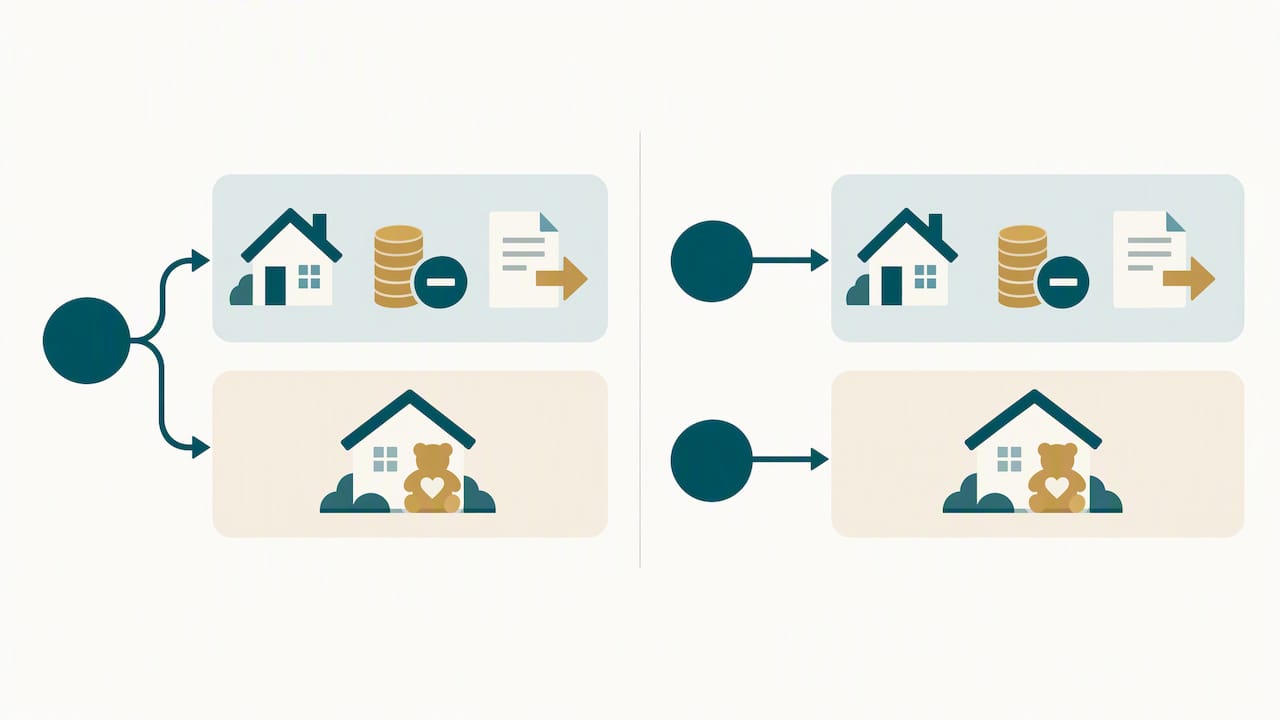
Your executor handles money and property. Your guardian is the person you would like to care for your children. A will can name preferred guardians, and South Australian legal handbook material confirms wills commonly include them alongside executors and pets.
You can choose the same person for both roles, or different people. Many parents split them: one person who is good with the children, another who is good with paperwork. Either way, a court and the circumstances at the time decide the final guardianship outcome. If you have a blended family, a dispute risk or a child with special care needs, talk to a lawyer.
For more on thinking through who could care for your children in an emergency, this guide to chosen family, guardianship and emergency caregivers covers the planning side.
When the backup actually steps in
This is the part many people miss. A backup is not automatically able to act just because they are named. The clause must cover the event that happens.
Typical triggers are:
- Death before you. The first executor dies before the will-maker.
- Death after you but before finishing. They die after you but before the estate is dealt with.
- Unwillingness. They decline the role, which is called renouncing.
- Inability. They lose capacity, are seriously ill or can't be found.
The NSW Supreme Court warns that some wills allow a substitute only where the first executor has died, not where they simply decline. If your clause covers only death and your first choice says no, your backup may be stuck. Use clear wording that lists every trigger you want.
What happens if the first executor steps aside
In NSW, Legal Aid explains that the first step is to check the will for substitute executors. If one is named, they may apply for the grant. If none is named, a beneficiary can apply for Letters of Administration with the will annexed.
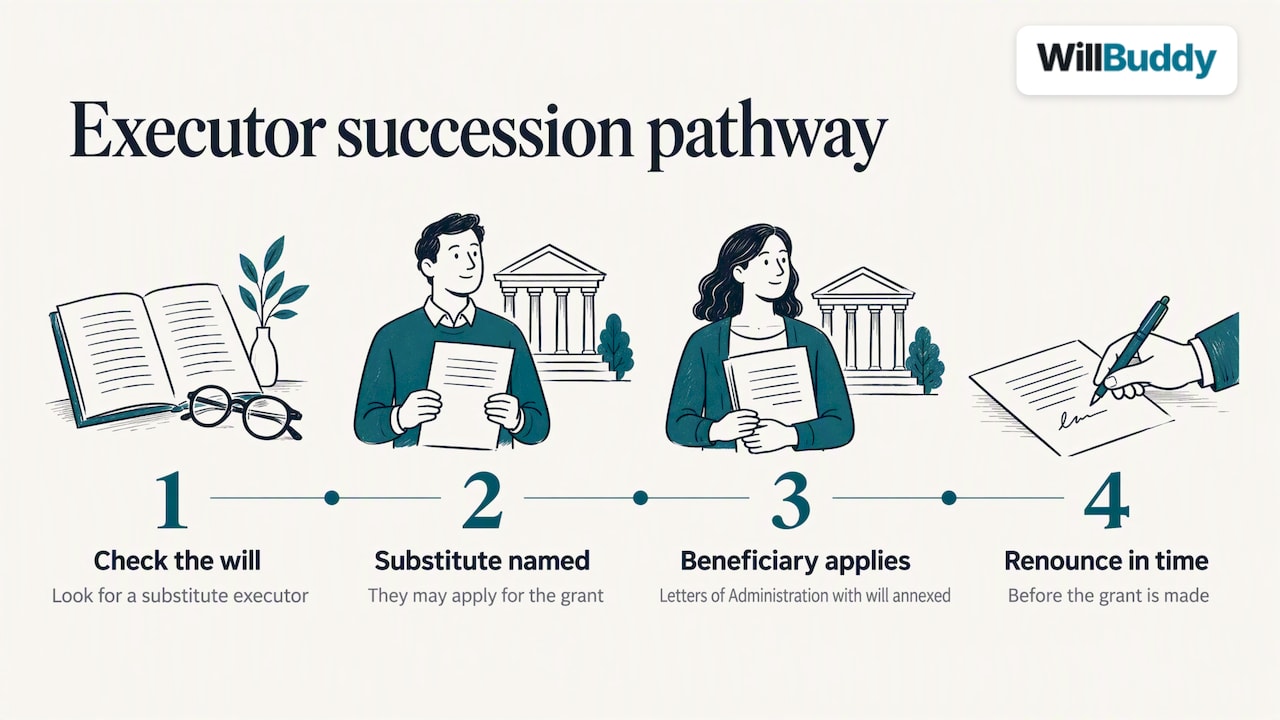
Timing matters too. The NSW court says that once a grant has been made, an executor cannot renounce. The decision to step aside has to come before probate is granted.
A backup may also need to show why the first executor isn't applying. The ACT Supreme Court says the reason must appear in the application and grant, with supporting evidence attached. Depending on the case, that could be a death certificate, a renunciation form or medical evidence.
Who to choose as your backup
Legal Aid NSW says an executor should be over 18, someone you trust and someone prepared to take on the responsibility. Those three tests apply to your backup just as much as your first pick.
Ask yourself:
- Are they likely to be around? If your children are young, choose someone who will probably still be available in 10 or 15 years.
- Are they organised? The job involves forms, banks, deadlines and sometimes tense conversations.
- Can they handle family pressure? Sorting out an estate can stir up conflict.
- Do they live somewhere practical? Distance isn't a barrier, but it can make things harder.
- Is it a different person from your first choice? Naming your spouse and then your spouse's sibling can leave both unavailable in a shared tragedy. Spread the risk.
Can a beneficiary be an executor?
Yes. South Australian guidance treats this as ordinary practice, as long as the person is legally capable. Many people name their partner or an adult child, who is also a beneficiary. The executor must still act fairly and follow the will.
Should a family member be an executor?
Often yes, but being family isn't a qualification. An adult child who is reliable and calm can be a better choice than a relative who is overwhelmed by paperwork. Where the family is divided, or the estate is large or complicated, some people name a professional such as a trustee company or lawyer as the backup. Professionals can charge fees from the estate. You can read more in our guide to what an executor can be paid.
Joint or separate: how your executors act together
If you name several people, the wording decides how they work. Legal Aid NSW notes that executors can be appointed jointly, or jointly and severally.
| Appointment | What it usually means | Good for | Watch out for |
|---|---|---|---|
| Jointly | Decisions need agreement between executors | Two people who get along and live close | One person's delay or disagreement can stall everything |
| Jointly and severally | Executors can act together or on their own | Busy people, or those in different cities | Less oversight between them |
| First choice, then backup | The backup acts only if the trigger occurs | Most simple estates | The trigger wording must be clear |
Don't confuse a second co-executor with a backup. A co-executor acts from the start. A backup waits in reserve. You can use both: two co-executors plus a named backup if either drops out.
How to word the backup clause
You don't need legal jargon. You need clear triggers and clear names. A plain version might say:
I appoint [full name] as my executor. If [full name] dies before me, or is unwilling or unable to act, I appoint [full name] as my executor in their place.
Check these points before you sign:
- Use full legal names. "My brother" is not enough if you have more than one.
- Cover each trigger. Death, unwillingness and inability. Add "or after my death, before the estate is finished" if you want that covered.
- Check the order. First choice, then second, then third if you want one.
- Match the rest of the will. If your will leaves everything to your spouse, and the spouse is also your executor, read the whole document for gaps in the "what if they die first" scenario.
The NSW court lesson is simple: a backup clause protects you only when its wording matches the event that occurs.
Talk to your backup first
Never name someone without asking. They may say no, and you want to learn that now, not after you have died.
Legal Aid NSW suggests choosing someone you trust who is prepared to take on the job, and letting your executor know where your will is stored. A short conversation helps:
- Explain what the role involves.
- Ask if they are happy to be your backup.
- Tell them where the original signed will is kept.
- Tell them who your first executor is, so they know when they may be called on.
- Update them if your will changes.
The time commitment is real. Many estates take around a year to finish, often called the "executor's year", and a large or tangled estate can take longer. Duties include securing assets, paying debts and distributing the estate. South Australian guidance is the source for the usual payment order in that state, starting with funeral and testamentary expenses.
If you want a step-by-step view of the job, see our executor role and responsibilities guide, or our executor choice guide, which matches the person to your state and assets.
State and territory differences to keep in mind
Wills and probate are governed by state and territory law, and court practice varies. A few examples from the sources above:
- NSW: Renunciation uses a court form and can't be filed after probate is granted. If no substitute is named, a beneficiary may apply for Letters of Administration with the will annexed.
- ACT: The Supreme Court requires the reason a named executor isn't applying to appear in the application, with evidence.
- South Australia: Handbook guidance says a back-up may act if the preferred executor dies, or is unable or unwilling to act.
- Victoria: Probate is granted by the Supreme Court of Victoria, and removing or replacing an executor is also a matter for that court.
If you own property in more than one state, or assets overseas, get legal advice. Your executor may need the grant recognised in each place, and overseas assets sometimes call for a separate will.
What if things go wrong later
Sometimes an executor is named, accepts, and then doesn't do the job well. Removal is a court process. There is no single fixed national cost. The NSW Supreme Court warns that contested proceedings can attract daily hearing fees and that the unsuccessful party may have to pay the winner's costs. If you are in that position, ask an estates lawyer for a written estimate first.
You can lower the odds of a dispute by choosing carefully, naming a backup and keeping your will up to date.
Keep your backup choice current
Life changes. Your backup moves overseas, falls out with the family, or becomes ill. A new baby, a separation or a new home are all moments to reread your will.
This is where an online will you can revisit is useful. With WillBuddy you answer plain questions one at a time, and the will is drafted for your state or territory. You can read every word free before you pay, then print it and sign it with witnesses. Annual access includes up to 50 AI-assisted edits a year, so changing a backup executor doesn't mean starting over. See current plan details on our pricing page.
If your situation is more complex, for example a blended family, a business or trust, overseas assets or a likely contest, see a lawyer. Plain online drafting is built for straightforward needs.
After someone dies, the executor's work follows a set path. Our estate administration guide walks through it, and the after death process guide covers probate.
FAQ
What is a substitute executor?
It is the second-choice executor named in your will. They can usually apply for probate if the first executor has died, renounced or is unable or unwilling to act. The exact result depends on your wording and your state or territory's probate rules.
Can the same person be my executor and my children's guardian?
Yes. The roles are separate, though. The executor deals with your estate, and the guardian is the person you prefer to care for your children. A court decides the final guardianship outcome, so get advice if your family situation is complicated.
How many backup executors should I name?
One is enough for many simple estates. Naming a second backup can help if your first two choices are close relatives who might be affected by the same event. Make sure each person is willing and has a clear place in the order.
What if I don't name a backup and my executor can't act?
In NSW, a beneficiary named in the will may be able to apply for Letters of Administration with the will annexed. Elsewhere the court may need to appoint an administrator, depending on the circumstances. This is usually slower and can cost more than having a backup in place.
Can I change my backup executor later?
Yes, while you have capacity. You update your will, or make a new one, and sign it with the required witnesses. Tell the people involved about the change.
Sources
Show the 9 sources
- Complex probate proceedings, Supreme Court of NSW
- Contested proceedings, Supreme Court of NSW
- When an executor is unwilling or unable to act, Legal Aid NSW
- Making a will, Legal Aid NSW
- Speaking for myself: Making a will, Legal Aid NSW
- Common errors to avoid, ACT Supreme Court
- Duties of executors, Law Handbook South Australia
- Problems with executors, Law Handbook South Australia
- Wills, Law Handbook South Australia
Start your will free at willbuddy.com.au and read it before you pay.
Recommended
For the one who makes it easy for everyone
Make it easy for whoever sorts things out after you
Your will names your executor, and a backup if they can't act, so nobody is left guessing. You can also say whether they're paid. WillBuddy drafts it for your state from plain questions. Read every word free, with no card. You pay only if you want to print it.
Start my will freeLast updated 20 October 2026.
This article is general information only and is not legal advice. It is our best interpretation of the law as at 20 October 2026. WillBuddy is not a law firm, and it never replaces advice from a lawyer or solicitor. Laws change and differ between states and territories, so for your own circumstances, please get legal advice.