How to Change the Executor in Your Will
General information, not legal advice.
On this page
- TL;DR
- Can you change your executor while you are alive?
- Two ways to change an executor
- What not to do
- Choosing a better executor this time
- Step by step: changing your executor with a new will
- Make the change with WillBuddy
- When the executor can't or won't act
- Can an executor be changed after the will-maker dies?
- When to see a lawyer
- FAQ
- Sources
- Recommended

Quick answer
You can change the executor in your will at any time while you have capacity. You do it by making a new will, or by signing a codicil that follows the same formal rules as a will. You cannot just cross out a name or tell someone. A will stays in force until you formally change or revoke it, according to the State Library of NSW.
This guide covers both routes, how to pick a better replacement, what happens if the executor can't or won't act, and what is possible after the will-maker dies. It is general information only, not legal advice. State and territory rules differ, so we name the state where it matters.
TL;DR
- While you are alive and have capacity, you can change your executor with a new will or a properly signed and witnessed codicil.
- For a simple change, many people choose a new will. The Legal Services Commission of South Australia calls it the simplest way to update a will, and a new will normally includes a clause that revokes earlier wills.
- Name a backup executor, and ask people before you name them.
- After a death, an executor is not simply swapped. Changes need a renunciation, a deed or a Court order.
- Get a lawyer for blended families, a business or trust, assets overseas, or a likely contest.
Can you change your executor while you are alive?
Yes. Your executor is only a name in a document. If you are an adult of sound mind, you can replace it whenever your life changes.
Common reasons include:
- Your first choice has died, moved overseas or become unwell.
- You have separated from the person you named.
- Your children have grown up and could now do the job.
- A friendship or family relationship has changed.
- You want a professional executor instead of a family member.
One rule catches people out. Marriage and divorce can change a will automatically in some states. The State Library of NSW says that under NSW law, marriage revokes a will unless it was made in contemplation of that marriage. It also says divorce revokes an ex-spouse's appointment as executor unless the will says otherwise. Other states have their own versions of these rules. Do not rely on them. If your relationship status has changed, update your will on purpose.
Two ways to change an executor
There are two legal tools. Both need to be signed and witnessed properly.
Option 1: make a new will
A new will names your new executor and repeats everything else you want. It usually includes a clause saying it revokes all earlier wills. Make sure yours does, so no part of an old will is left standing. The Legal Services Commission of South Australia describes a new will as the simplest way to update a will.
A new will suits you when:
- You are changing more than the executor.
- Your existing will is old or has been marked up.
- You want one clean document that your executor can find and follow.
- You have already made one codicil and want to avoid a stack of them.
Option 2: sign a codicil
A codicil is a separate document that amends your will. The Tasmania Legal Aid site says it must meet the same formal requirements as a will. In Tasmania, the Wills Act 2008 (section 8) means it must be in writing, signed by you while two witnesses are present at the same time, and then signed by both witnesses in your presence. Signing at the end of the document is good practice.
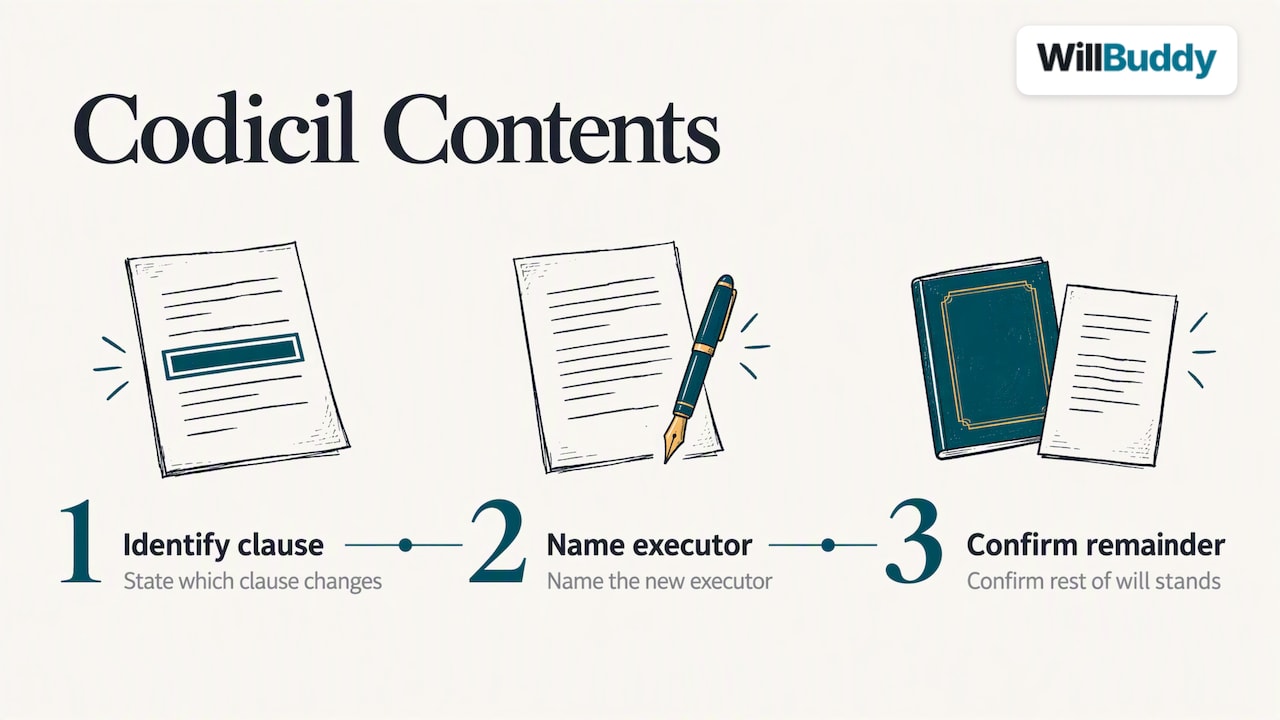
A codicil to change an executor is short. It says which clause of the will it changes, names the new executor, and confirms the rest of the will stands. The Legal Services Commission of South Australia notes that it must be formally signed and witnessed, and recommends legal advice before using one.
The risk is that the codicil gets separated from the will. Two documents also leave more room for confusion. We compare the two routes in more detail in our guide on codicils versus a new will, and explain the signing rules in proper execution requirements.
Which should you pick?
| Situation | Usually simpler |
|---|---|
| Only the executor changes, and your will is recent | Codicil or new will |
| Executor and guardians, gifts or beneficiaries change | New will |
| You have already made a codicil | New will |
| Your will is old or hard to read | New will |
| You want a fresh start after separation | New will |
For most families, a new will is easier to keep track of. It gives one document with one signing date.
What not to do
Some shortcuts feel harmless but can cause trouble.
- Do not cross out or write on the original. Unwitnessed changes may not be valid, and they can raise questions about what you meant.
- Do not just tell the old executor. A conversation does not change the will.
- Do not staple a note to the will. An informal note may not meet the signing rules.
- Do not destroy the old will before the new one is signed. If the new one is invalid, you may be left with nothing.
Once the new will is signed and witnessed, keep the old one only if you have a reason. Many people mark old copies as revoked and store them away from the original.
Choosing a better executor this time
A replacement is only useful if they can do the job. The executor is the person who carries out your will after you die.
According to Western Australia's Public Trustee information, an executor may:
- locate and secure the will
- identify and notify beneficiaries
- apply for probate
- secure and value assets
- pay creditors
- lodge tax returns
- distribute the estate
That is real work, and it can take a while. Think about who is organised, calm and trustworthy.
Practical rules to check
- Age. Choose an adult. Tasmania Legal Aid says an executor must be over 18, and someone under 18 cannot apply for probate.
- Closeness and age. Tasmania Legal Aid suggests someone close, trustworthy and of a similar age.
- Beneficiaries can be executors. The WA government says an executor may also be a beneficiary. Many people name a spouse or adult child.
- More than one is allowed. The same page says there can be more than one executor. See our guide on multiple executors.
- A professional is an option. The Public Trustee may be appointed as executor or substitute executor in WA. Other states have their own public trustee or trustee companies.
Ask first
Before you name someone, ask whether they would accept. The WA government advises this. A named person does not have to take the job, and a surprised executor may refuse when the time comes.
Name a backup
Tasmania Legal Aid recommends naming two executors in case one dies or no longer wishes to act. A substitute executor in your will avoids a gap. This is one of the most useful things to add when you update.
When the estate is complicated
If your estate includes a family trust, a business or a plan for a testamentary trust, the executor's job gets harder. Some people then look at a professional executor, or get advice on how testamentary trusts in Australia affect trustee choices. This is a good point to speak to a lawyer. For more help on matching an executor to your situation, read our guide on choosing a will executor.
Step by step: changing your executor with a new will
- Decide who you want. Pick a main executor and a backup. Ask them first.
- Write down what else has changed. Guardians, gifts, pets, funeral wishes and who you want to exclude all belong in the same check.
- Draft the new will for your state or territory. Rules on signing differ between jurisdictions.
- Read it through. Check every name, spelling and clause.
- Print and sign it with witnesses. Follow your state's witness rules. Our page on who can witness a will covers the basics, including who should not be a witness.
- Store the original safely. Tell your executor where it is.
- Deal with the old will. Make sure it can't be mistaken for the current one.
On step 6, the Legal Services Commission of South Australia says to keep the signed original safe and let your executor know where it is. The Sydney Morning Herald reports that there is no legal requirement to tell someone you have nominated them, but that telling them where the original is stored helps.
For the wider rules on valid wills, see our guide to will requirements in Australia. If you live in Tasmania, the page on making a will in Tasmania has local detail. Our general page on updating or changing a will covers other changes.
Make the change with WillBuddy
WillBuddy asks plain questions one at a time and drafts a will for your state or territory. You choose your executor, and you can read every word free before you pay. Then you print it and sign it with witnesses, as your state requires.

If your life changes again, an annual subscription lets you make up to 50 AI-assisted edits a year. See the Annual Access plan and price for the current details. You can also start on the WillBuddy home page.
When the executor can't or won't act
Sometimes you don't get the chance to change anything. The person you named dies before you, or they refuse. Here is what the research says.
- They don't have to accept. Legal Aid WA states that a named executor does not have to accept the responsibility. If they refuse, another named executor may act. If there is none, an application may be made to the Supreme Court for an administrator.
- Before probate, they can step back. In NSW, an executor who doesn't want to act, and hasn't dealt with the estate property, can file a Renunciation of Probate form with the Supreme Court, according to Legal Aid NSW.
- If all executors renounce. Legal Aid NSW says a beneficiary can then apply for Letters of Administration with the will annexed.
- If no one is willing or able. The Queensland Law Handbook says the court may appoint an administrator.
This is why a backup executor is so valuable. It saves your family a court application.
Can an executor be changed after the will-maker dies?
Generally, the will cannot be rewritten after death. The executor is whoever the will names. Changes are limited and run through the courts.
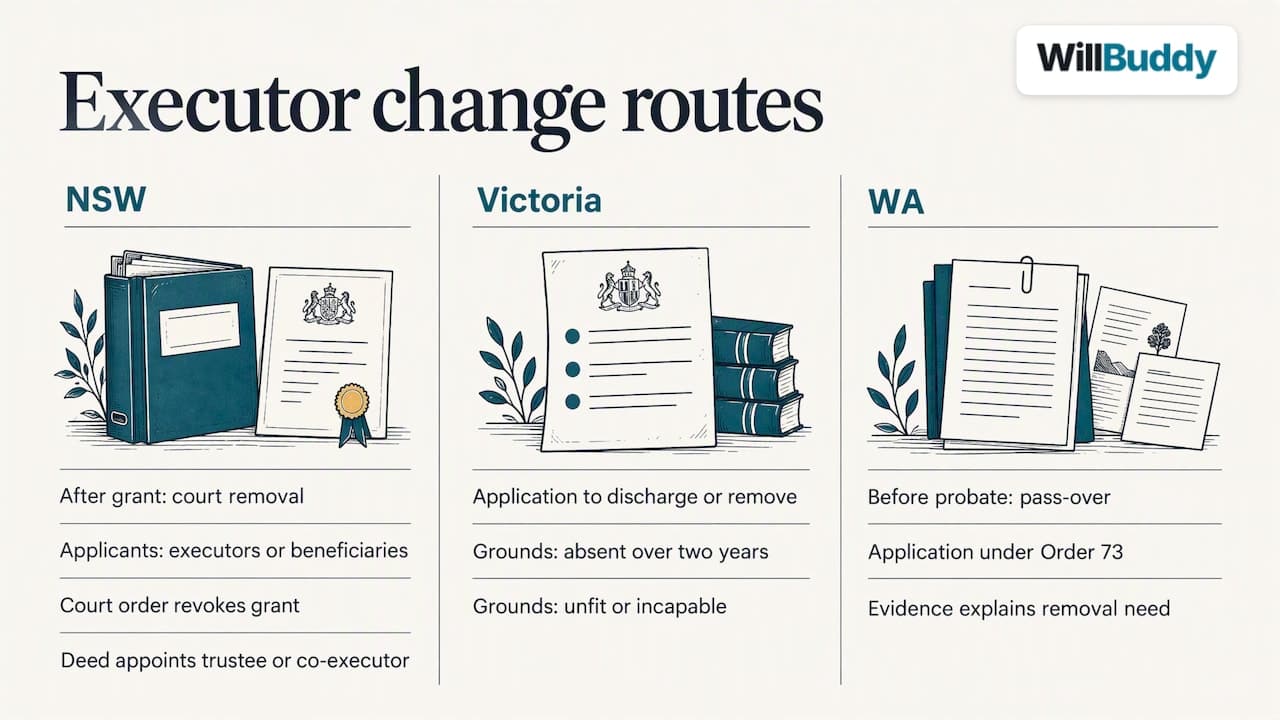
In NSW, an executor cannot renounce after a grant of probate. The Supreme Court of NSW says removal requires an application by other executors or beneficiaries and a Court order revoking the grant. The same page says that after a grant, an executor may, by deed, appoint the NSW Trustee and Guardian, or a trustee company, as executor in their place or as co-executor.
In Victoria, section 34 of the Administration and Probate Act 1958 allows the Court, on application, to discharge or remove an executor or administrator who already has a grant and who is out of Victoria for more than two years, wants to be discharged, or refuses, is unfit or is incapable of acting.
In WA, a law firm's guide says an executor may be passed over before probate on an application to the Supreme Court. The application needs evidence explaining why removal is necessary.
The lesson is simple. Court removal is slow and stressful for a grieving family. It is far easier to choose well and update your will while you can.
When to see a lawyer
A simple will with a clear family set-up is often straightforward. Speak to a lawyer if any of these apply:
- You have a blended family.
- You own a business or have a trust.
- You have assets overseas.
- You think someone is likely to contest your will.
These situations raise questions about who should act as executor and how your estate is structured. A lawyer in your state can advise on your circumstances.
FAQ
Can I change my executor without a lawyer?
Yes, many people make or update a will without one. The change must still meet your state's signing and witness rules, or it may not be valid. If your situation is complex, see a lawyer.
Is a codicil or a new will better for changing an executor?
Both can work if signed and witnessed correctly. A new will is often easier to manage because it revokes earlier wills and gives you one document. The Legal Services Commission of South Australia calls it the simplest way to update a will.
Do I have to tell my old executor they have been replaced?
There is no legal requirement to tell someone you have nominated them, according to the Sydney Morning Herald. It is still kind to talk to them. Make sure the right person knows where the current original will is stored.
Can a beneficiary be my executor?
Yes. The WA government says an executor may also be a beneficiary, and that there can be more than one executor. Many people name a spouse or adult child. Consider a second or professional executor if there could be conflict.
What if my executor dies before me?
Your will may then have no one able to act, unless you named a backup. Update your will to name a new executor and a substitute. If no executor can act after your death, the court may appoint an administrator.
Start your will free at willbuddy.com.au and read it before you pay.
Sources
Show the 13 sources
- Changing or revoking a will, State Library of NSW
- Wills, making a will, Tasmania Legal Aid
- Wills and Estates Law Factsheet Series, Legal Services Commission of South Australia
- Manage a Deceased Estate: Public Trustee, Government of Western Australia
- The final paper trail: How to make your executor's job easier, Sydney Morning Herald
- Applying for Probate, Legal Aid NSW
- Complex probate proceedings, Supreme Court of NSW
- Administration and Probate Act 1958 (Vic)
- Wills Act 2008 (Tas)
- Wills and Estates, Queensland Law Handbook
- How to remove an Executor of a Will in WA
- Duties of executors, Legal Aid WA
- Avoid Trustee and Tax Pitfalls with Testamentary Trusts in Australia
Recommended
For the one who makes it easy for everyone
Make it easy for whoever sorts things out after you
Your will names your executor, and a backup if they can't act, so nobody is left guessing. You can also say whether they're paid. WillBuddy drafts it for your state from plain questions. Read every word free, with no card. You pay only if you want to print it.
Start my will freeLast updated 4 November 2026.
This article is general information only and is not legal advice. It is our best interpretation of the law as at 4 November 2026. WillBuddy is not a law firm, and it never replaces advice from a lawyer or solicitor. Laws change and differ between states and territories, so for your own circumstances, please get legal advice.