How to Include Your Pets in Your Will in Australia
General information, not legal advice.
On this page

Quick answer
You include a pet in your will by naming who gets the animal, and by setting aside money or a trust to help pay for its care. You can't leave money to the pet itself. Under Australian law a pet is property, so the will has to work through people, a charity or a trustee. With WillBuddy you answer plain questions one at a time, and the will we draft covers pets and your other wishes for your state or territory. You can read every word free before you pay.
TL;DR
- Pets are property in Australia, so they can't receive a gift from a will. You leave the pet to a person or a charity instead.
- If your will says nothing about your pet, the residuary beneficiary inherits it. Without a valid will, it goes to your next of kin.
- You can pair the gift with money for the pet's care, or use a trust. Name a backup carer in case the first one can't do it.
- Ask the person first. Ask a charity first too, because some programs need a gift in your will.
- Update the will when your pets or your life change.
What happens to your pet if your will says nothing
Most people assume someone will "just know" who gets the dog. The law doesn't work that way.
The ACT Public Trustee and Guardian explains that if you make a will but don't provide for your pet, the residuary beneficiary inherits the pet. The residuary beneficiary is the person who receives whatever is left after the specific gifts in your will are made. If you die without a valid will, the pet goes to your next of kin.
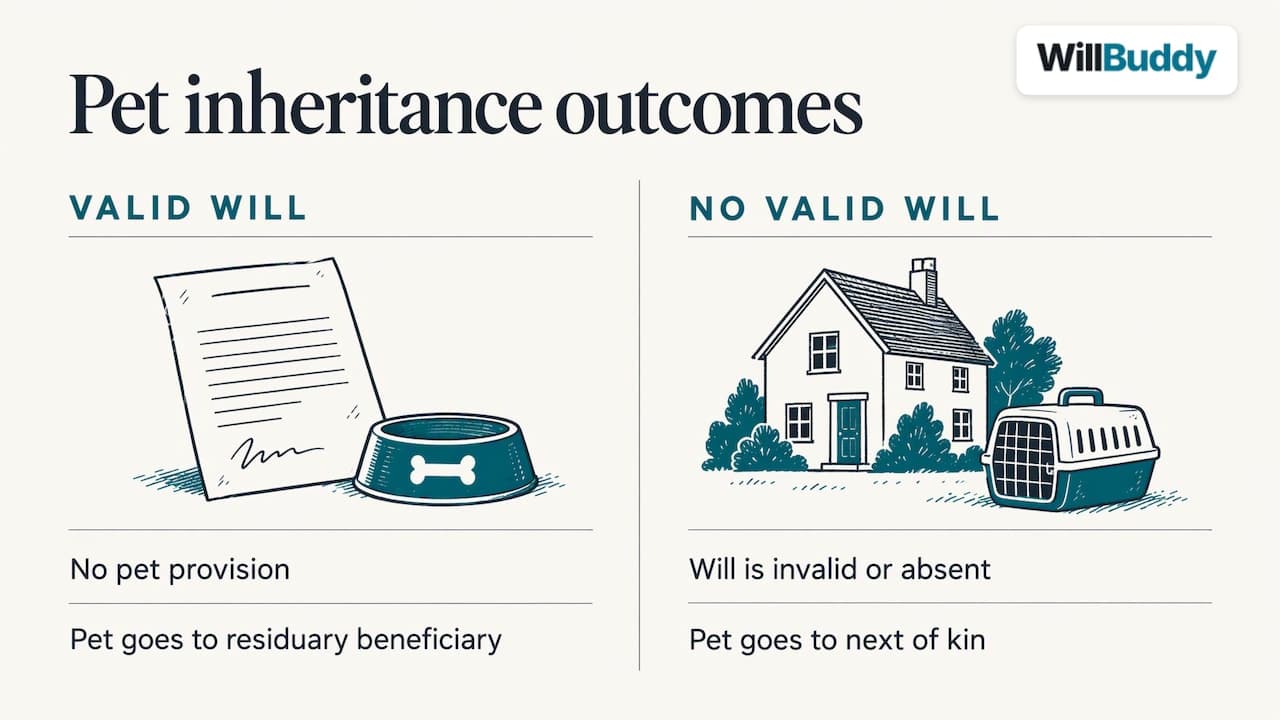
That might be exactly who you want. It might not. Your partner might be the best home for the cat. But if your residue is split between three adult children, or goes to a person who is allergic or lives in a rental that bans pets, the animal can end up with the wrong person, or with nobody who wants it.
NSW Trustee and Guardian says only about one in 50 people make provision for pets in their will, even though more than half of surveyed pet owners see their pet as part of the family. A few lines in your will close that gap.
Why a pet can't inherit money
People often ask if they can leave money to their dog. The answer is no. NSW Trustee and Guardian states that pets are property under Australian law and cannot receive a gift from a will.
What you can do is give the pet to a person or an animal charity, and leave a sum of money to that person or charity to help cover its care. You can also use a trust. The next sections cover each option.
The same NSW guidance compares planning for a pet with naming a guardian for a child. Both are about making sure someone you trust takes over. If you have children, you will likely be doing both in the one document. Our guide for parents on minor children, guardians and trusts in wills covers the child side.
Your options for providing for a pet
The ACT Public Trustee and Guardian lists three main options, and each can be made to a friend or a charity. The NSW Government's guidance on wills also covers leaving the pet to an animal shelter, charity or rescue service for adoption. Here they are side by side.
| Option | How it works | What to watch |
|---|---|---|
| Gift the pet to a person | You name a friend or family member to take the animal. | They must be willing and able. Name a backup. |
| Gift the pet plus money | The person receives the pet and a sum towards its costs. | A request to use the money on the pet is guidance only. A conditional gift can be written so the person must agree to use it as directed. |
| Gift the pet and set up a trust | A trustee holds funds for the pet's benefit during its life. | The trust needs enough money for the whole life of the pet and instructions for any money left over. |
| Leave the pet to a charity or rescue | An animal charity takes the pet and rehomes or fosters it. | Some programs need a gift to the charity in your will. Contact them first. |
Gifting the pet to a person
This is the simplest and the most common choice. You name one person who gets the animal. Pick someone who already knows your pet and has the space, time and money for it. Ask them before you write their name down. A person who finds out after your death that they have inherited a 14-year-old dog with medical needs may say no.
Adding money for the pet's costs
Leaving a cash gift alongside the pet helps the new owner cover food, vet bills and insurance. The ACT factsheet is plain about the limit here: a request that the money be spent on the pet is not binding. It is guidance you trust the person to follow. A conditional gift can require the person to first agree to use the money as directed, and your executor would check that they agree. After that, nobody supervises how the money is spent.
That is why the person you choose matters more than the clause you write.
Using a trust for the pet
The ACT factsheet describes a trust set up under your will as the most secure option. The trustee holds money for the pet's benefit for its lifetime. Two things to plan: the trust should hold enough for the pet's whole life, and the will should say what happens to money left over when the pet dies.
Tasmania's Public Trustee points out that a trust for an animal is a non-binding direction to the trustee. So you still need a trustee you trust. If you want to know how trusts inside a will work in general, see our guide to testamentary trusts in Australia.
A trust adds complexity. If you want one, take advice from a lawyer, as NSW Trustee and Guardian suggests.
Leaving the pet to an animal charity
If nobody in your life can take on the animal, a charity program may be the answer. Several run legacy pet programs:
- The RSPCA offers pet bequest programs where it cares for animals after the owner has died, with new homes and foster carers selected for continued care.
- Animal Welfare League NSW runs a Legacy Program that takes pets into care straight away, has them checked by vets at its Kemps Creek shelter and places them with foster families. The legacy gift helps cover ongoing medical care, nutrition and wellbeing for the pet's life.
- Animal Welfare League Queensland's Legacy Pets Program arranges future care and rehoming, and includes emergency boarding if you are hospitalised. According to Companion Animal Network Australia, owners must include a charitable gift to AWLQ in their will to take part. The same page notes that SAFE Inc may arrange foster care and rehoming without a gift, and that Dogs' Homes of Tasmania lets owners include instructions asking that their dog be placed in its care.
The NSW Government's guide to wills says a cash gift or other requirement may apply, so contact the organisation first. Each program has its own terms, and they change. Check the charity's own page before you write it into your will.
How to choose the right carer
The will is only as good as the person it names. Work through these points.
- Ask first. Have a direct conversation. Say what the pet needs, including medication or special care.
- Think about the long run. The NSW Government suggests you consider the pet's expected lifespan and lifetime costs, such as vet bills, food, exercise and insurance. A parrot or a horse can outlive its owner by decades. A young puppy may need fifteen years of care.
- Check the practical fit. Does the person have a yard, or a lease that allows animals? Are there other pets, or young children, in the home?
- Name a backup. Tasmania's Public Trustee recommends a substitute carer in case the first person can't or won't take the role. Name a second person, or say that the pet goes to a charity if both say no.
- Tell your executor. The executor is the person you name in the will to carry out your wishes. The Legal Services Commission of South Australia lists who will care for your pets among the things a will should cover, next to guardians for children and funeral arrangements. Your executor should know where the pets are, and who to call.
The first days matter most. A pet can be left alone in a home while the family sorts things out. Give your executor and your carer each other's phone numbers, and keep a note of the vet's details with your will papers. Some charity programs offer emergency cards you can keep in your wallet, so that loved ones or emergency services know who to call. AWL NSW's program includes an Emergency Card Program for this.
A worked example
Sam is 42, a single parent in Brisbane, with two kids and a ten-year-old kelpie called Bear. Sam's will leaves most of the estate to the kids, held for them until adulthood. Bear is the problem. If Sam says nothing, Bear is part of the residue, which goes to the kids. They are minors, and cannot realistically care for a large dog.
So Sam's will names Sam's sister Jo as Bear's carer, leaves Jo a set amount to help with costs, and names Sam's friend Dev as the backup if Jo can't do it. Sam tells both of them. Sam also notes that the money is a request, not a command, and decides that is fine, because Jo is trustworthy.
This is an illustration only, not a real case and not advice about your own situation. The amount you leave depends on the pet's age, breed and likely costs.
Where state and territory rules come in
Wills law is made by each state and territory. The core idea that pets are property applies across Australia, but formal requirements for a valid will, and the rules for trusts, differ by jurisdiction. The government bodies quoted here are the NSW and ACT trustees, the Tasmanian Public Trustee and the South Australian Legal Services Commission, and each writes for its own state or territory.
So check the rules where you live. If you are in Western Australia or South Australia, our free guides cover your state: the WA will guide and the SA will guide.
The will itself must also be signed correctly to count. Our guide on signing a simple will with two witnesses walks through it.
When to get a lawyer
A simple gift of a pet to a friend, with some money, is within reach of most adults using a clear online tool. Get legal advice if any of these apply:
- You have a blended family.
- You own a business, or you want a trust.
- You have assets overseas.
- You think someone is likely to contest your will.
A trust for a pet with a large sum of money sits in that group. NSW Trustee and Guardian suggests advice from a lawyer experienced in this kind of clause when you set one up. If your wider estate is complex, this overview of estate planning in Australia explains the planning side.
This article is general information only. It is not legal advice.
Making it simple with WillBuddy
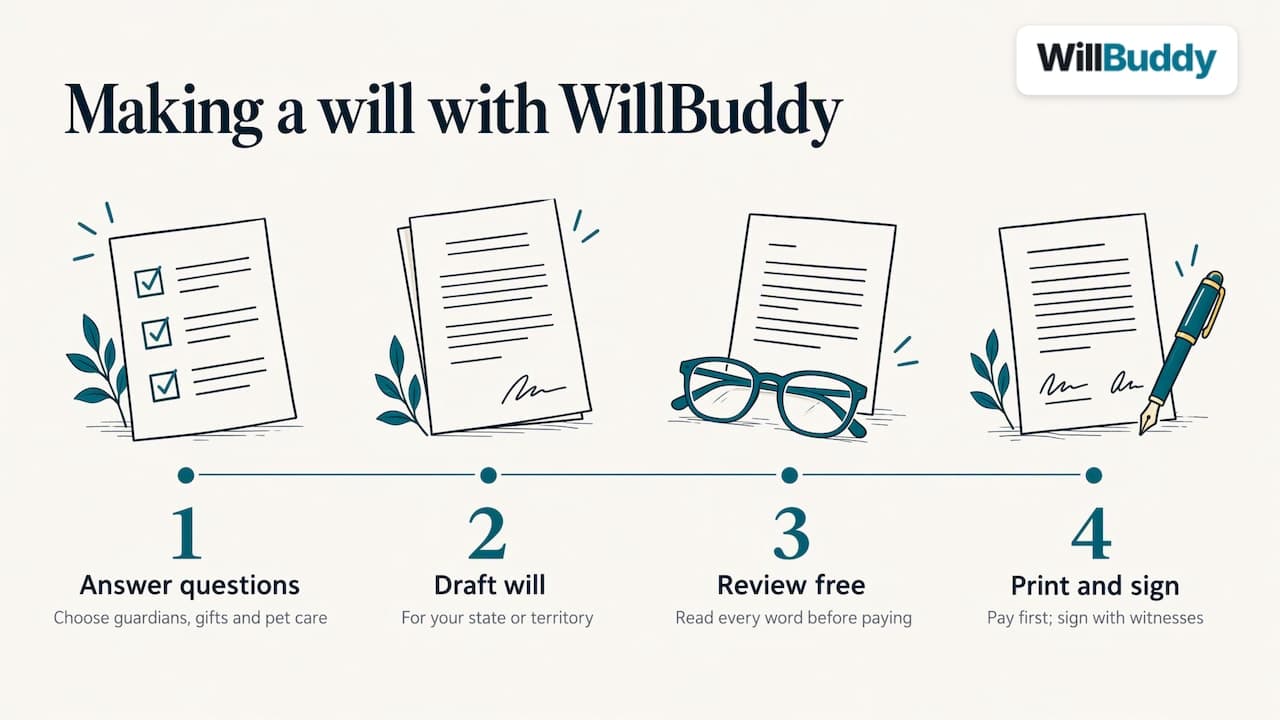
Most people who put off a will do it because the paperwork feels heavy. WillBuddy asks plain questions one at a time, then drafts a will for your state or territory. You choose guardians for your children, your executors, who gets what, gifts, funeral wishes and what happens to your pets.
You read every word of the will free before you pay. When you are happy, you print it and sign it with witnesses. The plan is an annual subscription, and it includes up to 50 AI-assisted edits a year, so you can update the will when a pet dies, you get a new one or your carer moves away. We encrypt your personal data and we don't sell it. See the Annual Access plan and price for the current cost.
Pets change faster than most things in a will. A puppy grows up, a friend moves interstate, a rescue cat arrives. Having a will you can edit easily means the pet clause stays true.
If you also want a broader check of your affairs, our estate planning checklist is a good next read. For the full process, see how to make a will in Australia.
FAQ
Can I leave money to my dog or cat in my will?
No. Pets are property under Australian law, so they can't receive a gift. You can leave the pet to a person with money for its care, set up a trust, or leave the pet to an animal charity. Which one suits you depends on your pet and the people around you.
What happens to my pet if I die without a will?
If you die without a valid will, the ACT Public Trustee and Guardian says the pet goes to your next of kin. If you have a will that doesn't mention the pet, the residuary beneficiary inherits it. Either way, you have no say in who ends up with the animal.
Is a request to spend the money on my pet legally binding?
Not usually. The ACT factsheet says a simple request is guidance you trust the person to follow. A conditional gift can require the person to agree to use the money as directed, but there is no ongoing supervision. A trust gives more structure, and you should take legal advice to set one up.
Do I need to ask the carer or charity first?
Yes. A person may not be able to take the pet when the time comes, and you won't know unless you ask. Some animal charity programs require a gift in your will, so contact the charity before you name it. Also name a backup in case the first choice can't take the pet.
Can I change the pet clause later?
Yes, you can update your will whenever things change, as long as you sign the new version correctly with witnesses. With WillBuddy, up to 50 AI-assisted edits a year are included in the annual plan.
Sources
Show the 8 sources
- ACT Public Trustee and Guardian, pets and wills factsheet
- NSW Trustee and Guardian, Don't forget about Fido when making your Will (18 October 2024)
- NSW Government, Learn about wills
- Legal Services Commission of South Australia, Wills and Estates Law Factsheet Series
- RSPCA Australia, Pet legacies
- Animal Welfare League NSW, Legacy Foster Care
- Tasmania's Public Trustee, Your pet and your Will
- Companion Animal Network Australia, Legacy pet programs: planning for your pet's future
Start your will free at willbuddy.com.au and read it before you pay.
Recommended
For the one who gets things sorted
Now write yours, with your family's names in it
Plain questions about your family, one at a time, and WillBuddy drafts a will for your state. Until you sign one, the law in your state or territory decides who gets what. Read every word free, with no card. You pay only if you want to print it.
Start my will freeLast updated 21 November 2026.
This article is general information only and is not legal advice. It is our best interpretation of the law as at 21 November 2026. WillBuddy is not a law firm, and it never replaces advice from a lawyer or solicitor. Laws change and differ between states and territories, so for your own circumstances, please get legal advice.