Choose a Will Executor in Australia: Match Their State to Your Assets
General information, not legal advice.
On this page
- What an executor does and when their duties start
- Who can be an executor, and how to structure the appointment
- Executor duties in practice, including probate and tax steps
- A practical checklist for choosing your executor
- When to choose a professional executor instead of a family member
- What happens if your executor can't act, or a dispute arises
- How we help you name the right executor while you draft your will
- Start your will and name your executor today
- FAQ
- Sources
- Recommended

Quick answer
Pick someone you trust who has the time and the head for paperwork, not just the closest relative. Name a back-up in case your first choice can't act, and if your estate is complex, weigh up a professional executor instead. Then tell the person you've chosen and write their full contact details into your will.
In short
- Confirm your choice is willing to serve and name an alternate; if your will says the alternate acts when the first executor can't or won't, the alternate can step in.
- Executors should provide for debts and tax before distributing assets; paying out too early can leave them personally responsible for a shortfall.
- Tax duties can include a date of death return and, if the estate earns income afterwards, trust returns for the estate.
- Choose a professional executor for business or overseas assets, blended families, or likely disputes, and check commission or set fees before naming one.
- A person in the state where most assets sit can simplify bank, property, court, and probate matters during estate administration.
What an executor does and when their duties start
An executor is the person named in your will to wind up your estate after you die. Their job only starts once you're gone, not before, and it covers both practical and legal work. According to the Legal Services Commission's factsheet on choosing an executor, core duties include locating the original will, organising the funeral, applying to the Supreme Court for probate and distributing assets according to the will. Along the way they also deal with debts and the deceased's tax.
An executor often has to deal with banks, courts and the Australian Taxation Office, sometimes all at once. The role isn't ceremonial.
- Locate the will and get a certified copy of the death certificate.
- Apply to the Supreme Court for probate where banks or others need it, which confirms their authority to act.
- Secure the deceased's assets and work out what's owed to creditors.
- Pay debts and valid expenses before distributing anything to beneficiaries.
Who can be an executor, and how to structure the appointment
The Law Handbook's guidance on executor duties says any adult with legal capacity may be an executor, and that more than one executor may be appointed to work together. It can be a relative, a trusted friend or a professional, and a solicitor or trustee company is worth considering for more complex estates. Naming each executor clearly, with their full name and address, helps avoid confusion later.
- A family member or friend usually understands your wishes but may need professional help for tricky assets.
- A professional executor charges fees but brings experience with probate and tax.
- Joint executors share the workload but generally need to act together.
- An alternate executor steps in if your first choice can't or won't act, as your will sets out.
Pro Tip: Where possible, choose someone who lives in the same state as most of your assets. It can make bank visits, property matters and court paperwork simpler.
Executor duties in practice, including probate and tax steps
Once appointed, an executor works through a fairly fixed sequence. Skipping a step, especially around debts or tax, can create personal liability.
- Secure the will, the death certificate and the deceased's important documents.
- Notify banks, government agencies and relevant institutions of the death.
- Apply for probate if needed, or letters of administration if there's no valid will.
- Collect and value all estate assets, from bank accounts to property.
- Pay outstanding debts, funeral costs and administration expenses.
- Prepare estate accounts showing money in and money out.
- Distribute the remaining assets to beneficiaries according to the will.
The ATO's checklist for what to do when someone dies sets out an executor's tax responsibilities, including a date-of-death tax return and, where the estate earns income after death, trust tax returns for the estate itself.
An executor who distributes assets before providing for the deceased's tax can be personally liable for it, up to the value of the estate assets they held, according to the ATO's guidance on confirming tax obligations are complete. Unpaid debts can carry similar risks. This is one reason many executors bring in a lawyer, accountant or registered tax agent once the estate involves property, a business or multiple beneficiaries. Our guide to estate administration and executor checklists walks through each stage in more depth.
A practical checklist for choosing your executor
The right executor combines a few traits that don't always sit in the same person. Trust matters most: you want someone who will follow your wishes rather than their own agenda, and who can stay impartial if beneficiaries disagree. Time and willingness come next. Administering an estate can take months, and an unwilling executor can renounce the role entirely.
- Trust and impartiality: can they act fairly, even if beneficiaries disagree with each other?
- Time and willingness: do they have the capacity to see the process through, possibly over many months?
- Financial and organisational skill: can they manage paperwork, deadlines and basic record-keeping?
- Ability to work with professionals: will they comfortably engage a lawyer or accountant if the estate needs one?
- Location: do they live in the state where most of your assets sit, making probate and bank dealings easier?
Before you finalise your will, talk to the person you're considering. Confirm they understand what's involved and are willing to take it on, then make sure their full name and address are recorded clearly in the will.
Pro Tip: Ask your chosen executor directly: "Are you comfortable handling paperwork, dealing with a bank and possibly a court, over several months?" Their answer tells you more than any assumption.
When to choose a professional executor instead of a family member
A professional executor, such as a solicitor or trustee company, is worth considering when your estate is genuinely complicated. Think blended families, a business, overseas property or beneficiaries who are likely to contest the will.
- Complex or overseas assets often need specialist handling a family member may not have.
- Blended families can create conflicts of interest that a neutral professional avoids.
- A likely dispute benefits from someone experienced in estate law rather than a grieving relative.
Professional executors are paid from the estate. Some charge a commission, while others charge set fees: Western Australia's Public Trustee, for example, no longer charges percentage commissions on new deceased estates and works from a schedule of fees instead. If you're weighing this option, check likely costs in advance and decide whether you want to authorise a specific commission rate in your will. Our executor fees guide breaks down how commission and fees typically work.
What happens if your executor can't act, or a dispute arises
An executor is never obliged to accept the role. If they decide not to act, they can generally renounce it formally, as long as they haven't started administering the estate. If your will names an alternate for that situation, the alternate can then step in, which is exactly why naming one matters.
- If no executor is willing or available, a court can grant letters of administration to someone else, often a beneficiary or close relative.
- Disputes between beneficiaries or over an executor's conduct can often be resolved with legal advice before they escalate to court.
- Community legal centres and state legal aid services offer free or low-cost information on estates and administration disputes.
How we help you name the right executor while you draft your will
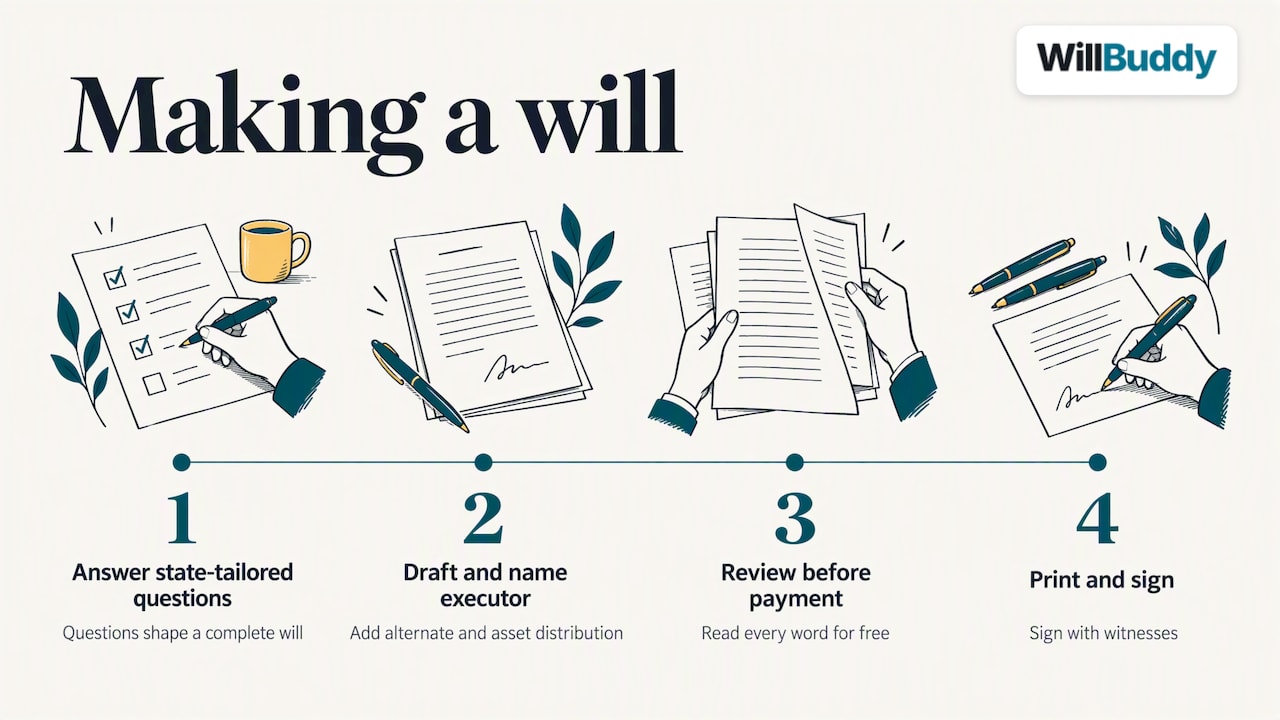
You answer plain questions, one at a time, so naming your executor and an alternate fits naturally into drafting your will. Your will is drafted to your state or territory's law, since the rules aren't identical across Australia.
- You name a main executor and an alternate, and you can add their addresses so they appear in your will.
- You can read every word of your will for free before you pay anything.
- Once you're happy with it, you print it and sign it with witnesses, then keep the signed original somewhere safe.
For more on what the role involves day to day, see our guide to the will executor's responsibilities.
Start your will and name your executor today
Naming the right executor is one decision inside a bigger one: getting your will done properly. We let you answer straightforward questions to draft a complete will for your state or territory, name your executor and alternate, and specify how your estate is distributed.

You read every word of your will for free before paying anything, then print and sign it with witnesses. Subscription details, including what's included for ongoing edits, are on our pricing page.
Start your will free at willbuddy.com.au and read it before you pay.
This article is general information, not a substitute for advice from a qualified lawyer. Consult a qualified legal professional about your own circumstances before acting on anything here.
FAQ
Who is a good executor of a will?
A good executor is someone you trust to follow your wishes, who has time to manage months of paperwork and is comfortable dealing with banks, courts and the ATO. The Law Handbook says any adult with legal capacity can be an executor, whether a relative, a trusted friend or a professional, and that you can name a back-up in case your first choice can't or won't act.
What is the legal responsibility of an executor of a will?
An executor locates the will, applies for probate where it's needed, pays the deceased's debts and tax, and distributes what's left to the beneficiaries. The ATO says an executor may need to lodge a date of death tax return and, if the estate earns income after the death, trust tax returns for the estate.
Is a trustee the same as an executor?
Not quite. An executor is the person named in your will to wind up your estate. A trustee holds and manages property for someone else, such as under a trust set up in a will, and a will can give one person both roles. You can also appoint a professional executor, such as a trustee company or a Public Trustee; the Legal Services Commission of South Australia notes professional executors usually charge a fee.
What are the disadvantages of being an executor?
Acting as an executor can take months of work, including dealing with debts, tax returns and sometimes disagreements between beneficiaries. An executor who distributes assets before providing for the deceased's tax can be personally liable for it, up to the value of the estate assets they held, according to the ATO.
Sources
Show the 5 sources
- Choosing an executor factsheet, Legal Services Commission of South Australia
- Checklist: what to do when someone dies, Australian Taxation Office
- Confirming tax obligations are complete, Australian Taxation Office
- Duties of executors, Law Handbook
- Managing a deceased estate, Western Australia government (Public Trustee guidance)
Recommended
For the one who makes it easy for everyone
Make it easy for whoever sorts things out after you
Your will names your executor, and a backup if they can't act, so nobody is left guessing. You can also say whether they're paid. WillBuddy drafts it for your state from plain questions. Read every word free, with no card. You pay only if you want to print it.
Start my will freeLast updated 12 October 2026.
This article is general information only and is not legal advice. It is our best interpretation of the law as at 12 October 2026. WillBuddy is not a law firm, and it never replaces advice from a lawyer or solicitor. Laws change and differ between states and territories, so for your own circumstances, please get legal advice.