International Assets and Your Will in Australia
General information, not legal advice.
On this page
- TL;DR
- What counts as an international asset?
- Does an Australian will cover overseas assets?
- Do you need a separate will in another country?
- International wills and the 1973 convention
- Are overseas wills recognised in Australia?
- How overseas assets are dealt with after death
- Tax on overseas assets and inheritances
- Digital assets and crypto in your will
- Your power of attorney does not travel
- When to see a lawyer
- Where a WillBuddy will fits
- A short checklist before you write
- FAQ
- Sources
- Recommended

Quick answer
An Australian will can name who gets your overseas assets, but it may not be the only document that decides it. Each country sets its own rules for property inside its borders, so overseas land or accounts can need local steps. The sensible approach is to make a clear Australian will for your Australian assets and wishes, list your overseas and digital assets, and get local legal advice for anything held abroad. This guide is general information only, not legal advice.
TL;DR
- Your Australian will can mention overseas assets, but the country where a property sits usually decides how that property passes.
- Cash, shares and belongings (movable assets) are generally governed by where you lived at death. Land and buildings (immovable assets) follow the law of the country where they are.
- An international will under a 1973 convention is one option. Australia has been a party since 10 March 2015.
- Digital assets and crypto need a written list and a plan for access, because no specific Australian law sets out how they pass when you die.
- If you have overseas assets, a blended family, a business or trust, or a likely contest, see a lawyer.
What counts as an international asset?
An international asset is anything you own outside Australia. Common examples:
- A holiday home or investment property overseas
- A bank account in your birth country
- Shares held through a foreign broker
- A pension or retirement account from a previous country of residence
- Belongings stored with family overseas
People often forget the small ones. An old bank account in the UK or New Zealand still forms part of your estate. Your executor (the person who carries out your will) can only deal with what they know about.
Does an Australian will cover overseas assets?
Often yes in part, but not on its own terms everywhere. The answer depends on the type of asset.
Australian succession law splits assets into two groups. According to the Chambers Private Wealth 2026 chapter on Australia, movable assets such as cash, shares and personal belongings are governed by the law of the place you were domiciled at death. Immovable assets such as real estate are governed by the law of the country where the property is located.
Domicile means the place you intend to make your home indefinitely. For most people who have settled in Australia, that is the state or territory where they live. If you live here but plan to go back to another country, your domicile may still be there, so ask a lawyer.
Here is what that means in practice:
| Asset | Which law usually decides | What to think about |
|---|---|---|
| Cash in an overseas bank | Your home state or territory (movable) | The bank may still ask for local paperwork |
| Shares in a foreign company | Your home state or territory (movable) | The company or broker may need its own proof of authority |
| House or land overseas | The country where it sits (immovable) | Local inheritance rules may limit who can receive it |
| Furniture, jewellery, car stored abroad | Your home state or territory (movable) | Moving or selling may involve local rules |
The Supreme Court of NSW makes a related point. It says probate law in Australia and many Commonwealth countries is similar, but there can be significant differences overseas in will validity and in who inherits when there is no valid will.
Some countries have forced heirship rules. These reserve part of an estate for certain relatives, such as children, whatever your will says. Whether that affects you depends on the country, so ask a local lawyer. Do not assume.
Do you need a separate will in another country?
Not always. Chambers notes that separate wills for assets in different countries are not strictly necessary, but can streamline probate. They can let grants be issued in several places at the same time, and let each will be tailored to that country's tax laws.
Probate is the legal process that confirms a will and gives the executor authority to deal with the estate. If you want to know when it is needed at home, see our guide on whether probate is required in Australia.
A separate local will can help when:
- You own land or a home in another country
- The local registry or bank is slow with foreign documents
- The country has strict rules on who can inherit
- You have a large portfolio in several countries
If you do sign a local will, it must not accidentally cancel your Australian one. Wills often contain a clause revoking earlier wills. A local lawyer and your Australian lawyer should check the wording together so each will covers only its own assets. This is exactly the sort of job for a lawyer, so get advice before you sign anything overseas.
International wills and the 1973 convention
An international will is a will made in a set form under the Convention Providing a Uniform Law on the Form of an International Will 1973. The aim is to make it easier to prove a will is valid in other countries that have joined.
The Attorney-General's Department says the convention entered into force for Australia on 10 March 2015, and all states and territories have passed laws to give it effect. The department describes it as a way to harmonise and simplify proof of formalities. It sits alongside normal will-making rules and does not replace them. Recognition applies only between countries that are parties to the convention.
Two points to keep in mind:
- An international will deals with the form of the will, meaning how it is signed and witnessed. It does not change the local rules about who can inherit land or how tax applies.
- It only helps if the country where your asset sits is also a party.
If you want an international will, ask a lawyer to prepare it. It has its own signing requirements that differ from an ordinary will.
Are overseas wills recognised in Australia?
Generally yes, if they were made properly. Take Victoria as an example. LawHub, a Victoria Legal Aid resource, explains that a will made outside Victoria is recognised there if it was properly executed under one of these:
- The law of the place where it was signed
- The law of the place where the will-maker was domiciled or habitually lived, at signing or at death
- The law of the country of the will-maker's nationality
Other states and territories have their own legislation, so the detail can differ. If a will made overseas is part of an estate you are dealing with, a lawyer in your state can confirm the position.
How overseas assets are dealt with after death
The executor of your Australian will deals with your Australian assets using an Australian grant of probate. Overseas assets may need their own process in the country where they sit.
Some countries will accept a foreign grant after a formal step. In Australia, accepting a grant made elsewhere is called resealing. The Supreme Court of NSW can reseal certain overseas grants under section 107 of the Probate and Administration Act 1898 (NSW). It only does this for grants from Commonwealth Realm countries where the monarch is, or was when the grant was made, head of state, such as the UK, New Zealand, Papua New Guinea and Solomon Islands. So a recent grant from a republic such as India, South Africa, Fiji or Ireland cannot be resealed there. Check the court's page for the current position.
This shows why local advice matters. Rules differ by country and by Australian state. A relative's estate handled in NSW may follow a different path from one handled in another state.
What your executor needs to start:
- A list of every overseas asset, with the institution and the country
- Account numbers or property title details
- Contact details for any overseas lawyer or accountant
- A copy of your Australian will and any local will
Keep the list somewhere your executor can reach it. A will is often read after the funeral, so do not rely on it alone to hold this information.
Tax on overseas assets and inheritances
Tax is a common worry, and it depends on the country and on who inherits. Here is the Australian side, from the Australian Taxation Office (ATO).
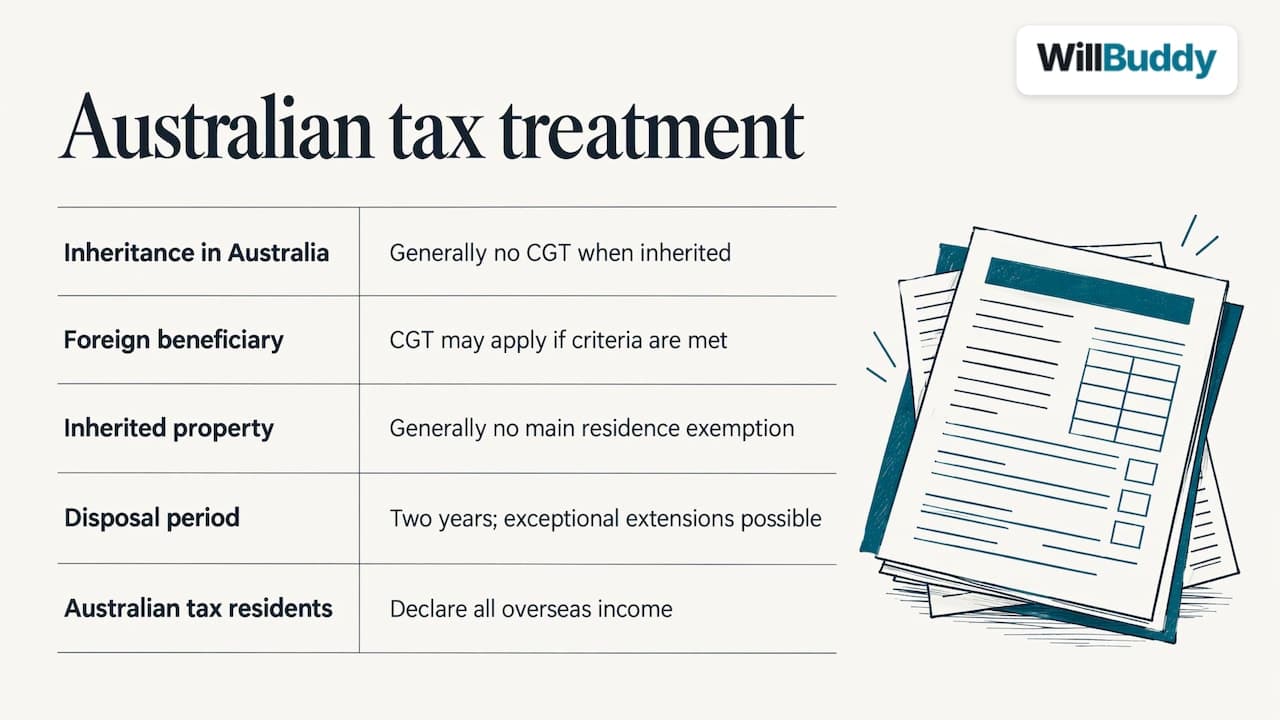
Inheriting in Australia. The ATO says that when an asset passes under a will, the beneficiary becomes its owner. Generally there are no capital gains tax (CGT) consequences at the time of inheritance. A CGT event may happen later when the beneficiary sells or disposes of the asset. CGT is the tax on the profit when you sell an asset.
Leaving assets to someone living overseas. The ATO says a different rule applies when an asset passes to a foreign resident beneficiary. CGT can apply to the deceased person at death if the asset was acquired on or after 20 September 1985, the deceased was an Australian resident, and the asset is not taxable Australian property in the beneficiary's hands. The gain is worked out using market value at the date of death and reported in the deceased's date of death tax return. The same ATO page covers the detail.
Inherited property. The ATO's guidance says foreign residents are generally not entitled to the main residence exemption when they dispose of inherited property, and the same applies if the person who died was a foreign resident. For other beneficiaries, an inherited home can be fully exempt if it is sold within two years of the death and other conditions are met. That period can be extended if exceptional circumstances outside your control delay the sale.
While you are alive. Chambers notes that Australian tax residents must declare all overseas income, including foreign rent, dividends, interest and capital gains. Temporary residents have different rules. When you stop being an Australian tax resident, Australian tax law treats some of your assets as sold at market value unless you choose to defer it, and other countries can have similar exit rules.
The other country may also have its own inheritance or estate tax. Whether it does is a question for a local adviser. For large or multi-country portfolios, Chambers advises getting advice on the tax rules in each relevant country.
Digital assets and crypto in your will
This part matters to almost everyone, not only people with overseas property. Digital assets include crypto, online accounts, cloud photos, domain names, loyalty points and online business accounts.
Chambers notes that Australia has no specific legislation on digital assets in succession, and that platform terms of service vary widely. Without clear planning, access can be blocked, which can cause distress, disputes and financial loss.
Crypto can be held on an exchange that may be based overseas, so it can be both a digital and an international asset. Anyone can see how this gets tricky: an executor who cannot log in cannot collect it.
A practical approach:
- Make a list. Write down each platform, wallet or account, and what it holds.
- Say who gets what. In your will, state who should receive your crypto or online accounts. Name the person, not just the asset.
- Plan access. Decide how your executor will get in. Do not write passwords or recovery phrases in the will itself. A will can become a public document once probate is granted.
- Store access details separately. Keep them somewhere secure that your executor knows about.
- Update the list. Review it when you open or close an account.
We cover this in more detail in our guide to digital assets in your will.
Your power of attorney does not travel
A will only starts to matter after death. Many families also need cover for illness or incapacity.
Chambers advises that estate planning for international assets should include local incapacity documents such as powers of attorney. These are jurisdiction-specific, and a global or universal power of attorney is not legally recognised. So an Australian power of attorney may not let someone manage your overseas bank account or property. Ask a lawyer in that country what they require.
When to see a lawyer
A simple will works for many Australians with simple affairs. Some situations need a lawyer. These include:
- You own property or assets overseas
- You have a blended family
- You own a business or have a trust
- You expect someone might contest the will
If you have overseas assets, a lawyer who understands both countries' rules can save your family time and cost. Ask whether you need a separate local will, an international will, or neither.
Where a WillBuddy will fits
Most of your estate is probably in Australia: your home, super, bank accounts and belongings. The will is also where you name guardians for your children, your executor and who receives your estate.
WillBuddy asks plain questions one at a time and drafts a will for your state or territory. You can read every word for free before you pay, then print it and sign it with witnesses. You can also set out your wishes on gifts, pets, funeral wishes and people you want to exclude. An annual subscription lets you make up to 50 AI-assisted edits a year, so you can update the will when you buy a property, open an account or add a crypto wallet. See the pricing page for the current plan.

For signing rules, see our guide to will requirements in Australia. For a list of what else to keep in order, try our estate planning checklist. If you hold overseas land or accounts, take your Australian will to a lawyer who can advise on the local side.
A short checklist before you write
- List all assets, in Australia and overseas, with the country and institution.
- Mark each as movable (cash, shares, belongings) or immovable (land and buildings).
- List digital assets and note who should receive each one.
- Choose an executor you trust and who can handle paperwork. For overseas assets, think about whether they can deal with another country's process.
- Name guardians for any children under 18.
- Check who you want to leave out, and why.
- Note any overseas wills or powers of attorney you already have.
- Book legal advice if you have overseas property, a blended family, a business or trust, or a likely contest.
Bring the list to your lawyer, or use it as you answer the questions in your will.
FAQ
Is my Australian will valid for overseas assets?
Your will can be valid in Australia and still need extra steps overseas. Movable assets are generally governed by the law of your domicile, and immovable assets by the law where they sit. A local lawyer can say what the other country requires.
Do I pay tax on an overseas inheritance in Australia?
The ATO says there are generally no CGT consequences when an Australian beneficiary inherits an asset. A CGT event may arise when they later sell it. Foreign income and the other country's own taxes can also matter, so speak to a tax adviser for your case.
How do I include crypto in my will?
List each platform or wallet, say who should receive it, and plan how your executor will get access. Keep passwords and recovery phrases out of the will, because it can become public after probate. Store them separately and securely.
What happens if a foreign resident inherits my Australian property?
The ATO says special CGT rules apply when an asset passes to a foreign resident. Foreign residents are generally not entitled to the main residence exemption on inherited property. Get tax advice before you finalise your gifts.
Sources
Show the 6 sources
- International wills, Attorney-General's Department
- Wills made interstate or overseas, LawHub
- Applying for a reseal of a Grant, Supreme Court of NSW (Probate and Administration Act 1898 (NSW), s 107)
- How CGT applies to inherited assets, Australian Taxation Office
- Inherited property and CGT, Australian Taxation Office
- Private Wealth 2026, Australia chapter, Chambers
Start your will free at willbuddy.com.au and read it before you pay.
Recommended
For the one who gets things sorted
Now write yours, with your family's names in it
Plain questions about your family, one at a time, and WillBuddy drafts a will for your state. Until you sign one, the law in your state or territory decides who gets what. Read every word free, with no card. You pay only if you want to print it.
Start my will freeLast updated 22 November 2026.
This article is general information only and is not legal advice. It is our best interpretation of the law as at 22 November 2026. WillBuddy is not a law firm, and it never replaces advice from a lawyer or solicitor. Laws change and differ between states and territories, so for your own circumstances, please get legal advice.