Joint Tenancy vs Tenants in Common in Australia
General information, not legal advice.
On this page

Quick answer
The main difference is what happens when an owner dies. Joint tenants own the whole property together, so a deceased owner's share passes automatically to the surviving owner, whatever the will says. Tenants in common own separate shares, which can be unequal, and each owner can leave their share to anyone through a will. That makes your will the key document if you hold a home as tenants in common. It is also why it pays to check how your title is held before you write one.
This is general information only, not legal advice. Property and succession law differs between states and territories, so we name the state where a rule differs.
TL;DR
- Joint tenants own the whole property together in equal shares. When one dies, the survivor takes the lot by survivorship. Your will does not touch it.
- Tenants in common each own a defined share, equal or unequal. Your share becomes part of your estate and goes to whoever your will names.
- Without a will, a tenant in common's share goes under your state's intestacy rules, which may not match what you want.
- A joint tenancy can be turned into a tenancy in common (called severing), and bankruptcy or a sale of one share can do it too.
- A will can also give a spouse a right to live in the home for life (a life interest), while the home later passes to others.
What each type of ownership means
When two or more people buy a property, the title records how they hold it. There are two common choices.
Joint tenancy
Joint tenants do not own halves or thirds. Together they own the whole property. Western Australia's land titles agency explains that a joint tenancy needs four "unities": time, title, possession and interest. In plain terms, everyone gets the same interest, in the same document, at the same time, and all of them can use the whole property. Because interests must be equal, joint tenancy cannot give one person a bigger share.
The Tasmanian community legal handbook adds that joint tenants cannot mortgage their share alone and must act together on dealings.
Tenants in common
Tenants in common each hold a separate, defined share. The Australian Taxation Office says these shares may be unequal, and each owner can sell, mortgage or lease their share without the other owners' agreement. Selling the whole property still needs everyone to agree.
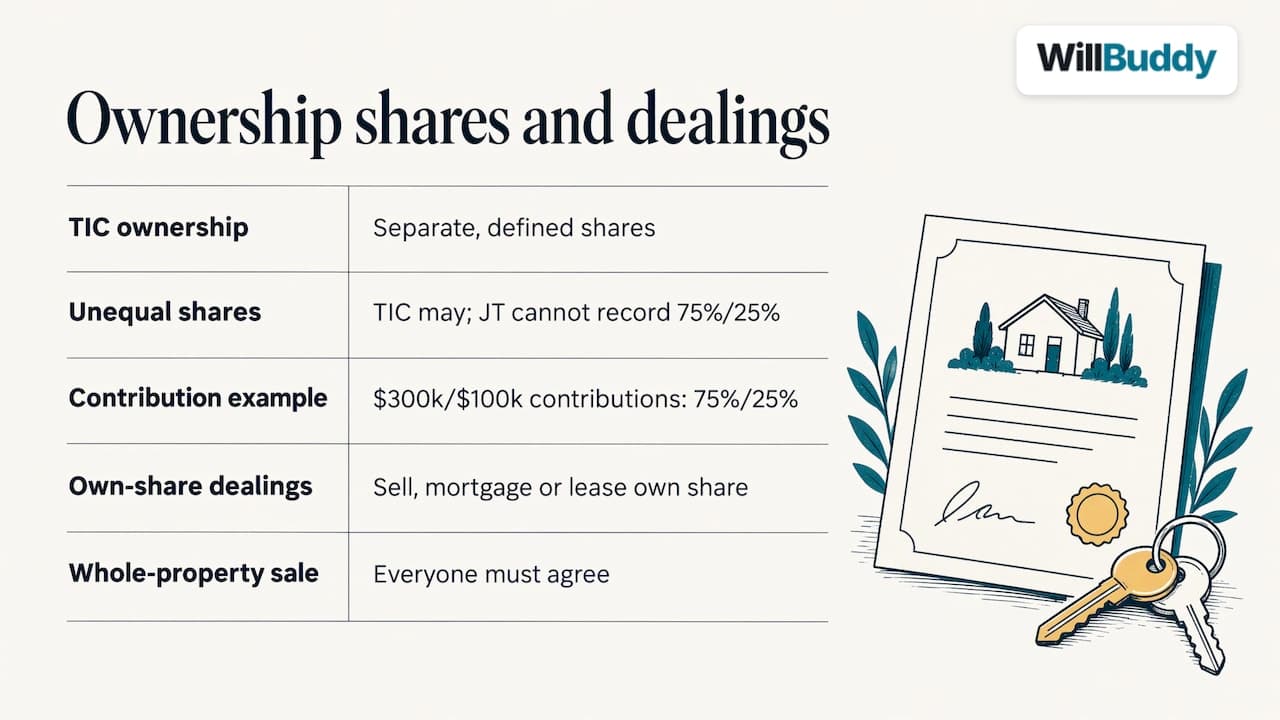
The Queensland Law Handbook notes that shares traditionally reflect what each person paid. Say a parent puts in $300,000 and an adult child puts in $100,000. They might hold 75% and 25%. Joint tenancy could not record that split.
Side by side
| Joint tenancy | Tenants in common | |
|---|---|---|
| Shares | Always equal | Equal or unequal |
| When an owner dies | Survivor takes the share automatically | Share goes into the estate |
| Does your will apply? | No | Yes |
| Selling or mortgaging your share alone | Not without severing the tenancy | Yes |
| Often used by | Couples in a long-term relationship | Friends, relatives, business partners, blended families |
What happens when an owner dies
Joint tenancy: survivorship
This rule is called the right of survivorship. Tasmania's Public Trustee explains that jointly held assets do not form part of the estate and pass to the surviving owner. A home owned by a husband and wife as joint tenants goes straight to the survivor.
The Queensland Law Handbook states that this happens regardless of what the deceased says in their will. You can write "my share of the house goes to my children" in your will, and it will have no effect on a joint tenancy.
For many couples this is exactly what they want. It is quick, and the surviving partner does not have to wait for the estate to be sorted out before the house is theirs.
Tenants in common: your will decides
A tenant in common's share is part of their estate. The Tasmanian Public Trustee gives an example: siblings who hold a property as tenants in common can each leave their share to whomever they choose. In Western Australia, the executor lodges a Transmission Application to be registered on the title. Other states have their own forms.
If there is no will, the Queensland Law Handbook says the share is distributed under the intestacy rules. Those are fixed by law and vary by state. They may split your share between a partner and children in ways you did not plan.
This is where a will earns its place. If you own a share as a tenant in common and have no will, the law decides who gets it.
Joint tenancy can end before you die
A joint tenancy is not permanent. Turning it into a tenancy in common is called severing.
The Victorian Law Reform Commission explains that a joint tenant can sever by transferring their interest to themselves as a tenant in common, by selling or giving away their share, or by agreeing with the other owners. Leaving your share in a will does not work, because survivorship takes effect the moment you die. Only a step taken while you are alive works.
Queensland's titles manual also covers it. Under section 59 of the Land Title Act 1994, a joint tenant can sever the joint tenancy by registering a transfer, and the owners then hold the property as tenants in common.
Bankruptcy can do it too. Legal Aid NSW says that if one owner of a family home becomes bankrupt, the joint tenancy is severed and the trustee owns the bankrupt person's share.
Separation is the common trap. After a relationship ends, one owner may still be a joint tenant with an ex-partner. If they die before anything changes, the ex-partner generally takes the whole property, whatever the will says. Anyone in that position should speak to a property lawyer about severing, and about family law, before they update their will.
How to choose
The Queensland Law Handbook says joint tenancy is most suitable for a couple who plan to live together permanently and want the property to go to their partner on death. Tenants in common suits arrangements where shares reflect different contributions.
A few questions help you decide.
- Do you want the survivor to get the whole home automatically? Joint tenancy does that.
- Did you put in different amounts? Tenants in common records unequal shares.
- Do you have children from an earlier relationship? Tenants in common lets you leave your share to them. Joint tenancy would send the whole home to your partner, who then decides who gets it.
- Are you buying with friends or relatives? Tenants in common is the usual fit, because each person wants their own share to go to their own family.
If you are comparing how a property is held with other title types, this guide on strata and Torrens title covers a related choice that affects costs.
Leaving your house to your spouse
The way you hold the home decides which tool does the job.
- Joint tenants: the home goes to your spouse by survivorship. A will is not needed to pass the house to your spouse, but you still need one for everything else you own, and for the house itself if you outlive your spouse or you both die together.
- Tenants in common: your share goes to your spouse only if your will says so. If it says nothing, intestacy rules apply.
- Home in your name only: the house is part of your estate, and your will controls it.
A spouse is not automatically entitled to half of a house held in the other spouse's name alone. If there is a will, it decides. Without a will, state or territory intestacy rules apply. In South Australia, if there is no will, section 102 of the Succession Act 2023 (in effect from 1 January 2025) lets a surviving spouse or domestic partner who was living in a house owned only in the deceased's name elect to acquire the deceased's interest in the house. The election is made within 3 months of the grant of administration or notice of the right, and what they receive under intestacy is reduced by the value of that interest. Other states have different rules, so check your own.
Taxes and duty on death
Title type can affect tax too. Queensland's Revenue Office says no transfer duty is payable on a transfer resulting from the death of a joint tenant, and the exemption does not apply to property held as tenants in common. Check your own state's revenue office for its rules.
For capital gains tax, the ATO says a deceased joint tenant's interest is taken to pass in equal shares to the surviving joint tenants. If it was the deceased's main residence, the survivors may be entitled to the main residence exemption for that share. For more on that exemption, see this main residence exemption guide. If you plan to leave a home to a child, our article on leaving your house to your child and CGT explains the two-year window.
Life interests: letting a spouse stay without giving up the inheritance
Some people want their partner to live in the home for life, but want the home to go to their children afterwards. A will can do this through a life interest, also called a life tenancy.
The South Australian Law Handbook explains that a will can give someone the right to live in a home for their life, possibly including the right to rent it out. When the life tenancy ends, the home passes to the other beneficiaries named in the will. The life tenant generally pays rates, taxes and maintenance, and the exact rights depend on the will's wording.
The same handbook warns that the wording decides whether the right ends if the life tenant stops living in the home. It also says legal advice should always be sought, because beneficiaries can apply to the Supreme Court about unpaid costs or ending the arrangement.
A life interest only works on a share you can control by will. A joint tenant's share passes by survivorship, so it cannot carry a life interest. If you want one, the title usually needs to be tenants in common first, and that is a job for a property lawyer.
When to see a lawyer
Many couples with a home and ordinary savings prepare a simple will themselves. Get legal advice if any of these apply:
- You are in a blended family, and you want to protect both your partner and children from an earlier relationship. Our guide to blended family wills covers the issues.
- You own a business or hold assets in a trust.
- You own property overseas.
- You think someone is likely to contest your will.
- You want to sever a joint tenancy, or set up a life interest.
- Co-owners are in dispute. In Queensland, a co-owner who wants to sell may need a court order for partition under the Property Law Act 1974.
Where your will fits in
A will does not change how a property is held. It does control everything that falls into your estate: a tenant in common's share, a home in your sole name, savings, and personal items. It also names guardians for your children and the executor who will carry out your wishes.
WillBuddy drafts a will for your state or territory by asking plain questions one at a time. You can read every word free before you pay, then print it and sign it with witnesses. Annual Access pricing is on the pricing page.

If you have children, a will is also where you name who would care for them. Our guide to guardians and trusts for minor children explains how. A broader estate planning checklist can help you keep the rest in order.
A will also needs to be updated when your life changes. If you buy a home, separate, or sever a tenancy, your will should reflect it. Check your title and your will together after any big change.
FAQ
Can I leave my share of a joint tenancy in my will?
No. A joint tenant's share passes by survivorship to the other owners, whatever the will says. To leave your share to someone else, you would first need to sever the joint tenancy while you are alive. A property lawyer or your state's titles office can explain how.
Is my wife entitled to half my house if it is in my name only?
Not automatically. If you have a will, it controls the house. If you do not, your state or territory's intestacy rules apply. They differ by state, and a surviving spouse may have particular rights, such as the South Australian election described above.
What does joint tenancy mean for a couple?
It means you own the whole home together, in equal shares. When one of you dies, the other becomes the sole owner. This often suits couples who want the home to go to the survivor without delay.
Can a joint tenancy be changed to tenants in common?
Yes. Severing does it. Common ways are transferring your interest to yourself as a tenant in common, agreeing with the other owners, or selling or giving away your share. Bankruptcy can also sever it. Each state has its own forms and rules, so ask your titles office or a lawyer.
Do I still need a will if we own our home as joint tenants?
Yes, in most cases. The house passes by survivorship, but your other assets do not. A will also names guardians for your children and covers what happens if both owners die together.
Start your will free at willbuddy.com.au and read it before you pay.
Sources
Show the 10 sources
- DOC-05 Tenancy, Landgate (Western Australia)
- Co-ownership and right of survivorship, Australian Taxation Office
- Joint Tenants or Tenants in Common, Queensland Law Handbook
- Ways to Own Property, Hobart Community Legal Service
- Assets held jointly or as tenants in common, Public Trustee Tasmania
- Disputes Between Co-owners, Victorian Law Reform Commission
- Land Title Practice Manual, Titles Queensland (Land Title Act 1994, Land Act 1994)
- Bankruptcy and property settlements, Legal Aid NSW
- Estates, South Australian Law Handbook (Succession Act 2023 (SA))
- Deceased estate transfer duty exemption, Queensland Revenue Office
Recommended
For the one who gets things sorted
Now write yours, with your family's names in it
Plain questions about your family, one at a time, and WillBuddy drafts a will for your state. Until you sign one, the law in your state or territory decides who gets what. Read every word free, with no card. You pay only if you want to print it.
Start my will freeLast updated 15 November 2026.
This article is general information only and is not legal advice. It is our best interpretation of the law as at 15 November 2026. WillBuddy is not a law firm, and it never replaces advice from a lawyer or solicitor. Laws change and differ between states and territories, so for your own circumstances, please get legal advice.