Testamentary Trust vs Will in Australia: What Is the Difference?
General information, not legal advice.
On this page
Quick answer
A testamentary trust is not a rival to a will. It is something a will can create. Your will is the document that says who looks after your children, who runs your estate and who gets what. A testamentary trust is an optional instruction inside that will, telling your executor to hold some assets on trust for a beneficiary instead of handing them over outright.
So the real question is not "which one?" It is "do I need a will only, or a will with a trust built in?" Every family needs the first step. Only some need the second. This guide explains the difference in plain words, so you can work out where you sit.
This is general information, not legal advice. Wills law differs by state and territory, so check the rules for where you live.
TL;DR
- A will is the document. A testamentary trust is an optional part of it that only starts after you die.
- Without a will, state or territory law decides who gets your estate. A testamentary trust needs a will to create it.
- A testamentary trust can hold an inheritance for a child, or for someone who may struggle to manage money. It adds a trustee, rules and ongoing admin.
- It can also have tax benefits for minors, but only in set circumstances.
- If you want a trust, or have a blended family, a business, overseas assets or a likely contest, see a lawyer. If you want a straightforward will with guardians and executors, you can start free with WillBuddy.
What a will does
A will is a written document, signed and witnessed, that takes effect when you die. In New South Wales, for example, the Succession Act 2006 requires a will to be in writing, and each state and territory has its own act with its own signing rules.
A standard will usually does these things:
- Names your executor, the person who collects your assets, pays debts and hands out the estate.
- Names a guardian for children under 18.
- Says who receives your assets, and in what shares.
- Lists specific gifts, such as a car, a ring or a pet's carer.
- Can record funeral wishes.
In a plain will, gifts are usually outright. If you leave your 10-year-old a share of your estate, the will normally needs a plan for who holds it until the child is old enough. That is where trusts come in. Our guide to minor children, guardians and trusts in wills covers that gap in more detail.
What a testamentary trust is
A trust is a legal arrangement where one person, the trustee, holds assets for the benefit of others, the beneficiaries. A testamentary trust is one set up by a will. It does not exist while you are alive. It begins when you die and your executor puts the will into effect.
Instead of a lump sum passing straight to a beneficiary, the assets go into the trust. The trustee manages them and pays out income or capital under the rules you wrote into your will.
There are two common shapes:
- A fixed trust. The will sets exactly what each person receives and when. For example, a child receives their share at 25.
- A discretionary trust. The trustee decides, from time to time, who gets income or capital within the group you named. This gives flexibility, and it is the type most often linked to tax planning.
Our complete guide to testamentary trusts goes deeper on the types.
Testamentary trust vs will: side by side
| Will only | Will with a testamentary trust | |
|---|---|---|
| What it is | The document that sets out your wishes | A will that also creates one or more trusts |
| When it starts | On your death | On your death |
| Inheritance | Usually passes outright to the beneficiary | Held by a trustee under rules you set |
| Guardian for children | Yes | Yes (a trust does not replace this) |
| Who manages the assets | The executor, then the beneficiary | The trustee, for as long as the trust runs |
| Admin after death | Estate is wound up, then it is over | Ongoing: records, accounts, tax returns |
| Drafting | Straightforward for most people | Needs careful wording, usually from a lawyer |
Notice the guardian row. A trust holds money and property. It does not decide who raises your children. You still need a will that names a guardian.
Why people choose a testamentary trust
Control over when and how a child inherits
A child who inherits outright at 18 receives it at 18. A trust can hold the money until a later age, or release it in stages. The trustee can pay for school fees, health costs or housing in the meantime.
Protection for a beneficiary
Some people use a trust where a beneficiary has a disability, struggles with money, or is going through a relationship breakdown or business risk. Because the assets sit with the trustee and not in the beneficiary's own name, there can be a layer of separation. How much protection you get depends on how the trust is drafted and on the facts, so this is a job for a lawyer. If you want a plain overview of the ways property can be owned, this piece on property ownership, tax and trust options is a good place to start.
Tax treatment for minors
This is the most talked-about reason, and the rules are narrow.
Usually, a child under 18 who receives investment income is taxed at high rates. The ATO explains that income a testamentary trust earns from the property of a deceased estate is treated as excepted income. That means a minor is taxed at ordinary adult rates on it, so the first $18,200 is tax free for a resident.
By comparison, the ATO's instructions for trustees with a beneficiary under 18 say that, unless an exception such as excepted income applies, trust income a minor is entitled to is generally taxed at the highest marginal rate, plus the Medicare levy.
Two cautions help you read this correctly:
- It applies to income from the estate's assets, and from what those assets are later sold or reinvested into. Income from assets a family member adds to the trust later does not qualify.
- It does not depend on the child being the will-maker's own. The test in section 102AG of the Income Tax Assessment Act 1936 is that the trust resulted from a will, so a grandparent's testamentary trust for a grandchild can qualify too, on the same estate-assets condition.
Trust tax is also changing. A 30% minimum tax on discretionary trusts, due to start on 1 July 2028, was passing through Parliament in November 2026. As proposed, income of testamentary trusts set up for genuine testamentary purposes is excluded, subject to conditions. The rules are set by tax law and the ATO updates its guidance, so confirm the current position with the ATO or a tax adviser before you rely on it.
What a trustee does
The trustee is the person or company you name to run the trust. Under the will's wording and the trust law of your state or territory, a trustee typically has to:
- Hold and invest the assets sensibly.
- Keep proper records and accounts.
- Treat beneficiaries according to the will's rules.
- Decide on payments, if the trust is discretionary.
The ATO states that the trustee is responsible for managing the trust's tax affairs. That includes registering the trust in the tax system, lodging trust tax returns and paying some tax liabilities.
That is real work, sometimes for many years. Choose someone you trust, who is organised, and who will say yes. You can name the same person as your executor, or a different one. If you want a plain-English look at the executor's role first, our guide to a valid will without a lawyer walks through choosing one.
The costs and admin to weigh up
A testamentary trust adds work and cost. Planning for that is part of choosing well.
- Drafting. Trust wording is more complex than a basic will. Errors can defeat the purpose, so most people use a lawyer. Our article on what a will costs with a lawyer explains how to find a good estate planning lawyer.
- Ongoing admin. The trust may need its own tax file number, bank account, records and annual returns.
- Professional help. Many trustees hire an accountant. That cost usually comes out of the trust.
- Rigidity. Trust terms are fixed at your death. If your family changes later, the will may no longer fit, so you need to review it as life changes.
The gain has to justify this. For a family with modest assets and adult beneficiaries, the extra layer may add little. For a family with significant assets and young children, it may add a lot.
Which one suits your family?
Use these questions as a starting point.
A will with guardians, executors and gifts often fits if:
- You have young children and the main aim is to name a guardian and set out who inherits.
- Your estate is mostly a home, super and savings, and your beneficiaries are adults or will be.
- You want something in place now, with the freedom to update it later.
A will with a testamentary trust is worth discussing with a lawyer if:
- You expect to leave a large inheritance to minor children.
- A beneficiary has a disability, or has trouble managing money.
- You want to shield an inheritance from a beneficiary's possible creditors or relationship breakdown.
- You want the possible tax benefit for minors.
See a lawyer, whichever way you lean, if you have:
- A blended family.
- A business or an existing trust.
- Assets overseas. Our article on international assets and your will explains why.
- A likely contest from a family member.
In those situations the stakes are high and the structure matters more than speed. A lawyer can advise on your state or territory's law and your actual circumstances.
Do the will first
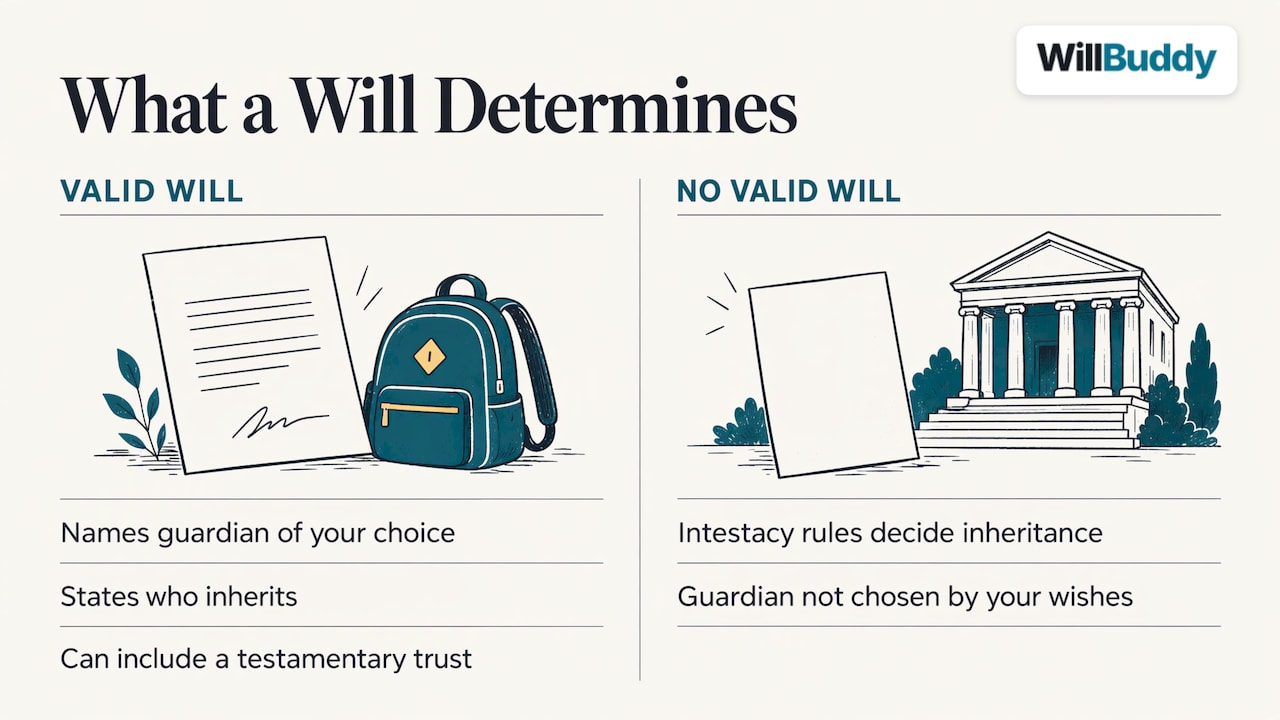
Here is the practical point. A testamentary trust cannot stand alone. It lives inside a will. And a will that names a guardian is the single most useful step for a parent. Without a valid will, your state or territory's intestacy rules decide who inherits, and a guardian is not chosen in the way you would choose.
Many Australians put off a will because it feels like a big legal project. For most people it does not have to be. WillBuddy asks plain questions, one at a time, and drafts a will for your state or territory. You can name guardians for your children, choose executors, list gifts, set out funeral wishes and think about pets. You can then print it and sign it with witnesses, following the signing rules for your state.
You can read every word of your draft free before you pay. After that, Annual Access lets you securely store the will and make up to 50 AI-assisted edits a year, so it can keep up when your family changes. WillBuddy encrypts your personal data and does not sell it.

If your plans later grow to include a trust, you will already have the base will and your wishes written down, which makes a conversation with a lawyer faster and clearer. Our estate planning checklist can help you gather the details.
Signing and keeping your will valid
Whatever you choose, a will only works if it is signed properly. The rules differ a little between states and territories, but the general pattern is the same: you sign in front of two witnesses who are there at the same time, and they sign too. Adults who receive nothing under the will are the safe choice. Our guide to signing a simple will correctly explains it step by step.
Two more habits protect your family:
- Review after big changes. A new child, a separation, a death in the family or a new home are all reasons to update.
- Be clear about gifts. Vague wording causes disputes. See our tips on saving specific gifts in your will.
You also need to be of sound mind when you sign. Our article on testamentary capacity explains what that means.
FAQ
Is a testamentary trust better than a will?
They do different jobs, so one is not better than the other. A will is essential for everyone. A testamentary trust is an optional extra inside a will, useful in some situations such as leaving a large amount to a minor or a vulnerable beneficiary.
Can I have a testamentary trust without a will?
No. A testamentary trust is created by the terms of a will, and it takes effect on death. If there is no will, your estate is shared under your state or territory's intestacy rules, and no testamentary trust exists.
Does a testamentary trust replace a guardian for my children?
No. A trust holds money and property. A guardian is the person who cares for your children. You name a guardian in your will, and you can also arrange for a trustee to manage money for the children's benefit.
What is the downside of a testamentary trust?
It adds drafting cost, a trustee role, record keeping and tax returns, sometimes for many years. Its terms are also set when you die, so they need regular review. These are the reasons to get legal advice if you are considering one.
Do I need a lawyer to make a will?
Not always. Many people with straightforward circumstances prepare their will online, then sign it properly in front of witnesses. Get a lawyer if you have a blended family, a business or a trust, assets overseas, or a likely contest.
Start your will free at willbuddy.com.au and read it before you pay.
Sources
Show the 5 sources
Recommended
For the one who gets things sorted
Now write yours, with your family's names in it
Plain questions about your family, one at a time, and WillBuddy drafts a will for your state. Until you sign one, the law in your state or territory decides who gets what. Read every word free, with no card. You pay only if you want to print it.
Start my will freeLast updated 26 November 2026.
This article is general information only and is not legal advice. It is our best interpretation of the law as at 26 November 2026. WillBuddy is not a law firm, and it never replaces advice from a lawyer or solicitor. Laws change and differ between states and territories, so for your own circumstances, please get legal advice.