Advance Care Directive vs Will: What Each One Does
General information, not legal advice.
On this page
- TL;DR
- The short answer: one is for your life, one is for after it
- Advance care directive and will side by side
- What an advance care directive can decide
- One name, many versions: directives across Australia
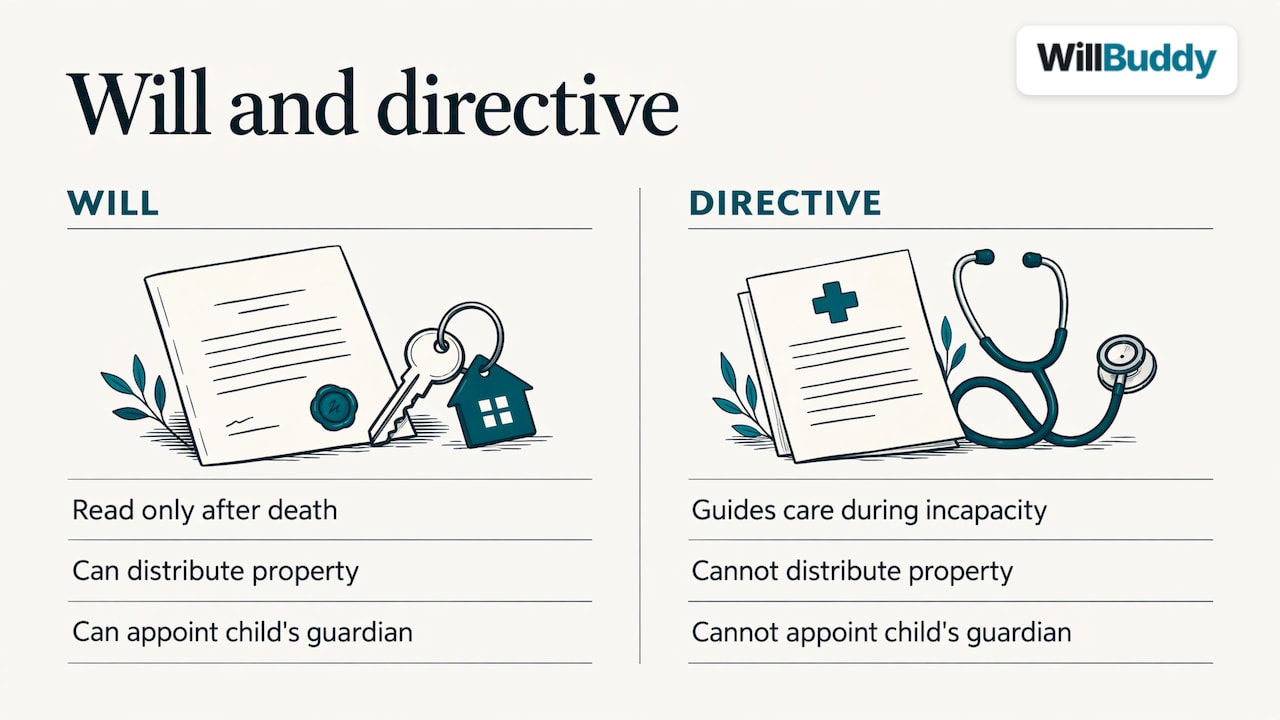
- Why a will cannot do the directive's job
- What a will does that nothing else can
- Making a valid will
- Where WillBuddy fits
- Keeping both documents current
- FAQ
- Sources
- Recommended

Quick answer
An advance care directive and a will do different jobs. An advance care directive records your wishes for health care if you cannot speak for yourself. A will says who gets your assets and who looks after your children after you die. One works during your life, the other only after your death, so one cannot stand in for the other.
If you are a parent, the will is the document that lets you name a guardian for your children. With WillBuddy you answer plain questions one at a time and get a will drafted for your state or territory. You can read every word before you pay.
TL;DR
- A will takes effect after you die. An advance care directive only applies while you are alive and cannot make your own health decisions.
- A will deals with your estate, your executor, your gifts and a guardian for children under 18. An advance care directive deals with treatment you would accept or refuse, and can name a substitute decision-maker.
- Advance care directive law differs in each state and territory, and the name of the document changes too. Check your own state's form and witnessing rules.
- Most adults benefit from having both, plus an enduring power of attorney or guardian, because each covers a different period and subject.
- You can start a will online and read it free before you pay.
The short answer: one is for your life, one is for after it
The Legal Services Commission of South Australia explains the split clearly. A will sets out who inherits your estate and takes effect after death. An advance care directive sets out your wishes for future health care, living arrangements and end-of-life preferences. It only has force when you lack legal capacity, and it has no effect after death.
"Capacity" means you can understand and make a decision for yourself. While you have it, you make your own choices. A directive only speaks for you once you lose it.
That is why people mix the two up. Both are written ahead of time. Both record your wishes. But they answer different questions: "What treatment do I want?" and "Who gets what, and who raises my kids?"
Advance care directive and will side by side
| Advance care directive | Will | |
|---|---|---|
| What it covers | Health care, living arrangements, end-of-life wishes | Assets, gifts, executor, guardian for children, funeral wishes, pets |
| When it applies | Only while you cannot make your own decisions | Only after you die |
| Who carries it out | Your substitute decision-maker, health professionals and family | Your executor |
| Can name a guardian for children? | No | Yes, for children under 18 |
| Law | Differs by state and territory | Differs by state and territory |
| Who can make one | Generally adults with decision-making capacity (some states, such as Victoria, also allow younger people who have capacity) | Generally adults with testamentary capacity |
The Tasmanian Public Trustee draws the same line in its Planning Ahead Guide. An advance care directive records your treatment wishes and does not appoint anyone. Appointing a person to make personal and medical decisions is a separate document, an enduring guardianship.
What an advance care directive can decide
The Australian Government Department of Health says a directive can include your chosen substitute decision-maker, your values and life goals, and the treatments you would accept or refuse for a life-threatening illness or injury. It says health professionals and family must follow a valid directive. Not every part binds in every state, though. In South Australia, for example, a refusal of particular health care is binding, while your other wishes guide decisions without binding anyone.
A few practical points:
- Pick someone you trust. The Department advises a person over 18 who will listen to your values and is comfortable making hard decisions. It also suggests naming an alternate in case the first person is unavailable.
- Talk to them first. A directive is only as useful as the conversation behind it.
- Say what matters to you, not only what you refuse. In most states you can record broad values as well as specific treatment choices. The ACT is narrower: its Health Direction only allows refusal or withdrawal of treatment.
If you have not made a directive, the law in each state decides who speaks for you. In Queensland, for example, a statutory health attorney automatically has authority over health care decisions if you lose capacity and have not made an advance health directive, appointed an attorney for personal matters or had a guardian appointed by QCAT. That is a default. It may not be the person you would have chosen.
One name, many versions: directives across Australia
There is no national law for advance care directives. Advance Care Planning Australia notes that each jurisdiction sets its own rules, and the National Framework notes that the terms vary. The main names in use are:
- ACT: Health Direction
- NSW: advance care directive (recognised at common law, not set out in an Act)
- Northern Territory: Advance Personal Plan
- Queensland: Advance Health Directive
- South Australia: Advance Care Directive
- Tasmania: Advance Care Directive
- Victoria: Advance Care Directive
- Western Australia: Advance Health Directive
Forms commonly ask for your name, address, date of birth, the date, your signature and a witness's signature. Signing and witnessing rules depend on the state or territory, so a form made in one place may not match another's rules. That matters if you move.
Some recent changes show why you should check your own state's current rules:
- Tasmania. Part 5A of the Guardianship and Administration Act 1995 gives a directive the same authority as your own decision when you had ability. Under the 2021 amending Act, a directive can be given in writing, orally or by audio-visual recording.
- South Australia. The Advance Care Directives Act 2013 was amended from 1 March 2024, with further changes from 9 July 2026. A 2024 academic review reports that the 2024 changes allow electronic copies to be relied on if entered in a prescribed electronic record system.
- Nationally. The same review says every jurisdiction now has a default hierarchy of substitute decision-makers, following Northern Territory reforms in July 2024.
Your state health department or guardianship body publishes the current form and witnessing rules for a directive. Use that official form.
Why a will cannot do the directive's job
People sometimes call these documents a "living will". It is a confusing label. The South Australian Commission notes that a power of attorney and an advance care directive are often called a "living will", yet neither distributes your property. It recommends having all three documents (power of attorney, directive and will) so your wishes are respected during life and after death.
The reverse also holds. A will is read only after you die, often days or weeks later. Writing treatment wishes into a will is too late to guide any doctor. And a directive cannot leave your house to anyone or name a guardian for your kids.
If you want to understand the other half of the picture, our guide to power of attorney vs will explains who acts for you while you are alive. A power of attorney handles decisions about money and property, and an enduring guardian handles personal and medical decisions. Moneysmart notes an enduring guardian cannot make financial decisions.
What a will does that nothing else can
For parents, this is the heart of the matter. A will is where you:
- Name an executor, the person who carries out your will.
- Say who receives your assets, including personal items and gifts.
- Record funeral wishes and care for pets.
- Nominate a guardian for children under 18.
The Tasmanian Public Trustee confirms you can nominate a guardian in your will if you have children under 18. It also says that in Tasmania, dying without a will means the estate is distributed under the Intestacy Act 2010, and someone usually has to apply to the Supreme Court for letters of administration. Intestacy means dying without a valid will. Other states have their own intestacy rules.
How guardianship in a will works
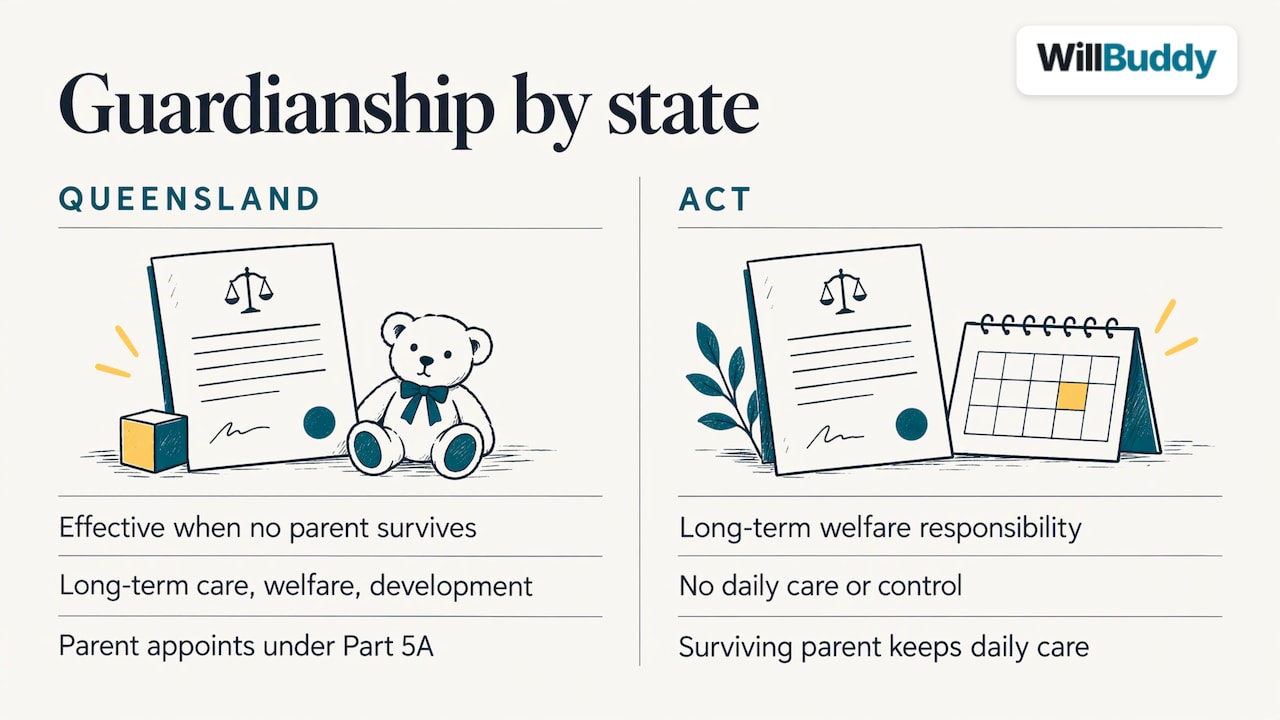
The name and detail vary by state. In Queensland, Part 5A of the Succession Act 1981 lets a parent appoint a testamentary guardian for a child under 18 in their will. If no other parent survives you, the appointment takes effect on your death. If a parent does survive you, it takes effect when the last surviving parent dies, unless your will shows you meant it to start on your death. Once it takes effect, Legal Aid Queensland says a testamentary guardian makes decisions about the child's long-term care, such as education or religion, and shares those duties with any surviving parent. Naming a guardian does not necessarily mean your child will live with that person.
In the ACT, the Testamentary Guardianship Act 1984 gives a testamentary guardian responsibility for the child's long-term welfare, but not the right to the child's daily care and control. If you are thinking of naming a couple together, consider what would happen if they later separated, since shared decisions could become hard.
Two practical tips follow from this. Ask the person before you name them. And name a backup in case your first choice cannot act.
Making a valid will
Formal rules differ by state and territory, so name your state before you start. In South Australia, a will must be in writing, signed by you and witnessed by two adults, ideally people not named in it, according to the Legal Services Commission. In the ACT, the Wills Act 1968 also requires writing and signing before two witnesses present at the same time. A will made by someone under 18 is generally invalid there, unless they are or have been married or in a civil union, or the Supreme Court has authorised it.
You can write a will without a lawyer, and many people with straightforward affairs do. Our guides on making a will in Australia, will requirements and who can witness a will cover the steps. If you are choosing who will carry it out, see how to choose a will executor.
See a lawyer if you have a blended family, a business or trust, assets overseas, or a likely contest. These situations need advice built around your facts.
Where WillBuddy fits
WillBuddy is built for the will side of this pair. You answer plain questions one at a time, and it drafts a will for your state or territory. You can name guardians for your children, choose executors, set out gifts and your estate, and record funeral wishes and pets. You can also name anyone you want to leave out, though that does not stop an eligible person making a claim on your estate.
You can read the whole will free before you pay. Then you print it and sign it with witnesses. The Annual Access plan is $39 a year. It includes up to 50 AI-assisted edits a year and secure, encrypted storage of your will in Australia while your plan is active, which suits families whose lives change. We never sell your data.

This article is general information, not legal advice.
Keeping both documents current
Queensland recommends reviewing your will every 3 to 5 years. Review it sooner after a birth, a separation, a move to another state, or a change in who you would trust as executor or guardian. A directive deserves the same check, especially if you change state, since forms and witnessing rules differ.
Timing matters. Both documents need you to have capacity when you make them. Advance Care Planning Australia says a dementia diagnosis does not rule out planning, and capacity is presumed unless shown otherwise. It also says conversations are best held before or in the early stages of dementia, because capacity becomes less likely as symptoms progress. If capacity is in doubt for you or a parent, speak to your doctor and a lawyer.
Planning ahead also lightens the load for those left behind. When a death does happen, the practical steps follow, and our guides to the after death process and debts after death explain them. Families facing loss may also look for grief support for men in Australia alongside the paperwork.
FAQ
Does a will include my medical wishes?
No. A will only takes effect after you die, so it cannot guide treatment while you are alive. Medical wishes belong in an advance care directive, or the equivalent document in your state or territory. A will can still record funeral wishes.
Can I name a guardian for my children in an advance care directive?
No. An advance care directive records your health care wishes and may name a substitute decision-maker for you. Guardianship of children under 18 is nominated in your will. The detail depends on your state or territory.
Can next of kin make medical decisions for me?
It depends on your state. If you have not appointed anyone, state law sets a default order of substitute decision-makers. In Queensland, a statutory health attorney can act in that situation. Naming your own person in a directive or enduring appointment gives you the say.
Do I need both documents?
They cover different things, so most adults benefit from both. The South Australian Commission recommends a power of attorney, a directive and a will together. Parents in particular should have a will so a guardian is named.
Can I write my own will without a lawyer?
Yes, if you follow your state's formal rules, such as writing it down, signing it and having it witnessed correctly. Get legal advice if you have a blended family, a business or trust, assets overseas, or expect a contest.
Sources
Show the 15 sources
- Wills and Estates Law Factsheet Series, Legal Services Commission of South Australia
- Planning Ahead Guide, Tasmanian Public Trustee
- Advance care directive, Australian Government Department of Health
- Wills and estate planning, Queensland Government
- Developments in Advance Care Planning in Australia, Journal of Bioethical Inquiry, 2024
- National framework for advance care planning documents, Department of Health, May 2021
- Advance Care Planning: Aged Care Implementation Guide, Advance Care Planning Australia
- Guardianship and Administration Act 1995 (Tas)
- Guardianship and Administration Amendment (Advance Care Directives) Act 2021 (Tas)
- Advance Care Directives Act 2013 (SA)
- Succession Act 1981 (Qld)
- Who will look after my children if I die?, Legal Aid Queensland
- Testamentary Guardianship Act 1984 (ACT)
- Wills Act 1968 (ACT)
- Wills and powers of attorney, Moneysmart
Start your will free at willbuddy.com.au and read it before you pay.
Recommended
For the one who gets things sorted
Now write yours, with your family's names in it
Plain questions about your family, one at a time, and WillBuddy drafts a will for your state. Until you sign one, the law in your state or territory decides who gets what. Read every word free, with no card. You pay only if you want to print it.
Start my will freeLast updated 28 November 2026.
This article is general information only and is not legal advice. It is our best interpretation of the law as at 28 November 2026. WillBuddy is not a law firm, and it never replaces advice from a lawyer or solicitor. Laws change and differ between states and territories, so for your own circumstances, please get legal advice.