Why a Will Can Be Invalid in Australia
General information, not legal advice.
On this page
- TL;DR
- What "invalid" actually means
- Reason 1: The signing rules were not followed
- Reason 2: Lack of testamentary capacity
- Reason 3: You did not know and approve the contents
- Reason 4: Undue influence, fraud and forgery
- Reason 5: The will was revoked or replaced
- Reason 6: Changes made after signing
- When a court can rescue an informal will
- A valid will can still be challenged
- Quick checklist: is my will likely to be valid?
- When to see a lawyer
- How WillBuddy helps you avoid these mistakes
- FAQ
- Sources
- Recommended

Quick answer
A will is usually invalid for one of five reasons: it was not properly signed and witnessed, the person lacked mental capacity, they did not know and approve what it said, someone pressured them, or the document was forged or later revoked or messed up. Most of these are avoidable. This guide explains each reason in plain words, names the state where the rules differ, and shows what you can do now to protect your family.
This is general information only, not legal advice. Wills law is set by each state and territory.
TL;DR
- The most common failure is the signing: a will must be in writing, signed, and witnessed by two witnesses present at the same time. Use adults.
- A will can also fail if the person lacked capacity, did not understand what they signed, or was pressured or tricked.
- Scribbled changes, crossed-out lines and stapled notes on a signed will can cause trouble later.
- Courts in some states can accept an informal document, but that means an expensive Supreme Court application.
- A valid will can still face a claim from family members who say it left them too little.
What "invalid" actually means
An invalid will is one a court will not accept as your last will. It might fail on paper, because the signing rules were not followed. Or it might fail on the facts, because of what was going on in your head or around you when you made it.
The result is the same. If no valid will is left, your estate is divided under your state's intestacy rules. The rules are fixed by law and may not reflect what you wanted, including who looks after your children and who acts as executor. Our guide to dying without a will in Australia covers how each state splits an estate.
Invalid also does not mean the whole will is lost in every case. Sometimes a court strikes out one part, or rules that an earlier will stands. The details depend on what went wrong.
Reason 1: The signing rules were not followed
This is the most common and the easiest to prevent. Victoria Legal Aid says a valid will must be in writing and signed in front of two or more witnesses, who must also sign it. State laws add that the witnesses must be present at the same time when you sign, as in section 10 of the Succession Act 1981 (Qld) and section 8 of the Wills Act 2008 (Tas).
In practice, these are the mistakes that cause trouble:
- Only one witness, or a witness who signs later without seeing you sign.
- Witnesses in another room. Both must be present when you sign, or when you acknowledge your signature to them.
- Signing in the wrong place. Sign at the end of the will. In South Australia, the will must be signed by the person making it, or by another person in their presence and at their direction, and it must appear that the signature was meant to give effect to the will. Signing at the end makes that clear.
- Witnesses who are very young or who cannot understand what they are doing. The Acts we checked set no minimum age, but adults are the safer choice.
- An unsigned draft left on a computer or in a drawer.
The rules on who can witness differ by state. In South Australia, for example, a beneficiary or their spouse can legally witness, although this is strongly discouraged because it invites conflict. Other states treat a gift to a witness differently. In Queensland and Tasmania, a gift to a witness can be void unless an exception applies (section 11 of the Succession Act 1981 (Qld); section 12 of the Wills Act 2008 (Tas)). Check your own state before you sign. Our page on who can witness a will in Australia sets out the state rules, and there is a state-by-state table too.
A simple signing routine
- Print the whole will. Do not sign a loose last page.
- Gather two adult witnesses who are not beneficiaries, and who can see you.
- Sign in front of both, using the same pen if you can.
- Each witness signs while you and the other witness are watching.
- Date it, and store the original somewhere safe that your executor knows about.
There is a fuller walk-through in the correct witnessing process, step by step.
Reason 2: Lack of testamentary capacity
To make a will, you must understand what a will is and what you own. You must also know who your family members are and who might expect something from you. This is called testamentary capacity.
The South Australian Legal Services Commission lists lack of capacity as a reason a will can be challenged. Dementia, mental illness and cognitive impairment are common claims.
Two points are worth knowing:
- A diagnosis alone does not make a will invalid. What matters is your understanding at the moment you made the will.
- Researchers note that vulnerability often peaks during illness, bereavement or decline, which is often when people rush to make a will.
If you have any health condition that affects memory or thinking, make the will early and keep records of how you decided. Our guide to testamentary capacity in Australia explains what courts look for.
Reason 3: You did not know and approve the contents
A will is not just a signature. The person making it must know what is in it and approve of it. This can fail if someone was blind, could not read English well, or signed a document that was never explained.
This is one reason to use plain questions and to read your will in full before you sign. If you speak another language at home, ask a trusted, independent person to go through it with you, and note that they did so. Do not use a person who gains from the will.
Reason 4: Undue influence, fraud and forgery
Undue influence means someone pressured you so much that the will no longer reflects your own wishes. Fraud means you were tricked. Forgery means the signature or document is fake. The NSW Supreme Court explains that probate is granted on the basis that the will is valid and shows the person's last intentions, and sets out how to challenge that.
Undue influence is hard to prove. It is more than advice or persuasion. It is usually raised where an older or unwell person depended on someone, often a carer or a family member who helped arrange the will.
You can lower the risk:
- Make the will yourself, in your own time, and keep your own copy.
- Do not let a person who benefits sit in on the process.
- Keep a short note of why you made big choices, such as leaving someone out.
- Choose witnesses who are independent.
If you want to know what evidence matters, see undue influence and the evidence to save.
Reason 5: The will was revoked or replaced
A will can be invalid because it is no longer your last will. A newer valid will usually replaces an older one. The SA Legal Services Commission also lists revocation and unclear or ambiguous contents as reasons a will can fail.
A few practical rules follow:
- If you make a new will, say clearly that it replaces all earlier wills.
- Do not leave old copies lying around with your papers.
- Review your will after major life events such as marriage, separation, divorce, a new child or a death in the family. State laws on how these events affect a will differ, so check your state's rules.
Reason 6: Changes made after signing
This one catches people out. You sign the will, then decide to change a name. You cross something out, write in the margin or clip on a note.
Unwitnessed changes can create doubt. The South Australian Law Handbook notes that marks on a will can cause the Registrar of Probates to ask for an affidavit to explain them, or lead to a court challenge to prove the document is genuine.
The safer approach is to make a fresh, fully signed and witnessed will, or a properly executed codicil. Do not write on the original. Do not remove staples either, as that can raise questions about whether pages were swapped.
When a court can rescue an informal will
Some courts can accept a document that missed the signing rules. This is called the dispensing power. In Queensland, section 18 of the Succession Act 1981 allows a court to treat a document as a will if it is satisfied the person intended it to be their will. The NSW Supreme Court deals with these applications in that state.
Tasmania's version is stricter. Under section 10 of the Wills Act 2008 (Tas), the court must be satisfied beyond reasonable doubt.
Do not rely on this. It means going to the Supreme Court, which takes time and costs money, and your family carries the stress while it plays out. The safer path is to follow the signing rules the first time. Our page on why strict compliance beats the court goes deeper.
A valid will can still be challenged
Validity is one question. Fairness is another. In Australia, you are free to choose who gets your estate, but that freedom has limits. A spouse, child or other eligible person may make a family provision claim if they say the will did not provide enough for them. Legal Aid NSW describes this as an application to the Supreme Court for a share, or a larger share, of the estate.
The SA Legal Services Commission also says you cannot stop someone contesting your will after you die. You can only make a challenge less likely to succeed, and a clear, properly made will helps.
Time limits differ by state
For a family provision claim, Legal Aid NSW says the limit in NSW is 12 months from the date of death. In Queensland it is 9 months after the death (section 41(8) of the Succession Act 1981 (Qld)). In South Australia, Victoria, Western Australia and the ACT, the clock runs from the date probate is granted, according to one state-by-state guide. Missing the trigger date can bar a claim for good. If you think you may have a claim, see a lawyer in your state quickly.
Quick checklist: is my will likely to be valid?
| Question | What to check |
|---|---|
| Is it in writing? | Typed or handwritten, on paper, as the original. |
| Did I sign it? | At the end, in front of both witnesses. |
| Are there two adult witnesses? | Both present at the same time, and independent of the will. |
| Did I understand it? | I know my assets, my family and what the will does. |
| Did I choose freely? | Nobody pressured me or controlled the process. |
| Is it my latest will? | Older wills are replaced or destroyed. |
| Is it clean? | No scribbles, crossings-out or attached notes. |
| Does it provide for dependants? | Consider whether anyone could claim it is unfair. |
When to see a lawyer
An online will suits many people with simple affairs. Speak to a lawyer in your state if any of these apply:
- You are in a blended family, or have children from more than one relationship.
- You own a business or have a trust.
- You have assets overseas.
- You think someone is likely to contest your will.
- You have doubts about your capacity, or someone else's influence over you.
The SA Legal Services Commission says having a will prepared by a lawyer reduces the chance of a successful challenge. In the situations above, that advice is worth taking.
How WillBuddy helps you avoid these mistakes
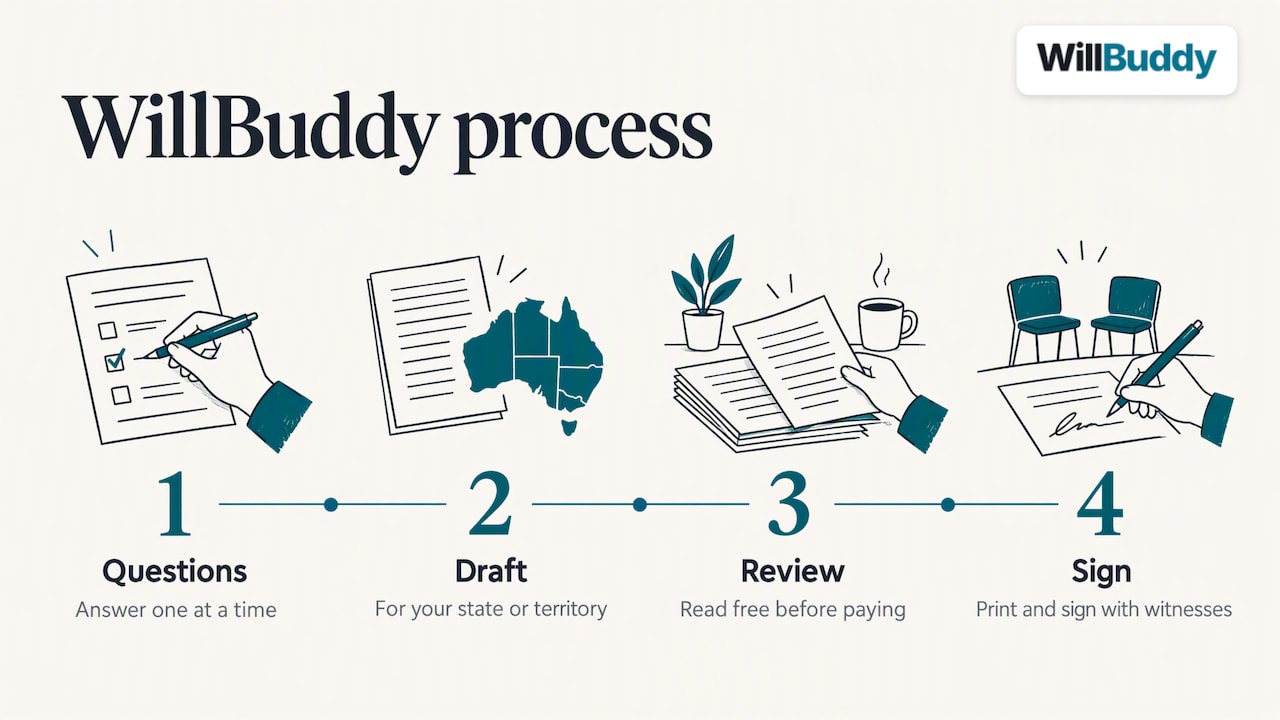
WillBuddy asks you plain questions, one at a time, and drafts a will for your state or territory. You can read every word free before you pay. Then you print it and sign it with your witnesses, following the steps for your state. That means you see what the will says before you commit, which goes to the "knowing and approving" point above.
You can name guardians for your children, choose executors, set out gifts and funeral wishes, and cover pets. Because life changes, you can also update your will with up to 50 AI-assisted edits a year, rather than writing on the original. See the pricing page for the current cost of Annual Access. Read more on our will requirements guide if you want the full list of formalities.
WillBuddy does not give legal advice, and it does not replace a lawyer where your situation is complex.
FAQ
What makes a will invalid in Australia?
The main causes are missing signing and witnessing rules, lack of capacity, not knowing or approving the contents, undue influence, fraud or forgery, and revocation by a later will. Messy changes made after signing can also cause doubt. The exact rules depend on your state or territory.
What happens if a will is declared invalid?
If no earlier valid will exists, the estate is divided under your state's intestacy rules. These are fixed by law and may not match your wishes, including who looks after your children. A court may still be asked to accept an informal document in some states.
Who can contest a will in Australia?
People with a legal interest in the estate can challenge validity, such as beneficiaries under an earlier will or people who would inherit on intestacy. Eligible family members can also make a family provision claim, even where the will is valid. Eligibility and time limits differ by state.
Can I fix a will after I have signed it?
Do not write on or mark the signed original. Make a new signed and witnessed will, or a properly executed codicil, so the change is clear and cannot be questioned later.
Can a beneficiary witness my will?
It depends on your state. In South Australia, a beneficiary or their spouse can witness, but it is strongly discouraged. The safest choice everywhere is two independent adults who gain nothing from the will.
Sources
Show the 11 sources
- Making a valid Will, Victoria Legal Aid
- Valid wills, South Australian Law Handbook
- Signing and witnessing a will, South Australian Law Handbook
- Who can contest my will?, Legal Services Commission of South Australia
- Safeguarding legal capacity in the context of electronic wills, QUT ePrints
- Contested proceedings, Supreme Court of NSW
- Applying for a grant of probate, Supreme Court of NSW
- Succession Act 1981 (Qld)
- Wills Act 2008 (Tas)
- Family provision claims, Legal Aid NSW
- Wills and Probate in Australia: A Guide by State and Territory, Recording Law
Start your will free at willbuddy.com.au and read it before you pay.
Recommended
For the one who gets things sorted
Now write yours, with your family's names in it
Plain questions about your family, one at a time, and WillBuddy drafts a will for your state. Until you sign one, the law in your state or territory decides who gets what. Read every word free, with no card. You pay only if you want to print it.
Start my will freeLast updated 23 October 2026.
This article is general information only and is not legal advice. It is our best interpretation of the law as at 23 October 2026. WillBuddy is not a law firm, and it never replaces advice from a lawyer or solicitor. Laws change and differ between states and territories, so for your own circumstances, please get legal advice.