8 Steps to a Valid Will in Australia Without a Lawyer
Make a valid will in Australia in 8 steps: who can make one, the signing and witnessing rules, and how solicitors, Public Trustees, kits and online services compare.

Yes, you can make a valid will in Australia without a lawyer. A solicitor is the safest route for complex estates, a Public Trustee may prepare your will if you are eligible, and a will kit or online service can suit a straightforward estate. The legal essentials are age (generally 18 or older), testamentary capacity, a written document, your signature and two witnesses who are present together when you sign.
TL;DR:
- A solicitor is the safer choice for complex estates, while kits and online services suit straightforward situations.
- Every state and territory requires a will to be in writing and signed in front of two witnesses present at the same time. Using witnesses who receive nothing under the will is best practice, and in some states a witness's own gift can be void.
- Superannuation is not automatically covered by your will: you nominate beneficiaries through your fund, and lapsing binding nominations generally expire after three years.
- Dying without a will (intestate) means your estate is shared by a fixed legal formula, which may not reflect your wishes.
- Regularly reviewing and securely storing your will, especially after major life events, helps keep it current and easy to find.
What makes a will legally valid in Australia
A valid will rests on a handful of formal requirements that apply across every state and territory, though the fine print differs locally. You generally need to be 18 or older and have testamentary capacity, meaning you understand what a will does, roughly what you own and who has a reasonable claim on your estate. Most states and territories allow limited exceptions for a younger person (for example, if they are married or have a court's approval); Western Australia has no such exception.
Service Victoria confirms that anyone over 18 with legal capacity can make a will, that a person under 18 can if they are married or with the court's consent, and that you can use a guided online platform or work with a professional.
The formal signing requirements are consistent nationally in substance:
- The will must be in writing, whether typed or handwritten.
- You sign it (or acknowledge your signature) in front of two witnesses who are present at the same time. Use adults, and date the will too: the Acts don't require a date, but an undated will can mean extra paperwork later.
- Each witness then signs in your presence (in the ACT, in each other's presence too). Choose witnesses who receive nothing under the will and aren't a beneficiary's partner: in NSW, Queensland, Tasmania and the NT a gift to a beneficiary who witnesses can be void unless an exception applies.
- Review your will after major life events: Moneysmart suggests updating it if you marry, divorce or separate, or have children.
If a will isn't signed or witnessed correctly, the Supreme Court in every state and territory can still accept a document as a will if it is satisfied the person intended it to be their will (the "dispensing power"), but that means a court application with no guarantee of success. Separately, a court can authorise a "statutory will" for someone who lacks testamentary capacity. Both are specialised court processes, not a DIY option.
Ways to make a will: solicitor, Public Trustee, online services and DIY kits
Your choice of route should match the complexity of your estate and your appetite for risk. Four main paths exist in Australia, each with different costs and trade-offs.
- Solicitors suit complex estates, blended families or anyone worried about a challenge to their will; a private lawyer can give personal advice and assess and record your capacity. The Legal Services Commission of South Australia says private lawyers may charge anything from $300 to $3,000 or more, depending on your needs.
- Public Trustees prepare wills for eligible people, often on the condition that the Public Trustee is named as executor. NSW Trustee and Guardian charges $462 for a standard will, and its will preparation is free for people eligible for a full Centrelink age pension; eligibility and fees differ between states.
- Online services and will kits usually cost less than a solicitor (kits usually cost less than $50), but they can't give personal legal advice, so they suit straightforward situations better than complex ones.
- Will kits sold at post offices are legal to use, but the Legal Services Commission of South Australia notes that a kit can't assess your capacity or give personal advice, and that an error may make your will invalid or have unintended consequences.
For a deeper breakdown of what these routes cost, see our guides to what a lawyer-drafted will costs and will kits in Australia.
Step-by-step checklist to create a simple, valid will today
Making a will doesn't need to be complicated if your estate is straightforward. Work through these steps in order.
- List your assets and debts, including property, savings, vehicles, and anything owed, so you know what you're actually distributing.
- Decide your beneficiaries and any specific gifts you want to leave to particular people.
- Choose an executor and at least one backup, someone willing and able to administer your estate.
- Nominate guardians for children if you have any under 18, naming a backup guardian too.
- Get professional advice before adding trusts or unusual clauses, since these carry formal requirements of their own.
- Draft the document through your chosen route (a solicitor, a Public Trustee, a kit or an online service) and read it back for clarity.
- Sign and date the will in front of two adult witnesses who are both present, and have each of them sign in your presence. Use witnesses who receive nothing under the will (and aren't a beneficiary's partner). Initialling each page isn't legally required, but it is good practice.
- Store the signed original somewhere secure and tell your executor exactly where it is, keeping any dated draft copies separately.
Pro Tip: Write a short letter of wishes alongside your will covering funeral preferences and sentimental items; it's not legally binding, but it spares your family guesswork.
Our full step-by-step guide to making a will in Australia covers state-specific checklists if you want more detail before you start.
Superannuation, life insurance and assets your will doesn't cover
Superannuation, including any life insurance held through your super, doesn't automatically form part of your estate, so your will alone won't direct where it goes. Moneysmart explains that you need to tell your super fund who should receive your super and any life insurance.
- Binding death benefit nominations must be completed exactly as your fund's form requires (including any witnessing), and lapsing nominations generally expire after three years unless renewed; some funds offer non-lapsing nominations.
- Without a valid binding nomination, your fund's trustee decides who receives your super (within the rules of super law), which may not match your wishes.
- Check your fund's specific nomination process, since forms and the rules on when a nomination stops being valid vary between funds.
- Record the date and location of every nomination alongside your will so your executor can check they're current.
Our guide to superannuation and your will in Australia covers how to line up your nominations with your broader estate plan.
Updating, revoking and storing your will safely
Treat your will as a document that needs occasional attention rather than something you sign once and forget. Marriage, divorce, the birth of a child, buying property or moving interstate are all good reasons to review it. In every state and territory, getting married generally revokes an existing will unless it was made in contemplation of that marriage (some states require the will to say so), and divorce generally cancels gifts to your former spouse and their appointment as executor (in Western Australia, divorce revokes the whole will unless it shows a contrary intention).
- The cleanest way to replace an old will is a new will that revokes it. Don't cross out or add to the signed original: a change made after signing generally has no effect unless it is itself signed and witnessed like a will.
- Codicils, formal amendments to an existing will, must be signed and witnessed in the same way as a will, and they are easy to get wrong.
- Public Trustees and solicitors often offer safe custody for original wills: the NT Public Trustee stores wills for free, while NSW Trustee and Guardian's WillSafe service starts from $29.
- A bank safe deposit box is secure but can be harder for an executor to access quickly, while a home safe is convenient but riskier in a fire or flood.
Our article on updating or changing a will in Australia walks through revocation and codicils in more depth.
Common mistakes that can invalidate a will or invite a challenge
Small drafting and signing errors can lead to disputes and court applications. Watch for these.
- Unnumbered or uninitialled pages can leave room to argue that a page was swapped or is missing.
- Witnesses who are also beneficiaries can lose their own gift in NSW, Queensland, Tasmania and the NT unless an exception applies (in Victoria, South Australia and the ACT the gift is not void, and Western Australia's Act has no rule voiding it). The rest of the will stands either way.
- Ambiguous clauses about who gets what, or vague descriptions of assets, invite interpretation disputes.
- Sudden or unusual gifts made late in life can trigger claims of undue influence, particularly without independent legal advice on record.
Pro Tip: Keep a brief written note of your reasoning whenever you make a major or unusual change to your will; it can help an executor explain your intent if anyone questions it later.
The Legal Services Commission of South Australia points out that a private lawyer can assess and record your capacity and check that you are acting voluntarily, and that a lawyer-prepared will offers the best protection against a successful challenge.
How a will affects tax and estate duties in Australia
There are no inheritance or estate taxes in Australia, so beneficiaries generally don't pay tax simply for receiving money or property under a will. That said, tax consequences can still follow an estate in specific situations.
Capital gains tax generally doesn't apply when an asset passes to a beneficiary, but it can apply when an asset like an investment property or shares is later sold, depending on when the asset was acquired and whether an exemption applies. Superannuation death benefits can also attract tax depending on who receives them and whether they were a dependant of the person who died under tax law, which is one more reason to keep your binding nomination current alongside your will.
The estate can also keep earning income, such as rent or interest, before it is finalised, and the executor may need to lodge tax returns for the estate. None of this changes the basic legal requirements for making a valid will, but it's worth flagging to your executor or solicitor if your estate includes investment property, overseas assets or a self-managed super fund, since these situations often benefit from specific professional advice rather than a generic template.
The role and duties of an executor
An executor is the person legally responsible for carrying out the instructions in your will, and the role carries real obligations rather than being a symbolic honour. Choosing someone who is organised, trustworthy and willing to take on administrative work matters more than choosing the person you're closest to.
Typical executor duties include locating the will, notifying beneficiaries, applying for probate where required, valuing the estate, paying creditors, lodging tax returns and distributing the estate according to the will. Executors also deal with banks, super funds and other institutions, and may need to keep the estate running for months while these steps play out.
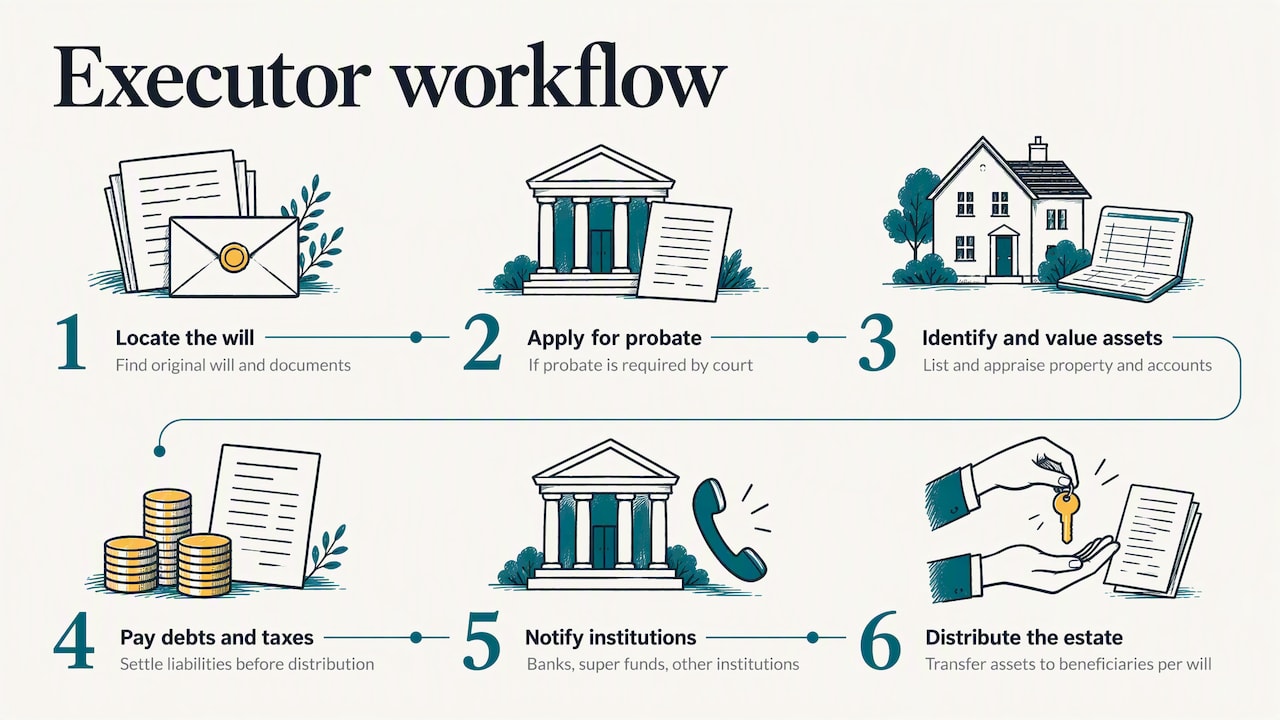
Because the role can take considerable time and carries legal responsibility, it's worth naming at least one backup executor in case your first choice is unable or unwilling to act, or dies before you. Some people choose a professional executor such as a solicitor or Public Trustee for complex estates, which shifts the administrative burden off family members during an already difficult time.
Special considerations for blended families and second marriages
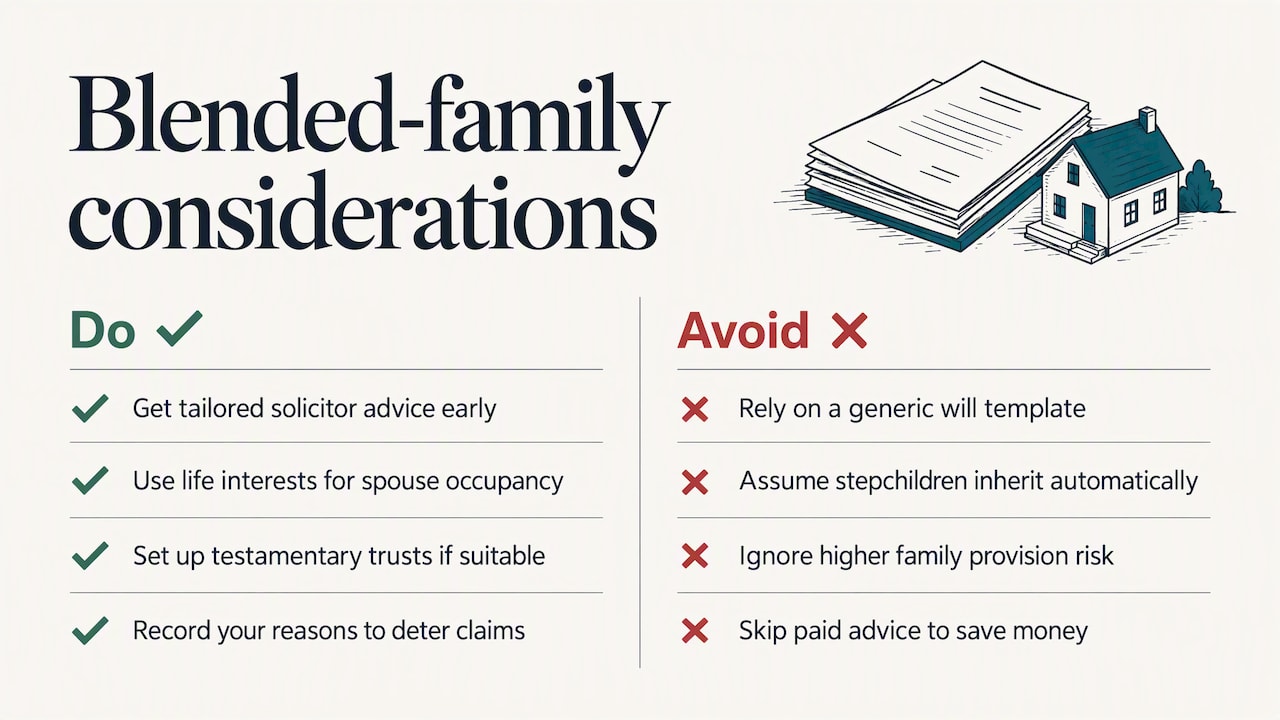
Blended families and second marriages raise estate planning questions that a simple will template may not handle well. Common situations include wanting to provide for a current spouse while also ensuring children from an earlier relationship inherit a fair share, or providing for stepchildren, who aren't always treated the same as biological or adopted children under the law (and the rules differ between states).
These situations carry a higher risk of a family provision claim, where an eligible person, such as a partner or child, asks the court for a larger share of the estate after your death. A solicitor can explain who may be able to claim in your state and help you structure the will and record the reasons for your decisions.
Options worth discussing with a solicitor include life interests, where a current spouse can live in the family home for life before it passes to children, or testamentary trusts that separate control of assets from entitlement to them over time. If your family situation is anything other than straightforward, this is one of the clearer cases where paying for tailored advice is worth the extra cost over a generic kit.
What happens if you die without a will in Australia
Dying without a valid will means your estate is distributed under intestacy rules, a fixed legal formula that varies between states and territories but generally favours a partner and children. You don't get to choose who receives what, and the formula can produce outcomes you wouldn't have picked yourself, particularly in blended families or de facto relationships.
There is also no executor you chose: someone (often a close family member) has to apply to the court for letters of administration to manage the estate, which can add time and cost. You also won't have named a guardian for your children. A surviving parent generally keeps parental responsibility, but if neither parent can care for them, a court may need to decide who does, which is one of the strongest practical reasons to put a will in place even when your estate is modest.
Without a will setting out your wishes, sorting out the estate may take more time and money than following a clear, valid will.
Where guided online drafting fits the landscape
Guided online drafting suits people with straightforward estates, a clear idea of their beneficiaries and executors, and a preference for a will they can keep current as life changes. With WillBuddy, your answers about your family and property become a will drafted for your state or territory, you read the whole will before you pay, and changes you ask for in plain English are saved as new versions.
Where an estate involves blended families, significant assets, overseas property or any doubt about capacity, a solicitor or Public Trustee remains the safer choice.
Get started with WillBuddy
If your estate is straightforward, it makes sense to match the cost of drafting to the complexity of your situation. With WillBuddy you answer plain questions about your family and property, your answers become a will drafted for your state or territory, and you can read your complete will before you pay anything.

The plan is $39 AUD a year to print, sign and keep your will current. It includes 50 AI edits a year, asked for in plain English, and every change is saved as a new version, so your will can keep pace with life changes without starting from scratch. Once you've signed it in front of two witnesses, you can upload the signed copy and we keep it encrypted. We never sell your personal data, and WillBuddy works in all eight Australian states and territories. WillBuddy is not a law firm and doesn't give legal advice, and your will is valid only once it is signed and witnessed correctly.
If a straightforward estate and ongoing flexibility sound like what you need, check the Annual Access plan for pricing, or start your will on the WillBuddy homepage and read it before you commit to anything.
This article is general information, not a substitute for advice from a qualified lawyer. Consult a qualified legal professional about your own circumstances before acting on anything here.
FAQ
Do you need a lawyer to make a will in Australia?
No. No Australian state or territory requires a lawyer to make a will; what matters is that it is in writing and signed and witnessed correctly. Legal advice is worth considering for complex estates, blended families, or where your capacity or a challenge to the will could be an issue.
How much does it cost to make a will in Australia?
Costs vary by route. Do-it-yourself will kits usually cost less than $50, NSW Trustee and Guardian charges $462 for a standard will (free for people eligible for a full Centrelink age pension), and private lawyers may charge from $300 to $3,000 or more depending on your needs. WillBuddy is $39 AUD a year, and you can read your whole will before you pay.
Can I write my own will in Australia?
Yes. Your will must be in writing and signed by you in front of two witnesses who are present at the same time, and each witness then signs it in your presence. Use witnesses who receive nothing under the will: in NSW, Queensland, Tasmania and the NT a gift to a witness can be void. Government guidance recommends having a do-it-yourself will checked by a professional, such as a solicitor or Public Trustee.
Is a will kit from the post office legal?
Yes. A will made with a kit can be valid, as long as it is signed and witnessed according to your state's rules. Kits can't give personal legal advice, and the Legal Services Commission of South Australia warns that an error in a home-made will may make it invalid or have unintended consequences, so a professional check is worth considering.
Sources
- NSW Trustee and Guardian fees | NSW Government
- Learn about Wills | NSW Government
- Making a will and getting legal help factsheet | Legal Services Commission SA
- Make a will | NT Government
- Make a will | Service Victoria
- Make a Will: Public Trustee | WA Government
- Wills and powers of attorney | Moneysmart
- Who gets your super if you die | Moneysmart
- If you are a beneficiary of a deceased estate | Australian Taxation Office
- Legislation: Wills Act 1997 (Vic), Succession Act 2006 (NSW), Succession Act 1981 (Qld), Wills Act 1970 (WA), Succession Act 2023 (SA), Wills Act 2008 (Tas), Wills Act 1968 (ACT), Wills Act 2000 (NT)
Recommended
- How to Make a Will in Australia 2025: Complete Step-by-Step Guide
- Will Requirements in Australia: Complete Legal Guide to Valid Wills 2025
- How to Update or Change Your Will Australia: Complete Step-by-Step Guide 2025
- Will Kits Australia: Complete Guide to DIY Wills, Legal Validity & Better Alternatives 2025
Ready when you are
Make your will for your state
WillBuddy guides you through a will designed for your state or territory. It is free to try, and you only pay when you are ready to finalise.
Last updated 5 October 2026.
This article is general information only and is not legal advice. It is our best interpretation of the law as at 5 October 2026. WillBuddy is not a law firm, and it never replaces advice from a lawyer or solicitor. Laws change and differ between states and territories, so for your own circumstances, please get legal advice.