Testamentary Capacity in Australia: What Courts Look For and 5 Steps
General information, not legal advice.
On this page
- The legal test for testamentary capacity
- How testamentary capacity is assessed and evidenced
- Court-made and statutory wills when capacity is lacking
- Challenging a will because of lack of capacity
- Practical steps to reduce the risk of a later challenge
- When to get legal help and next steps for families
- Common mental health conditions affecting testamentary capacity
- How testamentary capacity differs from other legal capacities
- Undue influence and coercion around testamentary capacity
- Case studies or examples illustrating testamentary capacity disputes
- How WillBuddy can help you draft a state-based will
- FAQ
- Sources
- Primary laws and authoritative guides
- Recommended
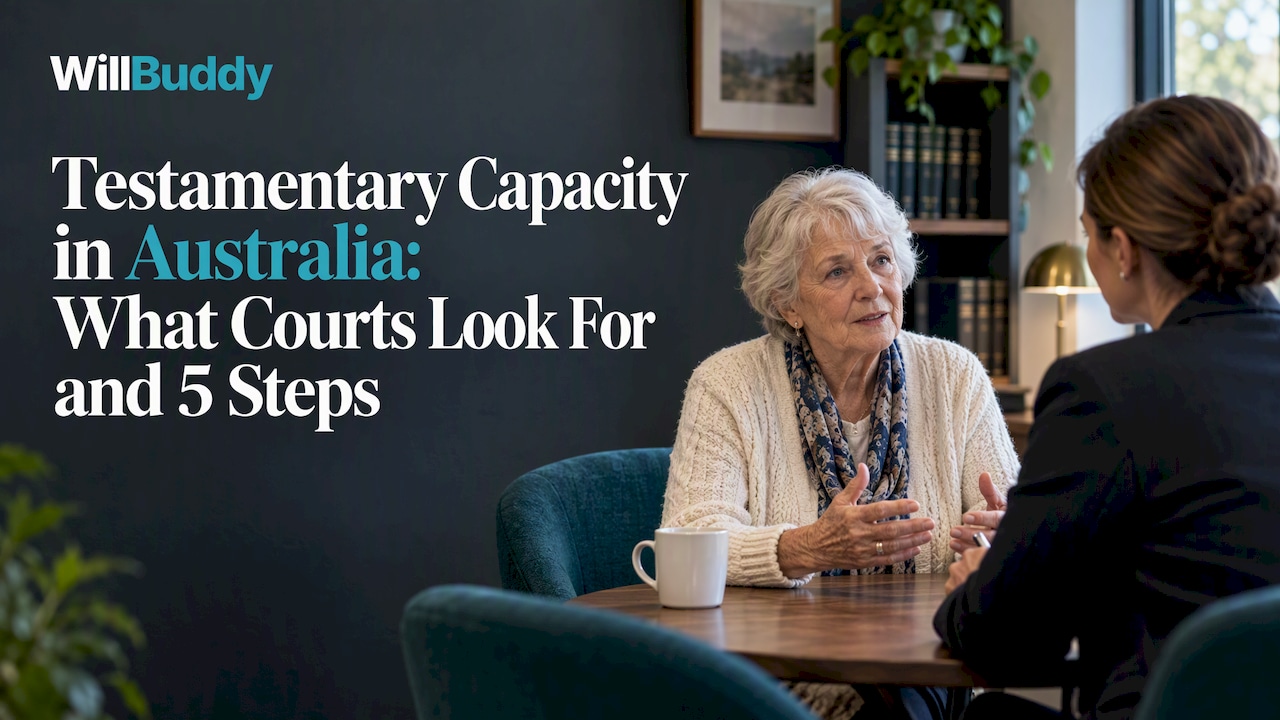
Quick answer
Testamentary capacity means knowing what a will is, roughly what you own, and who should reasonably share in it. Australian law sets a specific legal test for this, drawn from a 19th century case that still governs how courts assess capacity today. When someone lacks capacity, the Supreme Court can authorise a will to be made or altered on their behalf through a statutory will order.
In short
- Evidence of capacity is most credible when gathered at the time of signing, including solicitor notes, medical assessments, and witness testimonies.
- A person can have full testamentary capacity despite eccentric or harsh choices, as long as they understand what they are doing and why.
- Courts may approve a court-made or statutory will if the person lacked capacity but the proposed will reflects their likely wishes, based on extensive evidence.
- Recent diagnoses, sudden new beneficiaries, or signs of confusion can raise a real doubt about capacity at signing, which the person defending the will must then answer.
- Proper witnessing, contemporary explanation, and documented reasons for major changes are critical steps to prevent future disputes.
The legal test for testamentary capacity
Australian courts apply the test from Banks v Goodfellow (1870), restated in modern terms by the NSW Court of Appeal in Carr v Homersham [2018] NSWCA 65. To have testamentary capacity, a person must:
- Understand the nature of making a will and what it does
- Understand, roughly, the extent of the property they are disposing of
- Comprehend who has a reasonable moral claim to benefit, and weigh those claims without being disturbed by a delusion
A delusion only defeats capacity if it actually shapes the decision about who gets what. Someone can make eccentric or even harsh choices, such as cutting out an adult child, and still have full capacity. The test asks whether the person understood what they were doing and why, not whether a court agrees with the outcome.
How testamentary capacity is assessed and evidenced
Capacity is rarely tested at the time a will is signed. It usually becomes an issue later, when someone challenges the will after the will-maker has died. That is why the evidence gathered at the time of signing matters so much.
Several people can contribute evidence of capacity:
- The solicitor drafting the will, who takes instructions, observes the person's understanding and keeps file notes of the conversation
- A GP or specialist, who can provide a medical certificate or a more detailed capacity assessment if there is any doubt
- Witnesses to the signing, who can later confirm the person appeared to understand what they were doing
A best practice guide for legal practitioners sets out how solicitors can assess a client's capacity. In practice, a solicitor who goes through the will with the will-maker, discusses what it does, and keeps detailed notes made at the time creates evidence that can carry a lot of weight if the will is later disputed.
Where there is any doubt about a person's cognitive state, for example after a dementia diagnosis or a recent hospital stay, it is worth getting a specialist capacity assessment and, where possible, a sworn affidavit from the assessing practitioner.
Pro Tip: Ask your solicitor to keep a dated file note of the exact words used when you explained your reasons for any unusual gift or exclusion.
Court-made and statutory wills when capacity is lacking
When someone has already lost testamentary capacity and has no valid will, or needs one updated, they cannot simply sign a new one. Instead, a family member or other interested person can apply to the Supreme Court for a statutory will.
Under the Succession Act 2006 (NSW), sections 18 to 22, and equivalent provisions in other states and territories (in South Australia, section 7 of the Succession Act 2023), the court can authorise a will to be made, altered or revoked for a person who lacks capacity, provided that person is still alive when the order is made. The court must be satisfied that the proposed will reflects what the person would likely have wanted.
To support an application, the court typically expects:
- A draft of the proposed will
- Evidence of the person's prior wishes, relationships and likely intentions
- An estimate of the size and nature of the estate
- Medical evidence confirming the lack of capacity
Statutory will applications are legally complex and almost always require a lawyer with succession law experience. Families should expect the process to take some time, with costs that may be significant unless the estate is small and the facts are straightforward.
Challenging a will because of lack of capacity
A will can be challenged on several grounds: lack of testamentary capacity, undue influence, or lack of knowledge and approval of its contents. These grounds often overlap in practice, particularly where a vulnerable person made late changes to a long-standing will.
A will that looks rational and was properly signed and witnessed is generally presumed to have been made by someone with capacity who knew and approved its contents. A challenger needs evidence that raises a real doubt before that presumption falls away, not just a general feeling that the outcome seems unfair.
Grounds a challenger might raise include:
- A recent diagnosis affecting memory or reasoning around the time the will was signed
- A sudden, unexplained change favouring one beneficiary shortly before death
- Evidence that the will-maker was confused or disoriented when giving instructions
Once a real doubt is raised, the onus is on the person defending the will, usually the executor, to prove the will-maker had capacity and understood what they signed. Courts weigh medical evidence, solicitor file notes and witness accounts together rather than relying on any single factor.
Practical steps to reduce the risk of a later challenge
Families can take concrete steps now to lower the chance of a will being successfully challenged later.
- Make or update the will while the person is clearly well, rather than waiting until a health scare forces the issue
- If there is any doubt about capacity, get a medical assessment close to the date of signing
- Ask the solicitor to read the will aloud, explain its effect, and keep a written note of that conversation
- Use independent witnesses who are not beneficiaries, and keep earlier wills rather than destroying them
- Write down the reasons for any major change, such as excluding a child or favouring a carer, in case it is questioned later
Proper will witnessing matters here too. Witnesses who later recall a clear, unhurried signing process are far more persuasive than vague memories of a rushed hospital bedside visit.
Pro Tip: Keep a short written record of why you made a significant change, dated and signed, alongside your will. It can be the difference between a quick resolution and a drawn-out dispute.
When to get legal help and next steps for families
Some situations call for a solicitor rather than a do-it-yourself approach. Contact a lawyer if there has been a recent dementia or cognitive diagnosis, a sudden and significant change to long-standing arrangements, or the exclusion of a beneficiary who would normally expect to receive something.
Before the appointment, it helps to gather:
- Any prior wills
- Recent medical records or specialist reports
- Names and contact details of possible witnesses
- Notes of relevant conversations about intentions
If capacity has already been lost and there is no will, or the existing will needs updating, a family member, carer or other person can apply to the Supreme Court for a statutory will. In NSW any person may apply, but needs the court's leave first (Succession Act 2006 (NSW), sections 18 and 19). Readers planning the practical side of will-making, including general requirements for a valid will, will find it useful to understand these rules before any capacity issue arises.
Common mental health conditions affecting testamentary capacity
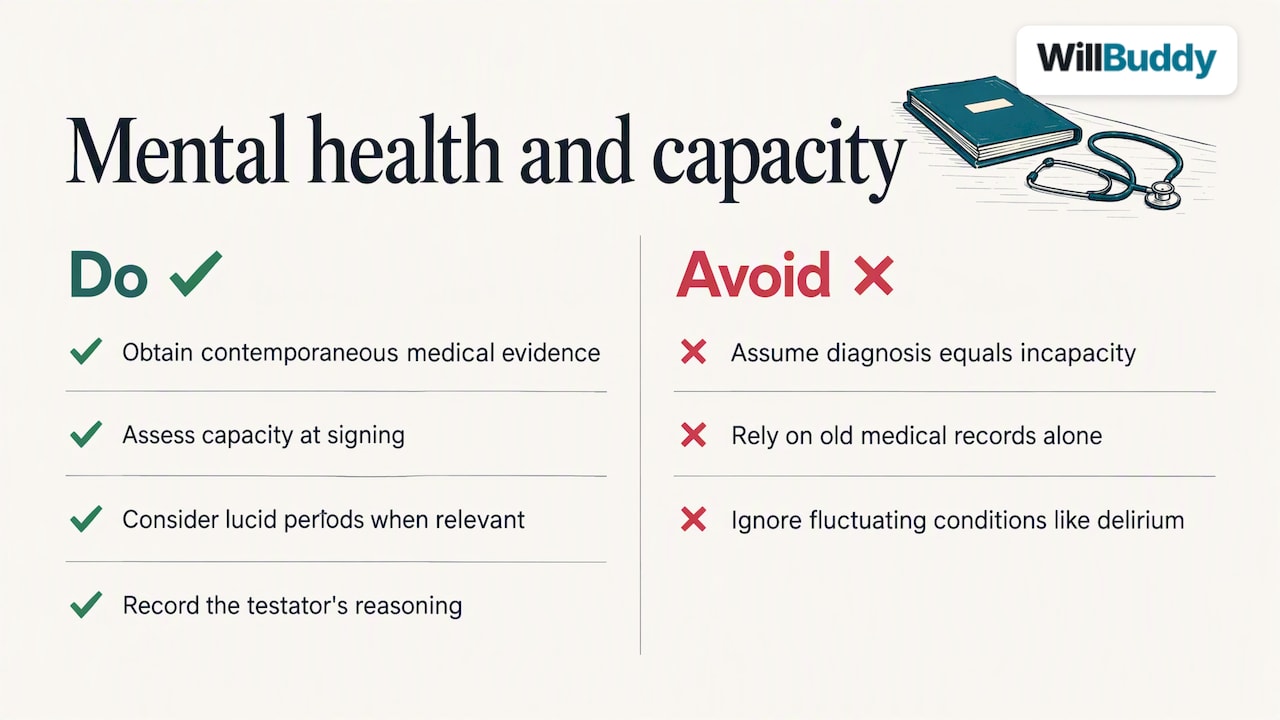
Several conditions commonly raise capacity questions, though a diagnosis alone never proves incapacity. Dementia, including Alzheimer's disease, is the most frequent trigger for disputes because it can affect memory and reasoning gradually, meaning capacity may fluctuate day to day or even hour to hour.
Delirium, often linked to infection, medication or hospital stays, can temporarily affect understanding without any lasting cognitive decline. This matters because a will signed during a lucid period, even amid a broader illness, can still be valid.
Severe depression, psychotic disorders and the effects of stroke or brain injury can also affect the specific elements of the Banks v Goodfellow test, particularly the ability to weigh up competing moral claims rationally. The presence of any of these conditions does not automatically mean a person cannot make a valid will. Courts look at capacity at the specific time the will was signed, not at a diagnosis in isolation. Someone with early-stage dementia may still clearly understand their assets and intended beneficiaries, while someone with no diagnosed illness could theoretically lack capacity during an acute episode. This is why contemporaneous medical evidence, gathered close to the date of signing, carries far more weight than a general diagnosis recorded months earlier.
How testamentary capacity differs from other legal capacities
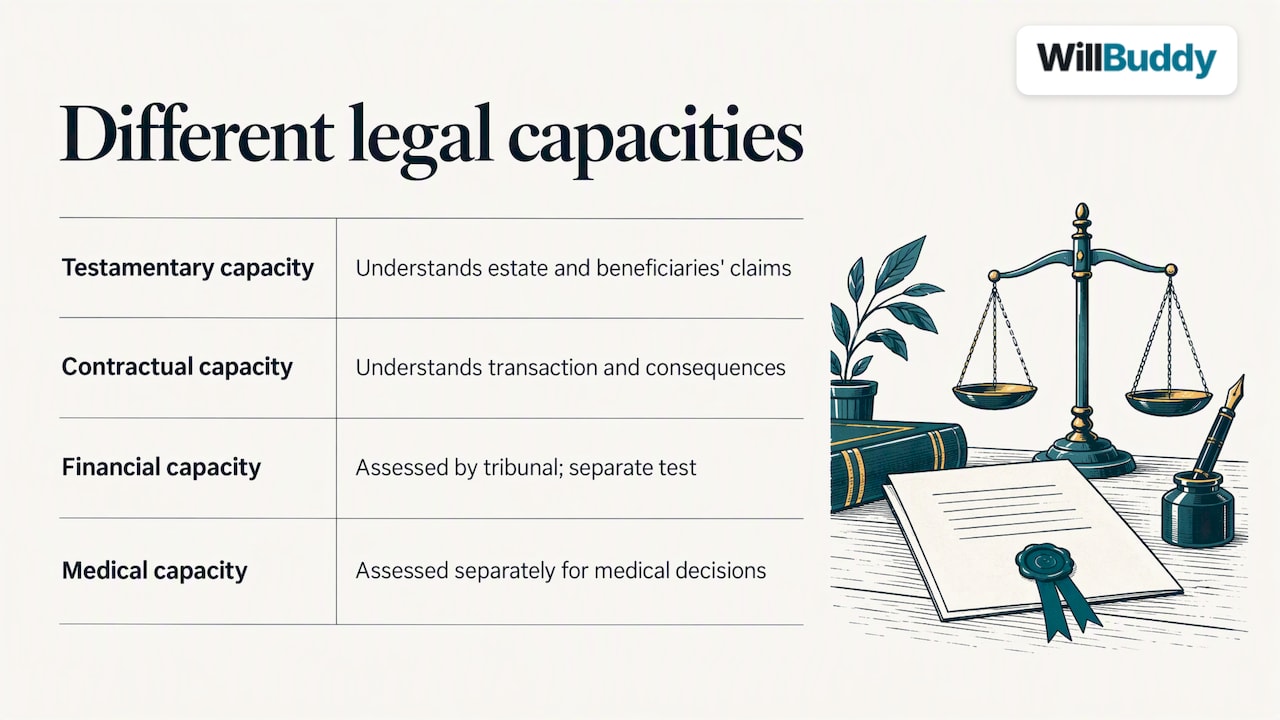
Testamentary capacity is not the same test as the capacity needed to sign a contract, manage finances or make medical decisions. Each area of law asks a different question suited to the decision at hand.
Contractual capacity generally requires understanding the nature of the specific transaction and its immediate consequences. Testamentary capacity is broader: it requires understanding the general extent of one's estate and weighing the moral claims of people who might reasonably expect to benefit, a more reflective exercise than agreeing to a purchase.
This means a person could potentially lack capacity to manage complex financial affairs or enter a contract, yet still retain testamentary capacity if they understand their assets and the people who matter to them. The reverse can also be true. Financial and medical decision-making capacity is often assessed under separate guardianship or administration frameworks in each state, which operate independently of the Banks v Goodfellow test used for wills. Families sometimes assume a tribunal finding of incapacity for financial management automatically rules out making a will. It does not, though it is a factor a court will weigh carefully alongside other evidence.
Undue influence and coercion around testamentary capacity
Undue influence is a separate legal ground from lack of capacity, though the two often appear together in disputes. A person can have full testamentary capacity and still have a will overturned if someone coerced or manipulated them into making particular gifts.
Undue influence typically involves pressure that overpowers the will-maker's free judgment, rather than simple persuasion or a reasonable request. It is more likely to succeed as a legal challenge where the will-maker was isolated, dependent on the alleged influencer for care, or recently changed a long-standing estate plan in that person's favour.
Vulnerability from illness, grief or cognitive decline can make undue influence easier to exert and harder to detect at the time. A will-maker who is physically frail but mentally sharp may still be pressured into decisions they would not otherwise make. This is one reason independent witnesses and a solicitor who meets the will-maker privately, without the influence of a potential beneficiary in the room, matter so much. A private consultation lets the solicitor ask open questions and observe whether the stated wishes genuinely belong to the will-maker, rather than someone standing nearby.
Case studies or examples illustrating testamentary capacity disputes
Court decisions illustrate how these principles play out in practice. Where there are red flags but no medical evidence from the time the will was made, courts look more closely at the other evidence, such as solicitor file notes and witness accounts. A lack of medical records does not automatically defeat a will, but it can invite closer scrutiny.
In Carr v Homersham, the New South Wales Court of Appeal applied the Banks v Goodfellow elements directly. A will-maker had left her estate to a friend instead of her niece because of a false belief about the niece. The court upheld the will: a mistaken belief is not enough on its own, and it only defeats capacity if it is a true delusion that the will-maker would hold onto whatever the evidence, and it affected the gifts. These cases share a pattern: courts do not look for perfection in a will-maker's mental state. They look for evidence that the person understood the nature of what they were doing, knew roughly what they owned, and could weigh the people who might reasonably expect to benefit, even if their final decision seems unusual to someone outside the family.
How WillBuddy can help you draft a state-based will
Reading about testamentary capacity often prompts a simpler question: how do we actually make a will properly, before any of this becomes an issue? We built WillBuddy so Australians can answer plain questions, one at a time, and get a complete draft tailored to their own state or territory.

- We draft a will for your state or territory, with signing and witnessing instructions for where you live
- You can read every word of your draft free before you decide whether to pay
- Once you are happy with it, you print it and sign it in front of witnesses, following those instructions
For straightforward estates, this gives you a clear way to get your will prepared and signed while you are well and your wishes are easy to document, for $39 a year. If you have a blended family, a business or trust, assets overseas, or think a challenge is likely, we recommend speaking with a lawyer rather than relying on a general drafting tool. You can see current plan details on our Annual Access pricing page.
Knowing roughly what your property is worth also helps you think through who gets what. A tool like OptiWealth AU gives model-based estimates of a property's value. They are estimates, not formal valuations, but they can give you a starting picture of your estate.
This article is general information, not a substitute for advice from a qualified lawyer. Consult a qualified legal professional about your own circumstances before acting on anything here.
FAQ
How is testamentary capacity determined?
Courts apply the Banks v Goodfellow test, asking whether the person understood they were making a will, understood the general extent of their property, and could weigh the moral claims of people who might reasonably expect to benefit. Evidence comes from solicitor file notes, medical assessments and witness accounts gathered around the time the will was signed, as set out in the best practice guide for legal practitioners.
Do I have to leave my son anything in my will?
No, Australian law does not require you to leave a specific gift to an adult child or any particular person. Excluding someone does not, by itself, show a lack of capacity, though it can prompt a family provision claim depending on the circumstances and the state you live in.
How much does it cost to do a testamentary trust?
Costs vary depending on the complexity of the trust and the solicitor involved, and no fixed figure applies across Australia. For background on how testamentary trusts work and when they might suit your situation, see our guide to testamentary trusts in Australia.
How do I avoid probate in Australia?
There is no way to fully avoid the probate process for assets held solely in a deceased person's name, though jointly owned assets and some superannuation or insurance nominations can pass outside it. A clear, validly executed will, with proper witnessing, still makes the probate process faster and less likely to be contested.
Sources
Show the 4 sources
Primary laws and authoritative guides
- Best practice guide for legal practitioners on assessing mental capacity (NSW)
- Carr v Homersham [2018] NSWCA 65
- Succession legislation (NSW provision on court-authorised wills)
- Law Handbook (South Australia) - Who can make a will?
- State Library of NSW - Wills guide
This is general information, not legal advice. Start your will free at willbuddy.com.au and read it before you pay.
Recommended
For the one who gets things sorted
Now write yours, with your family's names in it
Plain questions about your family, one at a time, and WillBuddy drafts a will for your state. Until you sign one, the law in your state or territory decides who gets what. Read every word free, with no card. You pay only if you want to print it.
Start my will freeLast updated 7 October 2026.
This article is general information only and is not legal advice. It is our best interpretation of the law as at 7 October 2026. WillBuddy is not a law firm, and it never replaces advice from a lawyer or solicitor. Laws change and differ between states and territories, so for your own circumstances, please get legal advice.