Sign It Right: Make a Valid Simple Will in Australia, 2 Witnesses
How to make a simple will in Australia: who can make one, what to include, and how to sign it in front of two witnesses so it meets your state’s rules.

Yes, you can make a valid simple will in Australia today if you follow the formal signing and witnessing rules. A will must be in writing and signed by you in front of two witnesses who are present at the same time, and each witness then signs it in your presence. Use adults who receive nothing under the will. The quickest safe path is to draft a short will, arrange your witnesses, and either handle the paperwork yourself or use an online service to guide the drafting.
TL;DR:
A will kit is legal to use, but a kit will can fail if it isn’t signed and witnessed correctly, and unclear wording can lead to disputes.
Sign in front of two witnesses who are both present; each witness then signs in your presence. Adults who receive nothing under the will are the safest choice.
A simple will should clearly specify beneficiaries, gifts, executor, backup, and guardianship for children, with straightforward language.
Store the original signed will in a secure location and review it after major life events like marriage, divorce, or new children.
For complex estates or when the risk of a challenge is high, a solicitor is the safer choice.
What a simple will is and who can make one in Australia
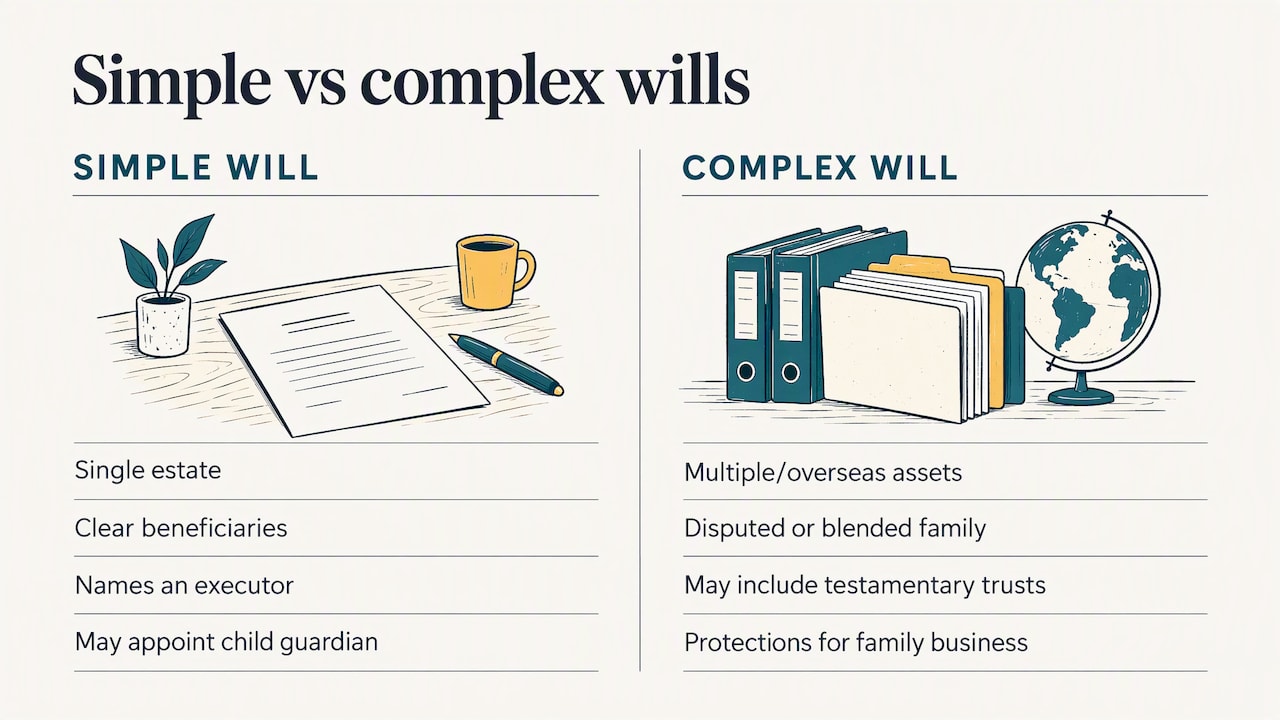
A simple will deals with straightforward situations: a single estate, clear beneficiaries, and no trusts or complicated tax structures. It names an executor, sets out who gets what, and appoints a guardian for children if needed. A complex will, by contrast, might include testamentary trusts, overseas assets, or protections for a family business.
To make a will in Australia you generally need to be 18 or older (most states and territories allow limited exceptions, such as a minor who is married or who has a court’s approval; Western Australia has no such exception), and you need testamentary capacity: you must understand what a will is, roughly what you own, and who might reasonably expect to benefit. If you have a blended family, a business, a disputed relationship, or substantial assets, a simple template may not suit your situation and legal advice is worth the cost.
Legal formalities: writing, signing and witnessing rules you must follow
Every valid will in Australia shares the same core formalities, set out in state and territory succession legislation and summarised for South Australia in the Law Handbook’s signing and witnessing guidance. If any of these steps is missed, the will may not be valid, and your family may need to ask a court to accept it anyway, which takes time and money and isn’t guaranteed.
The will must be in writing, whether typed or handwritten.
You must sign it yourself, or direct someone to sign on your behalf in your presence.
You sign (or acknowledge your signature) in front of two witnesses who are present at the same time, and each witness then signs in your presence. In the ACT the witnesses must also sign in each other’s presence, so signing together in one sitting is safest everywhere. Use adults: the Acts don’t set a minimum age, but an adult can later confirm what happened.
Use witnesses who receive nothing under the will. In NSW, Queensland, Tasmania and the NT a gift to a beneficiary who witnesses can be void unless an exception applies; in Victoria, South Australia and the ACT it is not void, and Western Australia’s Act has no rule voiding it.
Minor procedural differences exist between jurisdictions, so it’s worth checking your state or territory’s will requirements and confirming who can act as a valid witness before you sign anything.
Step-by-step: draft and execute a simple will correctly
Getting the signing right matters as much as getting the wording right. Here’s a practical sequence that keeps your will probate-ready.
List your assets and beneficiaries, then choose a primary executor and a backup in case the first can’t act.
Draft short, specific clauses: name exact gifts or percentages of the residuary estate, and add a plain guardianship clause if you have children under 18.
Run the signing ceremony properly: date the will, sign in pen at the end of the document while both witnesses watch, and have both witnesses sign immediately after, in your presence, ideally with the same pen.
Secure the document straight after signing: scan a copy, store the signed original somewhere safe, tell your executor where it is, and never leave this step for “later”.
Common mistakes that cause real problems include crossing out words after signing (a change made after signing generally has no effect unless it is itself signed and witnessed), scribbling notes in the margin, creating multiple “original” copies that contradict each other, and letting a beneficiary act as a witness, which can cost that person their gift in some states. Any one of these can lead to a dispute or a court application. The Northern Territory Government’s make a will page warns that if a will doesn’t meet all the legal requirements, or isn’t clear, your executor may need a lawyer to have it interpreted by a court, adding cost and delay.
Pro Tip: Sign in front of both witnesses in one sitting, rather than getting signatures separately, to avoid any argument later about whether everyone was truly “present together”.
What to include in a simple will: executors, gifts and guardianship
A simple will doesn’t need legal jargon, but it does need a handful of clauses covering the essentials.
Executor and backup executor: pick someone willing and able to do the job, and name a second choice in case the first can’t serve; the WA Public Trustee’s guide sets out what the role can involve.
Gifts: specify whether each beneficiary gets a fixed amount, a particular item, or a percentage of what’s left (the residuary estate), and avoid vague phrases like “my savings” that invite disputes.
Guardianship: name a guardian for children under 18 in plain, direct wording; if custody arrangements are contested, get legal advice rather than relying on a template clause.
Funeral wishes: these can be included, but your will may not be read until after the funeral, so tell your family and executor your preferences as well.
Superannuation usually sits outside your will altogether. As Moneysmart explains, your will doesn’t automatically cover your super: you need to nominate beneficiaries through your fund, and a binding nomination generally expires every three years unless your fund offers a non-lapsing one.
Risks of DIY will kits and mistakes that can invalidate a will
Cheap will kits are legal to use, but government guidance warns they carry real risk if not followed to the letter. Moneysmart suggests having an online will kit checked by a solicitor or Public Trustee, warning that a will that is not done properly may be invalid.
Typical problems are execution errors (missing witnesses, or witnesses who weren’t both present when you signed) and ambiguous wording that forces beneficiaries into court to work out what you actually meant. If your estate involves a business, overseas property, a trust, or a family arrangement anyone might contest, a solicitor or your state’s Public Trustee is the safer route, even though it may cost more upfront than a basic will kit.
Who can help in Australia: public, community and online options
Australians generally have four realistic paths to a valid will, and the right one depends on complexity, budget, and how often you expect to update it.
Public Trustee: Public Trustees prepare wills, some at no cost for eligible people such as pensioners or people who appoint the Public Trustee as executor, though eligibility rules differ by state and territory. In Western Australia, for example, the Public Trustee drafts wills that name it as sole or substitute executor.
Community wills days: some organisations, such as the Salvation Army, offer low-cost simple wills prepared by local solicitors as a community service.
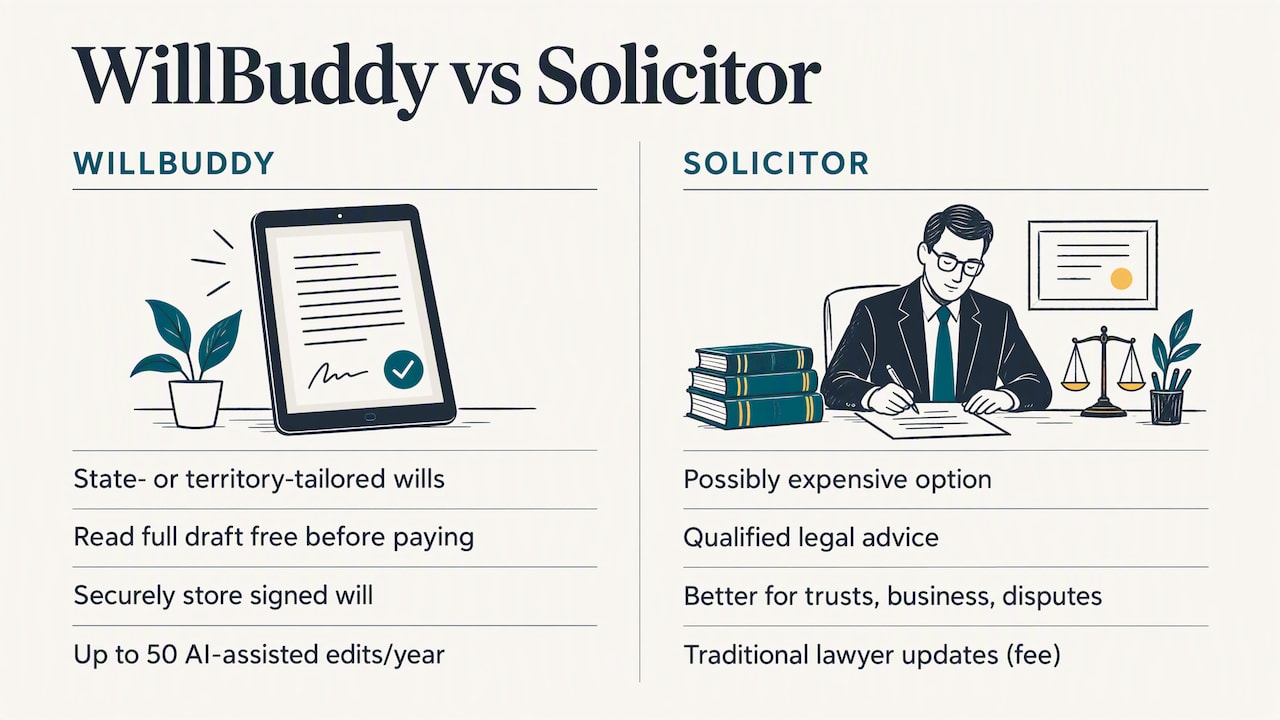
A solicitor: the right call for blended families, trusts, business assets, or any estate likely to be disputed.
An online service like WillBuddy: suited to straightforward estates. Your answers become a will drafted for your specific state or territory, you read all of it before you pay, and the plan lets you keep it current with edits asked for in plain English.
Where to keep your will, how to update it and when to review
The original signed document is what matters for probate, so store it somewhere genuinely safe: Moneysmart suggests a fireproof safe at home, or with your solicitor, the Courts or the Public Trustee. A scanned or uploaded copy helps your executor know what the will says, but it generally won’t replace the original.
Never alter a signed will by crossing out a clause or adding a note in the margin. The correct approach is to make a new will or add a formally executed codicil, both witnessed the same way as the original. Review your will after marriage, divorce, the birth of a child, a new property purchase, or a falling-out with a named beneficiary; in every state and territory, marriage generally revokes an existing will unless it was made in contemplation of that marriage.
One-page checklist: immediate next steps
Use this as a quick reference before you sign anything.
Draft your asset list, beneficiaries, executor and backup executor.
Add a guardianship clause if you have children under 18.
Arrange two independent adult witnesses with no interest in your estate.
Sign in pen, with both witnesses watching and then signing themselves.
Scan the signed will, then store the original somewhere secure.
Tell your executor exactly where the original is kept.
If your situation is complex, speak to a solicitor or your state’s Public Trustee; if it’s straightforward, a kit or an online service like WillBuddy can help you draft it.
A quick note on getting this right
A will can say exactly what you want and still cause problems if it isn’t signed and witnessed properly. Plain language and a correctly witnessed signature protect your family far more than clever legal phrasing ever does. Get the execution right first, and keep the wording simple.
How WillBuddy helps you draft, store and update a simple will
Drafting a will in Australia shouldn’t mean choosing between an expensive solicitor and a generic kit that ignores your state’s rules. With WillBuddy, your answers about your family and property become a will drafted for your specific state or territory, and you can read the complete document before you pay anything. Once you’ve signed it in front of two witnesses, you can upload the signed copy and we keep it encrypted.

The plan is $39 AUD a year and includes 50 AI edits a year: ask for a change in plain English (a new child, a new property, a change of executor) and it’s saved as a new version of your will, without starting from scratch. We never sell your personal data. This approach suits straightforward estates well; if your situation involves trusts, a business, or a likely dispute, a solicitor remains the better fit. WillBuddy is not a law firm and doesn’t give legal advice, and your will is valid only once it is signed and witnessed correctly. For everyone else, you can see pricing on our Annual Access plan and start your will for free today.
This article is general information, not a substitute for advice from a qualified lawyer. Consult a qualified legal professional about your own circumstances before acting on anything here.
FAQ
Can you write your own will without a lawyer in Australia?
Yes. A will can be valid without a lawyer, as long as it is in writing and you sign it in front of two witnesses who are present at the same time, and each witness then signs it in your presence. Moneysmart warns that a will that is not done properly may be invalid, and suggests having an online will kit checked by a solicitor or Public Trustee.
Are Australia Post will kits legal?
Yes. Will kits sold at post offices and online are legal to use, but the will is only valid if you complete, sign and witness it correctly. The NSW Government strongly recommends having a do-it-yourself kit checked by a professional, and the Legal Services Commission of South Australia warns that an error in a home-made will may make it invalid.
How do I write a basic will in Australia?
List your assets, choose an executor and a backup, write clear gifts (including who receives whatever is left), and name a guardian if you have children under 18. Then sign it at the end in front of two witnesses who are both present, and have each witness sign in your presence, as the signing steps in the Law Handbook describe.
What is the best way to write a simple will?
For a straightforward estate, a short, clear will that names an executor, sets out your gifts and names a guardian for young children, signed and witnessed correctly, is usually enough. You can use a solicitor, a Public Trustee (eligibility varies), a kit or an online service such as WillBuddy, which drafts your will for your state or territory and lets you read all of it before you pay. For complex estates, a solicitor is the safer choice.
Sources
Recommended
Ready when you are
Make your will for your state
WillBuddy guides you through a will designed for your state or territory. It is free to try, and you only pay when you are ready to finalise.
Last updated 5 October 2026.
This article is general information only and is not legal advice. It is our best interpretation of the law as at 5 October 2026. WillBuddy is not a law firm, and it never replaces advice from a lawyer or solicitor. Laws change and differ between states and territories, so for your own circumstances, please get legal advice.