Who Keeps the Will? Where to Store It and Who Needs a Copy
General information, not legal advice.
On this page
- TL;DR
- Who is allowed to keep your will?
- The main places to store an original will
- Who should have a copy of your will?
- What copies can and cannot do
- How your family finds the will after you die
- Do not hold back a will that is not yours
- State and territory differences to keep in mind
- A simple plan for keeping your will findable
- When to see a lawyer
- Making a will you can print, sign and keep
- FAQ
- Sources
- Recommended

Quick answer
You keep your will, or you choose someone to keep it for you. In Australia no one is forced to hold it. The original can sit at home, with a lawyer, with a public trustee or at a bank. What matters is that your executor knows where it is and can get it when the time comes. Other people can hold copies, but the signed original is the document that counts.
This is general information only, not legal advice. Wills law differs by state and territory, so we name the state when a rule differs.
TL;DR
- You decide who keeps your original will. No law says it must be a lawyer, a bank or a government office.
- Your executor must know where the original is. A will nobody can find does little for your family.
- While you are alive, no one has a right to see your will, not even your executor.
- Keep copies for convenience, but keep one signed original. A copy can be used in court only in limited cases, and you should not count on it.
- If you lose your own original, a court may presume you destroyed it on purpose. Your estate could then be shared as if you had no will, unless an earlier will that was never revoked still stands.
Who is allowed to keep your will?
You are. A will is your document until you die. Legal Aid NSW says you can store a will at home, with a lawyer, with NSW Trustee and Guardian, or at a bank, and that you do not have to register it (Legal Aid NSW). Other states offer similar choices, though the names of the public bodies differ.
There is also no national will register in Australia, and registering a will is not compulsory. That makes the question of who keeps the will more important, not less. If you want to read more on this, see our guide on keeping your will findable.
So the real question is not who must keep it. It is who can keep it safely, and who will know about it.
The main places to store an original will
Each option suits a different person. Here is how they compare.
| Where | Good for | Watch out for |
|---|---|---|
| At home | Quick access, no cost | Fire, flood, theft, a will nobody finds |
| Lawyer or law firm | People who had the will drawn up by a firm | Firms merge and close, and your executor must know which firm |
| Public trustee | People who want government-run storage | Rules, fees and eligibility differ by state |
| Bank | People who keep other key papers there | Access can be slow after death, and the box may be in your name only |
| Trusted person | Short-term, in a pinch | Relies fully on that person's honesty and memory |
Keeping it at home
Most people who make a will without a lawyer end up keeping it at home. That is allowed. Put it somewhere fireproof and dry, such as a small home safe or a sturdy folder with your other key papers. Do not hide it so well that no one can find it.
One risk is worth knowing. If a will was in your custody and cannot be found after you die, the law presumes you destroyed it with the intention of revoking it. This presumption can be challenged, but it is a hurdle (The Law Handbook). The Supreme Court of Victoria describes the same starting point: where a person held their will and it cannot be found, the court will generally presume the person destroyed it to revoke it (Supreme Court of Victoria).
The presumption is the reason a home copy needs a trail. Tell people where it is.
Leaving it with a lawyer
Lawyers often hold the original in safe custody and the testator keeps a copy. This works well when the firm drafted the will. The risk is on the executor's side: they have to know which firm holds it. Write the firm's name and phone number in a note kept with your other important papers.
Using a public trustee
Several states and territories have a public trustee or equivalent that stores wills. In New South Wales, residents can store a will with NSW Trustee and Guardian through its WillSafe service. The service is open only to NSW residents, and people elsewhere are told to contact their local public trustee office (NSW Government).
While you are alive, NSW Trustee and Guardian lets only you, or someone you authorise, access your stored will, unless the law requires otherwise (NSW Government). Fees and terms vary, so check the current details on your own state's public trustee site before you decide.
Using a bank
Some people store a will with their bank, often in a safe deposit box or sealed envelope. It keeps the will with other important papers such as mortgage documents. Make sure your executor can get into the box. Ask the bank what proof it needs after a death, and who is named on the box.
Who should have a copy of your will?
This is where people often get confused. A copy and an original are not the same thing.
Your executor should know where the original is. Ideally they also hold a copy, so they know what is expected of them before the day arrives. NSW Trustee and Guardian recommends telling your executor where your will is stored, and says you could also tell beneficiaries and loved ones (NSW Government).
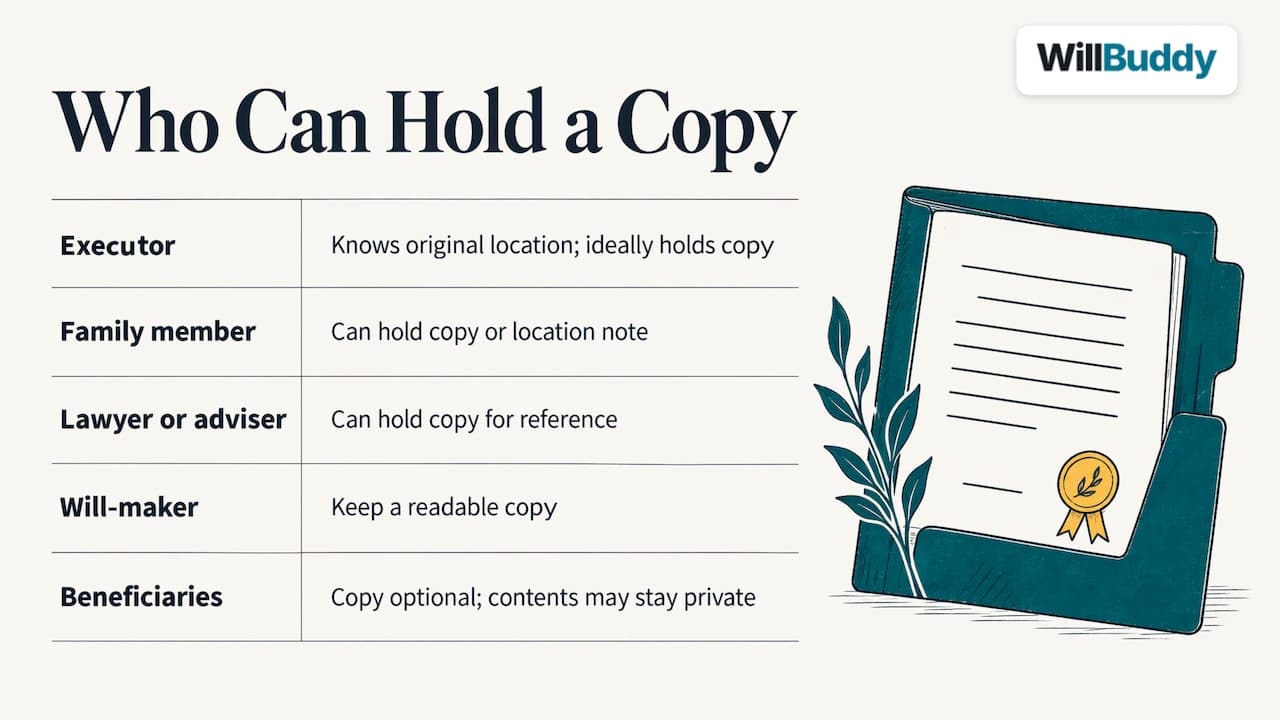
A trusted family member can hold a copy or a note on where the original is. Choose someone calm and organised, not necessarily the person who gets the most.
Your lawyer or financial adviser, if you have one, can hold a copy for reference.
You should keep a copy where you can read it. When your life changes, you will want to see what the will says.
Beneficiaries do not have to have a copy. Some people prefer to keep the contents private until death. That is your choice. Telling people where the will is does not mean telling them what is in it.
If you are choosing an executor, our guide to how to choose a will executor covers what to look for, and our page on the executor age requirement explains who can act.
Can anyone demand to see your will while you are alive?
No. The Legal Services Commission of South Australia puts it simply: no one is legally entitled to see your will while you are alive (Legal Services Commission SA). That includes your executor. In Victoria, LawHub explains that after death, specified people, such as people named in the will, a spouse or partner, and children, may inspect it (LawHub).
That means you control who learns what is in it.
What copies can and cannot do
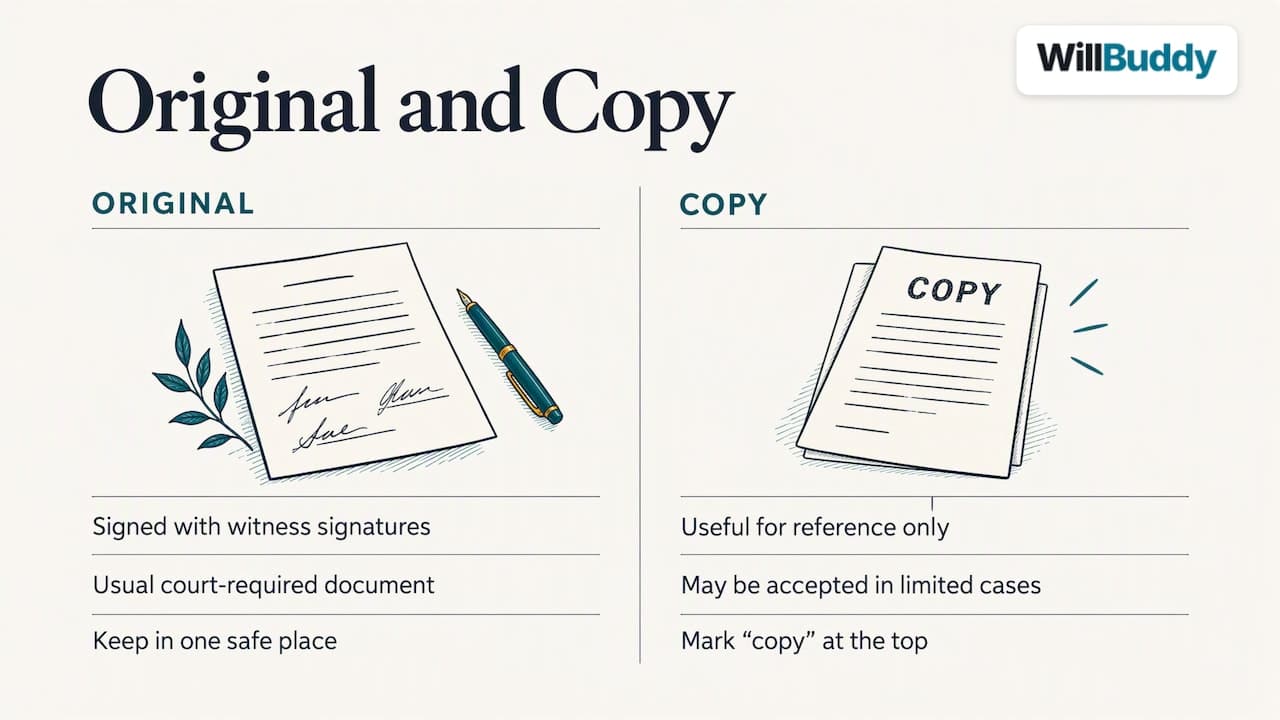
A photocopy, scan or printout is useful for reference. It is not the will itself. The usual rule is that the court wants the signed original with the witnesses' signatures on it.
If the original cannot be found, the Supreme Court may in limited circumstances allow a copy to be used. The South Australian Legal Services Commission says this should not be relied upon (Legal Services Commission SA). In Victoria, an application to prove a copy generally needs an affidavit from the witnesses about how the will was signed, an affidavit about where the original was last known to be and the searches made for it, and evidence to rebut the presumption that it was destroyed (Supreme Court of Victoria). That is time, stress and cost your family could avoid.
A separate Victorian power covers a different problem. Section 9 of the Wills Act 1997 (Vic) lets the court admit a document that was not signed and witnessed in the usual way, if it is satisfied the person intended it to be their will. It does not make a lost original any easier to replace.
A simple habit helps. Keep the original in one safe place, and keep copies marked "copy" at the top, so nobody mistakes them for the real thing.
How your family finds the will after you die
This is the part that trips people up. Your family is grieving, and they do not know where to look.
They will usually check, in this order:
- The home, including the desk, filing cabinet and any safe.
- Your lawyer, if you had one.
- The bank, in case of a safe deposit box.
- The public trustee in your state or territory.
- Your accountant, financial planner or any adviser who held a copy.
If you stored the will with NSW Trustee and Guardian, your executor contacts them and brings a copy of the death certificate and original identification to retrieve it (NSW Government).
The State Library of Queensland notes that copies of wills that did not go to probate may sometimes turn up in private hands or in the records of solicitors or executors (State Library of Queensland). Do not leave your family to rely on that.
What happens when it goes to probate
In Victoria, once a will is admitted to probate, anyone can obtain a copy, according to LawHub (LawHub). Not every will needs probate. It is usually needed when a bank or other institution wants formal proof of the executor's right to act. For the steps, see our probate process guide.
Do not hold back a will that is not yours
If you find a will after someone dies, do not sit on it. In Victoria, dishonestly concealing a will for gain can be a crime, and a person who conceals or keeps back a will may have to pay for the loss it causes (The Law Handbook). Other states have their own rules. The safe step anywhere is to give it to the named executor or to a lawyer or the relevant court registry promptly.
State and territory differences to keep in mind
Storage services and rules are not the same everywhere.
- New South Wales: WillSafe is open to NSW residents only (NSW Government). Our NSW will guide covers the requirements.
- Victoria: the law on keeping, inspecting and concealing wills is covered by LawHub and The Law Handbook, linked above.
- Queensland and other states: public trustees and courts offer their own options. Check your state's public trustee website for current services and fees.
- South Australia: the Legal Services Commission sets out what happens if the original cannot be found.
If you move states, your will does not become void just because you moved, but it is wise to review it. Storage you used in one state may not be open to you in another.
A simple plan for keeping your will findable
Follow these five steps and your family will not be left guessing.
- Sign it properly. Print it and sign it in front of the required witnesses. Our guide on who can witness a will sets out the rules state by state.
- Pick one home for the original. Home safe, lawyer, public trustee or bank. One place, not three.
- Tell your executor. Give them the location, and say who to call if they need access.
- Keep a labelled copy. Put it where you can read it, and tell your executor where that is too.
- Write a short "where to find it" note. Keep it with your other important papers. Include storage details and the names of your executor and lawyer.
Review this each time life changes. A new baby, a separation, a death in the family or a big purchase are all good moments to check the will and where it lives.
When to see a lawyer
A simple will for a simple estate can be done online. Get advice from a lawyer if you have a blended family, a business or a trust, assets overseas, or you think someone is likely to contest your will. Those situations carry extra risk, and storage and access are only part of it.
If you have young children, think about guardianship and how the will provides for them. Our guide for parents on minor children, guardians and trusts explains the options.
Making a will you can print, sign and keep
WillBuddy asks plain questions one at a time and drafts a will for your state or territory. You can read every word for free before you pay. Then you print it and sign it with witnesses, and decide where the original lives.
Our annual plan also lets you make up to 50 AI-assisted edits a year and keep your will stored securely in Australia, so you can update it as life changes. We encrypt your personal data and we do not sell it. See the current plan on our pricing page, or learn more about how our online will drafting works.

FAQ
Who keeps the original copy of a will in Australia?
You decide. Common choices are your home, a lawyer, a public trustee or a bank. You do not have to register your will (Legal Aid NSW). Whatever you pick, tell your executor where it is.
Who should have a copy of my will?
Your executor is the most important person to tell, and a copy helps them prepare. You may also tell beneficiaries and loved ones where it is stored, as NSW Trustee and Guardian suggests (NSW Government). Sharing the location is different from sharing the contents, and that choice is yours.
Can my family look at my will before I die?
No one has a right to see it while you are alive, and that includes your executor. Where a will is stored with NSW Trustee and Guardian, only you or someone you authorise can access it, unless the law requires otherwise (NSW Government). You can show it to anyone you choose.
What if the original will is lost?
If it was in your custody, the law presumes you destroyed it to revoke it, although that can be challenged (The Law Handbook). A court may allow a copy in limited cases, but you should not rely on it (Legal Services Commission SA). A family who faces this should speak to a lawyer.
Does a will have to go to probate?
Not always. It is usually needed when a bank or other institution asks for formal proof of the executor's authority, for example to release a larger account or transfer land. Your executor can ask the institution what it needs.
Sources
Show the 9 sources
- Making a will, Legal Aid NSW
- NSW Trustee and Guardian WillSafe, NSW Government
- Keeping and inspecting a Will, LawHub (Victoria Legal Aid)
- Frequently Asked Questions, Legal Services Commission of South Australia
- Storage of a will, The Law Handbook
- Wills and probate research guide, State Library of Queensland
- Unusual applications, Supreme Court of Victoria
- Who can view my will?, Legal Services Commission of South Australia
- Wills Act 1997 (Vic)
Start your will free at willbuddy.com.au and read it before you pay.
Recommended
For the one who gets things sorted
Now write yours, with your family's names in it
Plain questions about your family, one at a time, and WillBuddy drafts a will for your state. Until you sign one, the law in your state or territory decides who gets what. Read every word free, with no card. You pay only if you want to print it.
Start my will freeLast updated 2 November 2026.
This article is general information only and is not legal advice. It is our best interpretation of the law as at 2 November 2026. WillBuddy is not a law firm, and it never replaces advice from a lawyer or solicitor. Laws change and differ between states and territories, so for your own circumstances, please get legal advice.