Mirror Wills in Australia: How They Work for Couples
General information, not legal advice.
On this page
- TL;DR
- What a mirror will is
- Why couples choose mirror wills
- Mirror wills, mutual wills and joint wills
- Mirror wills and your children
- Signing and witnessing: the rules are the same for each will
- Changing or cancelling a mirror will
- When life changes, your mirror wills should too
- Disadvantages and limits of mirror wills
- Making your own will with WillBuddy
- Setting up mirror wills: a simple checklist
- FAQ
- Sources

Quick answer
A mirror will is one of two separate wills, made by two people (usually a couple), with matching terms. Each partner normally leaves everything to the other first, then to the same people if both die. The wills mirror each other, but each one belongs to one person, and either person can change theirs later. This is general information only, not legal advice.
TL;DR
- Mirror wills are two separate documents with matching terms. They are not one shared will.
- The matching terms alone do not stop either partner from changing their will later. That is the big difference from a binding mutual will.
- Parents can name the same guardians in both wills, so the plan lines up whichever of you dies last.
- Signing rules are strict in every state and territory. The core rule is two witnesses, present at the same time.
- Marriage, divorce and new children can change what a will does, so review your wills when life changes.
What a mirror will is
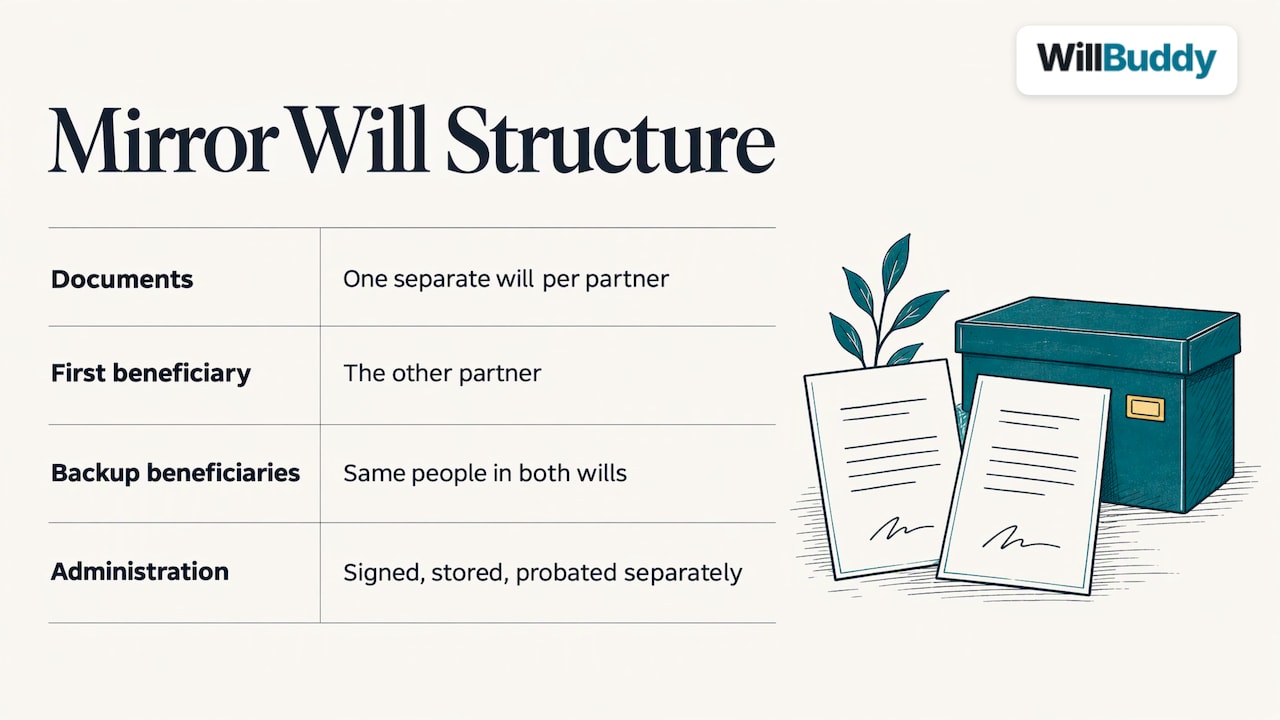
Picture two wills side by side. Both name the same main beneficiaries. Each names the other partner as the first person to inherit. Each names the same people as backups.
The Western Australian Public Trustee describes the usual set-up in its mirror wills application form for couples. Each partner leaves everything to the other. If both have died, the estate goes to the same beneficiaries. The form is for spouses and de facto partners.
The key point is that the wills are separate. Each one is the will of one person. Each is signed, stored and, if needed, put through probate on its own.
A simple example
Sam and Priya are married with two children, aged 4 and 7. They want the following:
- If Sam dies first, everything goes to Priya.
- If Priya dies first, everything goes to Sam.
- If both die, everything goes to the two children, held until a set age.
- If both die while the children are under 18, the children's guardian is Priya's sister.
Sam makes a will with those terms. Priya makes a will with the same terms in reverse. That pair is a set of mirror wills. The names are made up for illustration only.
Why couples choose mirror wills
Most couples with shared goals end up with something close to mirror wills without using the term. The reasons are simple:
- Same plan for the family. Both of you want the partner looked after first and the children next.
- Fewer gaps. If both wills point the same way, there is less chance of a mismatch about who gets what.
- Easy to compare. You can read them side by side and spot a mistake.
- Simple to understand. The family can see the plan quickly after a death.
Mirror wills suit people whose situations are alike. If your circumstances differ a lot, your wills may need to differ too. Examples include children from earlier relationships, a family business or very different assets.
Mirror wills, mutual wills and joint wills
These three terms get mixed up. They are not the same thing.
| Type | How many documents | Can one person change theirs? | Key feature |
|---|---|---|---|
| Mirror wills | Two separate wills | Yes, at any time | Matching terms, no binding promise |
| Mutual wills | Usually two separate wills | They can, but a proved agreement may still be enforced against the property | A specific agreement that the terms are binding, often an agreement not to revoke |
| Joint will | One document signed by more than one person | Complicated, see below | Each person's part is admitted to probate separately |
The Australian Law Reform Commission (ALRC) explains the difference in its piece on mutual wills. Mirror wills have reciprocal terms. Those terms alone are not enough to make them mutual wills. Mutual wills involve a specific agreement that the gifts are binding, often including an agreement not to revoke. Joint wills are made by more than one person in one document. As each person dies, the will (or the relevant part of it) is admitted to probate as that person's own will.
An academic article by Rosalind Croucher makes a related point. Mirror provisions may point to mutual wills, but they are not enough on their own. The binding agreement has to be proved.
In plain words: most couples who make matching wills have mirror wills. Nobody has promised the other to keep them in place. Mutual wills are rare and are usually a matter for a lawyer.
Mirror wills and your children
For many parents, guardianship is the main reason to make a will at all. A will is the place to say who you would want to care for your children if you both die while they are under 18.
The South Australian Law Handbook says a will can state preferred guardians for children under 18. The same page lists executors, beneficiaries, funeral wishes, pets and survivorship arrangements as things a will can cover.
Mirror wills help here because you can name the same guardian in both. You do not need to hope the two documents agree by chance.
The law on appointing a guardian
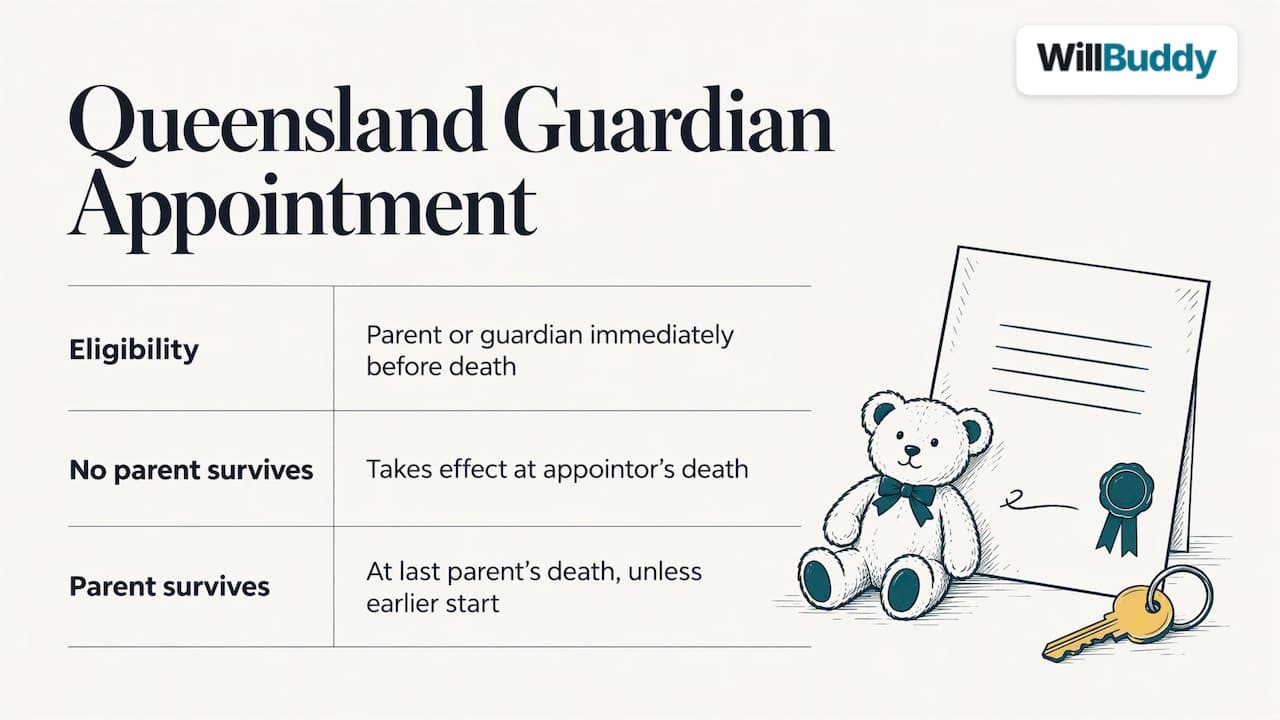
Rules differ by state and territory, so check yours. Queensland is a useful example. Part 5A of its Succession Act 1981 provides that a parent or guardian may appoint a person as a child's guardian by will (section 61C). The appointment has no effect if the person making it was not the child's parent or guardian immediately before death.
The same Queensland provisions deal with timing (section 61D). An appointment takes effect at the will-maker's death if no parent of the child survives them. Otherwise it takes effect at the death of the last surviving parent, unless the will shows it is meant to take effect at the will-maker's death.
That is why parents should think about the "both gone" scenario carefully. If you die first and your partner survives, your partner is normally the one raising the children. Your guardian choice matters most if the last surviving parent dies too.
For more on choosing a guardian, wording the appointment and handling trusts for children, see our guides on guardianship in wills and on minor children, guardians and trusts. If you and your partner disagree about who should be the guardian, our section on what to do if parents disagree can help you work it through before you sign.
Signing and witnessing: the rules are the same for each will
Because mirror wills are separate wills, each one must be signed properly on its own. Two matching documents do not become valid because they match.
The core rule is similar across states and territories. Two examples:
- Tasmania. The Wills Act 2008 requires a will to be written and signed by the testator, or by another person in the testator's presence and at their direction. The signature must be made or acknowledged before at least two witnesses present together. At least two witnesses must attest and sign in the testator's presence.
- Northern Territory. The Wills Act 2000 states the same core rule: writing, signature (or directed signature), acknowledgment before two witnesses present at the same time, and signatures by at least two witnesses in the testator's presence.
Some states, such as NSW and Victoria, also allow witnessing by video link under special rules. Check your own state's rules before relying on that.
Practical tips for a couple:
- Sign each will in front of two adult witnesses who are both there at the same moment.
- Pick witnesses who are not beneficiaries in either will. Some states still have rules that can affect a gift to a witness, so check yours first.
- Do not let your partner witness your will, and do not witness theirs.
- Keep the signed originals somewhere safe and tell your executor where they are.
Changing or cancelling a mirror will
Either partner can usually change their own will. That is the main practical feature of mirror wills, and it cuts both ways. It gives you flexibility. It also means your partner could change theirs without telling you.
The Northern Territory Wills Act shows the usual ways a will can be revoked. A later will, a properly signed written declaration of revocation, or destroying or marking the will with the intention to revoke all work. Changes made after signing generally need to be executed with the same formalities as the will itself.
So do not scribble on a signed will. Make a new will, or have the change formally made.
What this means for trust
Most couples are comfortable with this. You each agree to keep your wills in step and talk before changing anything. If you want a binding promise instead, that is a mutual will, and you should see a lawyer.
When life changes, your mirror wills should too
A mirror will is only as good as it is current. Common triggers for a review:
- a new baby or an adopted child
- marriage or a new relationship
- separation or divorce
- buying or selling a home
- a death in the family, including a named guardian or executor
- a guardian moving overseas or no longer being suitable
Some events change a will by law. In Tasmania, marriage or registration of a deed of relationship revokes a will, subject to statutory exceptions. Those include certain gifts and appointments for the spouse or registered partner, and wills made in contemplation of the marriage or relationship.
In Queensland, the Succession Act 1981 says divorce or annulment revokes a gift to the former spouse and the former spouse's appointment under an existing will, subject to the Act's exceptions. Because changes like marriage or divorce can cancel or alter how a will works, it makes sense to update your will when they happen.
This matters a lot with mirror wills. Separating without a divorce generally does not change a will by itself. If you separate, your will still names your ex-partner as the first beneficiary and perhaps as executor or guardian, unless the law or a new will changes that. Other states have their own rules, so do not assume Queensland's or Tasmania's apply to you. If you are going through a split, read our guide on how to update your will after a divorce.
Disadvantages and limits of mirror wills
Mirror wills suit many couples, but you should know where they stop.
They do not bind the survivor. If you die first, your partner can usually change their will afterwards. They could leave the estate to someone new. The ALRC notes that matching provisions alone do not establish a binding mutual-wills agreement. It also describes mutual wills as a strategy used in blended families to protect property for children from earlier relationships, but notes they can lack flexibility when families change.
They can go out of date at different speeds. One of you may update and the other may not. Then the wills no longer mirror each other.
Pressure can creep in. In its report on elder abuse, the ALRC identifies pressure to make or change a will as a form of financial abuse and notes that lawyers can help protect clients from possible undue influence. Each partner should make their own free choices.
They do not suit every family. Matching wills work best when you want the same things.
When to see a lawyer
Talk to a lawyer instead of relying on a simple mirror set-up if any of these apply:
- you or your partner have children from a previous relationship (a blended family)
- you own a business or are part of a trust
- you have assets overseas
- someone is likely to contest your will
- you want a binding agreement that your partner cannot change after your death
If you do use one lawyer for both wills, the Queensland Law Society says solicitors should explain that it is a joint retainer. They should disclose each client's instructions to the other, offer independent legal advice and address possible conflicts. The Society also warns that a conflict may require the practitioner to stop acting for both clients. Later instructions after a relationship breakdown can raise confidentiality and conflict issues. In other words, if your situation is tricky, ask for independent advice for each of you.
Making your own will with WillBuddy
You do not need a special product to have mirror wills. You need two valid wills with matching choices. WillBuddy takes you through plain questions, one at a time, and drafts a will for your state or territory. You can name guardians for your children, choose executors, decide who gets what, and note funeral wishes and pets.
For a couple, that means each of you can answer the questions on your own and make the same choices on the big items. You can read every word of your will free before you pay. Then you print it and sign it with witnesses. Our Annual Access plan includes up to 50 AI-assisted edits a year, so you can update your will as your life changes. See the pricing page for current details.

WillBuddy is general information and a drafting tool. It does not replace legal advice, and it is not the right tool for the situations in the lawyer list above.
Setting up mirror wills: a simple checklist
- Talk first. Agree who inherits first, who gets what after that, who the executor is and who the guardians are.
- Write down the shared choices. Use a single list so both wills match.
- Choose backups. Name a second executor, a second guardian and an alternative beneficiary in case your first choice cannot act.
- Make each will separately. Each of you answers for yourself.
- Compare them side by side. Check names, shares and ages for children.
- Sign with two witnesses present together. Follow your state's rules.
- Store them safely. Tell your executors where the originals are.
- Diarise a review. Revisit after any big life change and every few years.
If you want to think more about trusts for young children, our section on testamentary trusts for children explains the basics.
FAQ
Are mirror wills still valid in Australia?
Yes. A mirror will is just a normal will that happens to match your partner's. It must meet your state or territory's rules, including being in writing, signed and witnessed by two people present together. Each will is valid on its own or not at all.
What are the disadvantages of a mirror will?
The survivor can usually change their will after the first death, because matching terms alone do not create a binding promise. The wills can also drift apart if only one of you updates. If you want a binding arrangement, or you have a blended family, see a lawyer.
Which is better for couples, a mirror will or a joint will?
For most couples, separate mirror wills are easier to manage than a joint will. Each person has their own document that can be changed or probated on its own. A joint will is a single document made by more than one person, and each person's part is admitted to probate separately. It can be more complicated, so ask a lawyer before using one.
Can I make a mirror will if I am not married?
Yes. Mirror wills are usually made by married or de facto couples, but the idea is only that two wills match. The Western Australian Public Trustee's form covers spouses and de facto partners. Remember that rules on relationships and wills differ by state and territory.
Do mirror wills help me choose a guardian for my children?
They can. Name the same guardian in both wills so your wishes line up whichever of you dies last. Guardianship rules differ by state and territory, so check the law where you live, and see a lawyer if you and your partner cannot agree.
Sources
Show the 10 sources
- Will application form for couples, mirror wills (WA Public Trustee)
- Will clauses (Law Handbook South Australia)
- Succession Act 1981 (Queensland), Part 5A
- Wills Act 2008 (Tasmania)
- Wills Act 2000 (Northern Territory)
- Succession Act 1981 (Queensland)
- Mutual Wills: An Ancient Doctrine with Modern Teeth (ALRC)
- 8. Wills (ALRC Final Report 131)
- Mutual Wills and Dufour v Pereira: Contemporary Reflections on an Old Doctrine (Croucher, Melbourne University Law Review)
- Mirror wills (Queensland Law Society)
Start your will free at willbuddy.com.au and read it before you pay.
For the one who gets things sorted
Now write yours, with your family's names in it
Plain questions about your family, one at a time, and WillBuddy drafts a will for your state. Until you sign one, the law in your state or territory decides who gets what. Read every word free, with no card. You pay only if you want to print it.
Start my will freeLast updated 3 November 2026.
This article is general information only and is not legal advice. It is our best interpretation of the law as at 3 November 2026. WillBuddy is not a law firm, and it never replaces advice from a lawyer or solicitor. Laws change and differ between states and territories, so for your own circumstances, please get legal advice.