Digital Assets in Your Will: What to Include in Australia
General information, not legal advice.
On this page
- TL;DR
- What counts as a digital asset?
- Why digital assets cause trouble after a death
- Cryptocurrency in your will
- Passwords: keep them out of the will
- What to write in the digital part of your will
- A simple digital inventory to start with
- Does your state matter?
- When to see a lawyer
- Add digital wishes to your will with WillBuddy
- FAQ
- Sources
- Recommended

Quick answer
Your will can cover digital assets, but it can't unlock them on its own. You name who is in charge (your executor), say what should happen to each item, and keep the logins and recovery details in a separate, secure place. This guide shows you how, from crypto to family photos.
It is general information only, not legal advice. Succession law differs between states and territories, so we name the state when a rule differs.
TL;DR
- Digital assets include money-value items (crypto, online investments, domain names) and sentimental ones (photos, email, social media).
- Never write passwords or recovery phrases in your will. Wills can become public once probate is granted.
- Many online items are licensed to you, not owned, so a will may not pass them on. Check each platform's rules.
- Give your executor broad powers to get specialist help, and keep a separate, current access list.
- See a lawyer if you have a blended family, a business or trust, assets overseas, or expect a contest.
What counts as a digital asset?
Think of two groups. The Queensland Public Trustee describes assets with financial value, such as cryptocurrency and domain names, and assets with sentimental value, such as social media and personal photos.
In practice that covers:
- Money-value items: cryptocurrency, online investment and bank accounts, PayPal-style balances, loyalty points, online business accounts, domain names and websites.
- Sentimental items: photo libraries, cloud storage, email accounts, social media profiles, personal websites and blogs.
- Grey areas: streaming accounts, music, ebooks and game profiles. These may hold purchased content or licences, but whether they can pass to anyone depends on the terms you agreed to.
The eSafety Commissioner splits your digital legacy into digital assets and digital presence. That is a handy way to think about it. Some of it is worth money. Some of it is worth a great deal to your family and nothing on paper.
Why digital assets cause trouble after a death
A house has a title. A bank account has a branch you can walk into. Many digital assets have neither.
Three problems come up again and again.
You may not own what you think you own
The Queensland Public Trustee notes that much digital content, such as movies, music and social media content, is often covered by licence terms that give you a personal licence for your lifetime rather than true ownership. So you can't always leave it to someone, even if you paid for it. Each platform has its own policy on death and account closure.
Your executor has no automatic key
Being named executor does not give a right to get into every account or get around security such as two-factor authentication. Using the deceased person's login against a provider's terms can be a breach of contract or worse. Executors are expected to follow each provider's own deceased-estate process, which can be slow and paper-heavy.
The law is still catching up
One legal commentary in the Law Society of NSW journal notes that Australian courts increasingly treat digital assets as property, but the law is still evolving and many states lack clear statutory guidance. That is why your own instructions matter. If your will is silent, your executor is left guessing.
Cryptocurrency in your will
Crypto is the digital asset where mistakes cost the most. The South Australian Law Handbook says cryptocurrency such as Bitcoin or Ether forms part of a deceased person's estate. It also says that in Australia it isn't treated as money or foreign currency.
So you can leave it in your will like any other asset. For example, you might leave "my cryptocurrency holdings" to one person, or split them between your children. The hard part is access, not the gift.
Keys decide everything
Public ledger records don't prove who owns a coin or give anyone access. Without the private key or recovery phrase, the assets can be impossible to retrieve. If you hold crypto in your own wallet, your executor needs a safe way to find what is needed. If you hold it with an exchange, the exchange has its own process for deceased accounts.
Keep a record of what you hold and what you paid
Transaction history matters. Without it, beneficiaries may struggle to work out their own future tax. The Law Handbook points this out. A simple list of wallets, exchanges and approximate purchase dates helps your executor a lot.
Tax on inherited crypto
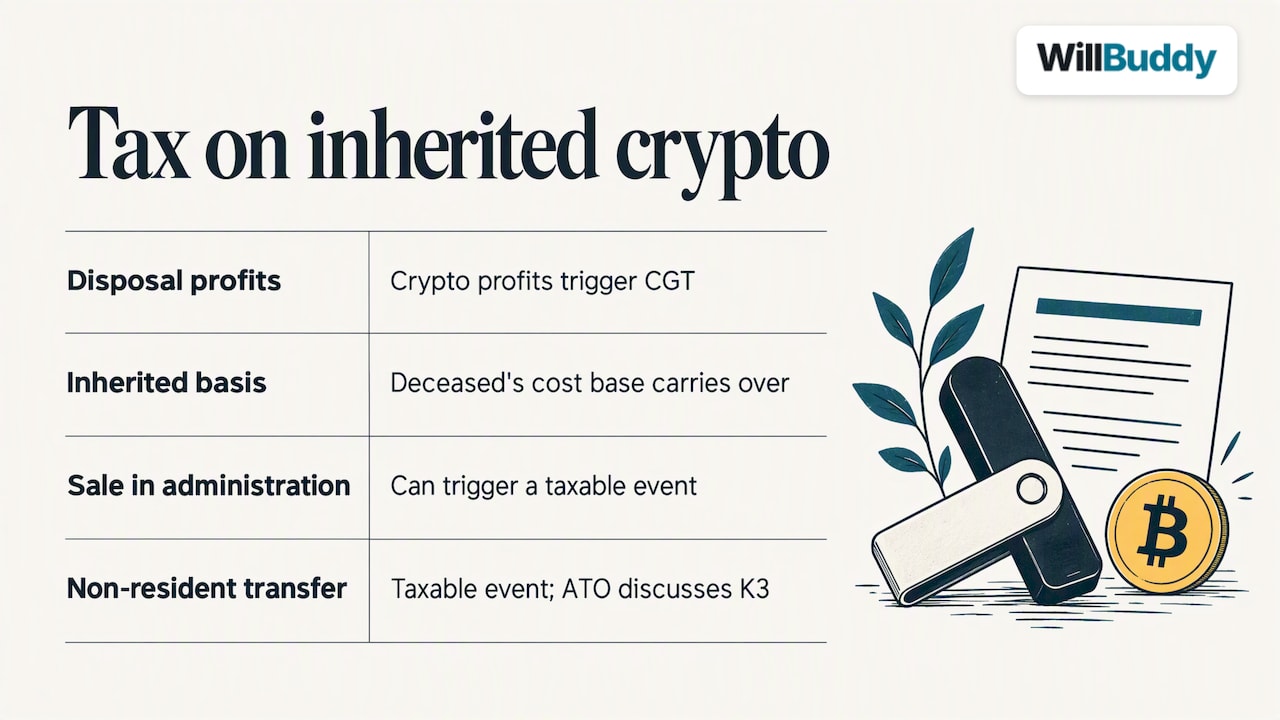
The ATO says capital gains tax applies to profits from disposing of assets, including crypto assets. In an estate, beneficiaries generally take on the deceased person's cost base rather than getting a reset to market value at the date of death. Selling during administration, or transferring to a non-resident beneficiary, can trigger a taxable event. The ATO's legal database discusses CGT event K3 for transfers to non-resident beneficiaries.
Tax depends on your situation. If you hold a large or complicated crypto portfolio, talk to a tax professional or lawyer before you decide who gets what.
Passwords: keep them out of the will
This is the mistake most people make. It feels sensible to write your logins into your will. Don't.
Wills often become public documents once probate is granted. The Queensland Public Trustee says to use a separate, secure and current access list or a trusted password manager with emergency access, and to record only where these are kept, not the credentials.
Here is a safer setup:
- Choose a password manager that has an emergency access feature.
- Set up that emergency contact with someone you trust, who may or may not be your executor.
- Keep a short list of your key accounts: what they are, not the passwords.
- Store the list somewhere safe, like a fireproof box or with your other papers.
- Tell your executor where the list is. Your will can mention the location.
- Review it once a year, or when you change devices or add accounts.
The eSafety Commissioner also covers steps you can take now, such as checking what each platform offers for memorialising or closing accounts.
What to write in the digital part of your will
Keep the wording general. Solicitors often point out that a "digital executor" isn't a recognised legal role. A better approach is to give your main executor broad powers to hire technical, forensic or tax help. Very specific technical steps can date fast, because platforms and methods change quickly.
A good digital section usually covers:
- Who deals with it. Your executor, with power to get specialist help and to deal with online providers.
- What happens to valuable items. For example, crypto goes to a named person or splits among your beneficiaries.
- What happens to sentimental items. Who gets the photo library or cloud storage.
- Your privacy wishes. Say if you want certain accounts, like private messages, closed rather than read.
- Where the access list is kept. Location only.
The privacy question
Your executor has a duty to collect and protect estate value. You may also want private emails or messages left alone. The Law Society of NSW journal commentary notes the tension between those two. Spell out which matters more for each account. If you don't, your executor has to decide.
Pick an executor who can cope
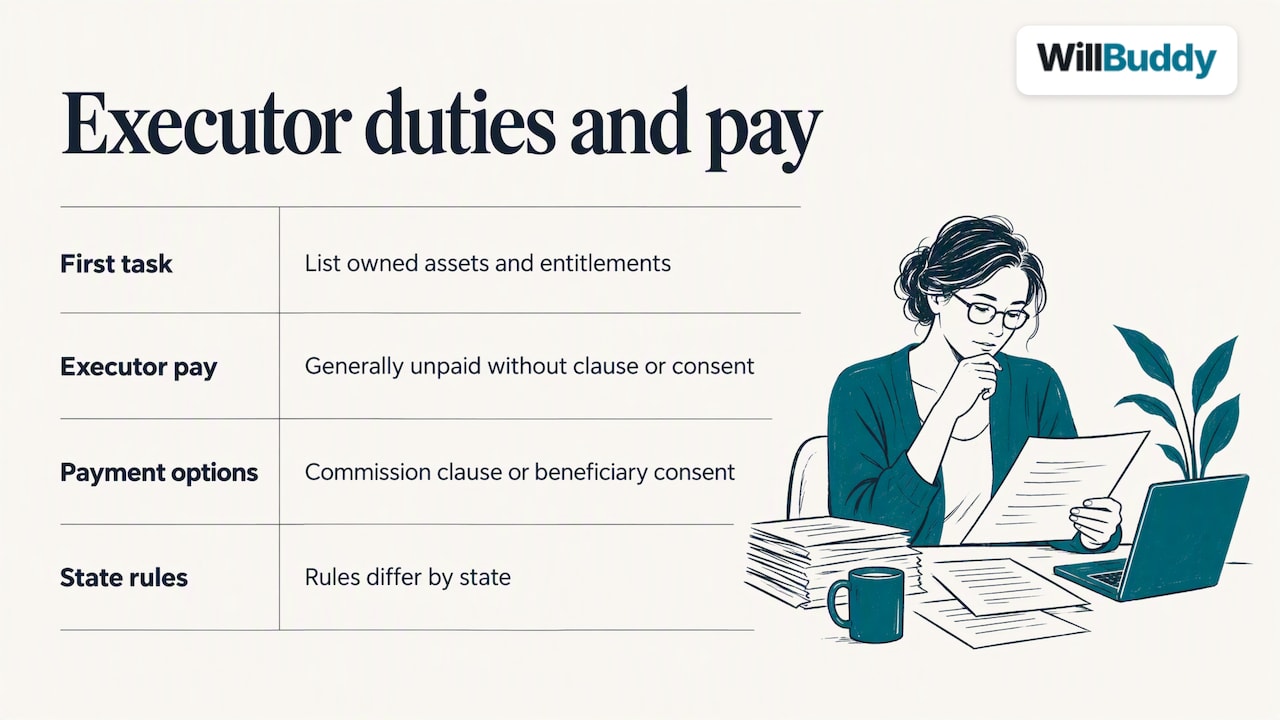
Your executor needs to be organised, and ideally comfortable with technology. The Law Society of NSW says an executor's first job is a list of everything the deceased owned, plus payments or assets they were entitled to. Your digital inventory feeds straight into that list.
If your executor will carry a lot of work, think about whether they can be paid. In Australia an executor is generally not paid for their time unless the will allows it, the beneficiaries agree, or the court allows commission. Rules and limits differ by state. Victoria's LawHub explains the position there. Our guide to executor fees in Australia covers state-by-state detail.
A simple digital inventory to start with
You don't need software. A page or two is plenty. For each item, record:
| Item | Type | What to note | Who should get it |
|---|---|---|---|
| Crypto exchange account | Money value | Name of exchange, rough purchase dates | Named beneficiary |
| Hardware wallet | Money value | Where the device is, where the recovery phrase is stored | Named beneficiary |
| Online investment account | Money value | Provider name | As per will |
| Domain name or website | Money or business value | Registrar, renewal date | Named person |
| Cloud photo library | Sentimental | Provider, how to download | Family member |
| Email account | Both | Provider, your privacy wishes | Close or pass on |
| Social media | Sentimental | Platform, memorialise or delete | Executor to action |
Keep passwords off this list. Add the list's location to your estate papers. Update it when you open or close an account.
Does your state matter?
Yes, for some parts. Wills law, executor commission rules and court processes are set by each state and territory. For example, the commission rules described for Victoria differ from other places. Plan for your own state's rules, and name your state when you get advice.
On digital assets specifically, many states have no dedicated statute. That means platform terms and your own clear instructions do most of the work. The practical steps above apply nationally. The formal requirements for a valid will, such as signing in front of witnesses, are set by your state or territory.
When to see a lawyer
For a straightforward estate, a will you draft yourself can cover digital assets sensibly. Get legal advice if any of these apply:
- You have a blended family.
- You own a business or a trust, including digital business assets.
- You hold assets overseas, including crypto held with overseas platforms.
- You think someone may contest your will.
- You hold a large crypto portfolio with complex tax.
Add digital wishes to your will with WillBuddy
WillBuddy asks plain questions one at a time and drafts a will for your state or territory. You can name your executor, say who gets what, and include gifts and your wishes. You read every word free before you pay, then print and sign with witnesses.
Life changes, and so do your online accounts. Your subscription includes up to 50 AI-assisted edits a year, so you can update your will when you add a wallet or change your executor. Your will and the personal details in it are stored encrypted, and we never sell your data. See the pricing page for current details.
FAQ
Can I leave my cryptocurrency in my will in Australia?
Yes. Crypto forms part of your estate and can be left to a named person like other property. The catch is access. Your executor needs a safe way to reach your keys or accounts, or the gift may be worthless.
Should I put my passwords in my will?
No. A will can become public after probate. Keep a separate, secure access list or use a password manager with emergency access. Your will should only say where it is kept.
Can my executor just log in to my accounts?
Not as of right. Being an executor does not override platform security or terms. Providers have their own deceased-estate processes, and your executor will usually need documents such as a death certificate and the grant of probate.
Do I need to appoint a digital executor?
Not as a separate legal role. Solicitors generally suggest giving your main executor broad powers to get technical or tax help. If you want someone with tech skills involved, say so in your will and name them as a helper.
Do my family pay tax on inherited crypto?
Possibly, when they later sell or dispose of it. Beneficiaries generally take on the deceased person's cost base, as the ATO's CGT guidance and legal database describe. Keep transaction records and ask a tax professional about your case.
Sources
Show the 9 sources
- Digital assets, Queensland Public Trustee
- Deceased Estates and Cryptocurrency Holdings, pl.com.au
- Cryptocurrency, Law Handbook South Australia
- What happens to your digital accounts after you die, eSafety Commissioner
- Digital assets in wills, Law Society of NSW Journal
- Being an executor, Law Society of NSW
- Executors, LawHub Victoria
- Capital gains tax, Australian Taxation Office
- CGT event K3 legal database entry, Australian Taxation Office
Start your will free at willbuddy.com.au and read it before you pay.
Recommended
For the one who gets things sorted
Now write yours, with your family's names in it
Plain questions about your family, one at a time, and WillBuddy drafts a will for your state. Until you sign one, the law in your state or territory decides who gets what. Read every word free, with no card. You pay only if you want to print it.
Start my will freeLast updated 21 October 2026.
This article is general information only and is not legal advice. It is our best interpretation of the law as at 21 October 2026. WillBuddy is not a law firm, and it never replaces advice from a lawyer or solicitor. Laws change and differ between states and territories, so for your own circumstances, please get legal advice.