Can a Will Be Contested in Australia? Grounds and Time Limits
General information, not legal advice.
On this page
- TL;DR
- The two ways a will can be contested
- Grounds for challenging a will's validity
- Unhappy with your share? That is not a ground by itself
- Who can make a family provision claim
- Can you leave your children out of your will?
- Time limits differ by state
- What happens when someone wants to challenge a will
- Can you stop someone contesting your will?
- When to see a lawyer
- Start with a will that is clear and complete
- FAQ
- Sources
- Recommended

Quick answer
Yes. A will can be contested in Australia, and you cannot stop someone trying after you have died. There are two main routes. One argues the will is not valid. The other accepts the will is valid but asks a court for a better share of the estate. Both are governed by state and territory law, so the rules, and especially the time limits, depend on where the person lived.
This guide is general information, not legal advice. It explains how contests work, who can make one, and what you can do while you are alive to make a challenge less likely.
TL;DR
- A will can be challenged because it is invalid (for example, no capacity, undue influence, fraud or poor signing) or because an eligible person did not get adequate provision.
- Being unhappy with your share is not enough on its own. The court looks at the law, the person's needs and the circumstances.
- Time limits are strict and differ by state. They run from as little as three months after the grant of probate (Tasmania) to 12 months (from the date of death in NSW, and from the grant in the Northern Territory). See the table below.
- You cannot block a contest in advance. You can lower the risk with a properly made will, clear reasons and good records.
- Blended families, businesses, trusts, overseas assets or a likely contest are all times to see a lawyer.
The two ways a will can be contested
People use "contest" and "challenge" loosely. In practice, the law treats two different questions.
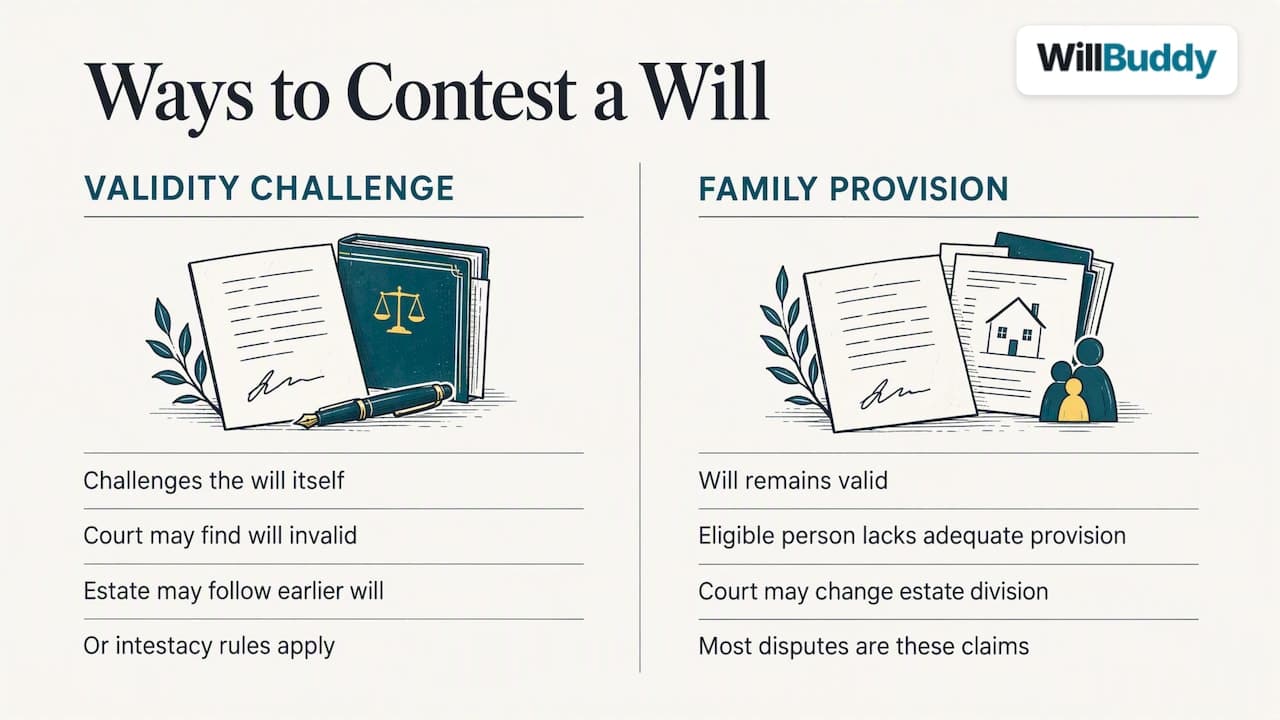
1. Is the will valid? This is a challenge to the document itself. If the challenge succeeds, the court can decide the will (or part of it) does not count. The estate may then be handled under an earlier valid will, or under the intestacy rules if there is none.
2. Was enough provided for an eligible person? This is a family provision claim. The will is valid, but a person with a close link to the deceased says it left them without adequate provision. In NSW, the Supreme Court explains that an eligible person who has not received adequate provision may apply for family provision, and the will is not set aside on that basis. The court can change how the estate is divided instead.
Most disputes in the real world are family provision claims. They are also the ones that surprise will-makers, because a will that is perfectly valid can still be changed.
Grounds for challenging a will's validity
The Supreme Court of NSW lists the usual grounds. A will may be challenged for lack of testamentary capacity, lack of knowledge and approval, forgery, fraud, undue influence or pressure, failure to comply with execution requirements, revocation, or because it is not the deceased's last will. Other states use similar ideas, though the detail can differ.
Here is what each one means in plain words.
Lack of capacity
To make a valid will, a person must understand what a will is, roughly what they own, and who might expect to benefit. Illness or age alone does not remove capacity. The question is the person's mind at the time they made the will. We explain what courts look for in our guide to testamentary capacity in Australia.
Lack of knowledge and approval
The will-maker must know what is in the document and approve it. This can come up when someone is frail, has limited English, or signs a document they did not read or understand. Reading every word before you sign matters.
Forgery and fraud
A forged signature, or a document changed after signing, is not the will-maker's will. Fraud covers tricking someone into signing, or lying about what a document says.
Undue influence
This means pressure that overrides the will-maker's own free choice. Persuading or asking is not the same as coercing. Courts look at the whole relationship and the circumstances. Our article on evidence to save before a will contest covers what tends to matter.
Problems with signing and witnessing
A will must follow the formal rules in the relevant state or territory. Typically that means it is in writing and signed by the will-maker in front of two witnesses who are present at the same time, and who then sign it too. A beneficiary should not be a witness: in some states that can cost them their gift. Mistakes here are common with homemade documents. See our overview of will requirements in Australia and the reasons a will can be invalid.
Revocation or a later will
A challenger may argue the will was cancelled, or that a later will exists. Marriage, divorce and new wills can all affect an older document, and the effect differs by state. Our guide to revoking or cancelling a will explains the methods.
Unhappy with your share? That is not a ground by itself
Many people believe they can challenge a will just because it feels unfair. It is harder than that. Legal Aid WA notes that being unhappy with how an estate is divided, or getting less than others, is not enough for a successful challenge.
The law starts with freedom to choose who gets what. But it also recognises a moral duty to provide for certain family members. The Legal Services Commission of South Australia describes this balance: freedom of testation sits alongside a duty to provide for some people. A family provision claim is where that balance gets tested.
Who can make a family provision claim
Each state and territory has its own succession law, and the differences include who may apply for family provision. Examples of the legislation include the Succession Act 2006 (NSW), the Family Provision Act 1972 (WA) and the Family Provision Act 1969 (ACT). Victoria, Queensland, South Australia, Tasmania and the Northern Territory have their own laws too.
In general, eligible people can include a spouse or de facto partner and the deceased's children. In some states and circumstances they can also include grandchildren, step-children or people who were financially dependent on the deceased. One legal guide describes the typical eligible groups and notes they depend on state legislation. In NSW, the eligible categories are set out in the Succession Act 2006 (NSW).
Being eligible only gets someone through the door. The court then considers things such as:
- the person's financial needs and resources
- their relationship with the deceased
- what the deceased gave them during life
- the size and make-up of the estate
- the needs of other beneficiaries
This is why outcomes are hard to predict. Two similar families can end up with different results.
Can you leave your children out of your will?
You can write a will that leaves a child out. Nothing stops you putting it in writing. But that child may still be an eligible person, and they can apply to the court for provision. An adult child who is financially independent faces a different case from a young child, or a child with a disability. The court looks at the facts.
If you do decide to leave someone out, a few habits help:
- Be clear about it in the will, so no one can say you forgot them.
- Keep a dated, private note of your reasons, stored with your records.
- Make the will while you are well, and keep proof you understood it.
- Think about whether a smaller gift would be fair to you and lower the risk.
Those steps do not prevent a claim. They give the executor better evidence if one is made. If you plan to exclude a child or a partner, speak to a lawyer first.
Time limits differ by state
This is the part people most often get wrong. Deadlines are strict, and courts do not always extend them.
| State or territory | Family provision time limit | Counted from |
|---|---|---|
| NSW | 12 months (Succession Act 2006 (NSW) s 58) | The date of death |
| VIC | 6 months (Administration and Probate Act 1958 (Vic) s 99) | The grant of probate or administration |
| QLD | 9 months (Succession Act 1981 (Qld) s 41(8)). Tell the executor in writing within 6 months, or they may share out the estate first (s 44) | The date of death |
| WA | 6 months (Family Provision Act 1972 (WA) s 7) | The grant of probate or administration |
| SA | 6 months (Succession Act 2023 (SA) s 118) | The grant of probate or administration |
| TAS | 3 months (Testator's Family Maintenance Act 1912 (Tas) s 11) | The grant of probate or administration |
| ACT | 6 months (Family Provision Act 1969 (ACT) s 9) | The grant of probate or administration |
| NT | 12 months (Family Provision Act 1970 (NT) s 9) | The grant of probate or administration |
In every state and territory the court can allow a late claim in some cases, but you cannot count on it. Once the estate has been shared out, a late claim gets much harder, and in some places, such as the Northern Territory, the time cannot be extended after the estate has been fully distributed. If you think you may have a claim, or you are an executor facing one, check your own state's rules straight away. The time can run out sooner than you expect. Challenges to validity follow different procedures from family provision claims, so a lawyer can tell you which deadline applies.
What happens when someone wants to challenge a will
The process varies by state, but it often looks like this.
- Someone raises a concern. A family member questions the will, or says they plan to claim.
- A caveat may be filed. In NSW, a person with a legitimate interest can file a caveat to stop a grant of probate. It stays in force for six months from filing unless it lapses or is withdrawn.
- Negotiation or mediation. Many disputes settle before a hearing. Courts commonly encourage this.
- A court application. If the matter does not settle, the court hears evidence and decides.
- Costs. Estate disputes can be expensive and can reduce what is left for everyone. That is a real reason to keep the will clear and the evidence good.
A challenge can also happen after probate is granted, but delay can hurt a claim, so act quickly.
Can you stop someone contesting your will?
Not completely. The Legal Services Commission of South Australia says plainly that you cannot stop someone contesting your will after you have died. It adds that having a lawyer prepare your will lowers the chance of a successful challenge.
You may have heard of "no contest" clauses, which say a beneficiary who challenges the will loses their gift. Do not rely on one to shut down a family provision claim. An eligible person can still apply, and a court decides what happens. A clause is no substitute for a well-made will.
What you can do is make a challenge less likely to succeed and less likely to start.
Practical steps while you are alive
- Follow the signing rules exactly. Use two adult witnesses who are not beneficiaries, and sign in front of them. Our guide to making a valid will walks through the steps.
- Name everyone who might expect something. Silence invites disputes. A short explanation can settle doubt.
- Keep your will current. Marriage, separation, a new child or a new home can change who should benefit. Divorce can affect a will, and the effect depends on the state.
- Tell your executor where the will is. A lost will creates trouble.
- Record your capacity if health is a worry. If you are elderly or unwell, a doctor's note around the signing date can be valuable evidence.
- Avoid involving a beneficiary in the process. A person who gains from the will should not organise it or be in the room.
- Do not die without a will. Without a valid will, your state or territory's intestacy laws decide who gets what, which may not match your wishes.
When to see a lawyer
An online will suits many straightforward situations. See a lawyer if any of these apply:
- You have a blended family, with children from more than one relationship.
- You own a business, or you use a trust.
- You have assets overseas.
- You expect a contest, or you plan to leave out a close family member.
- You are already facing a claim, or you think you have one.
These cases involve complex rules and big consequences. A lawyer can look at your own facts, which general information cannot.
Start with a will that is clear and complete
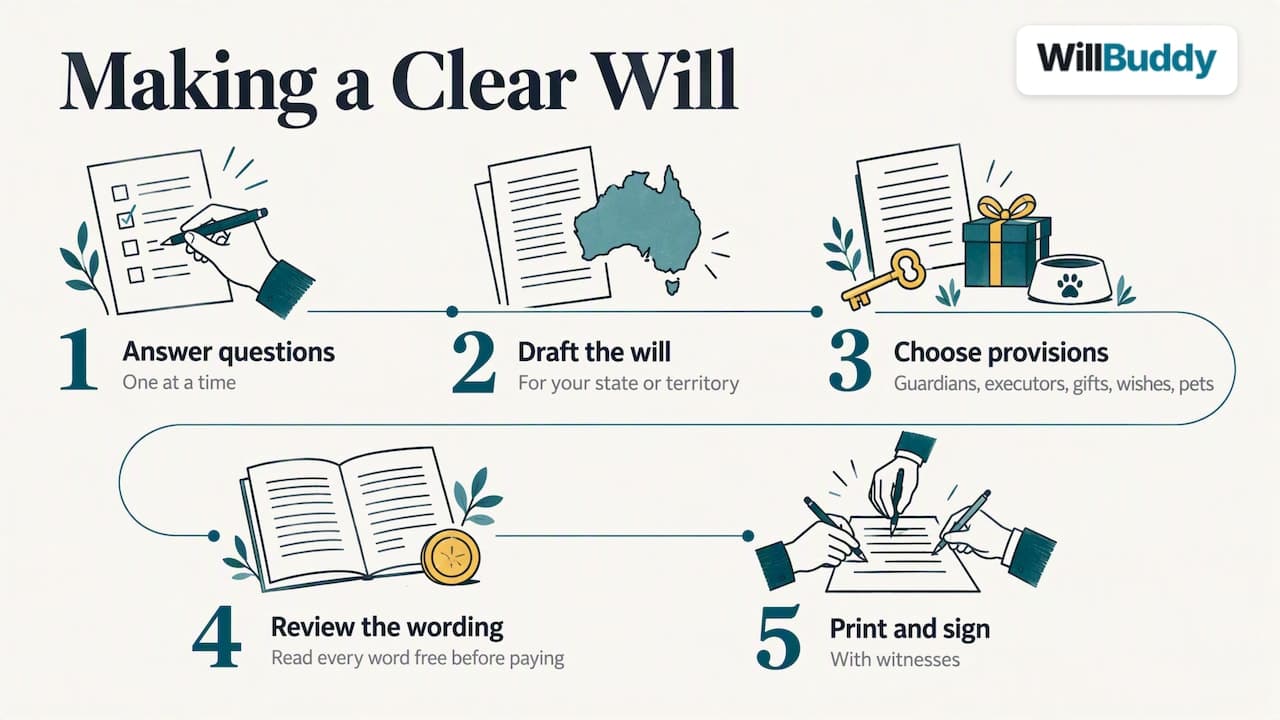
A contest is most likely where a will is vague, out of date or badly signed. WillBuddy asks you plain questions one at a time and drafts a will for your state or territory. You can name guardians for your children, choose your executors, set out gifts and decide on funeral wishes and pets. You can also choose to exclude someone, and you can read every word of the will free before you pay. Then you print it and sign it with witnesses.

As life changes, your will can change with it. Annual access includes up to 50 AI-assisted edits a year, and your personal data is encrypted and never sold. You can see the current price on our pricing page. To see how the process works, try the WillBuddy will builder.
WillBuddy gives general information and a drafting tool. It is not legal advice, and it cannot promise a will will never be challenged.
FAQ
Can a will be contested after probate has been granted?
Yes. A will can be challenged after probate, and a family provision claim can also be made after the grant. The time limit matters. In WA, for example, the limit runs from the grant of probate or letters of administration. Act quickly and get legal advice for your state.
What is the difference between challenging a will and a family provision claim?
A challenge says the will itself is not valid, for example because of undue influence or poor signing. A family provision claim accepts the will is valid but says an eligible person did not get adequate provision. In the second case, the court does not set the will aside in NSW, but it can change how the estate is shared.
Can I exclude my child from my will in Australia?
You can write a will that does so, but the child may still be eligible to apply to the court for provision. The law balances your freedom to choose against a moral duty to provide for some family members. If you plan to exclude a child or partner, see a lawyer in your state.
Does a no-contest clause stop a will being challenged?
No clause can stop someone from applying to a court. You cannot prevent a contest after your death. A properly signed, current will with clear reasons is a better way to reduce the risk.
Is being unhappy with an inheritance enough to contest a will?
No. Receiving less than you hoped, or less than someone else, is not enough on its own. You need a legal ground, or you must be an eligible person who can show a lack of adequate provision.
Sources
Show the 7 sources
- Contested proceedings, Supreme Court of NSW
- Challenging an unfair will, Legal Aid WA
- Who can contest my will?, Legal Services Commission of South Australia
- Uniform Succession Laws, Issues Paper 10, NSW Law Reform Commission
- Succession Act 2006 (NSW)
- Wills and powers of attorney, Moneysmart
- Contesting a Will: Guide to Estate Litigation, BlueRock
Start your will free at willbuddy.com.au and read it before you pay.
Recommended
For the one who gets things sorted
Now write yours, with your family's names in it
Plain questions about your family, one at a time, and WillBuddy drafts a will for your state. Until you sign one, the law in your state or territory decides who gets what. Read every word free, with no card. You pay only if you want to print it.
Start my will freeLast updated 1 November 2026.
This article is general information only and is not legal advice. It is our best interpretation of the law as at 1 November 2026. WillBuddy is not a law firm, and it never replaces advice from a lawyer or solicitor. Laws change and differ between states and territories, so for your own circumstances, please get legal advice.