Executor Age Requirement in Australia: Who Can Act
General information, not legal advice.
On this page
- TL;DR
- The age rule in plain words
- Can a minor be an executor?
- Other requirements besides age
- Is there a maximum age?
- Can an executor also be a beneficiary?
- Does the executor need to live in your state?
- How the rule looks state by state
- How many executors should you name?
- When a professional executor makes sense
- Can an executor be paid?
- What an executor actually does
- A short checklist before you name your executor
- When to see a lawyer
- Make your will and name your executor
- FAQ
- Sources
- Recommended

Quick answer
To act as an executor in Australia, a person must be at least 18 years old. You can write a younger person's name in your will, but they cannot do the job until they turn 18. If your only executor is a minor when you die, the court steps in. That costs time and money your family may not have.
This guide explains the age rule, what it means in each state, and who makes a good executor. It is general information only, not legal advice.
TL;DR
- An executor must be 18 or older when they apply for a grant of probate. LawHub states this plainly.
- You can name a person under 18, but they cannot act until they reach 18. A guardian usually steps in as administrator until then.
- There is no upper age limit. The real test is capacity: the person must be able to understand and manage the job.
- Name at least two executors, or one plus a backup. That makes a court-appointed substitute less likely.
- See a lawyer if you have a blended family, a business or trust, assets overseas, or a likely contest.
The age rule in plain words
An executor is the person you pick in your will to carry out its terms. They collect your assets, pay your debts, and hand over what is left to the people you chose.
The age rule is simple. The Victorian legal information service LawHub says an executor must be over 18 when they apply for a grant of probate. The Queensland Law Handbook puts it the same way: any person aged 18 or older may be an executor, as long as they do not lack mental capacity.
Two points are worth noting:
- The age is checked when the executor applies for probate, which is after your death. It is not checked when you sign your will.
- Turning 18 is the only age test. There is no rule that an executor must be 21, 25 or any older age.
Can a minor be an executor?
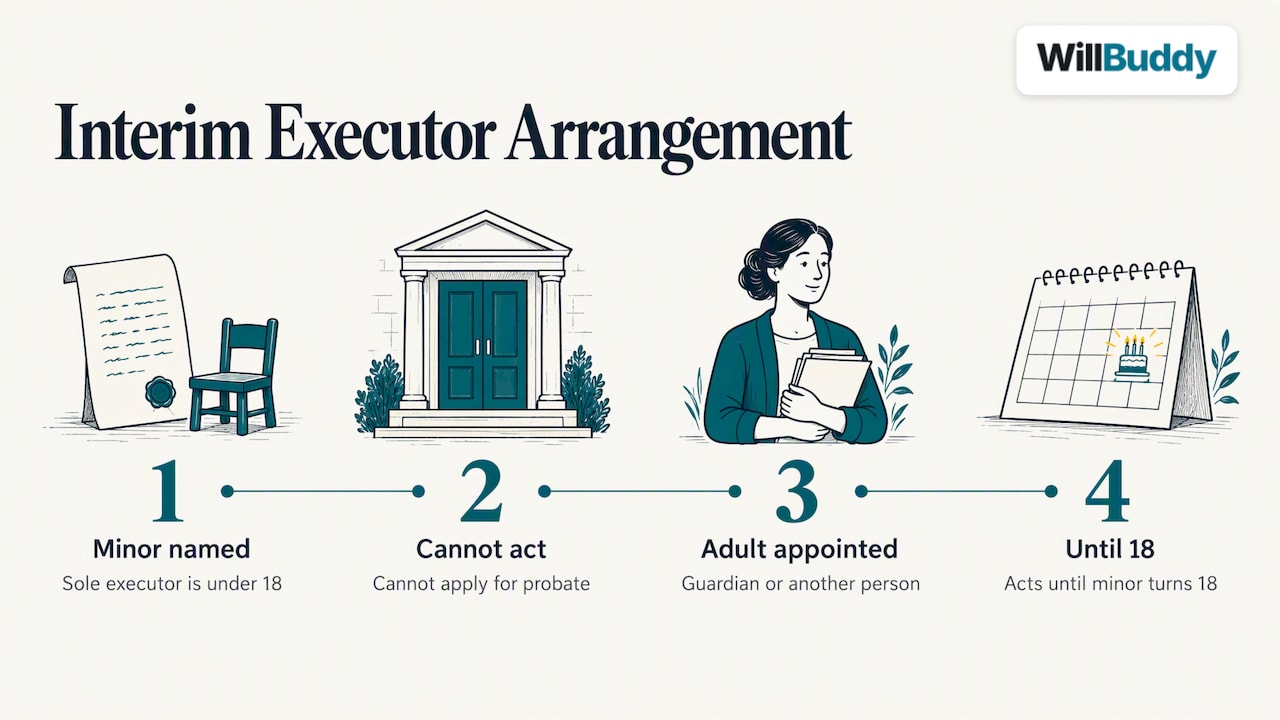
You can name a minor in your will. A minor cannot act until they turn 18.
That gap matters. Say you name your 16-year-old daughter as sole executor and you die when she is 16. She cannot apply for probate. Someone else must be appointed to run the estate until she is old enough.
The law deals with this in a set way. In New South Wales, section 70 of the Probate and Administration Act 1898 says that where a minor is sole executor, administration with the will annexed may be granted to a guardian of the minor or another person. In Victoria, grants of probate and administration are made under the Administration and Probate Act 1958, and LawHub's 18-year rule applies there.
In practice, the court usually appoints the minor's guardian to act as administrator until the minor turns 18, as the South Australian Law Handbook explains. Western Australia follows a similar approach. A legal commentary on the Administration Act 1903 (WA) says the court will not grant administration to a minor, but may grant it to their legal guardian for the period until they turn 18.
What this means for you
The court process is not impossible. It is just slower and dearer than it needs to be. The person who steps in may not be someone you would have chosen. Your estate also waits while the application is sorted out.
The fix is easy. Name an adult as your executor, and name a second adult as a backup. Our guide to a backup executor in a will shows how.
Other requirements besides age
Age is only the first test. Most Australian sources list a few more.
- Mental capacity. The person must be of sound mind. The Queensland Law Handbook says the person must not lack mental capacity.
- Able to do the work. Someone who is in prison, seriously unwell or rarely contactable may struggle to carry out the job, even where the law does not bar them.
- No special qualifications. You do not need a law or finance degree to be an executor. The role does call for a reliable and competent adult.
- A real willingness to act. Being named does not force anyone to take it on. A person can refuse the role. That is another reason to name a backup.
The rules on who can apply for probate differ a little between states and territories, and they can change. If you are unsure about a specific person, such as someone who is bankrupt or has a serious health condition, ask a lawyer in your state.
Is there a maximum age?
No. Nothing in the sources we checked sets an upper age limit. A 78-year-old with capacity can be an executor.
Still, think about time. Administering an estate often takes many months, and it can take a year or more. Legal Aid NSW says an executor in NSW should apply for probate within six months of the death, and the assets still have to be collected and the debts paid after that. If your first choice is your 85-year-old spouse, ask yourself who would carry on if their health failed. Then name that person too.
Can an executor also be a beneficiary?
Yes. LawHub notes that executors can benefit from a will, and that it is common to appoint a spouse or children. Many Australians name their partner as executor and as the main beneficiary.
This works well in a simple family. It can cause friction where relationships are strained, so think about it before you sign.
Does the executor need to live in your state?
There is no age rule about this, but there is a practical one. LawHub suggests it is often easier to appoint someone who lives in the same state as you. The executor may need to visit banks, manage a property and work with local professionals.
An executor who lives overseas or interstate can still act. It just adds cost and delay. Our guide to choosing a will executor in Australia explains how to match the person to your assets.
How the rule looks state by state
The 18-year threshold is consistent in the sources above, but the legislation sits in different Acts. Here is a quick map of what we cited.
| State or territory | Where the rule or procedure sits | What it covers |
|---|---|---|
| New South Wales | Probate and Administration Act 1898, s 70 | Minor is sole executor: administration with the will annexed can go to a guardian or another person |
| Victoria | LawHub (Victoria Legal Aid) | An executor must be over 18 when they apply for a grant of probate |
| Queensland | Queensland Law Handbook | Executors must be 18 or older and have mental capacity |
| Western Australia | Administration Act 1903 (commentary) | Court will not grant administration to a minor, but may grant it to a guardian |
| South Australia | SA Law Handbook | Guardian typically acts as administrator until the minor turns 18 |
If you live in Tasmania, the ACT or the Northern Territory, check your own local law or ask a local lawyer. We have not cited a primary source for those places here, so we do not state their rules.
How many executors should you name?
Naming at least two is a common good practice. LawHub says that if one executor dies, loses capacity or refuses the role, a second can step in. That avoids the need for a court to appoint an administrator.
A simple way to plan it:
- Pick a first executor. This is usually a spouse, partner, adult child or trusted friend.
- Pick a second executor to act with them, or a backup who takes over if the first cannot act.
- Check that every person is 18 or older now, and will still be an adult who can act later.
- Ask each person if they are willing. Do not surprise them.
- Review the choice when life changes, such as a divorce, a death or a move interstate.
Our guide on naming more than one executor covers how joint executors work together.
If your children are young
Parents often ask if they can name their kids. Name them only as a later option, not as the main choice. Say your eldest is 17 today. By the time you die, they may be 30. But you cannot count on that, so keep an adult in first place.
The same planning helps with guardians. Choosing who will care for your children is a separate decision from choosing who will manage your estate. One person can do both, or you can split the roles.
When a professional executor makes sense
Most people pick someone they know. LawHub says that where the estate or family dynamics are complex, an independent executor such as a lawyer or trustee company can be a better choice.
That can help when:
- Family members are likely to disagree.
- The estate is large or has many moving parts.
- Nobody in your circle has the time or temperament.
Professionals charge for their work, so weigh that cost. We do not recommend a particular provider.
Can an executor be paid?
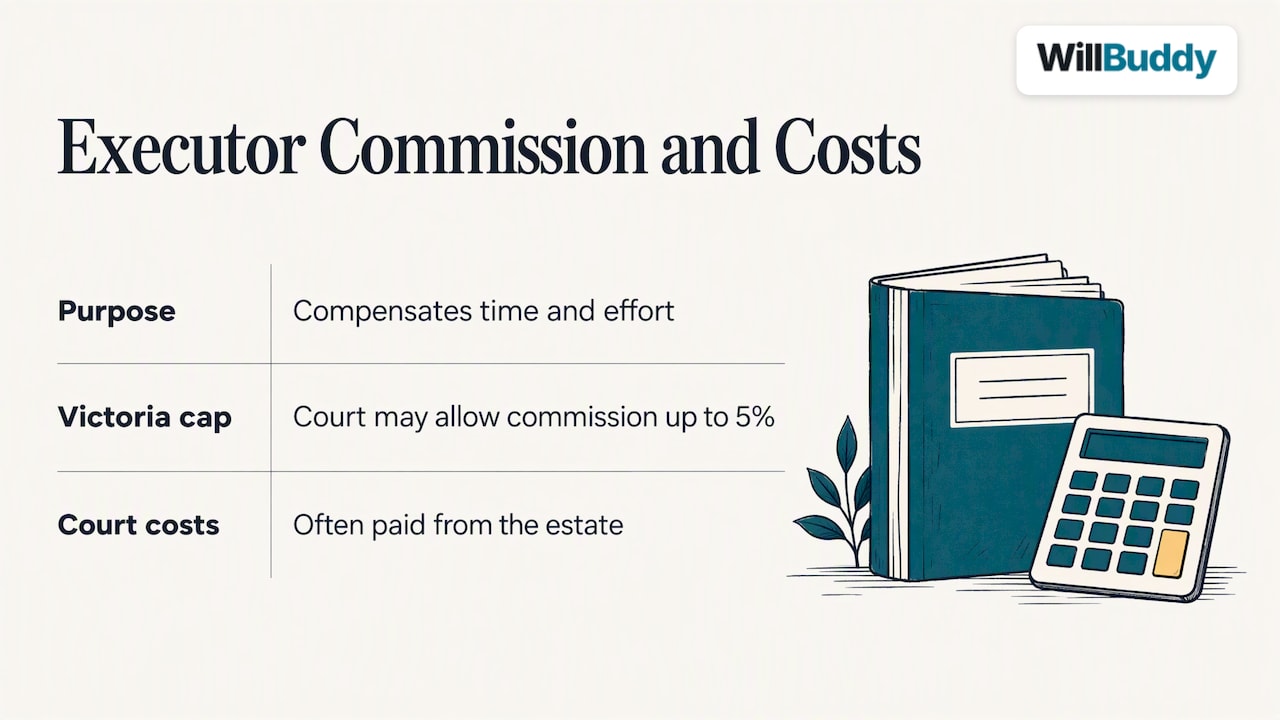
Sometimes, but not automatically. The Supreme Court of NSW explains that executor commission is meant to compensate for time and effort, which it describes as "pains and trouble". It is not a gift, and beneficiaries can challenge an executor's accounts.
The amount is capped in some places. In Victoria, section 65 of the Administration and Probate Act 1958 allows the court to allow commission not exceeding five per cent, as quoted in Re Steficar [2024] VSC 560. Rules differ by state.
If an executor forces a court application, the legal costs often come out of the estate. That reduces what beneficiaries receive. Talking it through early is the better path. We explain more in our guide to executor fees in Australia.
What an executor actually does
Knowing the job helps you choose well. In most estates, an executor will:
- Protect the estate's assets.
- Apply for a grant of probate where it is needed.
- Pay debts, taxes and funeral costs.
- Keep records of what they do and report to beneficiaries.
- Distribute what is left as the will says.
Legal Aid NSW names the most important of these: taking control of the assets, identifying and paying debts, applying for probate and distributing the estate. Our executor role and responsibilities guide goes into each step. If you want a full checklist, see the estate administration guide.
Probate is not needed in every estate. Legal Aid WA says you may need a grant of probate if the deceased held bank accounts, shares or real estate in their own name. Banks and other institutions set their own rules, so the executor should ask each one early.
A short checklist before you name your executor
- Are they 18 or older today?
- Are they likely to have capacity when you die?
- Do they live in your state, or can they manage from afar?
- Are they organised, honest and willing?
- Do you have a backup who also meets these tests?
- Have you told them where your will is kept?
If you can answer yes to each, you are in good shape.
When to see a lawyer
A simple will for a simple estate is something many adults can prepare themselves. Some cases need more care. Talk to a lawyer in your state if:
- You have a blended family.
- You own a business or have a trust.
- You have assets overseas.
- You expect someone to contest your will.
These situations raise questions that general information cannot settle.
Make your will and name your executor
WillBuddy lets you draft a will for your state or territory by answering plain questions, one at a time. You choose your executor, add a backup, name guardians for your children and set out who gets what. You can read every word for free before you pay. Then you print it and sign it with witnesses. Our will requirements guide explains how valid signing works.
An annual subscription keeps your will stored securely and lets you make up to 50 AI-assisted edits a year. That is handy when a child turns 18 or an executor moves away. See the Annual Access plan and price for details.
FAQ
Can a 17-year-old be an executor in Australia?
You can name a 17-year-old in a will, but they cannot act until they turn 18. If they are the only executor, the court usually appoints their guardian to act until then. It is safer to name an adult first.
Is there an age limit for executors?
The minimum is 18. The sources we checked set no maximum. The real test is whether the person has the capacity and health to do the job, which can take a year or more.
Does an executor have to live in the same state?
No. An executor can live elsewhere, but it is often easier if they live in your state. They may need to deal with local banks, property and professionals.
Can I name just one executor?
Yes, but naming two or more is common good practice. If your only executor dies or declines, the court may need to appoint someone else. A backup avoids that.
What if my executor is under 18 when I die?
They cannot apply for probate. Under laws such as section 70 of the NSW Probate and Administration Act 1898, administration can go to a guardian or another person. Rules vary by state, so a local lawyer can advise on your case.
Sources
Show the 11 sources
- Executors, LawHub (Victoria)
- Probate and Administration Act 1898 (NSW)
- Administration and Probate Act 1958 (Vic)
- Queensland Law Handbook, Wills and estates
- Letters of Administration, unusual situations (WA)
- South Australian Law Handbook, executors
- Applying for probate, Legal Aid NSW
- What to do with the estate, Legal Aid NSW
- Duties of an executor, Legal Aid WA
- Accounts passed and commission, Supreme Court of NSW
- Re Steficar [2024] VSC 560
Start your will free at willbuddy.com.au and read it before you pay.
Recommended
For the one who makes it easy for everyone
Make it easy for whoever sorts things out after you
Your will names your executor, and a backup if they can't act, so nobody is left guessing. You can also say whether they're paid. WillBuddy drafts it for your state from plain questions. Read every word free, with no card. You pay only if you want to print it.
Start my will freeLast updated 25 October 2026.
This article is general information only and is not legal advice. It is our best interpretation of the law as at 25 October 2026. WillBuddy is not a law firm, and it never replaces advice from a lawyer or solicitor. Laws change and differ between states and territories, so for your own circumstances, please get legal advice.