Will Template vs Online Will: What's the Difference?
General information, not legal advice.
On this page
- TL;DR
- What is a will template?
- What is an online will?
- The main differences side by side
- Why a guided will suits most families
- What makes a will valid in Australia
- Guardians for your children
- What a will cannot do
- Worked example: a couple with two young children
- Keeping your will up to date
- What does it cost?
- When to see a lawyer
- Make your will with WillBuddy
- FAQ
- Sources
- Recommended

Quick answer
A will template is a fixed document with blanks you fill in yourself. An online will asks you questions, one at a time, and drafts the document for your state or territory. For most Australian adults with a straightforward estate, and especially parents who want to name a guardian, the guided online route is the easier and safer way to end up with a will that is set out properly. WillBuddy lets you draft your will and read every word free before you pay.
This is general information only, not legal advice.
TL;DR
- A template is a blank form. You decide what goes in each gap and how it is worded.
- An online will asks plain questions and builds the document around your answers and your state or territory.
- Either way, a will must normally be in writing, signed, and witnessed by two adults. If a step is missed, the will may fail unless a court accepts it. Witnessing rules differ by state.
- Parents can name a guardian for children under 18 in a will. That is often the main reason to make one.
- See a lawyer if you have a blended family, a business or trust, assets overseas, or a likely contest.
What is a will template?
A template is a ready-made layout. You get headings and standard clauses, then you type in names, gifts and instructions. Some are free downloads. Some are sold as "will kits", often a form with a guide.
The template does not know your situation. It does not ask whether your children are under 18. It does not check whether you have named someone to receive a gift who is also about to witness your will. It does not tell you that some assets cannot be left in a will at all. You have to know what to include and how to word it.
That is fine if you know exactly what you want and are confident with legal wording. Most people are not, and that is the gap an online will is built to fill.
What is an online will?
An online will is made through a website. You answer plain questions. The platform turns your answers into a will, written for the state or territory where you live.
With WillBuddy, the questions come one at a time. You can cover:
- guardians for your children
- your executor, the person who carries out your will
- who receives your estate and any specific gifts
- funeral wishes and pets
- people you want to exclude
You can read the full will free before you pay. Then you print it and sign it with witnesses. Nothing about that last step changes because the drafting was done online.
The main differences side by side
| Will template | Online will | |
|---|---|---|
| How you start | Blank form with gaps | Plain questions, one at a time |
| Wording | You choose and edit it | Drafted from your answers |
| State or territory | You need to know your own rules | Written for your state or territory |
| Children and guardians | Only if you think to add them | Asked about as part of the questions |
| Changes later | Edit the document yourself | Update your answers as life changes |
| Signing | Print, sign, witness | Print, sign, witness |
The last row matters. Neither option is "digital" in the sense of being signed on a screen. For almost everyone, the will still has to be printed and signed in front of witnesses.
Why a guided will suits most families
The risk in will-making is rarely the big decision. It is the small gap. A missing guardian. A gift worded in a way that can be read two ways. A witness who should not have been a witness.
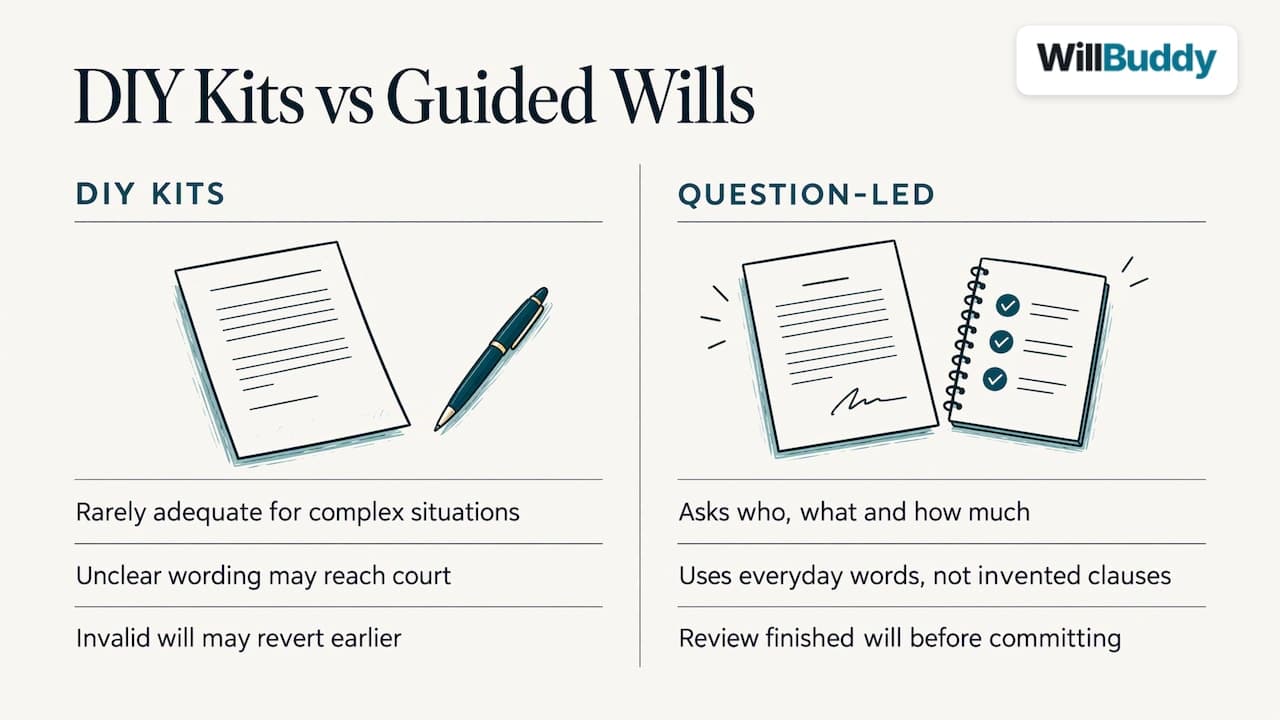
The NSW Trustee and Guardian warns that DIY will kits are rarely adequate for complex situations. It says unclear wording may have to be settled by a court, which can mean long delays and costs. It also says that if a court finds a will invalid, the estate can revert to an earlier will or to no will at all, which may benefit people you did not intend.
A question-led process is built to close those gaps before you reach the signing table. You are not asked to invent clauses. You are asked who, what and how much, in everyday words. You also see the finished will before you commit, so you can check that it says what you mean.
What makes a will valid in Australia
The rules sit in state and territory law, so details differ. The core is similar everywhere.
The NSW Government says a valid will must be in writing (typed or printed). You must sign it, or someone else must sign for you at your direction and in your presence if you are physically unable. Two adults must witness you signing, and witnesses cannot be beneficiaries, meaning people who receive something under the will. Under section 10 of the Succession Act 2006 (NSW), a gift to a witness can fail unless an exception applies, for example two other witnesses who are not beneficiaries.
The Northern Territory Government says the same in substance: written, dated and signed in front of two witnesses, preferably independent, who are not beneficiaries.
In the ACT, section 9 of the Wills Act 1968 requires a will to be in writing and signed by you, or by someone else in your presence and at your direction. The signature must be made or acknowledged in front of two or more witnesses present at the same time, who each sign in your presence. The same Act says, in section 8, that a will made by someone under 18 is not valid, apart from a few exceptions such as a minor who is married or has a court order.
South Australia differs on one point. Under the Succession Act 2023 (SA), as summarised in the South Australian Law Handbook, a beneficiary or their spouse or domestic partner may witness a will under section 13. The handbook still says it is preferable to use people who are not named in the will. The same handbook says a will should have one signed original only, any change made before signing should be signed or initialled by you and both witnesses, and nothing should be written on it after signing. If the signing rules are not met, the estate may be dealt with as if there were no will, unless a court orders otherwise.
The safe habit in every state is the same: use two independent adults who are not in your will and are not the partner of someone who is, and sign with both of them in the room. You can read more in our guides to will requirements in Australia and who can witness a will, state by state.
What about witnessing by video?
Victoria now allows it in some cases. Under the Wills Act 1997 (Vic), as changed by the Justice Legislation Amendment (System Enhancements and Other Matters) Act 2021, a will can be signed and witnessed by audio-visual link. The Victorian Government's guide for justices of the peace says everyone taking part must be physically in Victoria, every step must be done on the same day, and a special witness, such as a justice of the peace, is needed for a will. Check the rules in your own state or territory before relying on video.
Guardians for your children
This is the reason many parents finally make a will.
The NSW Government says that if you have children under 18, it is a good idea to nominate a guardian in your will. That person would look after them and make important decisions if both parents die. You can choose one or more people. It suggests talking over living arrangements, education, access to financial support and whether to set up a trust for the children.
If you do not name anyone, a relative or family friend can apply to the court to care for the children, and the court decides.
The South Australian Law Handbook adds a useful detail. Where one parent dies, the surviving parent would usually take sole responsibility for the children. A parent or guardian with sole responsibility for a child's long-term care, for example through a court order, can say in their will who should care for the children after their death.
A template will not prompt you on any of this. A guided online will asks about your children early, so the guardian question is not left until after you have signed. For a closer look, read our guides on minor children, guardians and trusts and how to word a guardian appointment.
What a will cannot do
Both templates and online wills share one limit. Some property does not pass under a will.
The NSW Government lists several examples:
- Super and life insurance. In many cases these are paid by the fund trustee, not through your will.
- Joint tenancy assets. A home or account held as joint tenants passes to the surviving owner.
- Trust assets. These follow the trust deed.
- Company assets. Your shares can be gifted, but the company's own assets cannot.
Property in your estate that your will does not deal with passes under intestacy law, the rules that apply when there is no valid instruction. Before you decide who gets what, list your assets and note how each one is held. That list makes any will, template or online, far more accurate.
Worked example: a couple with two young children
Take a couple in Adelaide with two children under 10. They own their home as joint tenants, have super in two funds, and a car and savings in their own names.
With a blank template, they might list the house and the savings and miss the guardian clause entirely. The house will pass to the surviving owner by survivorship, whatever the will says. The super may go by the fund's own rules.
With a guided process, they are asked who should care for the children, who should be the executor, who should receive the estate and in what order. The questions are in plain words and they can read the draft in full before paying. Then they print it and sign it with two independent adults, which in South Australia is the habit the Law Handbook prefers.
This is an illustration only, not a real case.
Keeping your will up to date
A will is not a one-off job. Children are born. Relationships change. You move house or buy property.
With a template, you usually edit the document yourself and sign the new version with witnesses, taking care not to scribble on a signed copy. The South Australian Law Handbook says nothing should be written on a will after signing, and any alteration made before signing should be signed or initialled by you and both witnesses.
With WillBuddy's annual access, you can make up to 50 AI-assisted edits a year, and your will is stored securely in Australia while your plan is active. You can print it or save it as a PDF when you need it. When you change the will, you still print and sign the new version with witnesses.
Where the original is kept matters too. Whoever will look for it needs to know where it is. Keep the signed original somewhere safe and tell your executor.
What does it cost?
Costs vary a lot. The NSW Government says will costs depend on your assets, how complex your affairs are and who prepares the will. With an online subscription, you know the cost before you commit, and you pay after you have read your will. You can see the current WillBuddy plan on the pricing page.
When to see a lawyer
An online will suits a straightforward estate. See a lawyer before you sign if any of these apply:
- You are in a blended family, with children from more than one relationship.
- You own a business or are part of a trust.
- You have assets overseas.
- You think someone is likely to contest your will.
The NSW Trustee and Guardian says the same about complex situations. These are the cases where tailored advice is worth having.
Make your will with WillBuddy
WillBuddy is built for people who have been putting a will off. You answer plain questions, one at a time. It drafts a will for your state or territory, and you read every word free before you pay. If you want your will kept current, annual access covers secure storage and up to 50 AI-assisted edits each year. Your personal data is encrypted and is not sold. See the annual access plan.
If you live in South Australia, you can also grab the free SA will guide.
FAQ
Is an online will legally valid in Australia?
A will is valid because of how it is made, not where it was drafted. It must be in writing, signed by you and witnessed by two adults, as set out in your state or territory law. An online will that you print and sign this way follows the same steps as any other will.
Can I use a will template for my children's guardian?
Yes, you can write a guardian clause into a template. The difficulty is knowing to do so and wording it clearly. A guided online will asks about children as part of its questions, so the clause is not forgotten.
Who can witness my will?
Use two adults who are not named in your will. NSW and the NT say witnesses cannot be beneficiaries. South Australia allows beneficiaries to witness but says it is preferable to use people who are not named. Both witnesses must see you sign.
Who keeps the original will?
The signed original is the document that counts, so keep it safe and tell your executor where it is. Some people keep it at home, in a safe, or with a trusted person. WillBuddy also stores your will securely, so you can print or download it again.
Can I leave my super in my will?
Often not. In many cases super and life insurance are paid by the fund trustee, not through your will. Check how each asset is held and what your fund allows.
Start your will free at willbuddy.com.au and read it before you pay.
Sources
Show the 6 sources
Recommended
For the one who checks before they pay
See your whole will before you spend a cent
Put off by the cost? Until you have a will, the law in your state or territory decides who gets what. WillBuddy drafts yours for your state from plain questions about your family. Read every word free, with no card. You pay only if you want to print it. A solicitor gives personal legal advice; WillBuddy doesn't.
Start my will freeLast updated 19 November 2026.
This article is general information only and is not legal advice. It is our best interpretation of the law as at 19 November 2026. WillBuddy is not a law firm, and it never replaces advice from a lawyer or solicitor. Laws change and differ between states and territories, so for your own circumstances, please get legal advice.