Power of Attorney vs Will: Australia’s State Rules and Who Acts
General information, not legal advice.
On this page
- What is a will and what does it cover?
- What is a power of attorney and how does it work?
- How do a will and a power of attorney differ?
- What types of power of attorney and related documents exist?
- Who should you appoint as attorney and executor?
- How do you make a will and an EPA in Australia?
- Do you need both a will and a power of attorney?
- What is your checklist for creating, signing and storing your documents?
- Draft a state-specific will with WillBuddy
- FAQ
- Sources
- Recommended


Quick answer
A will deals with your estate after you die. A power of attorney handles decisions while you are alive. The two never overlap in time: an enduring power of attorney ends at death, and the executor named in your will takes over. Most adults benefit from having both documents in place.
In short
- A general power of attorney ends if you lose capacity; an enduring power of attorney continues, but its powers and forms vary by state.
- Choose an attorney for trustworthiness, financial skill, and availability, name an alternate, and remember that a tribunal may appoint an administrator if none can act.
- Prioritise an enduring power of attorney when finances or health raise concern; prioritise a will naming a guardian when you have young children.
- Western Australia separates enduring guardianship from financial authority, while the Northern Territory uses an Advance Personal Plan; check your state’s forms before signing.
- There is no national register for enduring powers of attorney; check state witnessing rules, store originals safely, and tell appointees where to find them.
What is a will and what does it cover?
A will is a legal document that sets out how your assets are shared after your death. It usually names your beneficiaries, any specific gifts, your executor, guardians for young children and your funeral wishes. If you have kids, the guardian clause is often the most important line in it.
To make a valid will, you need testamentary capacity. In plain terms, that means you understand what you own, who your family is and what the document does. Our guide to testamentary capacity explains what courts look for. Adults in Australia who have that capacity can make a will, and the formal rules are set out in our guide to will requirements.
After you die, your executor collects the assets, pays debts and hands out gifts. For many estates, the executor first needs probate, the Supreme Court's grant confirming the will and the executor's authority to deal with your assets.
What is a power of attorney and how does it work?
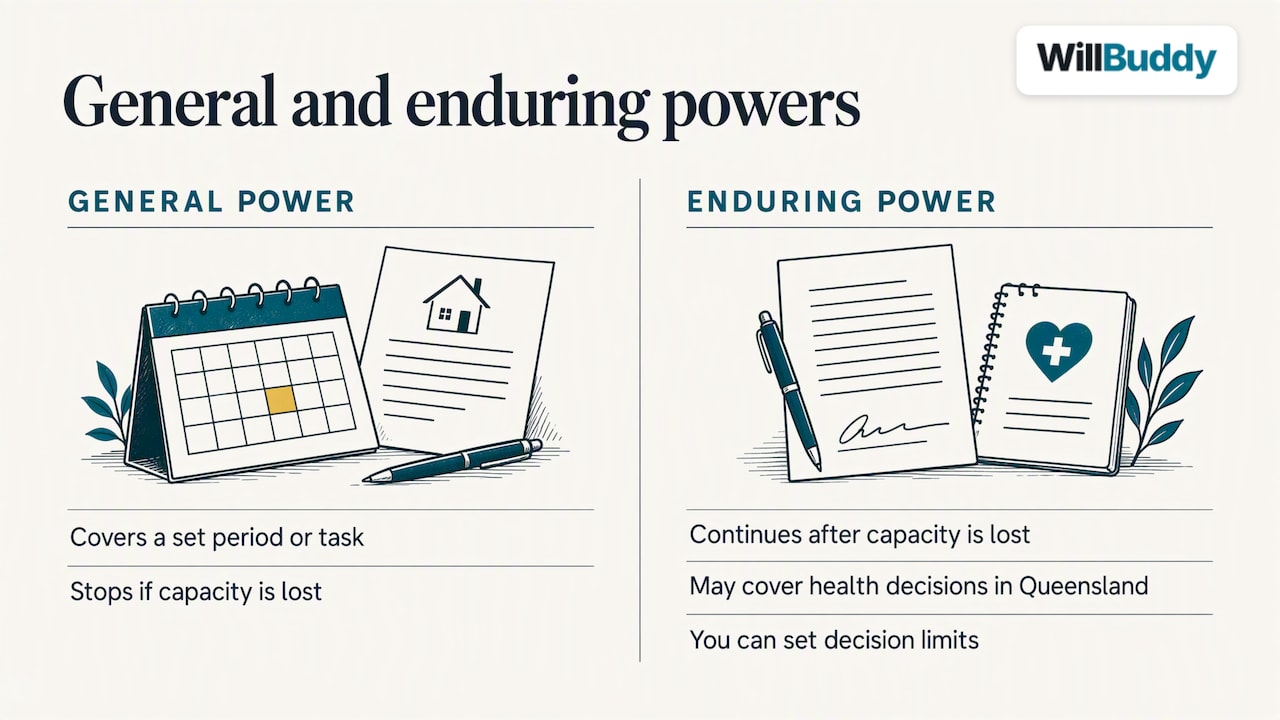
A power of attorney lets you appoint someone, called your attorney, to make financial and legal decisions for you while you are alive. A general power of attorney usually covers a set period or task, such as a property sale while you are overseas. It stops if you lose capacity.
An enduring power of attorney (EPA) keeps working after you lose capacity. In Queensland, it can also cover personal and health care decisions, and you can set limits on what your attorney may decide.
Typical attorney tasks include paying bills and managing bank accounts. Where you have authorised it, an attorney can also buy or sell property in your best interests. Our article on enduring power of attorney in Australia walks through the state steps.
How do a will and a power of attorney differ?
The easiest way to see the split is by timing, scope and who is in charge when you die.
- Timing: an EPA works while you are alive. A will only takes effect after death.
- Scope: an EPA covers financial matters and, in some states, personal and health matters. A will covers who inherits and who administers your estate.
- Effect at death: the power of attorney ends the moment you die, and the executor takes control under your will.
- Who acts: your attorney acts for you in life. Your executor acts for your estate after death.
- Limits: an attorney cannot make or change your will.
A common myth is that your attorney can keep using the power of attorney after you die. They cannot. Once you die, only the will and the executor's legal authority count.
What types of power of attorney and related documents exist?
Several documents sit alongside a will, and each covers a different job.
- Enduring power of attorney: financial and property decisions that continue if you lose capacity.
- General power of attorney: financial decisions for a limited time or purpose, which ends if you lose capacity.
- Enduring power of guardianship: personal, lifestyle and treatment decisions. In Western Australia this is a separate document from the EPA, which is the one that covers financial decisions.
- Advance care directive: your own written wishes about future health care.
Names and forms differ by state. In the Northern Territory, the equivalent document is the Advance Personal Plan. Some states, such as Queensland, let one EPA cover both financial and personal matters, while others, such as Western Australia, use separate documents, so check which forms your state uses.
Who should you appoint as attorney and executor?
An attorney handles money while you are alive, so look for:
- trustworthiness, since the role carries wide authority;
- financial competence;
- availability and willingness to take it on.
Because an EPA gives so much control, it is worth getting legal advice if you are worried the authority could be misused.
An executor needs to be organised, communicate well with family and be willing to do the paperwork.
The same person can fill both roles, and that often works well for a spouse. Splitting them can suit you if one person is better with money and another is better at handling family conversations.
If you lose capacity with no EPA, a tribunal may appoint someone you did not choose, such as a public trustee, to manage your finances.
Pro Tip: Name an alternate for both roles, so a plan does not fall over if your first choice is unwell or unwilling.
How do you make a will and an EPA in Australia?
Follow these steps, and check your own state's rules as you go.
Capacity comes first. Both documents must be signed while you have the capacity the law requires for each, so plan while you are well.
Witnessing rules are strict and vary by state. Check the rules that apply to your will. Our page on who can witness a will lists common mistakes. EPA forms also have their own witnessing rules, and some states limit who may witness one. In Queensland, for example, the witness must be a justice of the peace, commissioner for declarations, notary public or lawyer.
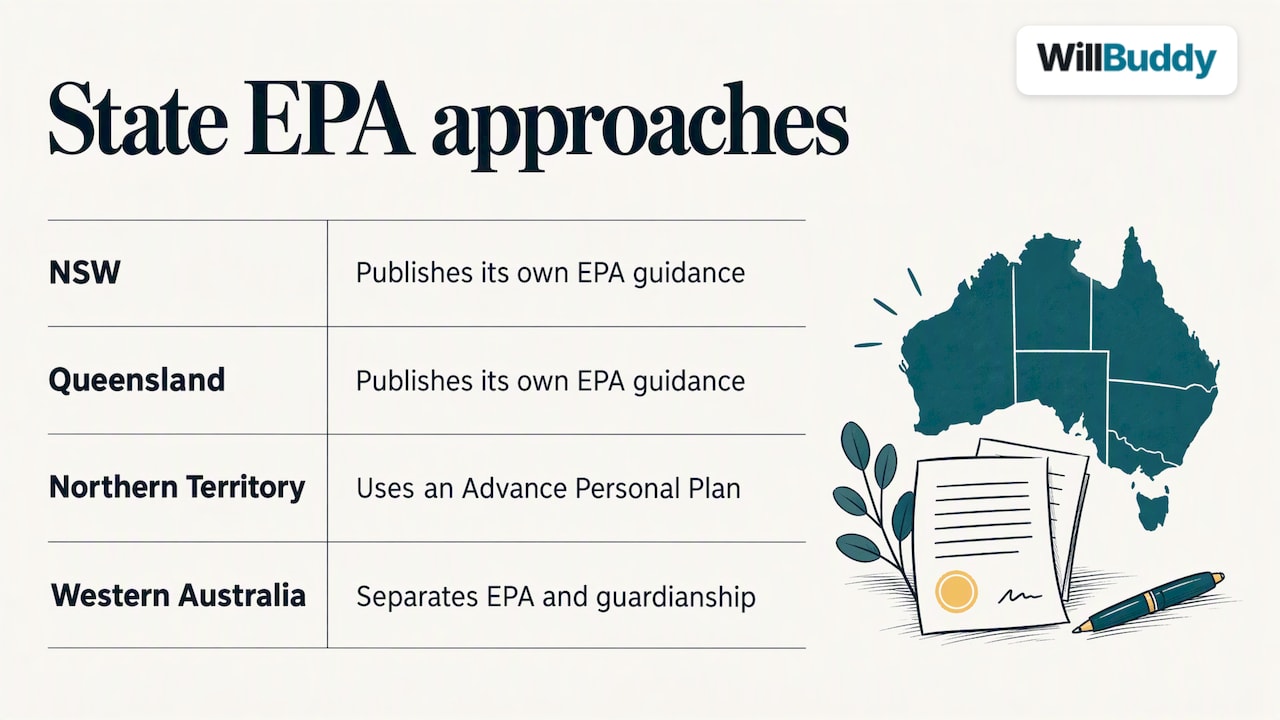
State differences are real. NSW and Queensland each publish their own EPA guidance. The Northern Territory uses an Advance Personal Plan, and Western Australia keeps the EPA and enduring guardianship separate. Check the page for your state before you sign.
Registration works differently from what many people expect. There is no national register for EPAs, though land transactions may need lodgement with state land registries.
Store and share. Keep originals somewhere safe, give copies to your attorney and executor, and tell family where to look.
Do you need both a will and a power of attorney?
Usually, yes. The two documents cover different times in your life, so one cannot stand in for the other. A will does nothing while you are alive, and an EPA does nothing once you have died.
Sometimes one is more urgent. If your finances are active or your health is uncertain, an EPA may come first. If you have young children, a will with a named guardian may be the priority.
Talk to a lawyer if you have a blended family, a business or trust, assets overseas, or a likely dispute over your estate. If you are arranging care for children across separate households, CoParent Navigator offers a tool for building a custodial plan.
What is your checklist for creating, signing and storing your documents?
- Decide who you trust and list an alternate for each role.
- Gather your asset details and contact information for your beneficiaries, attorney and executor.
- Complete the correct state forms or use a trusted service, then sign with the proper witnesses.
- Store the originals safely.
- Tell your attorney and executor where the originals are and how to access them.
Draft a state-specific will with WillBuddy
If you are ready to make your will, we ask you plain questions, one at a time, and draft a will for your state or territory. You can read every word for free before you pay. Our Annual Access plan, $39 a year, lets you print your will to sign with witnesses, keeps it in encrypted storage while your plan is active and includes 50 AI edits a year as life changes. For blended families, trusts or overseas assets, speak to a lawyer first. Start your will free at willbuddy.com.au and read it before you pay.
This article is general information, not a substitute for advice from a qualified lawyer. Consult a qualified legal professional about your own circumstances before acting on anything here.
FAQ
What is the main difference between a will and a power of attorney?
A will controls who gets your assets after you die. A power of attorney lets someone act for you while you are alive. An enduring power of attorney becomes invalid on death, and the will then takes over.
Who is the best person to assign power of attorney?
Choose someone trustworthy, sound with money and willing to do the job. Many people pick a spouse, adult child or close friend. Name an alternate in case your first choice cannot act.
What is an alternative attorney?
An alternative attorney is a backup you name to step in if your first attorney cannot or will not act. Naming one helps avoid a gap in decision-making. Without any attorney, a tribunal may appoint an administrator for you.
Can my attorney change my will?
No. An attorney cannot make or change your will. Only you can do that, while you have capacity.
Sources
Show the 2 sources
Recommended
For the one who gets things sorted
Now write yours, with your family's names in it
Plain questions about your family, one at a time, and WillBuddy drafts a will for your state. Until you sign one, the law in your state or territory decides who gets what. Read every word free, with no card. You pay only if you want to print it.
Start my will freeLast updated 16 October 2026.
This article is general information only and is not legal advice. It is our best interpretation of the law as at 16 October 2026. WillBuddy is not a law firm, and it never replaces advice from a lawyer or solicitor. Laws change and differ between states and territories, so for your own circumstances, please get legal advice.