What Happens to Debts After Death in Australia
General information, not legal advice.
On this page
- TL;DR
- Are debts inherited in Australia?
- Who deals with the debts
- The order debts are paid
- What if the estate cannot pay everything?
- When family members can be held responsible
- How a will affects debts
- Protecting the executor
- A practical checklist for an executor
- What to do if you are not the executor
- Where a clear will helps
- Make your will with WillBuddy
- FAQ
- Sources
- Recommended

Quick answer
When someone dies in Australia, their debts are paid from their estate. The estate is the money and property they leave behind. Family members are usually not responsible for those debts. There are exceptions, mainly joint debts, guarantees and loans secured against something you own. Whatever is left after the debts are paid goes to the people named in the will.
This guide explains how it works, who pays what, and how a clear will can make the process easier on the people you leave behind. It is general information only, not legal advice.
TL;DR
- Debts are paid from the estate first. Beneficiaries receive what remains.
- You are generally not liable for a relative's debts in their name alone. Joint debts, guarantees and loans secured on your assets are the main exceptions.
- Funeral costs, legal costs of the estate and tax usually come before ordinary debts like credit cards.
- An executor who distributes too early can be personally exposed. Rules differ by state.
- A will can say which part of the estate pays debts. Without one, the law decides.
Are debts inherited in Australia?
In most cases, no. The Cancer Council's national fact sheet says that debts are paid off by any money or property the person leaves behind. The remaining assets then go to the beneficiaries in the will.
That means a debt does not simply pass to a child or partner because they are family. The estate settles it first. If the estate is too small, the debt may go unpaid.
UNSW law professor Prue Vines notes that some families choose to pay an unpaid debt anyway, as a matter of honour. That is a choice, not a legal duty. She also points out that Australia's common law differs from some civil law countries, where a beneficiary can take the estate together with its debts.
Who deals with the debts
The executor named in the will handles them. If there is no valid will, a court appoints an administrator. Insurance industry commentary notes that debts are typically repaid through the estate before anything goes to beneficiaries.
The South Australian Law Handbook describes an executor's basic duties as collecting the assets, paying the debts and distributing the rest. Those duties start once the person has died.
The NSW Government's guide says the executor must find, protect and list the assets. They also need to tell banks, financial institutions and government agencies about the death. Telling them early helps the executor work out what is owed and stop regular payments that should end.
If you are thinking about who to name, our guide on how to choose a will executor covers what to weigh up. For the full job, see the executor role and responsibilities.
Probate and timing
Money is often locked up for a while. A trustee company explains that funds often do not become available to the executor until probate is granted. Until then, debts usually stay outstanding. Some small estates can be dealt with without probate.
If the person had a loan, the executor may be able to pause payments by telling the lender. The same source says interest normally keeps building until the loan is repaid.
Funeral bills often cannot wait for probate. Our guides on estate bank accounts and funeral funds before probate and paying for a funeral from the estate explain the options.
The order debts are paid
Not every debt ranks equally. The South Australian Law Handbook sets out the usual order: funeral expenses, testamentary (legal) expenses, statutory obligations such as tax, and then other debts. It says this priority also applies when there is more debt than assets.
Here is that order in plain terms.
| Priority | What it covers | Examples |
|---|---|---|
| 1 | Funeral expenses | Funeral director, cemetery or cremation costs |
| 2 | Costs of administering the estate | Legal costs, probate costs |
| 3 | Statutory obligations | Tax owing |
| 4 | Other debts | Credit cards, personal loans, medical bills |
Secured debts work a little differently. Professor Vines explains that a secured debt such as a mortgage is discharged by the executor before unsecured debts. Credit cards and personal loans are usually unsecured.
Australia has no death tax. But she notes tax owing on earnings and investments held by the person must still be paid. Often the executor lodges a final tax return for the person's last year.
What if the estate cannot pay everything?
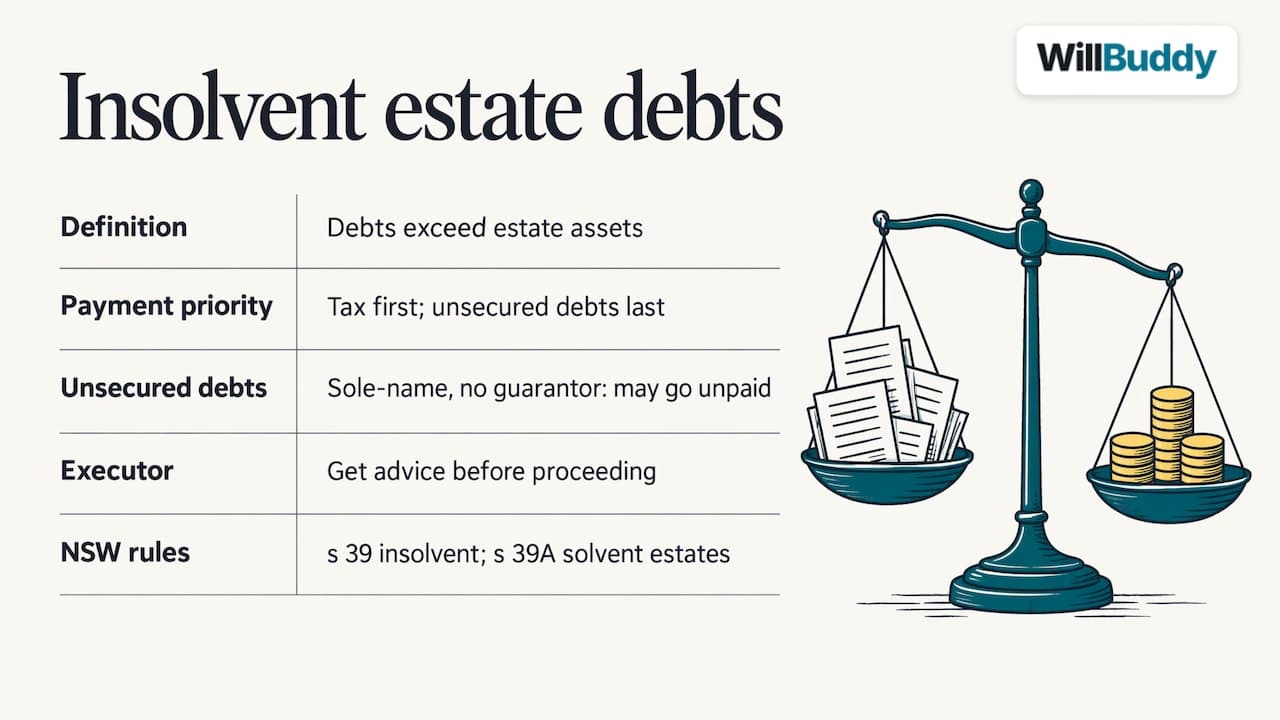
An estate with more debts than assets is called insolvent. Different rules apply.
Professor Vines says that in an insolvent estate, debts are paid on a scale based on bankruptcy or insolvent estate provisions, which gives some debts priority over others. Reasonable funeral, testamentary and administration costs are generally paid first. Ordinary unsecured debts are paid from whatever is left.
For families, the key point comes from the Cancer Council. If the debts are unsecured, in the person's name only and with no guarantor, they may not have to be repaid. The executor tells the lenders the money will not be repaid.
The executor should get advice before going ahead. A trustee company's executor toolkit says legislation dictates how an insolvent estate is administered. In Victoria, for example, The Law Handbook notes that section 39 of the Administration and Probate Act 1958 sets out which assets are used first for insolvent estate debts, while section 39A covers solvent estates.
When family members can be held responsible
Three situations can put a relative on the hook. AJG Australia lists them as guaranteed debts, debts taken out jointly, and debts secured against assets the relative owns. If none apply, a lender is unlikely to chase you.
Joint debts
The Cancer Council says that if a secured or unsecured debt is in joint names, everyone named on the account is responsible. The surviving joint holder must pay any amount the estate cannot cover.
A common case is a home loan. If a couple holds a mortgage together and one partner dies, the survivor remains liable for the remaining debt.
Guarantees
A guarantee is a promise to keep paying if the borrower stops. If you guaranteed someone's loan, the lender can pursue you after the borrower dies. Parents who guaranteed a child's loan, or the reverse, should check this early.
Loans secured on something you own
Suppose the person had a loan secured against an asset you own. If repayments stop, the lender can sell that asset. The Cancer Council adds that beneficiaries are not responsible for the debt, but the estate may lose the asset if the loan cannot be repaid.
Your spouse's debts
Generally, you are not responsible for your spouse's debts in their name alone. You do not need to act on unsecured debts that are in the deceased's name only with no guarantor. Joint debts are the key exception, as above.
How a will affects debts
A will can say which part of the estate pays the debts. Many people never think about this. Yet it can change who ends up with less.
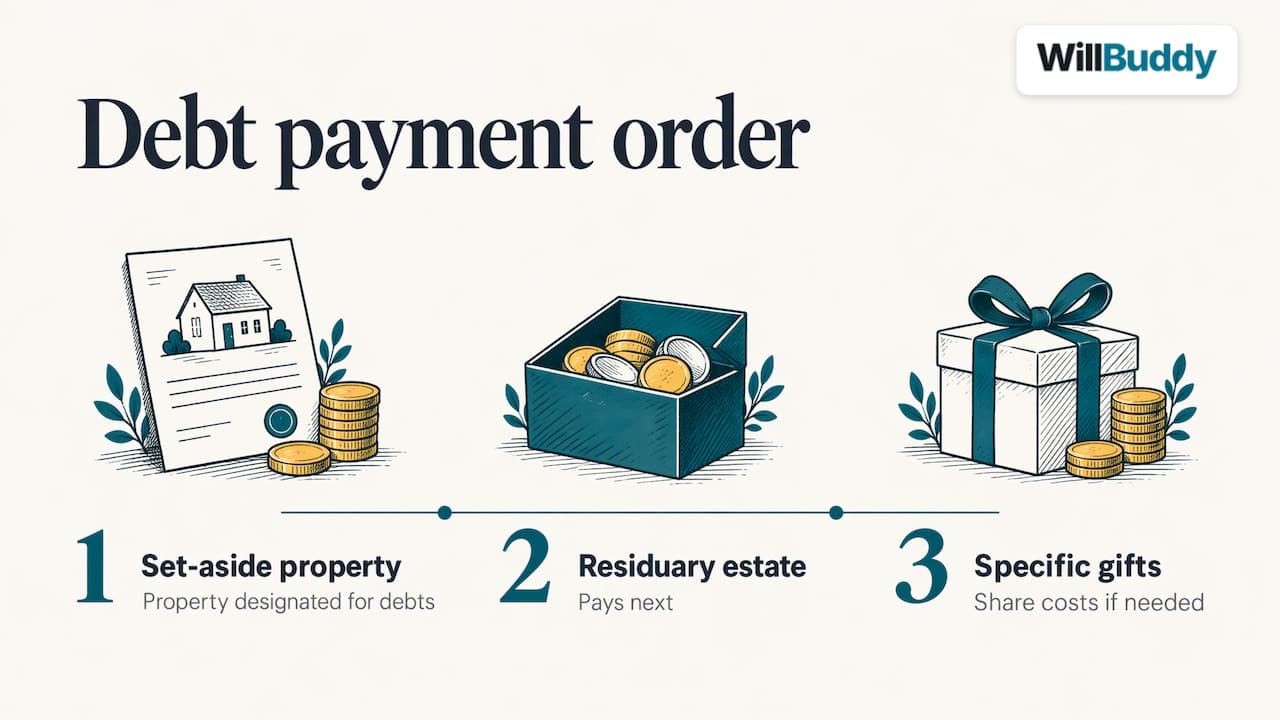
The South Australian Law Handbook says the will usually states which part of the estate pays debts, including funeral costs. The residuary estate is usually used. If that is not enough, other specific gifts may share the cost proportionately.
South Australia's Succession Act 2023, in force since 1 January 2025, sets a default order when the estate can cover all debts. Under section 83, debts come broadly from the residuary estate first, with specific gifts used last. A will can set a different order.
What does this mean in practice? Say you leave your home to one child and the rest of your estate to another. If the residue is small, the debts could eat into the home gift unless your will says otherwise. Clear wording helps avoid that.
The rules are not the same everywhere. Each state and territory has its own legislation. If your estate is complicated, a lawyer in your state can tell you how your will interacts with it.
Protecting the executor
An executor who hands out the estate before debts are known can face personal liability. Protections differ by state.
- NSW: The executor may publish a Notice of Intended Distribution on the NSW Online Registry. NSW Legal Aid says this gives 30 days for creditors to make a claim. It is not mandatory, but may offer some protection from later claims.
- Queensland: Since 28 April 2026, a notice of intention to distribute under section 135 of the Trusts Act 2025 (Qld) gives claimants at least two months to come forward. It replaced the six-week notice under the old Trusts Act 1973. Personal representatives who distribute without giving the notice can be personally liable for debts they later learn about.
- Victoria: Section 33 of the Trustee Act 1958 allows protection by advertising before distributing.
Where there is more than one executor, they should talk and agree a course of action. The executor toolkit says this too. Executors may also ask about fees. See what an executor can be paid.
For a wider view of the steps after a death, read our estate administration guide for executors or the after death process overview.
A practical checklist for an executor
- Get several copies of the death certificate.
- Find the will and check who is named as executor.
- List every asset and every debt you can find. Check mail, bank statements and credit reports.
- Tell banks, lenders and government agencies. Ask lenders about pausing payments.
- Do not pay unsecured debts from your own pocket. Do not distribute to beneficiaries yet.
- Apply for probate if it is needed.
- Use the notice process in your state before distributing.
- Ask for professional advice if debts look larger than assets.
What to do if you are not the executor
Sometimes a call or letter from a creditor arrives at your door. Do not agree to pay and do not sign anything just to make it stop. Tell the caller you are not the executor, and give them the executor's details if you have them. If there is no executor yet, say so.
Ask for the debt in writing. Check whether your name is on the account. If it is not and you did not guarantee it, the debt generally sits with the estate. If you are unsure, free legal help is available in each state, such as through a community legal centre or legal aid.
Where a clear will helps
A will cannot wipe out debts. But it makes the job simpler for the people you leave. It names who handles the estate, who gets what and who looks after your children. It can set out how your funeral is paid for and which gifts bear the costs.
Many Australians put this off. Without a valid will, the law decides who gets your estate and who administers it. Debts still come first either way, but your family loses your say.
A few things are worth thinking about when you draft:
- Who will be your executor, and a backup?
- Which part of the estate should cover debts and funeral costs?
- Are there joint debts or guarantees your family should know about?
- Does your will still match your life after a move, a new loan or a new child?
If you have assets overseas, other countries may have their own rules, including German inheritance tax rules for property in Germany. Speak to a lawyer in that case. Also get legal advice if you have a blended family, a business or trust, or expect someone to contest your will.
Make your will with WillBuddy
WillBuddy asks plain questions one at a time and drafts a will for your state or territory. You can read every word for free before you pay. Then you print it and sign it with witnesses. You choose your executor, your guardians and who gets what.
Life changes, so your will can too. Annual access includes up to 50 AI-assisted edits each year and secure, encrypted storage in Australia while your plan is active. It costs $39 a year. We never sell your personal data. See our pricing page for details.

If you would like to try it, start on willbuddy.com.au and read your will before you pay.
FAQ
Do my children inherit my debts?
Generally, no. Your debts are paid from your estate, and children receive what is left. They may be responsible only if they co-signed a loan, guaranteed it, or the loan is secured on something they own.
Can a bank take my house after I die?
If the home loan is not repaid, the lender can sell the property that secures it. The estate or a surviving joint borrower usually needs to keep up repayments or sort out the loan. Speak to the lender and a lawyer early.
What happens to credit card debt after death?
Credit cards are usually unsecured debts. They are paid from the estate after funeral costs, legal costs and tax. If the estate cannot cover them and no one else is liable, they may go unpaid.
Does the executor pay debts from their own money?
No, debts are paid from estate funds. The risk comes from distributing the estate too early. In Queensland, for instance, an executor who skips the statutory notice can become personally liable for later debts.
Can my will say which assets pay my debts?
Yes. A will can direct which part of the estate pays debts, such as the residuary estate. If it says nothing, the state or territory's default rules apply.
Sources
Show the 13 sources
- What happens to debts after death, Cancer Council (2022)
- What happens to your debts when you die? UNSW Newsroom (2020)
- Payment of Debts, South Australian Law Handbook
- Duties of executors, South Australian Law Handbook
- Succession Act 2023 (SA)
- Trustee Act 1958 (Vic) s 33
- Acting as an executor, NSW Government
- Distributing the estate, Legal Aid NSW
- Trusts Act 2025 (Qld)
- Legal actions after death and insolvent estates, The Law Handbook (Vic)
- Can You Inherit a Family Member's Debt? AJG Australia (2025)
- Do unpaid bills come out of your estate? Equity Trustees (2025)
- Executor Toolkit, Equity Trustees
Start your will free at willbuddy.com.au and read it before you pay.
Recommended
When you're ready
Make things simpler for your own family
Sorting out an estate shows how much a clear will helps. WillBuddy drafts yours for your state from plain questions. Read every word free, with no card. You pay only if you want to print it.
Start my will freeLast updated 5 November 2026.
This article is general information only and is not legal advice. It is our best interpretation of the law as at 5 November 2026. WillBuddy is not a law firm, and it never replaces advice from a lawyer or solicitor. Laws change and differ between states and territories, so for your own circumstances, please get legal advice.