How to Share Your Will With Your Executor Safely
General information, not legal advice.
On this page
- TL;DR
- Do you have to share your will with your executor?
- Why the location matters more than the contents
- Can you share a will with your executor online?
- How to hand over your will in five steps
- There is no central register, so your note is the register
- What happens once you die
- Common worries, answered
- Where WillBuddy fits
- A short checklist to keep
- FAQ
- Sources
- Recommended
Quick answer
You do not have to send your will to anyone while you are alive. What your executor needs is simpler: to know that you have a will, who to ask for it, and where the signed original is kept. A copy by email or download can help, but the original is what the court asks for later. This guide covers what to share, what to hold back, and how to set it up so your family is not left searching.
This is general information only, not legal advice.
TL;DR
- No one has a legal right to see your will while you are alive. You decide whether to show it or tell people what is in it.
- The most useful thing you can tell your executor is where the signed original is kept.
- A digital or printed copy is handy for reference, but courts usually want the original will for probate.
- Keep the original somewhere safe and findable, and update your executor when the location changes.
- With WillBuddy you can read your whole will free before you pay, then print it, sign it with witnesses and download a copy.
Do you have to share your will with your executor?
No. In South Australia, the Law Handbook explains that no one is legally entitled to view or copy a will while the willmaker is alive. It is up to you whether you show it or disclose what it says. The same general idea applies across Australia: your will is private until you die.
That said, most people tell their executor something. The executor is the person you name to carry out your will. They collect the assets, pay debts and hand over gifts. It is hard to do that job if they do not know a will exists.
There are three levels of sharing. You can pick the one that suits your family.
- Tell them only that you have a will and where it is. This is the minimum. It keeps the contents private.
- Tell them the location and give them a copy. This lets them read your wishes, including funeral instructions, before they are needed.
- Talk through the main points. This helps if you have chosen guardians for your children or left gifts that might surprise someone.
The Law Handbook, published in Victoria by Fitzroy Legal Service, says the executor or a relative should be told where the will is kept so it can be found easily when the willmaker dies.
Why the location matters more than the contents
The NSW Government says telling your executor, beneficiaries and family where your will is stored is vital. It warns that a will kept at home can be lost, damaged or stolen. If it cannot be found, assets may not be distributed as you intended, and extra legal costs can follow after death.
Think about what happens on the worst day. Your executor is grieving and has a long list of tasks. If they have to search every drawer, call banks and ring around local lawyers, the process is slower and more stressful. A single clear sentence from you now prevents that.
A good handover sentence sounds like this: "I have a will. It names you as my executor. The signed original is in the place I have written down for you." Then write the place down and give it to them.
Can you share a will with your executor online?
Yes, you can share a copy online. There is no rule against emailing a PDF or sharing a file. The question is whether it is wise, and what that copy can and cannot do.
What an emailed or downloaded copy is good for
- It lets your executor read your wishes ahead of time, including funeral preferences.
- It shows who the guardians for your children are, so nobody is surprised.
- It confirms the names and details of the people and gifts mentioned.
- It gives your executor something to refer to when they look for the original.
What a copy cannot do
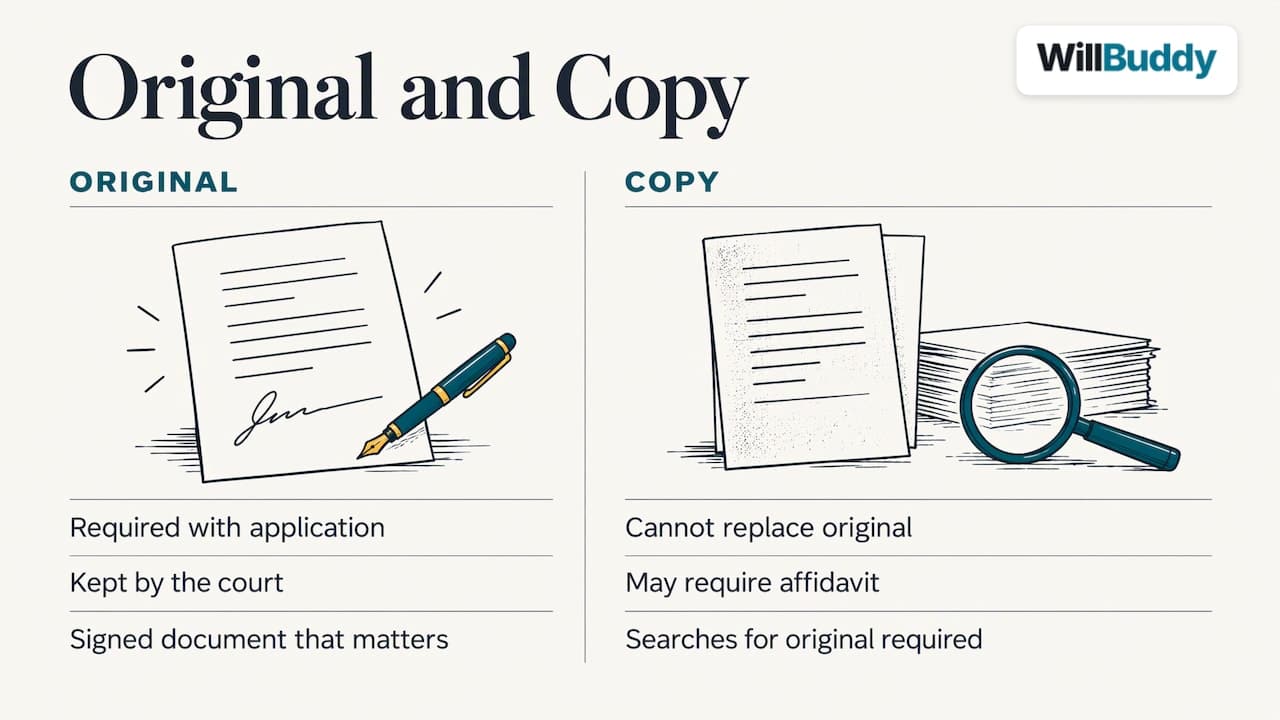
A copy is not your will. The Supreme Court of NSW says that for a grant of probate the original will must be filed with the application and kept by the Court, and that the will filed must not be a carbon or photocopy. If only a copy is found, the executor named in it may be able to apply for probate on the copy. That needs an affidavit (a sworn written statement) explaining where the copy was found and listing every search made for the original. At a minimum, those searches cover the person's papers, any solicitors used, any banks used and NSW Trustee and Guardian.
The court also notes a presumption in this situation. If the evidence suggests the original was last in the deceased person's hands, the law presumes they revoked (cancelled) it by destroying it. That presumption can be rebutted with evidence that they did not mean to revoke it, such as conversations about the will or no big change in circumstances that would have led to a new one. It is a harder path than simply producing the original.
This is NSW practice, and rules differ between states and territories. The lesson holds everywhere: the signed original is the document that matters. A copy supports it but does not replace it.
Keep your digital copy private
If you do share a file, treat it like any other sensitive document.
- Send it only to the person you trust, not to a group chat or family thread.
- Avoid leaving it in an email inbox that many people can access.
- Tell your executor that the file is a copy and where the signed original is.
- If you later change your will, replace the copy and tell them. An old copy circulating is a risk.
That last point is the one people forget. If you update your will and your executor still holds the old version, you have created confusion that can be hard to fix after you are gone.
How to hand over your will in five steps
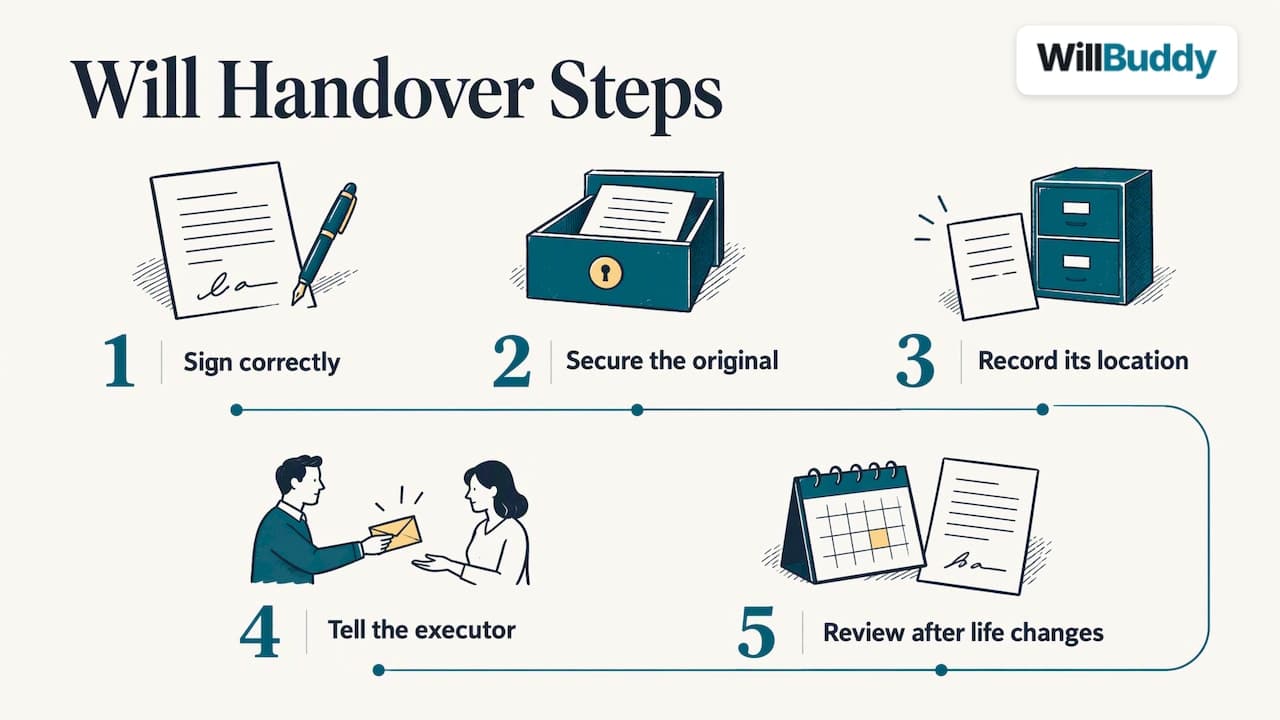
Step 1: Finish and sign the will properly
Signing and witnessing it correctly is what makes a will valid, and each state and territory sets its own rules. Our guide on who can witness a will in Australia sets out the rules state by state. Sign in front of your witnesses, and make sure the witnesses are not people who receive a gift under the will.
With WillBuddy, you answer plain questions one at a time and we draft a will for your state or territory. You read every word free before you pay. Then you print it and sign it with witnesses.
Step 2: Choose where the original lives
Pick one safe place and stick to it. Options include a fireproof safe at home, a safe custody arrangement with an institution, or another secure place you control. The Law Handbook notes that wills can be kept in safe custody with a solicitor, trustee company, accountant or other institution, or by the willmaker in a preferably fireproof safe place. Our guide to secure will storage in Australia walks through the choices.
Avoid splitting originals across several places. One original, one location, one record of where it is.
Step 3: Write down the location
Put it in a short note: where the original is, who holds the key or code, and who to contact. Keep the note simple enough that someone under stress can follow it.
Step 4: Tell your executor
Have a quick, calm conversation. Say that you have named them, where the will is, and whether you are giving them a copy. It also helps to mention your funeral wishes if they are in the will. If you are still deciding who to pick, see our guide to choosing a will executor, including why their state can matter for your assets.
You can also tell a second trusted person, such as your partner or a sibling, where the will is. That gives a backup if your executor is unreachable.
Step 5: Review it when life changes
A new baby, a separation, a move to another state or a new asset all mean your will may need an update. Each time, check that your executor knows where the current original is. If you ever need to change who is named, our article on removing an executor of a will explains the options.
There is no central register, so your note is the register
Many people assume Australia has one national place where wills are logged. It does not. That is why your handover matters so much. Our guide, no central will registry in Australia, covers four ways to keep your will findable.
If your executor does not know where to look, they may have to follow a search trail. NSW Legal Aid says to start by searching the deceased person's home. If the will is not there, the next step is to ask their lawyer or local lawyers, local banks, an accountant or financial adviser, NSW Trustee and Guardian, and the Supreme Court of NSW. The NSW Government gives a similar list, and says that if you do not know the solicitor's name, you can contact local lawyers with the person's full name, address, date of death and your relationship to them, as set out on its page about dealing with a will and estate after a death.
That is a lot of calls. A two-line note from you replaces all of them.
What happens once you die
The privacy you had in life changes after death. In South Australia, from 1 January 2025, section 48(1) of the Succession Act 2023 (SA) gives specified people the right to view and copy a deceased person's will, and anyone holding it must let them. Who counts as a specified person is set by the Act. Who may see a will after death, and how, differs between states and territories.
So you may keep the contents quiet now. After death, the right people can usually see it. The better your executor is prepared, the smoother that goes.
Common worries, answered
"I don't want my family to know what is in it."
That is your right. Share only the location. Your executor can still do the job. They will read the will when the time comes.
"I have guardians for my children in the will. Should I tell them?"
Most parents do, and it is a kind thing to do. Naming someone in your will does not mean they have agreed to take on the role. Asking them first means no one is caught off guard. You can do this without sharing the rest of the will.
"Is it risky to email my will?"
Email is not locked away like a safe. If you send a copy, send it to one person, and label it as a copy. Keep the signed original secure.
"Can my executor just use the copy?"
Not usually. As the NSW Supreme Court notes above, courts want the original. A copy leads to extra steps and evidence.
"What if I move states?"
Rules on wills can differ by state and territory, so check your will when you move and update your executor on where the original is. If your situation involves assets overseas, a business or trust, a blended family or a likely contest, speak to a lawyer. Those cases are outside what an online form can safely sort out.
Where WillBuddy fits
A handover only works if your will is finished, signed and current. WillBuddy is built for that. You answer plain questions one at a time about your guardians, executors, gifts and funeral wishes. We draft a will for your state or territory. You read every word free before you pay, then print it and sign it with witnesses.
Your annual subscription also covers encrypted storage of your will in Australia while your plan is active, and up to 50 AI-assisted edits a year, so your will can keep pace when life changes. We never sell your data. You can print and download your will, which gives you a copy for your records. A stored or downloaded copy does not replace the signed original, so the steps above still apply. For the current plan, see Annual Access.

If you are a parent who has not yet named guardians, that is the part to do first. You can begin on the WillBuddy home page and see the full draft before you commit.
A short checklist to keep
- I have a signed, witnessed will.
- I know where the original is.
- My executor knows where it is, and how to contact anyone holding it.
- If I gave a copy, it is the current version.
- I will review the will after any major life change.
- A second trusted person knows the location too.
Tick these off once, then revisit them each year.
FAQ
Can I email my will to my executor?
Yes. Nothing stops you from sharing a copy. Send it to one trusted person, say clearly that it is a copy, and tell them where the signed original is kept. Courts generally need the original for probate.
Does everyone named in a will get a copy?
No. While you are alive, no one is entitled to see it. After death, specified people can view and copy it. In South Australia, for example, section 48(1) of the Succession Act 2023 sets out who they are.
What should my executor do first if they cannot find the will?
They should search the home first. Then they should ask the person's lawyer, local banks, accountant or financial adviser, and the relevant state or territory authorities. NSW Legal Aid lists these steps on its page on searching for the will.
Can I write a will online in Australia?
Yes. You answer questions online, read the draft, then print it and sign it in front of witnesses as your state or territory requires. The signing step is what makes it a valid will, so do it carefully.
Sources
Show the 6 sources
- Getting a copy of a will, Law Handbook (SA)
- Storage of a will, The Law Handbook (Fitzroy Legal Service, Vic)
- Learn about wills, NSW Government
- Applying for probate, Supreme Court of NSW
- Searching for the will, Legal Aid NSW
- Dealing with a will and estate after a death, NSW Government
Start your will free at willbuddy.com.au and read it before you pay.
Recommended
For the one who makes it easy for everyone
Make it easy for whoever sorts things out after you
Your will names your executor, and a backup if they can't act, so nobody is left guessing. You can also say whether they're paid. WillBuddy drafts it for your state from plain questions. Read every word free, with no card. You pay only if you want to print it.
Start my will freeLast updated 20 November 2026.
This article is general information only and is not legal advice. It is our best interpretation of the law as at 20 November 2026. WillBuddy is not a law firm, and it never replaces advice from a lawyer or solicitor. Laws change and differ between states and territories, so for your own circumstances, please get legal advice.