Multiple Executors: Can You Have Two or More in Your Will?
General information, not legal advice.
On this page
- TL;DR
- Can you have two executors in a will?
- How co-executors work in practice
- When more than one executor is a good idea
- When it backfires
- Do all named executors have to apply for probate?
- What happens if one executor dies or cannot act?
- Replacing an executor in Australia
- What about pay and cost?
- How to decide: one, two or a substitute?
- When you should see a lawyer
- Make your will with the right executors named
- FAQ
- Sources
- Recommended

Quick answer
Yes. In Australia you can name more than one executor in your will. Two is the most common choice. Whether you should is a different question. A second executor gives you a back-up and a sounding board. It can also add delay, disagreement and cost if the two people do not work well together.
This guide explains how co-executors work, what changes between states, what happens if one dies or steps aside, and how to decide. It is general information only, not legal advice.
TL;DR
- You can appoint more than one executor. Two or three people is typical. The grant may name only a limited number, so check the rules in your state.
- Co-executors who apply for probate generally act together. A disagreement between them can stall the whole estate.
- Not every named executor has to take the job on. One can apply while the other steps aside or reserves the right to act later.
- A substitute executor is often a better safety net than a second one acting alongside the first.
- See a lawyer if you have a blended family, a business or trust, assets overseas, or a likely contest.
Can you have two executors in a will?
Yes. Nothing stops you naming two, three or more people. The executor is chosen by the will-maker, so it is your decision. The Victorian Law Reform Commission notes that at least two are often appointed, in case one dies before the will-maker or is unwilling or unable to act.
The Legal Services Commission of South Australia goes further. It says it is usually safest to appoint more than one executor, except in the simplest of cases. It also explains that executors can be set up to work together, or one can be named as a back-up.
That last point matters. "More than one executor" can mean two quite different things:
- Co-executors. Two or more people named to act together from the start.
- Primary and substitute. One person acts. A second person steps in only if the first cannot or will not.
Many people want the second arrangement but write the first. Think about which one you actually want before you choose names.
How co-executors work in practice
When more than one executor applies for probate, they share the job. They collect the assets, pay the debts and tax, and hand over what is left to the beneficiaries. They usually need to agree before they act.
That means joint decisions on things like:
- choosing the funeral director
- opening or closing bank accounts
- selling the home or other assets
- paying bills and lodging the final tax return
- dealing with the beneficiaries
The Public Trustee of South Australia says being an executor can be time consuming, complex and challenging. The tasks include paying debts, keeping assets protected and lodging final tax returns. Choosing several executors does not automatically make that work easier. It adds a layer of communication and agreement, which can be harder if the executors live in different places or work in different ways.
The exact rules on how co-executors exercise their powers come from each state's legislation and the general law, and they are not the same everywhere. Check the Act in your state or ask a lawyer.
Some wills also say how co-executors should act, for example whether they must act together or may act alone. Be careful with this. Letting each person act alone can be faster, but banks and other institutions may still want every executor to sign. Ask a lawyer if you want a clause that departs from the usual position.
Responsibility is shared
If you are a co-executor, you are responsible for what is done in the estate, not only for your own part. The South Australian handbook says executors who apply for probate are legally responsible for all actions taken. A co-executor who lets the other one run everything is still on the hook. Tell the people you choose that this is the deal.
For a fuller picture of the role itself, see our guide to the executor role and responsibilities in Australia.
When more than one executor is a good idea
Co-executors can work well when:
- The estate is big or mixed. Property, shares, a super fund and a car can be a lot for one person to handle.
- You want a check on one person. Two people watching each other can lower the chance of mistakes or misuse.
- The people are skilled in different ways. One is good with paperwork. The other is good with family.
- You want to be fair to your children. Naming two adult children can avoid the feeling that one was trusted over the other.
- You are worried about illness or death. A named second person is already in the will if the first drops out.
The common thread is shared control: decisions are not made by one person alone. That is a real benefit, as long as the two people can talk to each other.
When it backfires
The risks are real, and they tend to show up at a hard time, when the family is grieving.
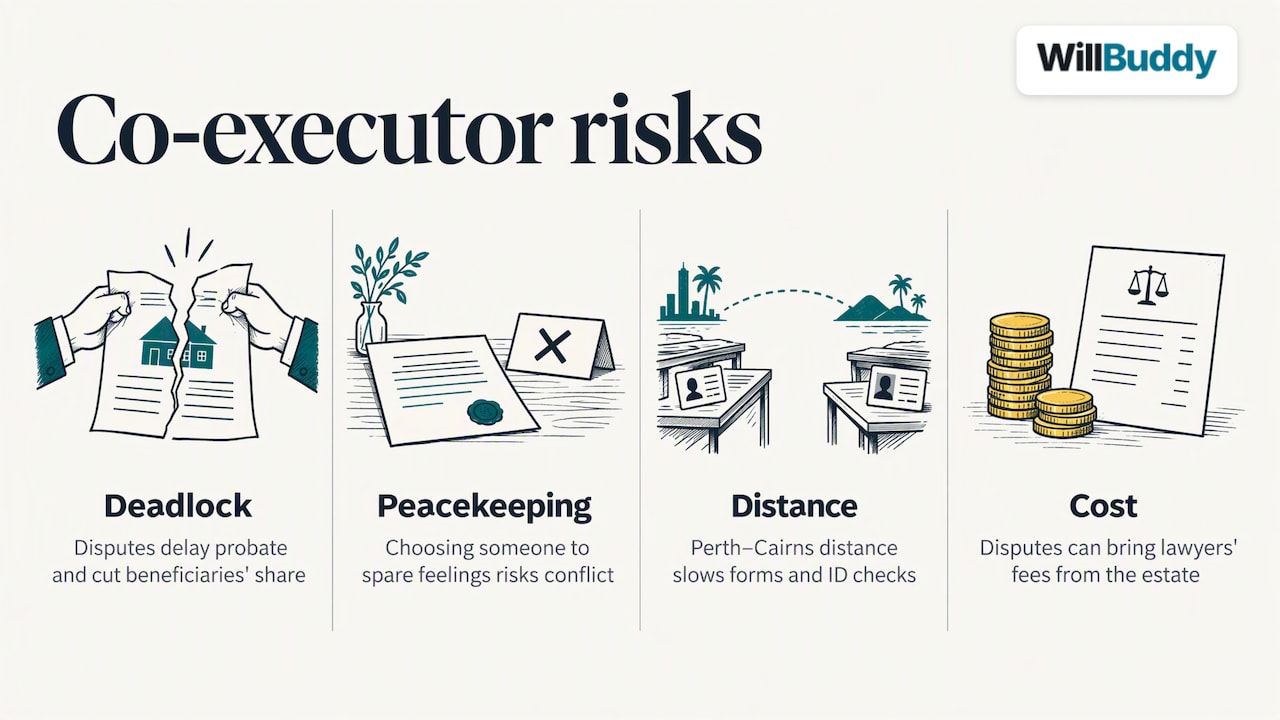
Deadlock. If the two cannot agree on the funeral, the sale of the house or the price, nothing moves. The South Australian handbook notes that co-executors who are often in conflict can fail in their duties, because the fight causes delays and legal costs that reduce what the beneficiaries receive.
Choosing to keep the peace. Naming a person only so they do not feel left out is a common reason for trouble. The same handbook says choosing a co-executor solely to avoid hurting someone's feelings can create long-term conflict. If the people do not get on today, they will not get on during probate.
Distance. If one lives in Perth and the other in Cairns, forms, signatures and ID checks take longer. It is not a reason to rule out either person, but plan for it.
Cost. More hands do not mean less work. Disputes can mean lawyers, and lawyers cost money from the estate.
If you want to pick people with care, our guide on how to choose a will executor in Australia covers the traits to look for, and how the state your assets are in can matter.
Do all named executors have to apply for probate?
No. This surprises many people. Naming two executors does not force both to take on the job.
As a general rule, NSW Legal Aid says that if more than one executor is named, the probate application must be made by all of them jointly unless they have died or are unable or unwilling to act. In practice, an executor who does not want the role can step aside. There are two common routes:
- Renounce. The person gives up the right to act for good.
- Reserve leave. The person lets the others apply now and keeps the right to apply later if needed.
The South Australian courts describe one or more executors applying while the others renounce or reserve their right, and the application must be set out in line with that state's rules. The ACT Supreme Court also covers what to do when not all executors named in the will apply, and flags it as a common source of errors in applications.
The practical point for you: you do not need to name two people just to make sure one is free. If you want a back-up, a substitute executor does that job without putting two people in charge at once.
Is there a limit on how many?
You can name as many as you like, but the court grant may be capped. Tasmania Legal Aid says the Grant of Probate will include a maximum of four executors, even if the will names more than four people. Other states have their own rules. Even where there is no tight cap, a large group is hard to run. Two or three is plenty.
What happens if one executor dies or cannot act?
This depends on whether there is a co-executor, a substitute, or no one left.
One of two co-executors dies. The remaining executor can usually go ahead with the probate application. In NSW a copy of the death certificate must be included in the executor's affidavit. NSW Legal Aid covers this in its probate application guidance.
The only executor dies, and a substitute is named. Victoria's LawHub says that if the will names another or alternative executor, that person can apply for a Grant of Probate. The application must clearly explain why the first executor is not the applicant.
No one is left. If no named executor can or will act, a beneficiary may need to apply for Letters of Administration with the will annexed. The same NSW page explains this for the case where every named executor renounces. It is slower and more formal than a grant of probate.
A sole executor dies after the will-maker. Things can get complex. Rules such as the executor of the executor (chain of representation) may apply, or a court may need to appoint an administrator. Many people avoid this by writing in a substitute executor. See the LawHub page on what happens when an executor dies for the Victorian process.
A simple way to cover the gap
A good structure for many families looks like this:
- Name your first choice as executor.
- Name a second person as a substitute, to act only if the first cannot or will not.
- Optionally, name a third as a further back-up.
You get the safety net without two people needing to agree on every step.
Replacing an executor in Australia
There are two different situations. They get mixed up often.
Replacing an executor in your own will
If you are the will-maker and you change your mind, update your will. Say a person has moved overseas, you have fallen out, or they have passed away. You can name someone new.
Do it properly. The new will must be signed and witnessed in line with your state or territory's rules. Do not scribble a name over the old one. Our guide to executors and witnesses explains who can witness and what to avoid.
If you have a WillBuddy will, you can make edits as life changes. The Annual Access plan ($39 a year) includes 50 AI edits a year. You then print and sign the updated will with witnesses.
Removing an executor after the will-maker has died
This is much harder. The executor was chosen by the will-maker, and courts respect that choice. The Victorian Law Reform Commission says courts are cautious about removing an executor because it sets aside what the will-maker wanted. Removal exists for an executor who is unfit or unable to act. It is not meant as an easy fix for a disagreement.
Beneficiaries can go to the Supreme Court if an executor acts improperly, fails to administer the estate, or causes loss through negligence or breach of duty. The Legal Services Commission of South Australia says the court can remove an executor or hold them personally liable for losses. Time limits apply to claims like these, and they vary by state, so do not wait if you think something is wrong.
If you are in this position, speak to a lawyer in your state. Do not rely on a general guide.
What about pay and cost?
Being an executor is real work, and people often ask whether co-executors share a fee. The rules on what an executor can be paid differ by state. Our guide to executor fees in Australia sets out the state-by-state position. Also see the probate process in Australia for the steps and costs that come with it.
How to decide: one, two or a substitute?
Use these questions.
| Your situation | A common approach |
|---|---|
| Simple estate, one trusted adult who lives nearby | One executor, plus a named substitute |
| Larger estate, two capable and friendly adult children | Two co-executors, plus a substitute |
| Children who do not get on | One executor and a substitute, not both children together |
| Partner is the main beneficiary | Partner as executor, with an adult child or friend as substitute |
| Family business, trust or overseas assets | See a lawyer before you choose |
Then test each name:
- Will they say yes? Ask them first.
- Are they over 18, organised and calm under pressure?
- Can they work with the other person?
- Do they live close enough, or can they manage remotely?
- Do they know where your will is kept?
If you answer no to the third question, do not name them together. Use a substitute.
When you should see a lawyer
A plain online will suits many Australians with simple affairs. But get advice from a lawyer in your state if:
- you are in a blended family
- you own a business or have a trust
- you have assets overseas
- you think someone is likely to contest your will
These cases bring extra rules, and a mistake can be costly for the people you leave behind.
Make your will with the right executors named
A will is where you choose your executors, your substitute and your guardians for your children. WillBuddy asks plain questions one at a time and drafts a will for your state or territory. You can read every word of your will free before you pay. Then you print it and sign it with witnesses.
See WillBuddy's Annual Access plan on the pricing page for what is included. If you want a wider picture of what your executors will face, read our estate administration guide for executors and the after death process in Australia.
FAQ
Is it wise to have two executors of a will?
It can be, if the two people trust each other and can work together. It is a poor idea if they are likely to clash, or live far apart. In that case, name one executor and a substitute.
Can one executor overrule another?
Generally not. Co-executors who act together are usually expected to agree on decisions. Your will can set out how they should act, and the rules vary by state. If they are stuck, they may need legal advice, and in the end a court can be asked to step in.
What happens if there are two executors and one dies?
The surviving executor can usually continue and apply for probate, with proof of the death. If every named executor gives up the right to act, a beneficiary may have to apply for Letters of Administration with the will annexed. NSW Legal Aid explains this process.
Can an executor be removed if they are not doing the job?
Yes, but courts are careful. Beneficiaries can apply to the Supreme Court if an executor fails in their duties or causes loss to the estate. The court can remove them or hold them personally liable, so get advice from a lawyer in your state.
Do I have to name more than one executor?
No. One is enough. If you want a safety net, add a substitute who steps in only if your first choice cannot act. You do not need two people just to make sure someone is available.
Sources
Show the 8 sources
- Problems with executors, Legal Services Commission of South Australia
- Executors, Public Trustee of South Australia
- Applying for probate, Legal Aid NSW
- Applying for a grant, Courts of South Australia
- Common errors to avoid, ACT Supreme Court
- Wills, following a will after someone has died, Tasmania Legal Aid
- Executor dies, LawHub Victoria
- Effect of the forfeiture rule, Victorian Law Reform Commission
Start your will free at willbuddy.com.au and read it before you pay.
Recommended
For the one who makes it easy for everyone
Make it easy for whoever sorts things out after you
Your will names your executor, and a backup if they can't act, so nobody is left guessing. You can also say whether they're paid. WillBuddy drafts it for your state from plain questions. Read every word free, with no card. You pay only if you want to print it.
Start my will freeLast updated 17 October 2026.
This article is general information only and is not legal advice. It is our best interpretation of the law as at 17 October 2026. WillBuddy is not a law firm, and it never replaces advice from a lawyer or solicitor. Laws change and differ between states and territories, so for your own circumstances, please get legal advice.