How to Remove an Executor of a Will in Australia
General information, not legal advice.
On this page
- TL;DR
- Two very different situations
- If you are alive: change your own executor
- If the will-maker has died: only the court can remove an executor
- What counts as a good reason
- What to try before going to court
- How a court application usually works
- What happens to the estate if an executor is removed
- Money questions people ask
- When to see a lawyer
- Avoid this problem in your own will
- Draft or update your will with WillBuddy
- FAQ
- Sources
- Recommended

Quick answer
You can remove an executor in Australia, but only in two ways. If you are the will-maker and still alive, you change your will. If the will-maker has died, you ask the Supreme Court of the state or territory, and the court decides. A beneficiary cannot simply remove an executor. This guide covers both paths, the grounds courts use, what happens next, and what to try first.
This is general information only, not legal advice. Wills and probate law differs by state and territory, so we name the state where a rule differs.
TL;DR
- Still alive? Make a new will that names a different executor and revokes your earlier wills. No court is needed.
- Will-maker has died? Only the Supreme Court can remove or pass over an executor. Family members, beneficiaries and co-executors cannot do it themselves.
- Grounds are about fitness to act. Examples include refusing to act, being unfit or incapable, living outside the state for years, or delaying and mishandling the estate.
- Try the cheaper steps first. A dated written request and mediation settle many stalled estates, and court costs can come out of the estate.
- Get a solicitor before filing anything. Court removal is contested and technical.
Two very different situations
People search for this topic in two situations. They need different answers.
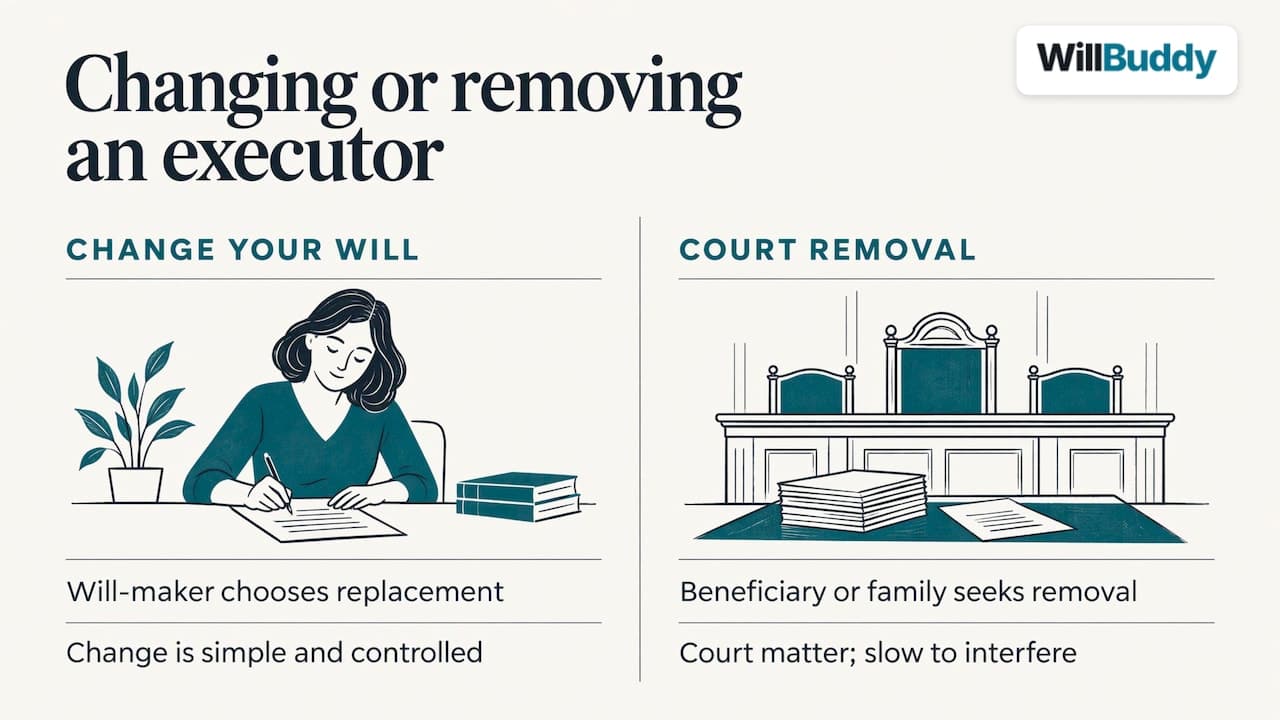
Situation one: you are making or updating your own will. You named someone as executor years ago. Now you want someone else. This is simple and you control it.
Situation two: someone has died, and the named executor is not doing the job. You are a beneficiary or family member. You are worried about delay, secrecy or money. This is a court matter, and the court is slow to interfere with the will-maker's choice.
Read the section that fits you. If you are in the second situation, read the section on what to try before court as well.
If you are alive: change your own executor
The executor is chosen by the will-maker. While you have capacity, you can change that choice whenever you like.
The usual way is to make a new will. The new will should say that it revokes all earlier wills, and it should name your new executor and a back-up. Then sign it in front of witnesses, as your state requires. Do not scribble over the old will. Crossing out names on a signed document can cause confusion later.
Some good reasons to change an executor:
- The person has moved overseas or lost touch.
- Your relationship has ended or changed.
- The person has died or become unwell.
- The estate is bigger or more complex than when you first wrote the will.
- You want a younger or more organised person.
If you are picking a replacement, our guide to choosing a will executor in Australia explains how the person's state and your assets fit together. Our page on the executor age requirement in Australia covers who can act.
A short checklist for the person you pick:
- Are they an adult you trust with money and paperwork?
- Will they cope with a long, dull job that can take many months?
- Do they live somewhere that makes it practical to act?
- Have you named a back-up in case they cannot or will not act?
- Have you asked them if they are willing?
Naming a back-up executor means that if the first person dies or declines, the court does not need to step in. That one line can save your family a lot of trouble.
If the will-maker has died: only the court can remove an executor
Once the will-maker has died, nobody can swap the executor by agreement alone in the way the will-maker could. The will-maker chose that person. Courts respect that choice, so they need good reason to override it.
The court is the Supreme Court of the relevant state or territory. The power comes from legislation, and from the court's own inherent jurisdiction. The wording differs by state, so here are the examples we can point to.
New South Wales
In NSW, the Probate and Administration Act 1898 lets the court revoke an administration it has already granted when a person interested in the estate applies. Under section 66 of that Act, the court may also remove the administrator on default and appoint a replacement. If you think the matter involves theft or serious misconduct, a NSW solicitor can tell you which provision and which procedure fits your facts.
Victoria
In Victoria, section 34(1) of the Administration and Probate Act 1958 lets the court discharge or remove an executor. This applies where the executor:
- has been out of Victoria for more than two years,
- wants to be discharged from the office, or
- after the grant, refuses to act, is unfit to act or is incapable of acting.
Australian Capital Territory
The ACT has a very similar rule. Section 32 of the Administration and Probate Act 1929 lets the Supreme Court order the discharge or removal of an executor on the same kinds of grounds: more than two years out of the ACT, a wish to be discharged, or refusal, unfitness or incapacity after the grant.
Other states and territories
Queensland, Western Australia, South Australia, Tasmania and the Northern Territory each have their own rules and procedures. When probate has not yet been granted, the application is often called a "passing over" application (the term is common in Queensland, for example). The name is different, but the basic idea is the same: the court is asked to stop a named executor from acting. Because the details differ by place, a solicitor in your state should confirm the right provision and forms.
What counts as a good reason
Courts look at whether the estate is being administered properly and whether the executor can do the job. The legislation above uses words such as "unfit" and "incapable". A bad personal relationship with the executor is not enough on its own.
Real cases show what "unfit" can look like. In Victoria, the court in Cicvaric v Blazevic [2024] VSC 450 removed an executor and appointed the beneficiary who applied in her place. The court found that many parts of her conduct, taken together, showed she was unfit to act. They included:
- delaying the administration of the estate, and
- paying her own legal costs from estate funds while she delayed repaying the applicant for the funeral.
In a later decision, Cicvaric v Blazevic (No 2) [2024] VSC 633, she was ordered to pay back the legal fees she had taken from the estate and to pay the applicant's costs.
Other grounds that commonly come up in practice include:
| Concern | What it can look like |
|---|---|
| Refusal to act | The executor will not apply for probate or will not do the work |
| Incapacity | Illness, dementia or another condition stops them acting |
| Absence | They live overseas and cannot be reached |
| Delay | Months pass with no information and no progress |
| Poor accounts | They will not show where estate money went |
| Self-dealing | They use estate assets for their own benefit |
| Conflict of interest | Their personal interests clash with the estate's |
The table is a guide to the kinds of problems courts hear. It is not a list of automatic wins. The court decides each case on its facts.
What to try before going to court
Court is the last step, not the first. Many stalled estates are slow rather than dishonest, and simpler steps often get them moving.
Put your request in writing
Quillio suggests that the first step in almost every stalled estate is a clear, dated written request. Ask for specific information by a specific date. In its view, an overwhelmed executor is a more common cause of delay than a dishonest one, and a clear request often helps.
A good letter or email:
- is polite and short,
- asks for named things, such as a copy of the will, the grant of probate, a list of assets, and an update on timing,
- sets a reasonable date to reply, and
- is kept in a file with a copy of anything sent back.
That paper trail also helps if you later need a solicitor or the court.
Try mediation
Quillio also recommends mediation before court. It says community justice and dispute resolution services in most states offer low-cost mediation, and that many estate disputes settle there. Mediations Australia says disputes about an executor's conduct, such as delay, alleged mismanagement, missing accounts or self-dealing, can go to the Supreme Court. It adds that mediation is often more suitable. It lets people deal with the real concerns, agree how the estate will be run, and keep family relationships intact without the cost and delay of formal proceedings.
Ask the executor to step aside
Sometimes the executor does not want the job. In Victoria and the ACT, the legislation above expressly covers an executor who wants to be discharged. A person named as executor who has not yet acted may be able to formally give up the role. That is cheaper and faster than a contested removal. A solicitor can explain which step suits your state and how far the executor has already gone.
Get advice early
Quillio notes that the Supreme Court can order an executor to produce accounts, require an estate to be administered under its supervision, or in serious cases remove an executor and appoint someone else. It also warns that these are contested proceedings with real costs, often paid out of the estate everyone is arguing over. In its words, litigation can shrink the thing being fought about. It suggests seeing a solicitor before filing anything, as many will say in one appointment whether a dispute is worth running.
How a court application usually works
The exact forms and steps depend on your state or territory. The general shape is similar.
- Check who you are. The court usually expects the person applying to have a real interest in the estate, such as a beneficiary. The NSW Act refers to a person interested in the estate.
- Collect your evidence. This is the heart of the application. Gather the will, any grant, emails and letters, and anything that shows delay, missing accounts or poor conduct.
- Prepare the court documents. These normally include an application and a sworn statement (an affidavit) explaining why the executor should be removed or passed over. A solicitor usually prepares these.
- File and serve. The application goes to the Supreme Court registry. The executor and other interested people must be told.
- Hearing. The court hears from both sides and decides. It may also order accounts or supervision instead of removal.
- New appointment. If the executor is removed, the court can appoint someone else. It may be a family member, a beneficiary or a professional.
We could not find a reliable published figure for the cost or typical time of an executor-removal application, and it depends on how contested it is. Ask a solicitor for a cost estimate in writing before you start, and ask who will pay and whether costs may come out of the estate.
Evidence that helps
The court is looking at what actually happened. Useful evidence includes:
- dates showing how long the estate has sat untouched,
- copies of your written requests and the replies, or the lack of them,
- statements or bank records that show where money went,
- proof that the executor lives overseas or cannot act,
- medical evidence, if capacity is in question.
Keep your tone factual. Written opinions about the executor's character do less than dates and documents.
If you also suspect the will itself was made under pressure, that is a different issue. Our guide to evidence to save before a will contest explains what to keep.
What happens to the estate if an executor is removed
Removal does not end the estate. Someone else takes over.
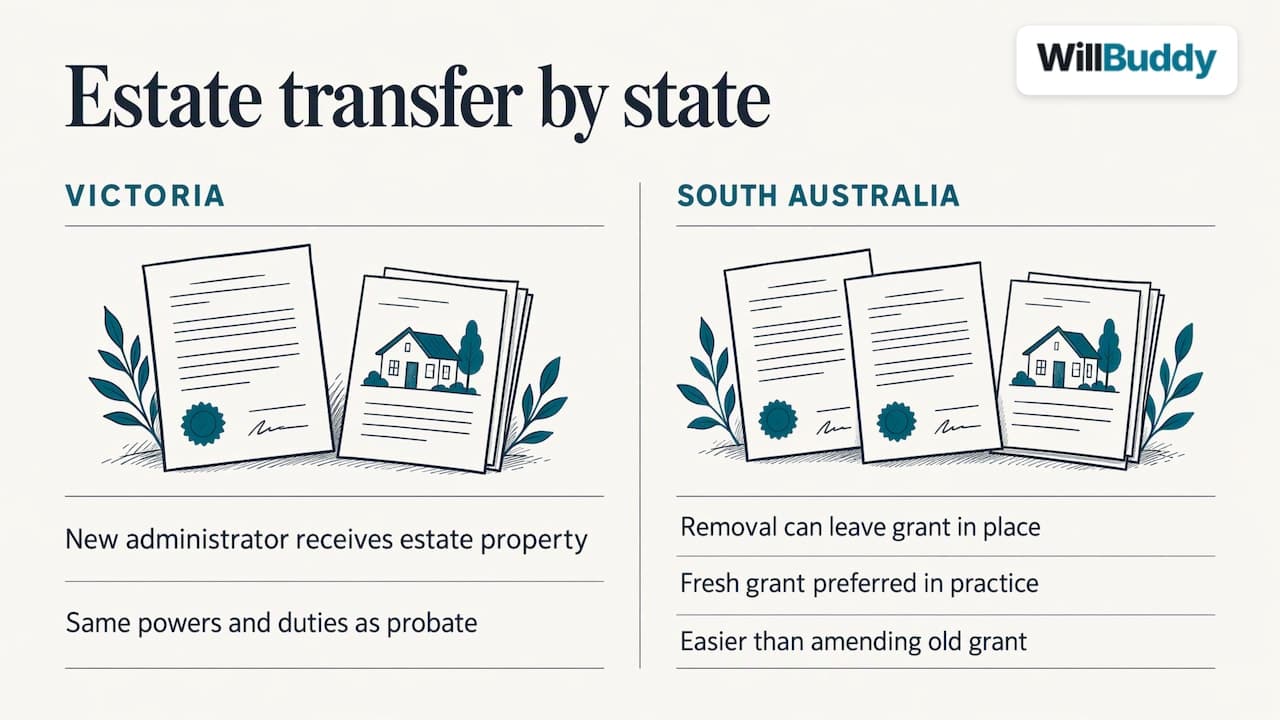
In Victoria, under section 34(4), when a new administrator is appointed, the estate's property and rights and the liabilities properly incurred pass to that person. The new administrator has the same privileges, rights, powers, duties, discretions and liabilities as if probate had originally been granted to them.
The paperwork can differ by state. In South Australia, Mullins-Trnovsky v Adams [2014] SASC 116 held that the court can remove an executor by amending the grant of probate, without revoking it. It also said that where there are good reasons, the traditional approach of revoking the grant and issuing a fresh one is still appropriate.
What this means for you in plain words: the court is likely to hand the job to a new person with full legal authority. Banks, land titles offices and others will deal with that person. If you are unsure whether a grant is needed at all, see our page on whether probate is required in Australia.
If you are the new person stepping in, our executor guide and checklists walk through the job step by step, and our note on estate bank accounts covers handling money before probate.
Money questions people ask
Some disputes begin with money. Executors can be paid in some cases, and they can be reimbursed for proper expenses. Our page on executor fees in Australia sets out what an executor can be paid state by state. Paying your own costs from the estate ahead of others is one of the things that can lead a court to step in, as the Victorian case above shows.
When to see a lawyer
Seek advice from a solicitor in your state if any of these apply:
- you plan to apply to the Supreme Court,
- the family is blended, with step-children or children from earlier relationships,
- a business or trust is part of the estate,
- there are assets overseas,
- a contest of the will is likely.
These situations are often too complex for a simple online process or a general guide.
Avoid this problem in your own will
Most executor fights can be prevented by a clear will. If you are making one, a few small choices help:
- Name a back-up executor. If the first cannot or will not act, the second steps up.
- Consider two executors. Think carefully about whether two people can work together.
- Choose for ability, not for fairness. The eldest child is not always the best organiser.
- Tell them. An executor who knows the plan acts faster.
- Review the will when life changes. Marriage, separation, a new child, a move to another state or a death in the family are all good prompts.
Draft or update your will with WillBuddy
WillBuddy asks plain questions one at a time and drafts a will for your state or territory. You choose your executors and guardians for your children, say how your estate is shared, and read every word free before you pay. Then you print it and sign it with witnesses. If you later want to change an executor, you can come back and update your will with up to 50 AI-assisted edits a year. See the Annual Access plan for the current price.

Your data is encrypted and is not sold. If your situation involves a blended family, a business or trust, overseas assets or a likely contest, speak to a lawyer as well.
FAQ
Can you remove someone as an executor?
Yes, but only through the court if the will-maker has died. The Supreme Court can remove or pass over an executor on grounds such as unfitness, incapacity or refusal to act. If the will-maker is alive, they can simply make a new will naming someone else.
Can a beneficiary remove an executor without going to court?
No. A beneficiary has no power to dismiss an executor. You can ask in writing for information, try mediation, or ask the executor to step aside. If that fails, you need a court order.
Can an executor resign?
In some cases, yes. Victoria and the ACT allow the court to discharge an executor who wants to be discharged. The right steps depend on your state and on whether the executor has already started acting, so get legal advice.
Does making a new will remove the old executor?
Yes, if the new will validly revokes the earlier one and names a new executor. Make sure the new will is signed and witnessed properly for your state. The old will should then be kept apart from the new one or destroyed on advice.
What if the executor is just slow?
Slow is not always unfit. Start with a dated written request that asks for specific information by a specific date. Mediation can then help. Court is for serious or continuing problems.
Sources
Show the 7 sources
- Probate and Administration Act 1898 (NSW), section 66, AustLII
- Administration and Probate Act 1929 (ACT), section 32, AustLII
- Administration and Probate Act 1958 (Vic), section 34, AustLII
- Cicvaric v Blazevic [2024] VSC 450, CaseChat AU
- Mullins-Trnovsky v Adams [2014] SASC 116, CaseChat AU
- Deceased estate disputes between family, Quillio
- Estate and inheritance dispute mediation in Australia, Mediations Australia
Start your will free at willbuddy.com.au and read it before you pay.
Recommended
For the one who makes it easy for everyone
Make it easy for whoever sorts things out after you
Your will names your executor, and a backup if they can't act, so nobody is left guessing. You can also say whether they're paid. WillBuddy drafts it for your state from plain questions. Read every word free, with no card. You pay only if you want to print it.
Start my will freeLast updated 8 November 2026.
This article is general information only and is not legal advice. It is our best interpretation of the law as at 8 November 2026. WillBuddy is not a law firm, and it never replaces advice from a lawyer or solicitor. Laws change and differ between states and territories, so for your own circumstances, please get legal advice.