Is Probate Required in Australia? When You Need a Grant
General information, not legal advice.
On this page
- TL;DR
- What probate actually is
- The short answer: it depends on the assets
- When you generally do need probate
- When you may not need probate
- Small estate help in Victoria
- How to work out whether you need a grant
- Does probate mean a long wait?
- Money is needed before probate: funeral costs
- Why a clear will makes this easier
- Make your will now, free to read before you pay
- When to see a lawyer
- FAQ
- Sources
- Recommended
Quick answer
No, probate is not required for every will in Australia. Whether an executor needs a grant depends on what the person owned, how they owned it, and what the bank, super fund or land titles office will accept as proof of authority. Real estate in one person's name usually needs a grant. A joint bank account or a very small estate often does not.
This is general information only, not legal advice. The rules differ by state and territory, so we name the state wherever it matters.
TL;DR
- Probate is a court's confirmation that a will is valid and that the executor can act. It is not automatic and not always needed.
- You generally need a grant if the person owned real estate alone or as a tenant in common, or if an asset holder demands one.
- Joint assets usually pass to the surviving owner without a grant. Small, simple estates can sometimes be dealt with without one too.
- Thresholds differ by state, and banks set their own limits. Ask each asset holder before you spend money on an application.
- Having a clear, current will makes the executor's job much easier, whether or not probate is needed.
What probate actually is
When someone dies, their assets have to be collected, debts paid and the rest passed on. If there is a valid will, the executor named in it usually has the authority to do that. Probate is the formal proof of that authority. Queensland Courts explain that banks and super funds often require this formal proof, which is why people think it is compulsory.
It is not a tax and it is not a test of the will's fairness. It is a certificate from the Supreme Court of the state or territory. It tells third parties they can safely hand over assets to the executor.
If there is no will, the court can instead give a grant of administration to a close family member. If there is a will but no executor able to act, a third type of grant exists. In Victoria, Victoria Legal Aid lists four main types: probate, letters of administration with the will annexed, letters of administration, and limited grants.
The short answer: it depends on the assets
The Supreme Court of Victoria says a grant is needed when an executor must prove title to the deceased's assets. Whether it is required depends on the assets and the asset holder's requirements. There is no single dollar figure that applies across Australia.
So the useful question is not "does this will need probate?" It is "which assets can the executor not touch without a grant?" Go through them one by one.
When you generally do need probate
Real estate in the deceased's sole name
The Supreme Court of Victoria's guidance is that you generally need a grant if the deceased owned real estate solely or as a tenant in common. A tenant in common holds a defined share that does not pass automatically to the other owner. Land titles offices usually want a grant before they will register a transfer or a sale.
Queensland Courts note that probate may not be needed in some property situations, so check the position with the titles office in your state before assuming either way. Property is the most common reason an executor ends up applying.
Bank accounts and shares in one name
If bank accounts or shares are in the deceased's name alone, the institution may ask for probate. The Victorian court says these organisations have discretion to release funds for smaller, uncomplicated amounts. Larger balances usually need a grant.
Banks often set their own internal limits, and those limits differ from bank to bank. A figure you read online is a guide, not a rule. The only answer that counts is the one from the institution holding the money.
When someone may challenge the will
A grant can also give an executor protection and certainty. If you expect a family member to dispute the will, a formal grant puts the will's validity on the court record. In that situation, speak to a lawyer early. We cover this again below.
When you may not need probate
Jointly held assets
Assets held as joint tenants, such as a family home or a joint bank account, typically pass automatically to the surviving owner. The Victorian guidance says a grant is often not needed for these. Usually the survivor provides a death certificate and the institution updates its records.
The State Library of NSW also says a grant is generally unnecessary when all assets are held as joint tenancies.
This is why many couples find that the first death needs no probate, while the second death often does. Once one partner is gone, everything sits in the survivor's sole name.
Small, simple estates
Small estates can sometimes be handled without a grant. The thresholds below are examples from official sources. They are not a national rule, and they can change.
| State or territory | What the official source says |
|---|---|
| New South Wales | Estates that are very small (the State Library of NSW gives under $15,000 as an example) and uncomplicated are sometimes administered without a formal grant. |
| Victoria | A grant is generally unnecessary for bank balances under $5,000 and outstanding wages up to $12,500. Banks may release funds to a surviving spouse or child if they are indemnified. |
| Northern Territory | The Territory has its own process for some small estates. Check the current limit with the NT Supreme Court or the Public Trustee before relying on it. |
| Queensland | Probate may not be needed where assets are of low value, such as a small bank account. |
Sources for the table: the State Library of NSW, the Supreme Court of Victoria and Queensland Courts.
These figures are not legal limits on what a bank can do. Many institutions follow their own policies. Treat them as a sign of the scale where informal handling is realistic.
Superannuation and life insurance
Super and insurance are often paid to a named beneficiary or to the estate, depending on the nomination. Whether a grant is needed depends on who the money is paid to and on the fund's or insurer's rules. Ask the fund or insurer directly. Do not assume super falls under the will.
Small estate help in Victoria
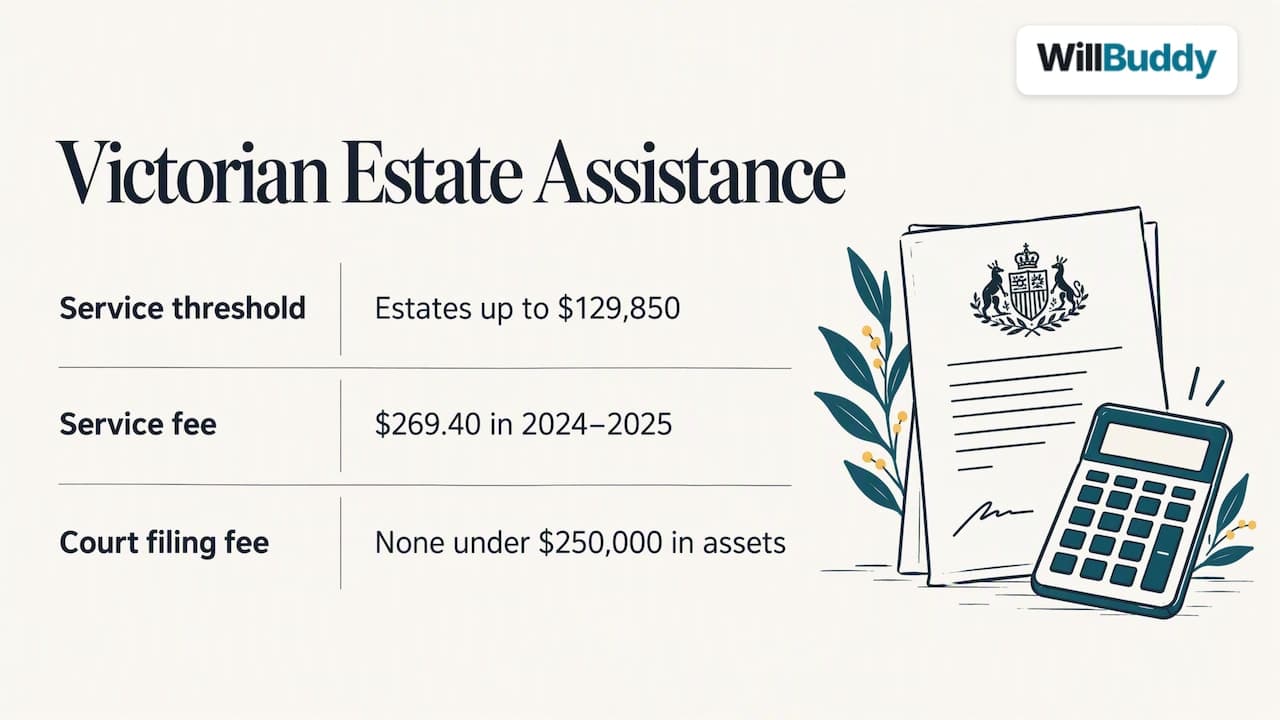
Victoria has a service for simple estates. Small Estates helps eligible executors prepare grant applications for estates not exceeding $129,850 (the limit LawHub gave as of 27 May 2025; it changes each year). LawHub lists a fee of $269.40 for the service under the 2024-2025 fee schedule. Fees are updated each year, so check the current figure on the official page.
The Supreme Court of Victoria's probate fee schedule for 18 November 2024 to 30 June 2025 also listed no filing fee for grant applications where the gross value of Victorian assets is under $250,000. Fee schedules are reissued, so confirm what applies when you apply.
How to work out whether you need a grant
You can do this in an afternoon, before you pay anyone.
- List every asset. Include property, bank accounts, shares, super, insurance, vehicles and wages owing.
- Note how each is owned. Sole name, joint tenants or tenants in common. This is the biggest factor.
- Estimate the value of each. Use recent statements and a rough property value.
- Contact each asset holder. The executor should ask each bank, share registry or fund whether it requires a formal grant before releasing the asset.
- Ask about their evidence. Find out whether they want a death certificate, the will, or a court grant.
- Decide. If any significant asset is stuck without a grant, apply. If everything can be released informally, you may not need to.
Keep notes of each call and name. If a bank later questions what you did, a written record helps.
Does probate mean a long wait?
A grant is not instant. In NSW, executors are generally encouraged to apply within six months of the date of death, unless there is a reasonable explanation for the delay. Other states have their own timing rules and practices. Check the Supreme Court's website for your state.
After the grant is made, the executor can collect and distribute assets. If you want to know the steps in order, our guide to the probate process in Australia walks through them. For the wider job of an executor, see our estate administration guide.
Money is needed before probate: funeral costs
A common worry is paying for the funeral while the estate is frozen. Accounts in the deceased's sole name may be locked until the bank is satisfied. Our article on estate bank accounts and funeral funds before probate explains the options.
Why a clear will makes this easier
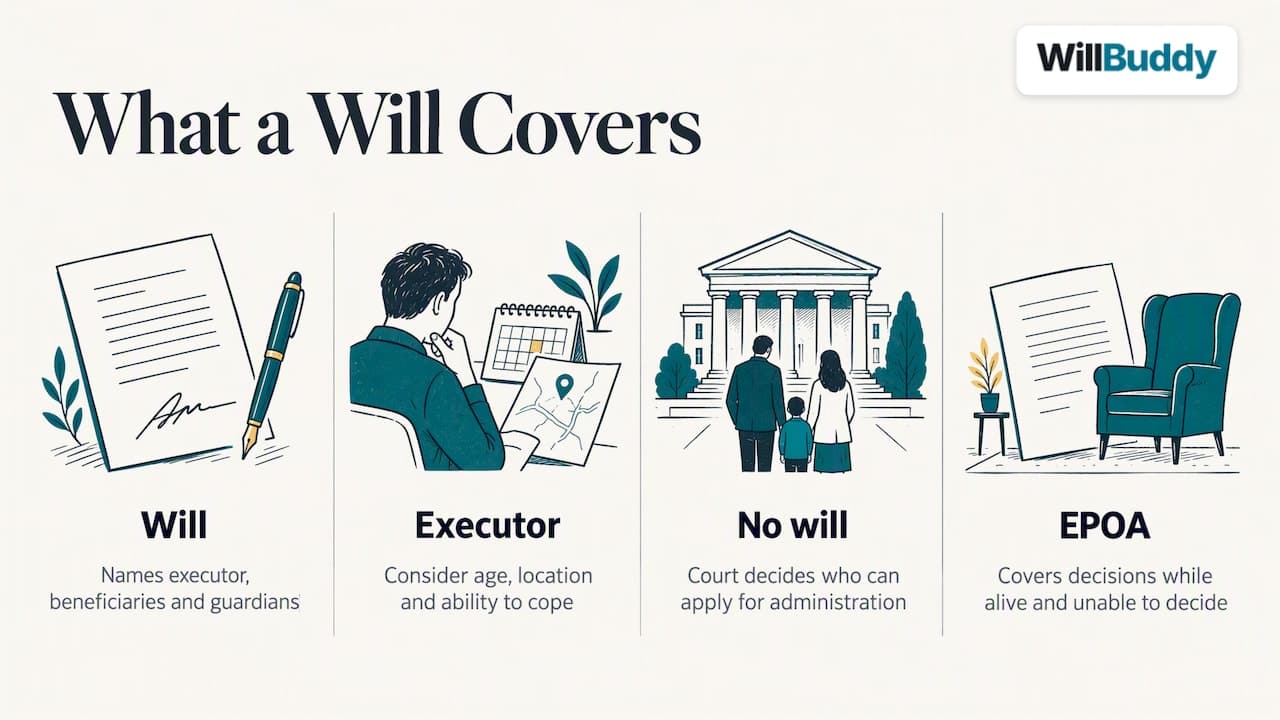
Probate is about proving the will and the executor's authority. A will that is clear, current and properly signed is far simpler to prove than a messy one. It names an executor, says who gets what, and names guardians for children.
The will is also where you choose the person who will do all this work. Think about their age, location and ability to cope. Our guides on choosing a will executor and the executor age requirement help you pick well.
If you have no will, your family may need a grant of administration and the court decides who can apply. For parents, a will is also the place to name who would care for your children. Without one, that choice is not in your hands.
A will is not the only document that matters. A will only applies after death. An enduring power of attorney covers you while you are alive but unable to decide. See power of attorney vs will and enduring power of attorney in Australia.
Make your will now, free to read before you pay
WillBuddy asks you plain questions, one at a time. It then drafts a will for your state or territory. You read every word for free before you pay. Then you print it and sign it with witnesses.
You can name executors, guardians for your children, gifts, pets and funeral wishes. Annual Access also includes up to 50 AI-assisted edits a year, so you can update your will as life changes. See the Annual Access pricing for the current cost.

If you want to see how it works first, you can start from the WillBuddy home page.
When to see a lawyer
An online will suits many straightforward situations. Get advice from a lawyer if:
- you have a blended family
- you own a business or use a trust
- you have assets overseas
- you think someone is likely to contest your will
Executors should also get advice if an estate is large, complex or disputed, or if an asset holder refuses to release funds. This article is general information only.
FAQ
Do I need probate in Australia?
Often, but not always. You generally need it if the person owned real estate in their sole name or as a tenant in common, or if a bank or other holder demands it. If everything was jointly held or very small, you may not. Check with each asset holder.
Does every will need probate?
No. Many estates are administered informally when assets are low in value, jointly owned, or when the institutions do not require a formal grant. The will still matters, because it shows who the executor is and who receives what.
Can a small estate go without probate?
Sometimes. The State Library of NSW gives under $15,000 as an example of a very small estate, and Victoria's guidance mentions bank balances under $5,000. Banks set their own limits, so ask them. The Northern Territory has its own process for estates under $20,000.
Does probate differ by state?
Yes. Each state and territory has its own Supreme Court, forms, fees, timing and small estate rules. Victoria, for example, has a Small Estates service. Always use the guidance from the state where the person lived and where their property sits.
What if there is no will?
A close family member may need to apply for a grant of administration, which gives them legal authority to deal with the estate. Queensland Courts describe this for intestacy. The estate is then shared under your state's rules, not your wishes.
Sources
Show the 7 sources
- Supreme Court of Victoria: Grants of probate and administration of deceased estates
- Queensland Courts: Wills and estates (probate)
- Victoria Legal Aid: Administration of the estate
- LawHub: Small estates
- Supreme Court of Victoria: Probate Office fees list
- State Library of NSW: Estates
- NSW Government: Get a grant of probate or letters of administration
Start your will free at willbuddy.com.au and read it before you pay.
Recommended
When you're ready
Make things simpler for your own family
Sorting out an estate shows how much a clear will helps. WillBuddy drafts yours for your state from plain questions. Read every word free, with no card. You pay only if you want to print it.
Start my will freeLast updated 30 October 2026.
This article is general information only and is not legal advice. It is our best interpretation of the law as at 30 October 2026. WillBuddy is not a law firm, and it never replaces advice from a lawyer or solicitor. Laws change and differ between states and territories, so for your own circumstances, please get legal advice.