Estate Bank Accounts in Australia: Funeral Funds Before Probate
General information, not legal advice.
On this page
- Tell the bank: what to expect and what happens first
- Who can legally access accounts: executor, administrator and next of kin
- Opening an estate bank account and how funds are paid out
- Small estate rules and limited release for funeral or emergency costs
- Probate and letters of administration: when you need them and the usual timeline
- Tax and super considerations when accessing estate funds
- Practical step by step checklist for executors or administrators
- An alternative: make a will now to spare your family this uncertainty
- FAQ
- Sources
- Recommended

Quick answer
An executor or administrator usually needs a grant of probate or letters of administration before a bank will release more than a small amount from a deceased person's bank account. Banks freeze the account once notified of a death, but many will pay funeral costs or use a small-estate process for modest balances. Beyond that, banks typically pay estate money by cheque to the "Estate of the late" or by transfer into a dedicated estate bank account.
In short
- Notify the bank with a certified death certificate and identification, then request its written document requirements, account balances, and confirmation that payments have stopped.
- Banks may pay funeral costs before probate against a provider’s tax invoice. In South Australia, a bank may pay $15,000 or less to a surviving spouse, domestic partner or child without a grant, but it does not have to.
- After receiving probate or letters of administration, open an estate account, pay expenses from it, and keep records; personal deposits can expose executors to liability.
- Large balances, real property, or disputes usually require a court grant; while waiting, collect records, but do not withdraw funds or sell property.
- The ATO can provide three income years of tax and super information after verifying your authority, but contact each super fund separately.
Tell the bank: what to expect and what happens first
Notifying the bank is usually the first task after a death. You will generally need a certified copy of the death certificate and identification for yourself before the bank will discuss the account in detail.
Once notified, banks follow a fairly standard process. According to Legal Aid NSW, once notified, a bank will provide a list of the deceased person's accounts and their balances at the date of death, and may ask for documents such as a certified death certificate, the will or the grant, and proof of your identity before releasing funds or closing accounts.
Expect the bank to:
- Freeze the account so no further withdrawals, direct debits or card transactions can occur.
- Cancel linked cards and stop any recurring payments or subscriptions.
- Provide a written list of accounts and balances as at the date of death.
- Tell you what documents it needs before it will release funds. Some banks call this a "letter of requirements".
That list is worth asking for early, in writing. Requirements vary from bank to bank, so getting this in writing avoids repeat visits or delays later.
Who can legally access accounts: executor, administrator and next of kin
An executor is the person named in a valid will to manage the estate. An administrator is appointed by a court when there is no will, or when the named executor cannot act. Both need formal legal authority before a bank will release the bulk of an estate's funds.
Being next of kin does not automatically give you access to a deceased person's account. Banks need proof of legal authority, not just a family relationship, before handing over estate money.
- The person who notifies the bank can often get a list of accounts and balances, depending on the bank's policy.
- Full withdrawal rights normally require a grant of probate or letters of administration.
- Banks may release a small, defined amount without probate, most commonly to cover funeral costs.
- Larger balances or multiple accounts almost always require the formal grant before release.
Where small-estate release is possible, banks still expect supporting paperwork, so it pays to ask what they need rather than assume.
Opening an estate bank account and how funds are paid out
Once you have formal authority, opening a dedicated estate account keeps things clean. Legal Aid NSW notes that money paid out of a deceased person's account is usually paid by cheque to the "Estate of the late" person, to be deposited into an estate bank account or a solicitor's trust account. A separate account also makes it easier to keep records of receipts and payments, which an executor may be asked to show to beneficiaries or a court.
- The executor or administrator opens an account in the name of the estate, typically titled "Estate of the late [Name]".
- The bank pays estate money into this account, often by cheque made payable to the estate rather than to any individual.
- Funeral costs, debts and administration expenses are paid from this account, not from a personal one.
- Records of every transaction are kept, since they may be needed for tax purposes or if a beneficiary queries the distribution later.
Depositing an estate cheque into a personal account is a mistake worth avoiding. It blurs the line between estate assets and personal funds, which can leave an executor personally answerable if something goes wrong. A solicitor's trust account is a common alternative if you are working with a lawyer on probate. If the estate includes a car registered in Norway, Selge bil etter dødsbo: dette må arvinger vite explains the Norwegian steps for heirs selling it (in Norwegian).
Small estate rules and limited release for funeral or emergency costs
Thresholds for releasing money without a full grant of probate vary by state and by bank. In South Australia, the Law Handbook SA explains that, from 1 January 2025, section 100 of the Succession Act 2023 (SA) permits a person or institution holding $15,000 or less of the deceased's money or property to pay or transfer it to a surviving spouse, domestic partner or child without a grant of probate or administration. The law permits this; it does not require it, and each bank sets its own requirements.
For funeral costs, a bank may be able to pay the funeral director directly from the deceased's account when given the funeral provider's tax invoice, often well before probate is granted. Some banks may also reimburse whoever paid the bill, so ask what yours allows.
Pro Tip: Call the bank's deceased estate team early and ask directly what their small-estate or immediate-expense policy allows, since limits and required documents differ between institutions.
Probate and letters of administration: when you need them and the usual timeline
Not every estate needs a court grant. Small balances, jointly held accounts and some superannuation can often be dealt with directly by the bank or fund. But once an estate includes real property, larger bank balances or disputed assets, a grant of probate (where there's a will) or letters of administration (where there isn't) is usually required.
Processing times vary by state and by how complete the application is, so it is worth checking your state's probate registry for current timeframes before assuming a date.
- You can notify banks, utilities and government agencies while waiting for the grant.
- You can collect death certificates, the will, and account statements in the meantime.
- You generally cannot withdraw larger sums or sell real property until the grant is issued.
- Some banks will still process small-estate or funeral payments during this waiting period.
For a closer look at how long probate typically takes and what affects the timeline, see our guide to the probate process in Australia.
Tax and super considerations when accessing estate funds
The Australian Taxation Office has its own process for recognising who can act for a deceased estate. According to the ATO, once an executor or administrator is verified as the authorised legal personal representative, the ATO can provide a deceased-estate data package covering tax returns and superannuation information for the past three income years.
- Provide the ATO with a grant of probate or letters of administration to be recognised as the authorised legal personal representative.
- Request the deceased-estate data package to help identify assets, income and any outstanding tax obligations.
- Notify each superannuation fund separately, since super is usually not automatically part of the estate.
- Expect each fund to ask for its own documents, including a certified death certificate, before releasing a death benefit.
Keeping these processes separate, tax matters through the ATO and super matters through each fund, avoids confusion about who is dealing with what.
Practical step by step checklist for executors or administrators
- Obtain several certified copies of the death certificate before contacting banks or government agencies.
- Notify each bank, collect account statements and passbooks, and ask for their letter of requirements.
- Open a dedicated estate bank account once you have proof of your authority to act.
- Use estate funds to pay funeral costs and urgent debts, keeping every receipt and invoice.
- Apply for probate or letters of administration if the estate's assets require it.
- Notify the ATO and any superannuation funds, and request the deceased-estate data package.
- Prepare clear executor accounts, then distribute remaining funds only after debts, tax and any required waiting periods have been settled.
For a fuller walkthrough of each stage, our executor guide and checklists covers the administration process in more depth, and our executor role and responsibilities guide sets out record-keeping obligations in detail.
An alternative: make a will now to spare your family this uncertainty
Much of the uncertainty around estate bank accounts comes down to one thing: whether there's a clear, valid will naming an executor. A state-specific will removes a lot of the guesswork for the people left sorting out accounts, probate and bank paperwork later.

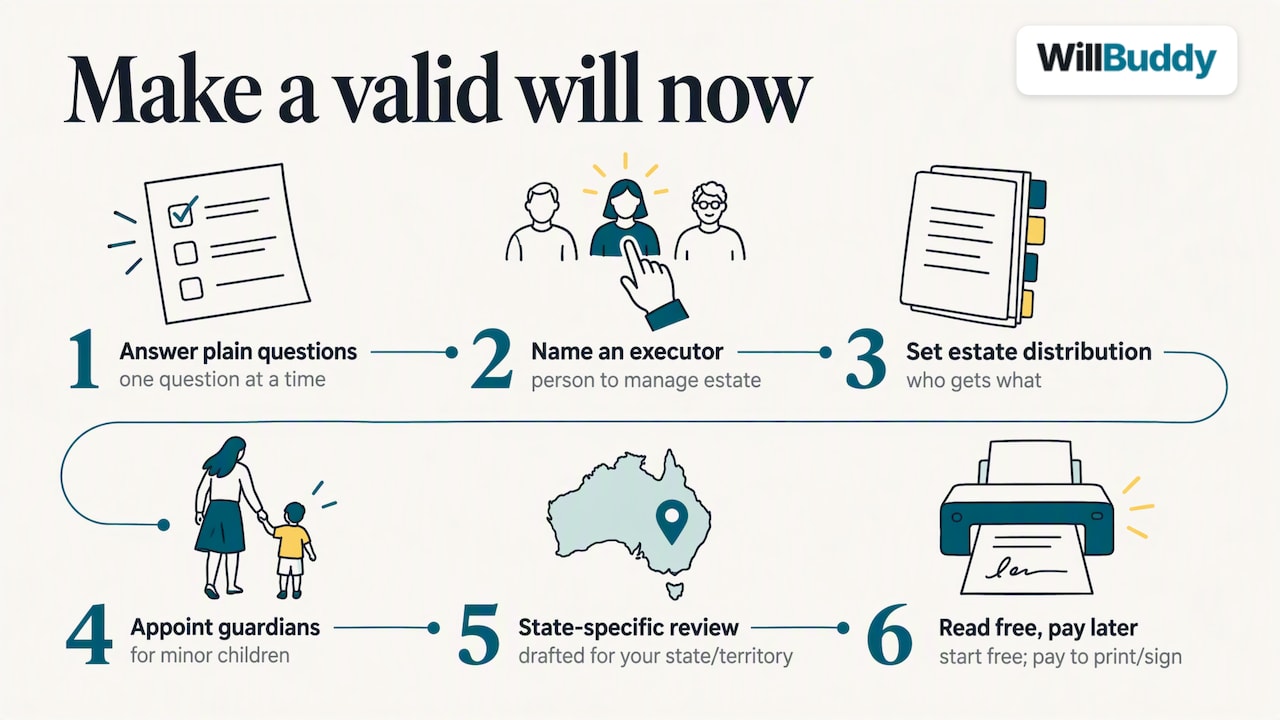
We use plain questions, asked one at a time, so you can name your executor, set out how your estate is distributed, and appoint guardians for children without wading through legal jargon. Your will is drafted for your own state or territory, and you can read every word for free before you pay anything. You can start your will free at Willbuddy and only pay once you're ready to print and sign it with witnesses. Full details on cost and what's included are on our pricing page.
This article is general information, not a substitute for advice from a qualified lawyer. Consult a qualified legal professional about your own circumstances before acting on anything here.
FAQ
Can an executor withdraw money from an estate bank account?
Yes, once an executor has a grant of probate (or letters of administration if there's no will), banks will generally allow withdrawals from the estate account to pay debts, funeral costs and eventual distributions. Before the grant is issued, a bank may release only limited amounts, such as paying funeral costs against the funeral provider's tax invoice.
What is the 2 year rule for deceased estate property?
This generally refers to a capital gains tax concept for a deceased person's main residence, where beneficiaries or executors may need to sell within a set period to access a tax exemption. Rules and timeframes depend on the specific circumstances, so it's worth checking current ATO guidance or speaking with a tax professional for your situation.
Can next of kin withdraw money from a deceased bank account?
Being next of kin does not give automatic access to withdraw funds. Banks generally require formal proof of legal authority, such as a grant of probate or letters of administration, before releasing more than a small amount. Some banks pay funeral costs without a grant, and in South Australia a bank may pay $15,000 or less to a surviving spouse, domestic partner or child, but it does not have to.
How do I open a bank account for a deceased estate?
Once you have legal authority as executor or administrator, you can approach the bank with your grant of probate or letters of administration and ask to open an account in the estate's name, often titled "Estate of the late [Name]". The bank will then pay estate funds into that account rather than to any individual.
Do I need probate to access a deceased person's bank account?
It depends on the account balance and the bank's own policy. Some banks release smaller amounts, such as for funeral costs, without probate, while larger balances typically require a grant of probate or letters of administration first.
Sources
Show the 3 sources
Recommended
When you're ready
Make things simpler for your own family
Sorting out an estate shows how much a clear will helps. WillBuddy drafts yours for your state from plain questions. Read every word free, with no card. You pay only if you want to print it.
Start my will freeLast updated 9 October 2026.
This article is general information only and is not legal advice. It is our best interpretation of the law as at 9 October 2026. WillBuddy is not a law firm, and it never replaces advice from a lawyer or solicitor. Laws change and differ between states and territories, so for your own circumstances, please get legal advice.