Joint Will in Australia: How It Works and What to Do Instead
General information, not legal advice.
On this page
- TL;DR
- What a joint will is
- Joint, mirror and mutual wills: the difference
- Why joint wills are uncommon
- What most couples do instead
- What a will can and cannot do for a couple
- Marriage, divorce and your will
- Signing and witnessing: the rules that apply to every will
- When to talk to a lawyer
- How to make a simple will for each partner
- Make your will with WillBuddy
- FAQ
- Sources
- Recommended

Quick answer
A joint will is a single will document signed by two people, usually a couple, that sets out what happens to both estates. It is legal to make one in Australia, but it is rare. Most couples are better served by two separate wills that say similar things. This guide explains why, and what each option means for your partner, your kids and your assets.
This is general information only. It is not legal advice.
TL;DR
- A joint will is one document for two people. Mirror wills are two documents with matching terms. Mutual wills are wills made under an agreement not to change them.
- The risk with a joint or mutual will is that the survivor may be locked in, even when life changes.
- Two separate wills give a couple the same result with far more flexibility.
- Jointly owned assets like a family home usually pass to the surviving owner outside the will.
- See a lawyer if you have a blended family, a business or trust, assets overseas, or a likely contest.
What a joint will is
A joint will is one document that two people sign together. It usually says three things:
- When the first person dies, everything goes to the surviving partner.
- When the second person dies, what is left goes to named people, often the children.
- The same executor looks after both estates.
The idea is simple and appealing. You are a team. You want the same outcome. One page seems tidy.
The trouble is that the single document is meant to work as two wills, and it can also carry an agreement between you. That agreement is where the problems start.
Joint, mirror and mutual wills: the difference
These three terms are often mixed up, even on legal websites. Here is how they differ.
| Type | How many documents | Is the survivor bound? | Typical use |
|---|---|---|---|
| Joint will | One, signed by both people | Can be, if the document shows an agreement not to change it | Rare in Australia |
| Mirror wills | Two, with matching terms | No. Each person can change their own will at any time | Common for couples |
| Mutual wills | Two or one, made under an agreement | Yes, if the agreement is proven | Sometimes used in second marriages |
The key word is agreement. Mirror wills match, but they do not bind anyone. Mutual wills are different. They exist because two people agreed not to revoke or change their wills after the first death, and one of them then did what they promised.
If you want a simple way to remember it: mirror wills are about matching. Mutual wills are about promising.
How courts treat mutual wills
The High Court of Australia set out the modern framework in Birmingham v Renfrew in 1937. As the Australian Law Reform Commission explains, the survivor is bound in equity if an agreement not to revoke is proven. The doctrine works like a trust over the property the survivor receives.
That is a heavy outcome. It means a will can be a promise that a court will enforce after you have gone.
Why joint wills are uncommon
Most people who ask about joint wills simply want their partner looked after and the children to inherit later. They do not mean to bind anyone. Yet a joint will can do exactly that, often by accident.
The survivor may be locked in
The ALRC notes that mutual wills can lack flexibility when families change, because the doctrine operates as a trust. Think about what can happen after the first death:
- The survivor remarries.
- A child becomes estranged, or has a serious illness, or needs more help than the others.
- The survivor needs to sell the home and move into aged care.
- A beneficiary dies before the survivor.
- A new grandchild is born.
With a bound will, each of these can become a legal question instead of a simple update.
Proving the agreement is hard
In Re Miglic [2024] VSC 20, the Supreme Court of Victoria pointed to the difficulty of proving an oral mutual wills agreement made decades earlier. Memories fade and records are often missing. A joint document can be unclear about whether an agreement was intended at all. That uncertainty is what ends up in court, and court is slow and costly for families.
One document, two people, one set of problems
A joint will can also cause practical headaches:
- Privacy. Each partner sees and shares the whole document, including gifts the other might prefer to keep private.
- Changes need both people. While you are both alive, changing a joint will fairly means agreement from both.
- Separation. If the relationship ends, one document covering two people is messy to untangle.
- Probate confusion. After the first death, it may not be clear which parts take effect and which are held back.
There is a fair point on the other side. The ALRC observes that mutual wills have stayed useful in second or later marriages, where a couple wants to protect the inheritance of children from earlier relationships. That is a real need. It is also exactly the situation where you should talk to a lawyer rather than rely on a template. More on that below.
What most couples do instead
For most couples, two separate wills do the job better. Each of you makes your own will. Both say the same things if that is what you want:
- Everything goes to your partner first.
- If your partner has died before you, your estate goes to your children or other chosen people.
- You name the same guardians for your kids.
- You name each other as executor, with a backup.
This is the mirror will approach. The difference is that each person stays free to change their own will later. If the first of you dies, the survivor can update their will to suit the new situation. If you want to know how, see our guide to updating or changing a will.
The trade-off is trust. Nothing stops the survivor from changing their will in a way you did not expect. For most couples with shared children, that risk is small and the flexibility is worth more. If it worries you, that is a conversation to have with a lawyer before you decide.
What a will can and cannot do for a couple
Before you worry about the type of will, check what your will actually controls.
Jointly owned assets often skip the will
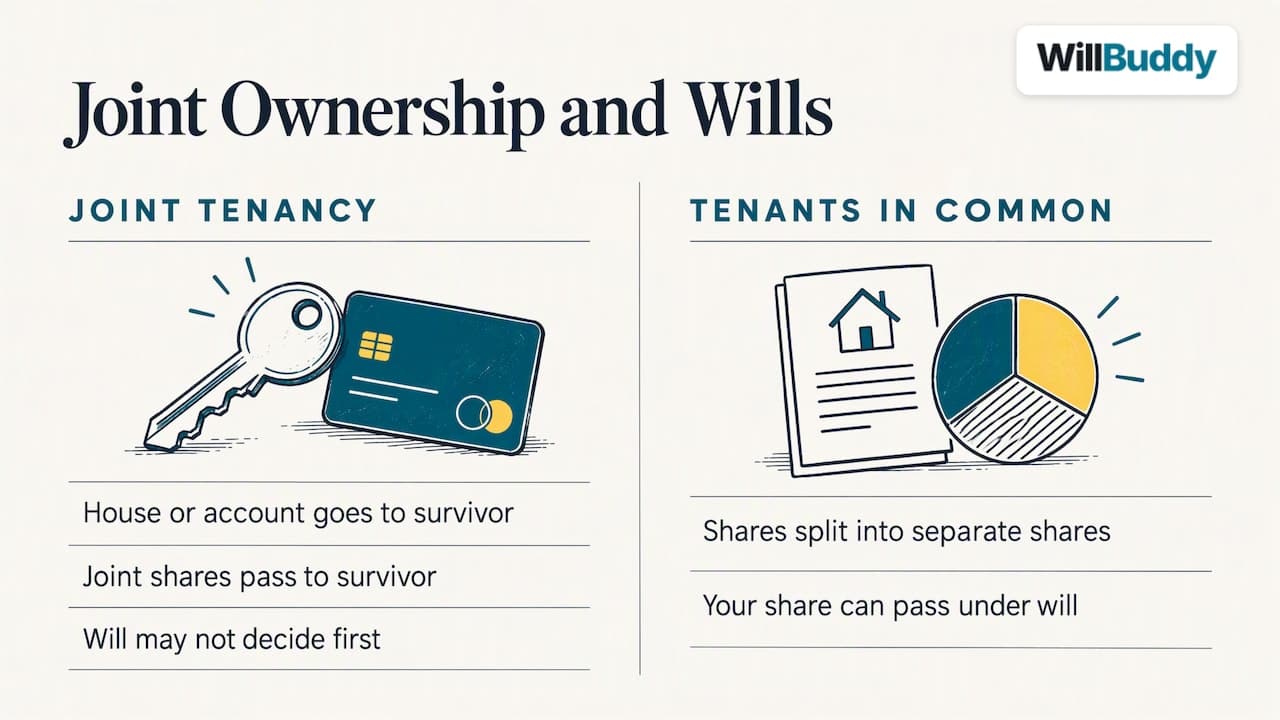
A house or bank account held as joint tenants usually goes straight to the surviving owner. As the Northern Territory Government notes, jointly owned assets such as a house or bank account transfer to the survivor and then form part of their estate when they die. So your will may not decide who gets the family home first.
This matters for the question "what happens to jointly owned shares?". The answer depends on how they are held. Shares held as joint tenants generally pass to the surviving holder. Shares held as tenants in common are split into separate shares, and your share can pass under your will. Check your registry or account records to see which applies. A lawyer can confirm it.
Guardians for your children
Parents can name a guardian in their will for children under 18 if both parents die. The NSW Government explains this alongside the role of the executor, who is the person or organisation responsible for managing assets in line with the will.
This is one reason couples need to think carefully about wills. A joint will that is only about money can miss the most important question: who looks after the kids?
Choosing an executor
Pick someone you trust, who is organised and who is likely to outlive you. Many couples name each other, then a backup such as an adult child, a sibling or a close friend. Ask the person first. It is a real job, with paperwork and deadlines.
Marriage, divorce and your will
Life events can change what your will does, whatever type it is.
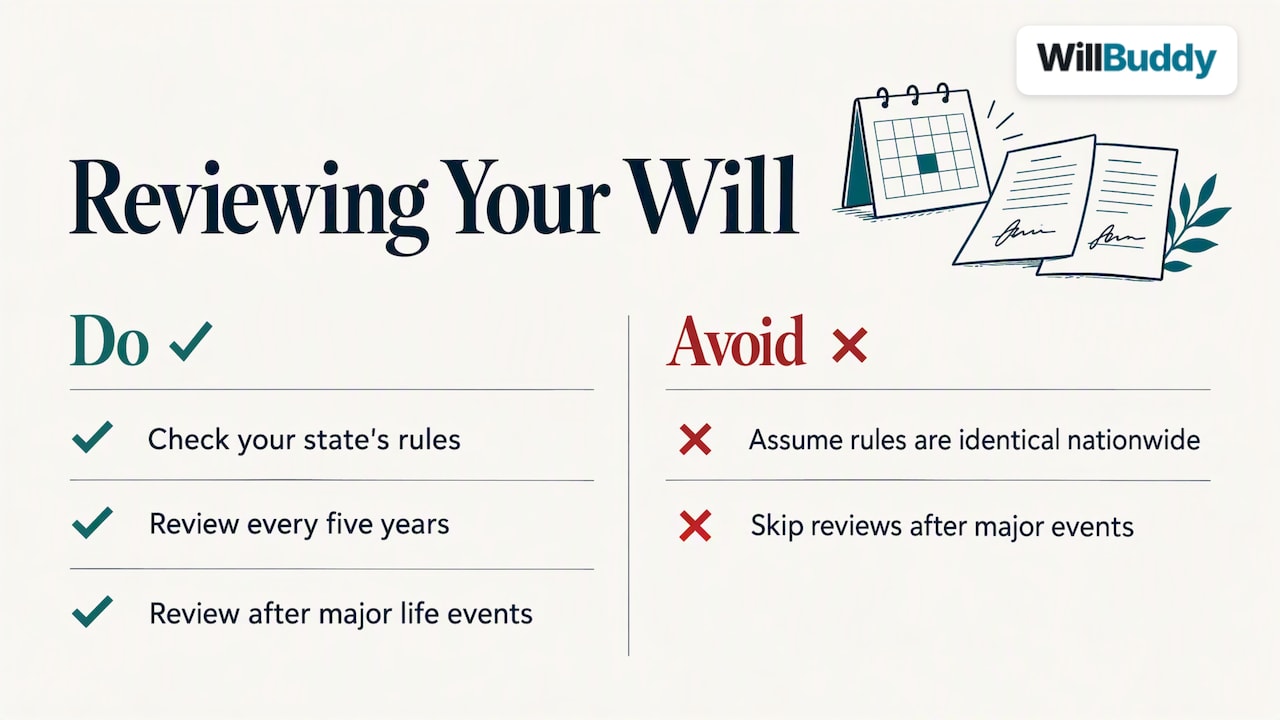
In New South Wales, the Succession Act 2006 generally treats a will as revoked when the will-maker marries, unless it was made in contemplation of that marriage. Other states and territories have their own rules, so check yours. Our guide to automatic revocation by marriage and the effect of divorce on wills explains how this plays out.
The NSW Government recommends reviewing your will every five years, and after big events such as marriage, separation or divorce, or the death of a proposed beneficiary or executor. A joint will makes that harder, because two people need to agree. Two separate wills keep each of you in control.
Signing and witnessing: the rules that apply to every will
A will that is not signed properly may not count. The general rule, as set out by the NSW Government, is:
- The will-maker signs, or another person signs at their direction and in their presence.
- Two adult witnesses watch the will-maker sign.
- The witnesses sign too, in the will-maker's presence.
- Witnesses should not be people who benefit under the will. In some states, including NSW (Succession Act 2006 s 10), a gift to a witness can be void.
If you and your partner each make a will, each will needs its own signing with its own witnesses. A joint will needs the same care, with both of you signing.
Details can differ between states and territories, including rules on remote witnessing. Check the rules for your state or territory before you sign.
A common mistake: scribbling on a signed will
Some people cross out a name or write in a new gift on a signed will. Tasmania Legal Aid warns that this does not work. Changes should be made through a codicil or by making a new, properly signed will. Our guide to codicil vs new will covers how to sign each correctly. With a joint will, a messy edit can be even more confusing, because it is unclear whose wishes changed.
When to talk to a lawyer
An online will suits many people with straightforward lives. A joint or mutual will is rarely the simple option, so get legal advice if any of these apply:
- Blended family. You or your partner have children from an earlier relationship, and you want to protect their inheritance. This is the classic case for mutual wills, and the wording matters.
- A business or trust. Family companies, trusts and self-managed super funds have their own rules that a standard will does not cover.
- Assets overseas. Property in another country may be governed by that country's law.
- A likely contest. If someone might challenge the will, such as a partner, child or other dependant, professional advice early can save a lot of grief.
If you are unsure whether you fit one of these, treat that as a sign to ask.
How to make a simple will for each partner
If you are a couple with no complicated assets, here is a practical path:
- Talk first. Agree on guardians, executors and who gets what if you both die.
- Write down your assets. Note which are joint and which are in one name. Include super and insurance, and check who is nominated on those, because they often sit outside your will.
- Each make your own will. Same wishes, separate documents.
- Sign with proper witnesses. Follow your state or territory's rules.
- Store the originals safely. Tell your executor where they are.
- Review it. Revisit after major life events and every few years.
Make your will with WillBuddy
WillBuddy lets each partner draft their own will for their state or territory by answering plain questions, one at a time. You can read every word of your will free before you pay. Then you print it and sign it with witnesses.

If your circumstances change, the annual plan lets you make up to 50 AI-assisted edits a year, so your will can keep up with your life. Your data is encrypted and not sold. See the Annual Access plan and pricing for details.
WillBuddy is for straightforward wills. If you have a blended family, a business or trust, assets overseas or a likely contest, speak to a lawyer first.
FAQ
Is a joint will legal in Australia?
Yes, a joint will can be valid if it is signed and witnessed properly. It is uncommon, though, and often discouraged because of the risk of binding the survivor. Rules can differ by state or territory, so a lawyer can confirm what applies to you.
Can the surviving partner change a joint will after the first death?
It depends on whether the couple agreed not to change it. If that agreement is proven, the survivor can be bound in equity, as the High Court found in Birmingham v Renfrew. If there was no agreement, the survivor is generally free to make a new will. This is a good reason to get advice before relying on a joint document.
What is the difference between a joint will and mirror wills?
A joint will is one document signed by two people. Mirror wills are two separate documents with matching terms. Each person can change their own mirror will later, which is why many couples prefer them.
Do we need a joint will if we own our home together?
Not usually. A home held as joint tenants typically passes to the surviving owner outside the will. Your will still matters for your other assets, for naming guardians and executors, and for what happens if you both die.
Start your will free at willbuddy.com.au and read it before you pay.
Sources
Show the 6 sources
Recommended
For the one who gets things sorted
Now write yours, with your family's names in it
Plain questions about your family, one at a time, and WillBuddy drafts a will for your state. Until you sign one, the law in your state or territory decides who gets what. Read every word free, with no card. You pay only if you want to print it.
Start my will freeLast updated 28 October 2026.
This article is general information only and is not legal advice. It is our best interpretation of the law as at 28 October 2026. WillBuddy is not a law firm, and it never replaces advice from a lawyer or solicitor. Laws change and differ between states and territories, so for your own circumstances, please get legal advice.