Conditional Gifts in a Will: How They Work in Australia
General information, not legal advice.
On this page
- TL;DR
- What a conditional gift in a will actually is
- Which conditions Australian courts tend to accept
- Conditions that can go wrong
- What happens if the condition is not met
- How to word a conditional gift clearly
- When a trust is the better tool
- Conditions, family claims and contests
- What your executor will do
- Making a will that gets the basics right
- FAQ
- Sources
- Recommended

Quick answer
A conditional gift is a gift in your will that the person only keeps, or only receives, if something happens. Maybe they finish a degree, reach 25 or survive you by 30 days. Australian courts will enforce many conditions, but not all, and the wording decides the outcome. For most families, the simplest and safest conditions are age and survival. Anything more complex is better handled with clear gifts in your will, and with a lawyer for the harder cases. This is general information, not legal advice.
TL;DR
- A conditional gift depends on an event. A condition precedent must happen before the person receives the gift. A condition subsequent can take the gift away after they have it.
- Courts accept conditions that are clear, possible and not against public policy. Vague, impossible or unlawful conditions can fail.
- If a condition is not met, the gift usually falls back into the rest of your estate, unless your will names who gets it instead.
- Age conditions and survival periods are the most common conditions for parents. Plain wording matters more than clever wording.
- If you want to control how money is spent over many years, a trust is usually the tool. That is a job for a lawyer.
What a conditional gift in a will actually is
Most gifts in a will are simple: "my car to my sister" or "half of my estate to my daughter". A conditional gift adds an "if". "My car to my sister, if she is still living at my death." "$20,000 to my nephew, if he finishes his apprenticeship."
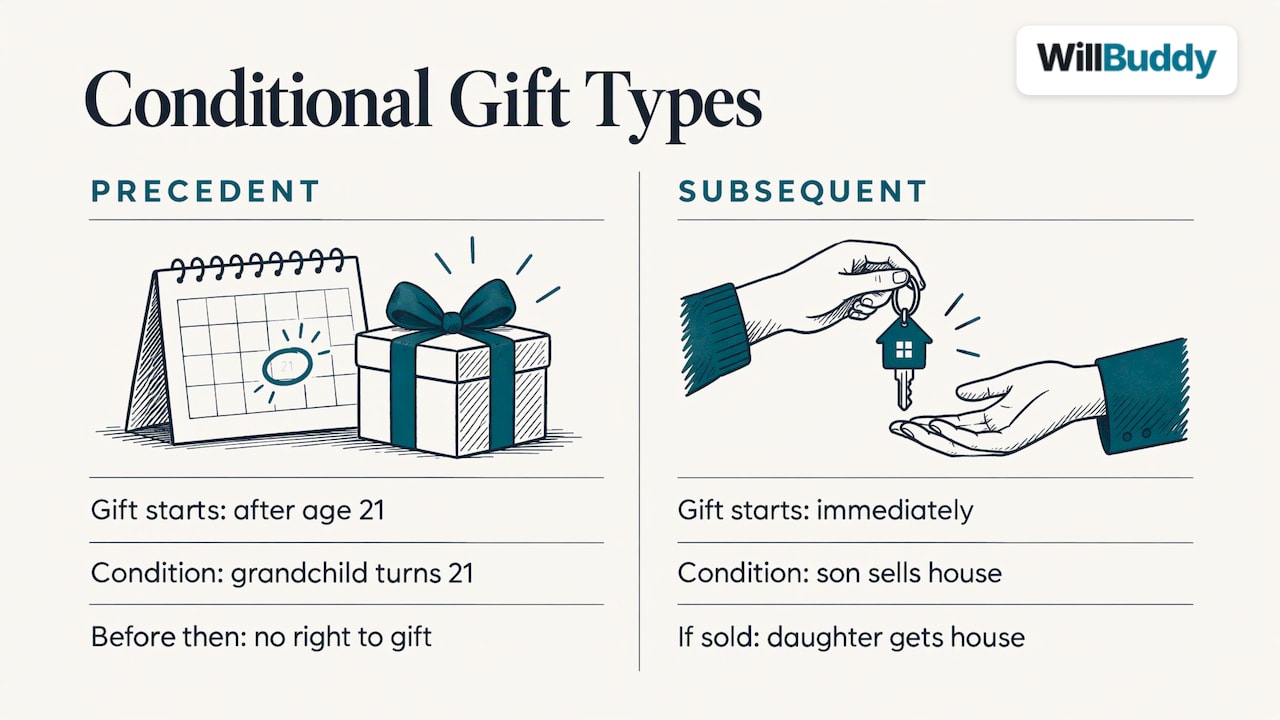
There are two types, and the difference matters.
Condition precedent. The person must meet the condition before the gift is theirs. A gift to a grandchild "if they turn 21" is an example. Until the event happens, they have no right to the gift. The exact words matter: a court can read some age wording as a gift that is already theirs, with only the handover delayed.
Condition subsequent. The person gets the gift straight away, but it can be taken back if something happens, for example "to my son, but if he has not finished his apprenticeship by the age of 25, it goes to my daughter".
Courts do not always treat the label in your will as the final word. They look at what the words mean. Where the wording is doubtful, courts tend to favour a reading that lets the gift take effect early. In Goodman v Bryant (2025), the NSW Supreme Court held that a gift vested when the will-maker died, rather than depending on the beneficiary reaching 25. A condition that can take a gift away must also be precise. Since Clavering v Ellison, an 1859 House of Lords decision that Australian courts follow, the test has been whether the person can see from the start exactly what event will end their gift.
Which conditions Australian courts tend to accept
There is no single Australian statute on conditional gifts in wills. In NSW, the position rests on case law. A condition is generally acceptable if it is not impossible, not uncertain and not against public policy. The same article gives a simple example: inheriting only after completing a university degree, where the person has the ability and means to do it.
In practice, these are the conditions most people consider.
Age conditions
"To my daughter when she turns 25." This is clear, possible and easy to check. Still, say whether the gift is hers only once she turns 25, or hers from your death and handed over at 25, because courts can read age wording either way. It is the most common condition in wills made by parents of young children. It sits well alongside naming a guardian and an executor.
Survival conditions
A will often says a beneficiary must outlive you. Some states also build in a survival period by law. In Queensland, section 33B of the Succession Act 1981 says that if a beneficiary dies within 30 days after you, the will takes effect as if they died before you, unless your will shows a different intention. A general requirement that the beneficiary survive you is not treated as that different intention. Rules differ by state and territory, so check the law where you live.
Education or life-event conditions
Conditions such as finishing a degree or getting married can be valid if they are clear. Courts have upheld some that many people would find harsh. In Nicholls v Public Trustee (SA), the High Court of Australia held in 1945 that a condition requiring a granddaughter to renounce the Roman Catholic religion within three months of the will-maker's death was valid. In NSW, Hickin v Carroll (No 2) upheld a will that required four children to become Catholics within three months of their father's death. They did not, and their share went to the other beneficiaries.
These cases show that courts respect what a will-maker wrote. They also show that the beneficiary lives with the result. If you are tempted to attach a condition about someone's beliefs, relationships or lifestyle, talk to a lawyer first. The wording and the facts of your family matter a great deal.
Conditions that can go wrong
A condition can fail for a few reasons.
It is uncertain. "To my son if he behaves well" gives an executor nothing to measure. Who decides? Over what period? A condition needs a test that a stranger could apply.
It is impossible or unlawful. A condition that cannot be done, or that requires something illegal, will not work.
It is against public policy. Courts can refuse conditions that, for example, push someone to break the law.
It tries to control property after it is given. In NSW Trustee and Guardian v Hirsch (2013), the will-maker wanted to protect a beneficiary's inheritance from relatives. The court held that the estate was held on trust for her, with the money used for her benefit without coming into her own hands. The case shows that you can control money while trustees hold it. You cannot usually give property outright and then say it stops belonging to the person if they sell it or give it away.
South Australia adds a wrinkle. Section 23 of the Law of Property Act 1936 (SA) says a gift is not void only because the will-maker attached an illegal stipulation to it, whether as a condition precedent or subsequent. Unless the beneficiary agreed to the stipulation when the will was made, the gift is read as if the stipulation was not there. The High Court considered this section in Nicholls. South Australia also replaced its Wills Act 1936 with the Succession Act 2023 from 1 January 2025, so ask a lawyer when the stakes are high.
What happens if the condition is not met
It depends on the type of condition and what your will says.
If a condition precedent is not met, the person generally does not receive the gift. It usually falls into the residue, the part of your estate left after specific gifts, debts and costs. If a condition subsequent is invalid, the person may keep the gift without the condition.
Time limits can also be argued. Where a will sets a time to perform a condition and the person is late, a court may decide whether time was really essential, or whether late performance still achieves what the will-maker wanted. That kind of argument costs money and delays everyone. A clear deadline and a named back-up person avoid it.
This is why a back-up gift is worth writing. "To my nephew if he completes his degree, and if not, to my niece." Now the executor knows exactly where the gift goes.
Charities and community organisations face the same rules. Justice Connect's guide to gifts and bequests says an organisation must generally comply with any conditions attached to a gift it accepts. It may ask a court to vary a condition that is impractical or impossible. If you want to leave a gift to a charity with strings attached, ask the charity first so the gift can actually be used.
How to word a conditional gift clearly
Most disputes about conditions come from wording, not from the idea behind them. These habits help.
- Say who. Use full names and relationships. "My niece, Jane Smith" is better than "my niece".
- Say what. Name the item or the amount or the share.
- Say the condition in one test. "Who turns 25" or "who completes a bachelor's degree" is a test. "Who makes good choices" is not.
- Say when. Is the deadline your death, a birthday or a set period? Pick one.
- Say who decides. If the condition needs proof, say what proof, such as a certificate or a birth certificate.
- Say what happens if it fails. Name a back-up person or say the gift goes back into the residue.
On timing, the Law Society Journal's December 2025 report on Goodman v Bryant (NSW Supreme Court) is useful. The court distinguished a gift that is "vested in interest but not in possession" from one that is contingent or conditional, where the person has no right to the interest yet. Drafters were advised to use clear language about when a gift vests. For you, the plain-English version is: say exactly when the person becomes the owner, and what must happen first.
It also helps to keep each condition simple. Our guide to wording fixes for specific gifts covers how small wording changes can save a gift from failing.
When a trust is the better tool
Sometimes a condition is really a worry about how money will be used. You might fear a beneficiary will spend it quickly, or you want money used only to care for a person or a pet.
The Legal 500 article notes that a gift to care for a person or pet is hard to police once the money is paid. It suggests a testamentary trust instead. The trust can limit access to funds to specific care costs, and a trustee can take action if the terms are breached.
A testamentary trust is a trust that starts when you die, set up by your will. Read more in our guide to testamentary trusts in Australia. Trusts are one of the situations where you should see a lawyer, as are blended families, a business, assets overseas or a likely contest.
Conditions, family claims and contests
A condition does not put your will beyond challenge. Eligible family members can apply to a court for provision from an estate in every state and territory, and a successful claim can reduce the gifts in your will. The family provision laws include the Succession Act 2006 in NSW, Part IV of the Administration and Probate Act 1958 in Victoria and the Succession Act 1981 in Queensland.
In South Australia, the Succession Act 2023 started on 1 January 2025. A College of Law commentary says it makes the will-maker's wishes the court's main consideration in family provision claims and requires evidence of the will-maker's reasons to be considered. A short, signed note of your reasons can help, so talk to a lawyer about how to record it.
If you worry about a challenge, read can a will be contested in Australia and how to disinherit a child.
What your executor will do
Your executor carries out the will. The Legal Practitioners' Liability Committee's Guide for Executors says an executor must act in the best interests of the estate and all beneficiaries, keep full and accurate records, and give beneficiaries a summary of financial transactions.
When a gift has a condition, the executor may have to check whether it has been met. That is much easier when you have written a test they can check, such as a date of birth or a certificate. It is much harder with a test that needs a judgement call. Choose an executor you trust, and tell them where your will is.
Making a will that gets the basics right
A conditional gift only works if the will itself is valid. Each state and territory has its own formalities, such as signing in front of two witnesses. Our guide to will requirements in Australia explains them, and why a will can be invalid shows the common mistakes.
WillBuddy asks plain questions one at a time and drafts a will for your state or territory. You can name guardians for your children, choose executors and set out who gets what. You can read every word for free before you pay, then print it and sign it with witnesses. Annual Access is $39 a year and includes up to 50 AI-assisted edits a year, so you can update your will when life changes. See the Annual Access plan for details.

For parents, the most important decision is usually who will care for your children, then who inherits and at what age. Those are the choices to get down first. If you then want a more detailed condition, such as staged payments or spending limits, a lawyer can help you build it on top.
FAQ
Can I leave a gift only if someone does something?
Yes, in many cases. The condition must be clear, possible and lawful. A condition such as finishing a degree or reaching an age is generally acceptable, as long as the person is able to meet it. Vague conditions are at risk of failing, so use one test that an executor can check.
What happens if the person does not meet the condition?
For a condition precedent, they usually do not receive the gift and it goes to the residue or to a back-up person named in the will. If the condition is invalid, the result can differ. A named back-up beneficiary removes most of the doubt.
Is a gift at age 18 or 25 a conditional gift?
It can be. If your will says the gift is theirs only if they reach 25, that is a condition precedent about age, and it suits parents who do not want young adults receiving a large sum straight away. But courts favour reading a gift as theirs from your death, with only the handover delayed. In Goodman v Bryant (2025), a NSW court read a gift to grandchildren who reach 25 that way. Say clearly when the gift becomes theirs and what happens if the child dies before that age.
Do I need a lawyer to add conditions?
Simple conditions such as age or survival can be written in plain words. See a lawyer if you have a blended family, a business or trust, assets overseas, or expect a contest. They are also the right person for complicated conditions about behaviour, beliefs or spending.
Sources
Show the 11 sources
- Nicholls v Public Trustee (SA) [1945] HCA 32; (1945) 72 CLR 86
- NSW Trustee and Guardian v Hirsch [2013] NSWSC 1397
- Legal 500: Can you put conditions in a will? Conditional gifts and bequests in NSW
- Succession Act 1981 (Qld)
- Succession Act 2006 (NSW)
- Administration and Probate Act 1958 (Vic)
- Law of Property Act 1936 (SA)
- Justice Connect: Gifts, wills, bequests and endowments
- Law Society Journal: Elder law and succession, December 2025 (Goodman v Bryant [2025] NSWSC 1240)
- College of Law: South Australia has a new Succession Act
- Legal Practitioners' Liability Committee: A Guide for Executors
Start your will free at willbuddy.com.au and read it before you pay.
Recommended
For the one who gets things sorted
Now write yours, with your family's names in it
Plain questions about your family, one at a time, and WillBuddy drafts a will for your state. Until you sign one, the law in your state or territory decides who gets what. Read every word free, with no card. You pay only if you want to print it.
Start my will freeLast updated 27 November 2026.
This article is general information only and is not legal advice. It is our best interpretation of the law as at 27 November 2026. WillBuddy is not a law firm, and it never replaces advice from a lawyer or solicitor. Laws change and differ between states and territories, so for your own circumstances, please get legal advice.