Can an Executor Also Be a Beneficiary in Australia?
General information, not legal advice.
On this page

Quick answer
Yes. In Australia, the person you name as executor can also receive a gift under your will. The Legal Services Commission of South Australia says your executor may also be a beneficiary, and that any adult with legal capacity can be appointed. It is common for a spouse or an adult child to hold both roles. The dual role does work, but only if your will is clear and the executor understands the duty that comes with it. With WillBuddy you answer plain questions one at a time, name your executor and your beneficiaries, and read every word of your will free before you pay.
This article is general information, not legal advice.
TL;DR
- An executor can be a beneficiary in every Australian state and territory. It is very common for a partner or adult child to be both.
- The executor must act in the best interests of the estate and all beneficiaries, not in their own interests where the two differ.
- Witnesses are the trap. In some states a gift to a person who witnesses your will can fail, so use two independent adults.
- Naming a backup executor and talking to your family early prevents most disputes.
- See a lawyer if you have a blended family, a business or trust, assets overseas, or a likely contest.
What an executor does
An executor is the person you choose to carry out your will after you die. Their job starts only after your death. According to the Legal Services Commission of South Australia, that includes:
- finding the original will
- organising the funeral
- applying for a certified copy of the death certificate
- applying to the Supreme Court for probate (the court's formal confirmation that the will is valid and the executor can act)
- distributing assets as the will directs
The same factsheet makes clear that being an executor does not mean paying the deceased's bills or debts personally if the estate cannot cover them. The debts are paid from the estate, before the beneficiaries receive anything. Even so, the job takes time and care, which is one reason to pick someone organised and trusted.
A beneficiary is simply a person, charity or group who receives something under the will. Nothing stops one person being both.
Why the dual role is so common
Most people want their spouse or children to inherit. They also want someone close to handle the paperwork. The two groups overlap almost completely. The law allows it, and the Legal Practitioners' Liability Committee's guide for executors sets out the duties that come with the role, whoever holds it.
In practice this means:
- A married person often names their partner as sole executor and main beneficiary.
- Parents often name one adult child as executor and leave the estate to all their children equally.
- Many people name two executors who are also two of the beneficiaries.
If you want more than one person to act, see our guide on having two or more executors in your will.
The duty that comes with inheriting
Being a beneficiary does not loosen the executor's duty. It sharpens it. The LPLC guide says the executor must act in the best interests of the estate and all beneficiaries. They cannot put their own interests first where those differ.
In plain terms, an executor who is also a beneficiary must:
- Manage and protect the assets. That means looking after property, accounts and investments until they are distributed.
- Pay the debts first. In Queensland, for example, section 56 of the Succession Act 1981 makes the deceased's property available to pay their debts, and section 52 requires the estate to be collected, administered according to law and distributed as soon as may be.
- Keep full and accurate records. The LPLC guide also says beneficiaries should get a summary of the financial transactions.
- Follow the will. If the executor wants to distribute assets in a different way, the guide says all adult beneficiaries should consent, preferably in writing after independent legal advice.
- Keep people informed. The LPLC says open, honest and regular communication with beneficiaries is often the best way to minimise difficulties.
The Victorian Law Reform Commission explains the reasoning. Its consultation paper on executors discusses the executor's fiduciary duty, which means a duty owed by someone trusted to act for others. An executor has a duty to act in the interests of the beneficiaries, and any conflict between that duty and the executor's own interest has to be carefully managed.
A worked example
Say Priya names her son Arjun as executor. She leaves her house equally to Arjun and his sister Meera. Arjun lives in the house and wants to buy Meera out cheaply.
He cannot simply decide that himself. His duty is to both children. The LPLC guide says an executor who wants to buy something from the estate needs an appropriate valuation and the consent of all the adult beneficiaries. So Meera needs to agree, and the guide says consent to a change from the will is best given in writing after independent legal advice. If he keeps Meera informed from the start, the sale is far less likely to turn into an argument.
State rules differ on witnesses
The executor question is the same across Australia. The witness question is not, and it is where people trip.
The basic signing rule is much the same everywhere. Your will must be in writing and signed by you in the presence of two witnesses who are there at the same time, and both witnesses then sign in your presence (see, for example, s 10 of the Succession Act 1981 (Qld) and s 8 of the Wills Act 2008 (Tas)). The Acts set no minimum age for a witness, but adults who could later explain what they saw are the safe choice.
The problem is when a witness is also a beneficiary. The Victorian Law Reform Commission says the old rule, which voided gifts to witnesses, was abolished in Victoria in 1997 and also in South Australia, Western Australia and the ACT. The other four jurisdictions keep a modified version. There, a gift to a witness does not fail if at least two witnesses are not beneficiaries, if all affected beneficiaries consent in writing, or if the court is satisfied the will-maker knew and freely approved the gift.
| Place | Gift to a witness |
|---|---|
| Victoria, South Australia, Western Australia, ACT | Rule abolished, per the Victorian Law Reform Commission |
| NSW, Queensland, Tasmania, Northern Territory | Gift is void unless an exception above applies (for example s 10, Succession Act 2006 (NSW), s 11, Succession Act 1981 (Qld) and s 12, Wills Act 2008 (Tas)) |
So if you live in NSW, Queensland, Tasmania or the Northern Territory, a witness who is also a beneficiary puts that gift at risk.
The simple fix works everywhere. Independent witnesses are the safe choice in every state and territory, even where the rule was abolished. Ask two adults who receive nothing under your will, and who are not your executor or beneficiaries. Our guide to who can witness a will, state by state covers the detail.
Note that the witness rule is about gifts. It is a separate question from whether your executor can inherit. An executor who also witnesses could cause a gift problem in some states, so keep the roles apart.
What if the executor has a conflict?
Sometimes the dual role becomes awkward. The estate might be messy, the executor might want to make a claim against it, or family tension might be high. These are the usual options.
- Refuse the role. The LPLC guide says an executor should refuse the position if their personal interests will be in conflict with the role, preferably before probate is granted. After probate, stepping down needs the Supreme Court's consent.
- Get advice before making a claim. An executor who wants to make their own claim against the estate is in a direct conflict and should get legal advice about stepping aside first. In Victoria, a named executor can decline (renounce) without giving reasons, but once they start dealing with the estate's assets (called intermeddling), they generally cannot simply renounce.
- Manage the conflict. Common tools include a clause in the will that expressly allows what the executor plans to do, an independent co-executor to share decisions, the informed consent of the beneficiaries, or the court's approval.
If an executor will not act or cannot act, the court can step in. In Victoria, section 34(1) of the Administration and Probate Act 1958 lets the Supreme Court remove an executor who refuses, is unfit or is incapable, and appoint a proper person or trustee company instead. Our page on how to remove an executor explains the process.
Accountability has a time limit. In South Australia, the Legal Services Commission says court action to hold an executor to account must start within 3 years of becoming aware of the failure. The court may order an executor to repay improper benefits or compensate people who lost out.
If your executor cannot act
People die, move overseas or lose capacity. If your only executor is also your main beneficiary, you want a plan for that. Name a backup executor in your will. Our guide on naming a backup executor shows how.
If nobody named can or will act, someone else usually has to apply to the court to administer the estate. Property transfers can then become a step of their own. In NSW, for example, the process for deceased estate transfers covers moving real estate out of the deceased's name.
How to set it up well in your will
If you want your executor to also inherit, these steps keep things smooth.
- Pick someone reliable, not just someone close. The role takes time and organisation. Our guide to choosing a will executor explains how to match the person to your state and assets. Check the age rule too: see executor age requirements.
- Name a backup. One more name costs nothing and avoids a court application.
- Consider a second executor. An independent co-executor can share the decisions where your main executor has a personal stake.
- Be specific about gifts. Say who gets what, and what happens if a beneficiary dies before you.
- Tell your family. A short conversation now prevents a long argument later.
- Use independent witnesses. Two adults who gain nothing from your will.
- Keep the will current. Marriage, separation, a new child or a new home can all change who you want.
When to see a lawyer
A simple will for a couple with a home, some savings and children is a common situation. Speak to a lawyer if you have a blended family, a business or trust, assets overseas, or a will that someone is likely to contest. In those cases, an executor who is also a beneficiary can face more conflict, and tailored advice is worth having.
Making it simple with WillBuddy
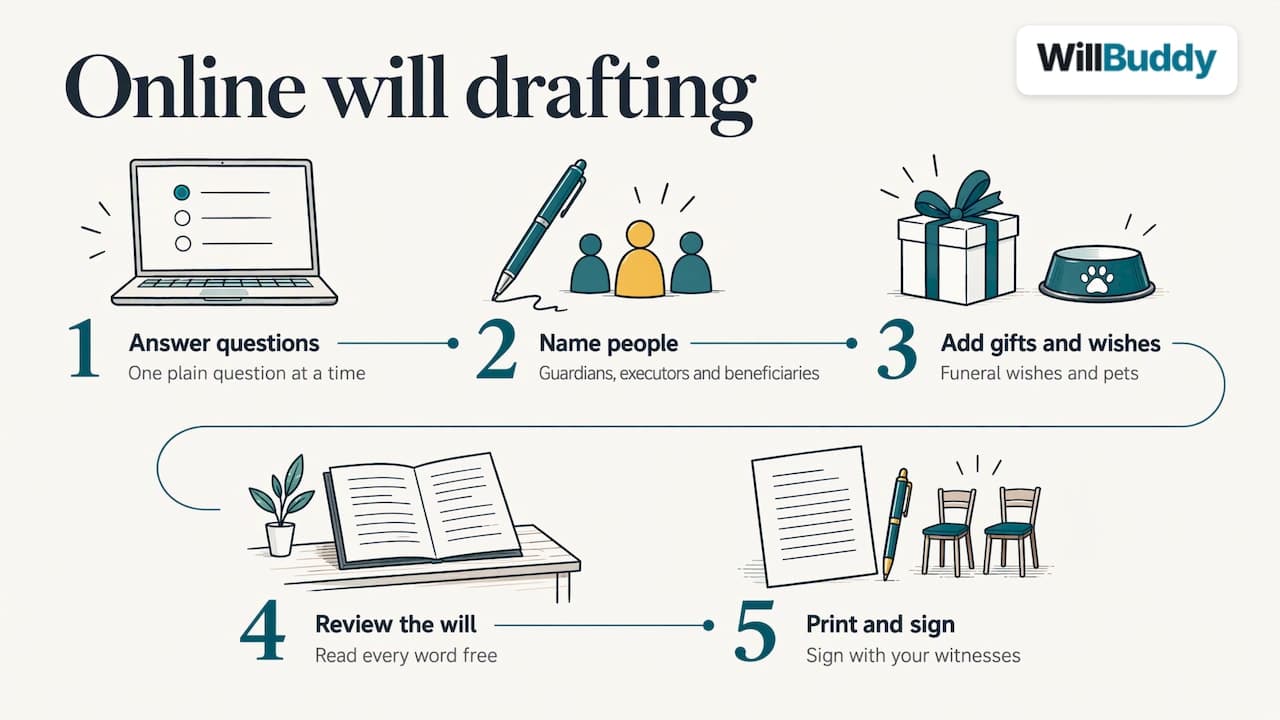
WillBuddy is an online platform for drafting a will that suits your state or territory. You answer plain questions one at a time. You name your guardians for children, your executors and your beneficiaries, and you can add gifts, funeral wishes and pets. You can read every word of your will free before you pay, then print it and sign it with your witnesses.

Your life will change, and your will should too. The annual subscription includes up to 50 AI-assisted edits a year and secure storage in Australia. We encrypt your personal data and never sell it. You can see the plan on the pricing page. If you want a guide for your state first, we have free PDFs for Victoria, Western Australia and South Australia.
When the time comes, your executor can use our step-by-step estate administration checklist to know what to do next.
FAQ
Can my spouse be both my executor and my main beneficiary?
Yes. This is one of the most common set-ups in Australia. Your spouse must act in the interests of the estate and all beneficiaries, which includes any children you name. Naming a backup executor covers the case where your spouse dies first or cannot act.
Can an executor take a fee as well as an inheritance?
Not automatically. Executors are not usually paid just for acting. If you want your executor to receive a fee, say so in the will. Otherwise it generally needs the agreement of the beneficiaries or a court order. Ask a lawyer if you want to include a fee.
Can an executor who is a beneficiary witness my will?
It depends on your state. Victoria, South Australia, Western Australia and the ACT have abolished the rule that voids gifts to witnesses. NSW voids the gift unless an exception applies, and other jurisdictions keep a modified rule. The safe answer everywhere is to use two independent adults.
What if the executor-beneficiary does not do the job properly?
Beneficiaries can ask the court to act. A court can remove an executor who refuses, is unfit or is incapable, and can order repayment of improper benefits. In South Australia, action must start within 3 years of becoming aware of the failure. Speak to a lawyer about your own situation.
Can an executor say no after being named?
Yes. In Victoria, a named executor can decline without giving reasons, but loses that right once they start dealing with the estate. Other states have their own rules, so an executor who is unsure should get legal advice before touching any assets.
Start your will free at willbuddy.com.au and read it before you pay.
Sources
Show the 8 sources
- Choosing an Executor factsheet, Legal Services Commission of South Australia
- A Guide for Executors, Legal Practitioners' Liability Committee
- Succession Laws: Executors consultation paper, Victorian Law Reform Commission
- Succession Laws report: Witnessing wills and undue influence, Victorian Law Reform Commission
- Succession Act 2006 (NSW)
- Succession Act 1981 (Qld)
- Wills Act 2008 (Tas)
- Administration and Probate Act 1958 (Vic)
Recommended
For the one who makes it easy for everyone
Make it easy for whoever sorts things out after you
Your will names your executor, and a backup if they can't act, so nobody is left guessing. You can also say whether they're paid. WillBuddy drafts it for your state from plain questions. Read every word free, with no card. You pay only if you want to print it.
Start my will freeLast updated 25 November 2026.
This article is general information only and is not legal advice. It is our best interpretation of the law as at 25 November 2026. WillBuddy is not a law firm, and it never replaces advice from a lawyer or solicitor. Laws change and differ between states and territories, so for your own circumstances, please get legal advice.