Electronic Wills in Australia: What Is Valid and What Is Not
General information, not legal advice.
On this page
- TL;DR
- Electronic will or online will: what is the difference?
- Are online wills legally binding in Australia?
- What the law says state by state
- Online witnessing: possible, but not casual
- When can a digital document still count as a will?
- The real risks of electronic and DIY wills
- A checklist before you rely on any online will
- Guardians for children and keeping your will current
- Where WillBuddy fits
- FAQ
- Sources
- Recommended
Quick answer
In most of Australia, you cannot safely make a will by typing it and signing it on a screen. You can draft a will online, but the safe way to finish it is still to print it and sign it on paper in front of two witnesses. A few states allow limited electronic or audio-visual witnessing, with strict conditions. Courts have also accepted some digital documents as wills after death, but that is a rescue, not a plan.
This guide explains the difference between an electronic will and an online-drafted will, what each state says, and what to check before you rely on any online process. It is general information only, not legal advice.
TL;DR
- An electronic will is signed and witnessed in electronic form. An online-drafted will is written on a website, then printed and signed on paper. They are not the same thing.
- Wills law is state and territory law. New South Wales and Western Australia exclude wills from their general electronic signing rules. New South Wales and Victoria allow remote witnessing only in tightly controlled ways, and Queensland's temporary pandemic rules have ended.
- Courts can sometimes accept a digital document as a will if they are satisfied the person meant it to be their will. That means cost, delay and family stress.
- For most adults, the lowest-risk path is to draft online, print, and sign with two independent adult witnesses present together.
- See a lawyer if you have a blended family, a business or trust, assets overseas, or a likely contest.
Electronic will or online will: what is the difference?
People use these terms as if they mean the same thing. They do not.
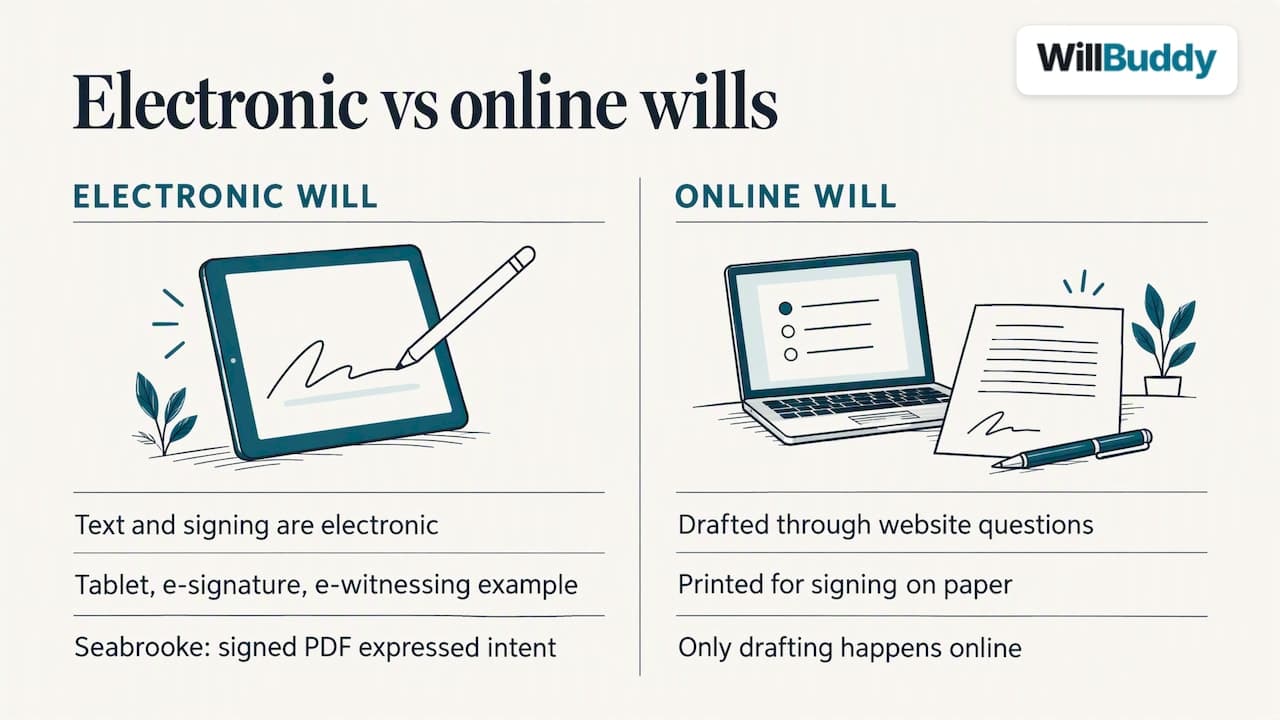
An electronic will is a will whose text and signing both exist in electronic form. One example is a document prepared and signed on a tablet with an electronic signature and electronic witnessing. Courts have accepted some electronic documents as wills after the person died, using their power to excuse missing formalities, as the Law Society of NSW Journal explains.
An online will is usually something simpler. You answer questions on a website, the site produces a document for your state or territory, and you print it. Then you sign it on paper with witnesses. The will itself is a normal paper will. Only the drafting happened online.
That difference matters because the law checks how a will was signed, not how it was written. A will drafted in a browser and signed in ink in front of two witnesses follows the same formal path as one typed up by a solicitor.
Are online wills legally binding in Australia?
A will drafted online can be valid if it meets the formal rules of your state or territory. The tool does not make it valid. The signing does.
The core rule is similar across the country. The will must be in writing and signed by you. Two witnesses must be present at the same time, and they must sign too. Adults are the safe choice. In New South Wales, for example, section 6 of the Succession Act 2006 says the will must be in writing and signed by the person making it. It must be signed or acknowledged in front of at least two witnesses present at the same time. Those witnesses must attest and sign in the person's presence. The Law Society of NSW sets this out in its paper on electronic witnessing.
Other states have their own wording, so check your own state's Act. Our guide to will requirements in Australia covers the basics.
Two more points sit behind validity:
- Capacity. You must understand what a will is and what you are doing. Our page on testamentary capacity explains what courts look for.
- Freedom from pressure. Remote signing can make identity, capacity and undue influence harder to assess, which the Law Society of NSW flags as a risk.
What the law says state by state
The general electronic signing laws in each jurisdiction usually carve out wills. Here is what the checked sources show.
| State or territory | What the sources say |
|---|---|
| New South Wales | Wills and other testamentary instruments are excluded from the Electronic Transactions Act 2000, so they generally need traditional signing. A separate audio-visual-link method for witnessing exists, but the Law Society says it does not replace face-to-face signing. |
| Western Australia | Part 2 Division 2 of the Electronic Transactions Act 2011 does not apply to creating, executing or revoking a will. |
| Victoria | Audio-visual witnessing is allowed for some documents, but wills are subject to strict requirements. These include a special witness (a legal practitioner or justice of the peace) and all participants being physically in Victoria. |
| Queensland | A temporary 2020 COVID-19 regulation let a will be witnessed by audio-visual link, but only with a special witness who verified the signatory's identity. That measure has ended. The Succession Act 1981 (Qld) s 10 now requires the witnesses to be present. |
| South Australia | The Succession Act 2023 (SA), which replaced the Wills Act 1936 from 1 January 2025, has no procedure for video witnessing. Two witnesses must be present at the same time, and a justice of the peace is not required. The City of Marion suggests using two adults not named in the will, and signing with the same pen. |
Rules in this area have been changing. Some jurisdictions made temporary pandemic measures, and others have updated their laws since. Before you rely on any remote method, check the current rule for your state on its official government or legislation website.
What this means in practice
If you live in Western Australia, Queensland or South Australia, plan on paper and ink, signed in person. In New South Wales and Victoria, remote witnessing is a narrow path with set steps, and in Victoria a qualified special witness. It is not something to improvise on a video call with a friend.
In every state, the safest approach is the same: sign in person, with two adults who are not beneficiaries, all in the same room.
Online witnessing: possible, but not casual
Some Australian laws now allow witnessing over audio-visual link. These provisions are specific. A witness has to watch you sign in real time. The witness then signs the document or a copy. In NSW, the Law Society notes that the provisions provide an additional method and do not replace the traditional one.
The Legal Practitioners' Liability Committee advises that when remote execution is attempted under a legislative exception, recording the video session is best practice. A recording helps show compliance and supports a later probate application.
Why do the rules push so hard on process? A witness does not need to read the will. Their signature shows that they saw it being signed, not that they checked what it says. So the witnessing step proves the signing happened properly. That is why shortcuts cause trouble.
Our guides on who can witness a will and the state-by-state witnessing rules go through the detail.
When can a digital document still count as a will?
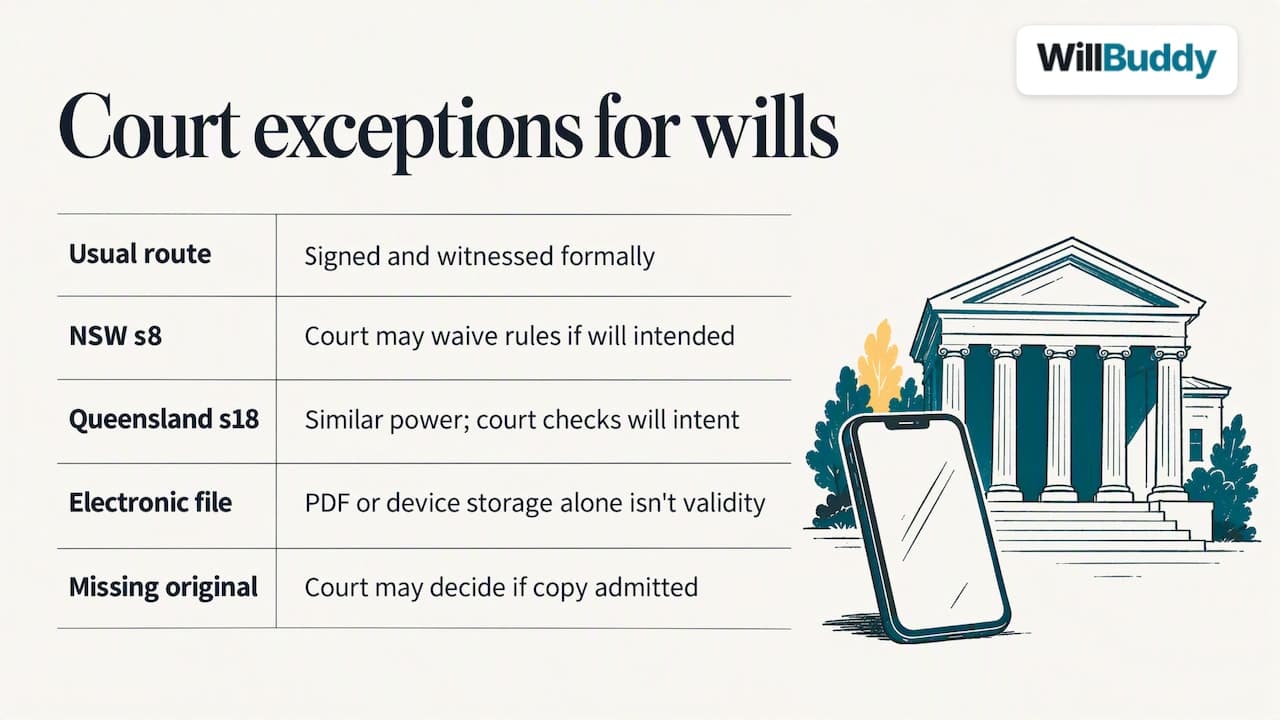
Some states let a court accept a document that was not signed and witnessed in the usual way. In New South Wales, section 8 of the Succession Act 2006 lets a court dispense with formal requirements if it is satisfied the document was intended to be the person's will. The Law Society of NSW describes this power in its paper on electronic witnessing.
Queensland has a similar power in section 18 of the Succession Act 1981. In a 2011 case, the Supreme Court of Queensland considered a Microsoft Word file. For section 18, "document" takes its wide meaning under the Acts Interpretation Act 1954 (Qld), which covers electronic records. Even so, the court still had to be satisfied that the deceased intended the document to be their will.
That is the key point. A digital file is not automatically a will. As the Law Society of NSW Journal notes, an electronic will is not valid just because it is stored as a PDF or on a device. If the original electronic file cannot be found, a court may have to decide whether a copy can be admitted at all.
So a note on a phone might, in some cases, be accepted after death. But your family would have to go to court, prove your intention, and wait. Most people want to spare their children and partner that.
The real risks of electronic and DIY wills
The main risk is not the technology. NSW Trustee and Guardian says ordinary words can have specialised legal meanings. If there is uncertainty about meaning or signing, a court may need to decide it, at real cost. See the NSW Government's warning on DIY wills.
The same page warns that DIY wills can contain mistakes. Incorrect signing can lead to court proceedings, delay and expense. It can also mean your estate is shared under an earlier will or under the intestacy rules.
The common failure points are:
- Signing in the wrong order or wrong place. Witnesses must see you sign, or you must acknowledge your signature to them together.
- Using a beneficiary as a witness. A gift to a witness can fail. Choose two independent adults.
- Trusting an electronic signature. State and Territory laws contain further exemptions from electronic-signature rules, so the law for your document type must be checked.
- Skipping updates. An old will may not reflect a new partner, a new child or a separation.
- Complex situations. Online tools suit simple, standard circumstances. The Legal Services Commission of South Australia says they have limited ability to give personal advice or assess capacity.
Our article on how online will signing can fail looks at a real court example, and our guide on common witnessing mistakes lists what to avoid.
A checklist before you rely on any online will
Run through these before you sign anything:
- Is it made for your state or territory? Rules differ, so the document should follow yours.
- Can you read the whole will before you pay? You should see every word, not a summary.
- Are you signing on paper? In most places, this is the safest route.
- Do you have two independent adult witnesses? They should not be beneficiaries or their spouses.
- Will both witnesses be in the room together, watching you sign?
- Do you know where the signed original will be kept? Tell your executor.
- Is your situation simple? If not, see a lawyer first.
Guardians for children and keeping your will current
For parents, the guardian clause is often the reason to make a will at all. A will can name one or more guardians for your children. Legal Aid NSW suggests discussing your wishes with them and your family. It also recommends updating your will after marriage, separation or divorce, having children, or any other change in circumstances.
This is where ongoing access helps. A will that sits in a drawer for ten years often stops matching life. Review it when something big changes.
Where WillBuddy fits
WillBuddy is an online will drafting platform for every Australian state and territory. We ask plain questions one at a time and draft a will for your state. You can name guardians for your children, choose executors, set out gifts, record funeral wishes and plan for pets. You can read every word of your will free before you pay. Then you print it and sign it with witnesses, the way the law expects.
An annual subscription gives you secure storage and up to 50 AI-assisted edits a year, so you can update your will as life changes. We encrypt your personal data and never sell it. You can see the current plan on our pricing page.
We are not a law firm and this is not legal advice. If you have a blended family, a business or trust, assets overseas, or a likely contest, speak to a lawyer.
FAQ
Are electronic wills legal in Australia?
Not as a simple, safe default. Wills are excluded from the general electronic signing laws in places like New South Wales and Western Australia. Some states allow limited audio-visual witnessing with strict conditions. Courts may accept a digital document after death if they are satisfied it was meant as the will, but that needs a court process.
Are online wills legally binding in Australia?
A will drafted online can be valid if it meets your state or territory's formal rules. That means writing, your signature, and two adult witnesses present at the same time who also sign. The online tool helps you draft. The signing is what the law checks.
Are Australia Post will kits legal?
A will kit is a form, and a form can produce a valid will if it is completed and signed correctly. The risk sits in the details. NSW Trustee and Guardian warns that DIY wills can contain mistakes or uncertainty, and that incorrect signing can lead to court proceedings, delay and expense.
Can you write your own will without a lawyer in Australia?
Yes, in many cases. A simple will can be written without a lawyer if you follow your state's signing rules. See a lawyer if you have a blended family, a business or trust, assets overseas, or a likely contest.
Can I sign my will on a tablet or phone?
It is risky. In New South Wales and Western Australia, wills sit outside the general electronic signing rules. Where remote witnessing is allowed, such as Victoria, it needs a special witness and other conditions. Printing and signing in ink with two witnesses present is the safer path.
Sources
Show the 13 sources
- Exploring the legal implications of electronic wills, Law Society of NSW Journal
- Implications of the electronic witnessing provisions, Law Society of NSW (December 2021)
- Implications of the electronic witnessing provisions, Law Society of NSW (January 2022 copy)
- Legal admissibility of digital records, NSW Government
- Electronic Transactions Regulations 2012, Western Australia
- Electronic signing and online witnessing of legal documents, Victoria
- Queensland subordinate legislation 2020 No. 72
- Justice of the Peace, City of Marion
- Guidance on executing wills remotely, Legal Practitioners' Liability Committee
- Supreme Court of Queensland, QSC 11-243
- DIY will kits: buyers beware, NSW Trustee and Guardian
- Making a will and getting legal help, Legal Services Commission of South Australia
- Making a will, Legal Aid NSW
Start your will free at willbuddy.com.au and read it before you pay.
Recommended
For the one who gets things sorted
Now write yours, with your family's names in it
Plain questions about your family, one at a time, and WillBuddy drafts a will for your state. Until you sign one, the law in your state or territory decides who gets what. Read every word free, with no card. You pay only if you want to print it.
Start my will freeLast updated 27 October 2026.
This article is general information only and is not legal advice. It is our best interpretation of the law as at 27 October 2026. WillBuddy is not a law firm, and it never replaces advice from a lawyer or solicitor. Laws change and differ between states and territories, so for your own circumstances, please get legal advice.