Probate Timeline in Australia: How Long Each Stage Takes
General information, not legal advice.
On this page
- TL;DR
- What the probate timeline actually covers
- Stage 1: Gathering documents and getting organised
- Stage 2: Valuing the estate and preparing the application
- Stage 3: Publishing the notice and waiting
- Stage 4: The court stage, state by state
- What causes delays, and which ones you can avoid
- Stage 5: After the grant, when beneficiaries get paid
- A rough timeline you can plan around
- How to keep the process moving
- The best way to shorten probate is a clear will
- FAQ
- Sources
- Recommended

Quick answer
Probate in Australia often takes a few weeks to a few months once a complete application is lodged. Settling the whole estate usually takes a year or more. The grant itself is only one stage. Preparing the application comes first. Collecting assets, paying debts and waiting out the claim period come after.
This guide sets out the stages in order, with official figures from the courts and government bodies of several states. It also covers what causes delays and how an executor can avoid the ones that can be prevented. It is general information, not legal advice.
TL;DR
- The court stage is often the shortest part. Official sources put it at roughly 2 to 5 weeks in South Australia and 3 to 18 weeks in Tasmania once the papers are in order. In 2026, the NSW Supreme Court's weekly updates have shown routine probate applications being assessed about two to three weeks after filing.
- Before you can apply, expect a notice period. Most jurisdictions need a notice of intention published at least 14 days before you file.
- Finalising the estate commonly takes at least a year, because of asset collection, debts, tax and the family provision claim period.
- The most common avoidable delays are incomplete applications and slow replies to court requests for more information.
- Rules differ by state and territory. Always check your own Supreme Court's current guidance.
What the probate timeline actually covers
People use "probate time" to mean two different things. One is how long the Supreme Court takes to issue a grant. The other is how long until beneficiaries receive their share. These are far apart.
Probate is a Supreme Court order confirming that a will is valid and allowing the executor to distribute the estate as the will says. The NSW Government explains that it is generally needed for solely owned assets or assets over a certain amount. It may not be needed if all assets are shared with one person, or if total assets are under a set amount. If there is no valid will, or no executor able or willing to act, the application may be for letters of administration instead.
If you are not sure whether an estate needs a grant at all, our guide on when probate is required in Australia walks through the common situations.
A realistic way to think about the timeline is in five blocks:
- Arranging the funeral, finding the will and gathering documents.
- Working out what the estate owns and owes, then preparing the application.
- Publishing notice and waiting for the minimum period.
- The court reviewing the application and issuing the grant.
- Collecting assets, paying debts and tax, waiting out the claim period, and distributing.
The sections below take each block in turn.
Stage 1: Gathering documents and getting organised
This stage is in the executor's hands, so its length depends on how organised the paperwork is. You will usually need the original will, a death certificate and details of the deceased's assets and debts.
Being the executor also means you have a short list of urgent jobs. Funeral costs often have to be paid before any grant exists. Our article on estate bank accounts and funeral funds before probate covers how families usually handle that.
A clear will makes this stage quicker. When the original cannot be found, or the will is unclear about who the executor is, the process slows from the start. That is one reason a will that is easy to find and easy to read matters so much to the people left behind.
Stage 2: Valuing the estate and preparing the application
Before you apply, you need to identify the assets and debts and put approximate values on them. These include property, bank accounts, shares, super payable to the estate, vehicles and personal items. They also include debts such as loans, credit cards and unpaid bills.
The time this takes depends on how many assets there are and how quickly banks, super funds and other institutions respond. A simple estate with one home and a couple of accounts moves faster than one with many holdings.
The application itself must be complete and correct. This matters later. Courts send an application back with a request for more information when something is missing. We cover that below.
Stage 3: Publishing the notice and waiting
In most Australian jurisdictions, the executor must publish a notice of intention to apply before filing. The details differ by place:
| Jurisdiction | Notice rule | Source |
|---|---|---|
| ACT | Notice on the Supreme Court website at least 14 days and no more than 3 months before filing (in effect since 1 March 2022) | ACT Supreme Court |
| Tasmania | Notice on the court-maintained website at least 14 days before filing | Probate Rules 2017 (Tas), rule 33 |
| Victoria | Notice on RedCrest-Probate at least 14 days before applying | Supreme Court (Administration and Probate) Rules 2023, rule 2.03 |
| NSW | Publish a probate notice, wait 14 days, then lodge | NSW Government |
| Queensland | Notice in the Queensland Law Reporter, then wait 14 days; the Public Trustee must also be notified | Queensland Courts |
The Northern Territory also uses a 14-day notice on its Supreme Court website. Western Australia and South Australia do not require a published notice, though South Australia will not make a grant until 28 days after the death.
The notice lets people who may have an interest, such as someone with a different will, find out that an application is coming. The minimum wait is built into the timeline. You cannot skip it, so plan around it.
Getting the notice right matters. If a notice is worded incorrectly, it can need to be published again, and the waiting period can start over. Check the wording against your court's requirements before you publish.
Stage 4: The court stage, state by state
Once the application is lodged, the registry reviews it. Official figures vary by state and change with workload, so treat these as guides.
South Australia
The Law Handbook says probate is usually granted within 2 to 5 weeks of application, depending on registry workload and whether the papers are in order. It also says a grant is not made before 28 days after the death.
Tasmania
Tasmania Legal Aid says that after the notice has been published and the papers are in order, a grant can take 3 to 18 weeks. The court cannot issue it until 14 days after the notice is published.
New South Wales
NSW is the busiest registry, and its figures have moved a lot. In a statement dated 21 July 2025, the Chief Justice said average processing had dropped from 83 business days to 60 days. The same statement notes that requisitions and incomplete applications can add delay.
It has become faster since. The Court publishes processing times each week on its wills and probate page. In 2026 those updates have shown routine probate applications being assessed about two to three weeks after filing. Letters of administration and complex applications can take longer. Check the page for this week's figures, as they change.
Victoria
The Supreme Court of Victoria's probate FAQs say it usually takes 5 to 10 working days for an application to be reviewed. The Court also warns when applications are taking longer than that, so check its page for the current position.
Western Australia
The Supreme Court of WA says it aims to process applications within four weeks of receiving them, although complex applications may take longer.
Queensland, the ACT and the NT
We could not find a published official processing time for these courts. Ask the registry, or check the relevant Supreme Court website, before you promise anyone a date. Rules, forms and fees also differ, so do not assume one state's process applies in another.
For a fuller walk through of the application itself, see our probate process guide for Australia.
What causes delays, and which ones you can avoid
Some delays are outside your control, such as registry workload. Many are not.
Requisitions
A requisition is a court request that your application be fixed or added to. Queensland Courts explain that one is issued when an application does not comply. Common causes include incomplete documents or an applicant who is not eligible. The court may also ask for more information or documents.
The NSW Chief Justice's July 2025 statement names incomplete applications and slow responses to requisitions as two important causes of delay, and both are in the applicant's hands. It also said that, as at July 2025, responses to requisitions were being considered within 5 to 10 working days of being received. So a quick, complete reply helps directly.
Small paperwork errors
The NSW statement gives examples: a death certificate that was not certified, an affidavit that was not properly taken, or a photocopy lodged instead of the original will. A wrongly worded notice or a mismatched name can also trigger a delay. Read the court's checklist line by line before lodging. Keep copies of everything.
Problems with the will itself
A will that is unsigned, missing a witness, unclear or hard to locate can hold things up. A will that names an executor who is unable or unwilling to act can also change the type of application. If you are choosing who to appoint, our guide to executor age requirements in Australia is a useful check.
Disputes
A dispute can stretch the timeline by months or years, depending on whether it settles early or goes to a hearing. If you think a contest is likely, speak to a lawyer early. The same goes for blended families, a business or trust in the estate, or assets overseas. These situations call for personal legal advice.
Stage 5: After the grant, when beneficiaries get paid
Getting the grant does not mean the estate is finished. The executor still has to:
- collect the assets, which can mean selling property
- pay debts, funeral costs and any tax
- wait out the period for family provision claims
- distribute what is left
The NSW Office of the Legal Services Commissioner says administering an estate commonly takes at least a year. Property sales, tax matters and extra complexity can push that out further.
The family provision wait
Eligible people who believe they were left out can apply for a share of the estate. Victoria's LawHub notes that lawyers often advise executors not to distribute before the six-month period for family provision claims has ended. In Victoria, that period starts when probate is granted. Other states differ. In NSW, for example, a claim must generally be made within 12 months of the death (Succession Act 2006 (NSW), section 58). Check the time limit for your state.
Can anything be paid early?
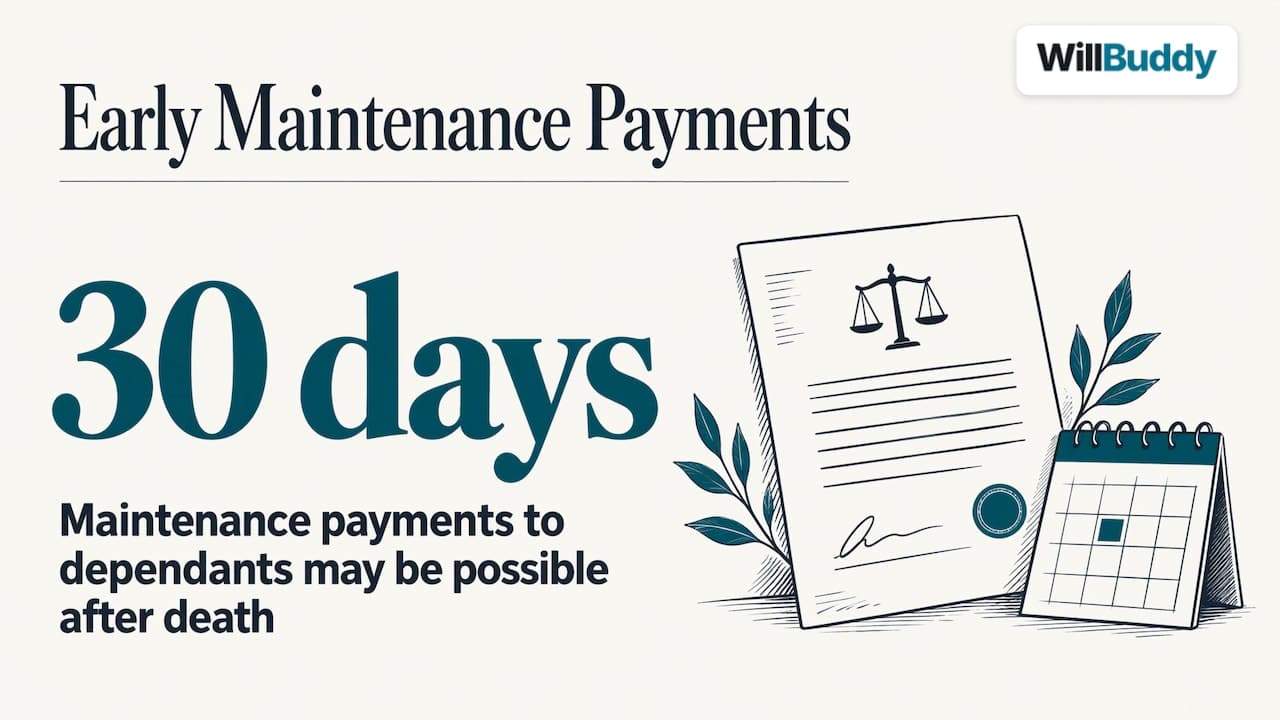
Sometimes. The State Library of NSW's legal guide says that maintenance distributions to dependent beneficiaries may be possible within 30 days of death, under specific provisions such as section 92A of the NSW Probate and Administration Act 1898. It stresses that appropriate legal advice should be sought first.
The same guide says advertising for creditors after the grant is not mandatory but is recommended in most cases, unless the executor is the sole beneficiary. Following the legal requirements helps protect the executor when distributing.
If you want a checklist for this long middle stretch, our executor and estate administration guide sets it out. The wider picture is in our after death process overview.
A rough timeline you can plan around
This is an illustration built from the figures above. Your estate will differ.
| Stage | What happens | Typical time |
|---|---|---|
| Documents and valuation | Find the will, list assets and debts, prepare the application | Varies with the estate, often weeks to a few months |
| Notice | Publish notice of intention | At least 14 days in the jurisdictions listed above |
| Court | Registry reviews and issues the grant | About 2 to 5 weeks in SA, 3 to 18 weeks in Tasmania, an aim of four weeks in WA, and about two to three weeks for routine NSW applications in 2026 |
| Administration | Collect assets, pay debts and tax, wait for claims period | Commonly at least a year in total |
The order matters more than the exact numbers. Most of the time you control is before the application and after the grant. Little of it is at the court.
How to keep the process moving
Executors can shorten the path with a few habits:
- Find the original will first. Everything else depends on it.
- Start the asset list early. Request balances and statements from institutions as soon as you can.
- Check your court's checklist. Match every document to it before lodging.
- Get the notice right the first time. A re-advertised notice restarts the wait.
- Answer court queries fast. Slow replies were named as a cause of delay in NSW.
- Keep records. Note every payment, sale and communication. You will need them when you finalise.
- Get legal advice where the estate is complex.
The best way to shorten probate is a clear will
The people who go through this process are usually grieving. A current, properly signed, clearly worded will makes their job easier. It names an executor, says who gets what, and says who looks after young children. It also avoids the guessing and arguments that slow things down.
A will does not decide whether probate is needed. That depends on the assets. But a clear will helps at each stage above, from the application to the distribution.
WillBuddy asks you plain questions one at a time and drafts a will for your state or territory. You can read every word for free before you pay, then print it and sign it with witnesses. Our annual plan also lets you update your will as life changes. For current pricing, see our pricing page.

If you have not made a will yet, you can start with WillBuddy and see your full draft before deciding anything.
FAQ
How long does probate take in Australia?
Once a complete application is lodged, official sources suggest a few weeks to a few months, depending on the state. South Australia reports 2 to 5 weeks, Tasmania 3 to 18 weeks, and in 2026 the NSW Supreme Court's weekly updates have shown routine applications assessed about two to three weeks after filing. Preparing the application beforehand and administering the estate afterward add considerable time.
How long does it take to settle an estate overall?
The NSW Office of the Legal Services Commissioner says administering an estate commonly takes at least a year. Property sales, tax, debts and the claim period all affect the total. Disputes can lengthen it significantly.
Why wait six months after probate before distributing?
Eligible people can make a family provision claim against an estate, and in some states the time limit runs from the grant. Lawyers often advise executors to wait until that period ends before distributing. Check the time limit for your state and get legal advice for your situation.
What delays a probate application the most?
Incomplete applications and slow replies to court requests are named as major avoidable causes by the NSW Supreme Court. Small errors, such as a wrongly worded notice or missing document stamps, can also cause delay. Disputes over the will can add months or years.
Does every estate need probate?
No. Probate is generally needed for solely owned assets or assets above a set amount. It may not be needed when assets are jointly held with one person or the estate is small. The threshold and practice differ by state, and some institutions have their own requirements.
Sources
Show the 14 sources
- Grant of probate or letters of administration, NSW Government
- Probate, ACT Supreme Court
- Probate Rules 2017 (Tas), Tasmanian Legislation Online
- Supreme Court (Administration and Probate) Rules 2023 (Vic)
- Wills and probate, Supreme Court of NSW (weekly processing times)
- Probate FAQs, Supreme Court of Victoria
- Filing with the Court, Supreme Court of Western Australia
- How long does it take? Law Handbook South Australia
- Wills, following a will after someone has died, Tasmania Legal Aid
- Statement by the Chief Justice in relation to probate applications, Supreme Court of NSW, 21 July 2025
- Apply for a grant of administration, Queensland Courts
- OLSC Factsheet 12 Deceased Estates, February 2023
- Distributing the estate, LawHub Victoria
- After the Grant of Probate or Letters of Administration, State Library of NSW
Start your will free at willbuddy.com.au and read it before you pay.
Recommended
When you're ready
Make things simpler for your own family
Sorting out an estate shows how much a clear will helps. WillBuddy drafts yours for your state from plain questions. Read every word free, with no card. You pay only if you want to print it.
Start my will freeLast updated 5 November 2026.
This article is general information only and is not legal advice. It is our best interpretation of the law as at 5 November 2026. WillBuddy is not a law firm, and it never replaces advice from a lawyer or solicitor. Laws change and differ between states and territories, so for your own circumstances, please get legal advice.