Make a Will Without a Lawyer in Australia
General information, not legal advice.
On this page
- TL;DR
- Is it legal to make your own will in Australia?
- What makes a will valid
- Eight steps to write your own will
- Choosing an executor
- Guardians for children under 18
- What happens if you do not have a valid will
- Mistakes that can sink a homemade will
- When to see a lawyer instead
- Where an online will fits
- Draft your will with WillBuddy
- Keeping your will up to date
- FAQ
- Sources
- Recommended

Quick answer
Yes, you can write your own will in Australia. No law says a lawyer must draw it up. But the will only works if it follows the rules of your state or territory, so the way you make it matters more than who types it. This guide covers what makes a homemade will valid, the steps to follow, the mistakes that cause trouble, and the situations where you should see a lawyer first.
TL;DR
- You can make a will without a lawyer, but it must be in writing, signed, and witnessed correctly under your state or territory's law.
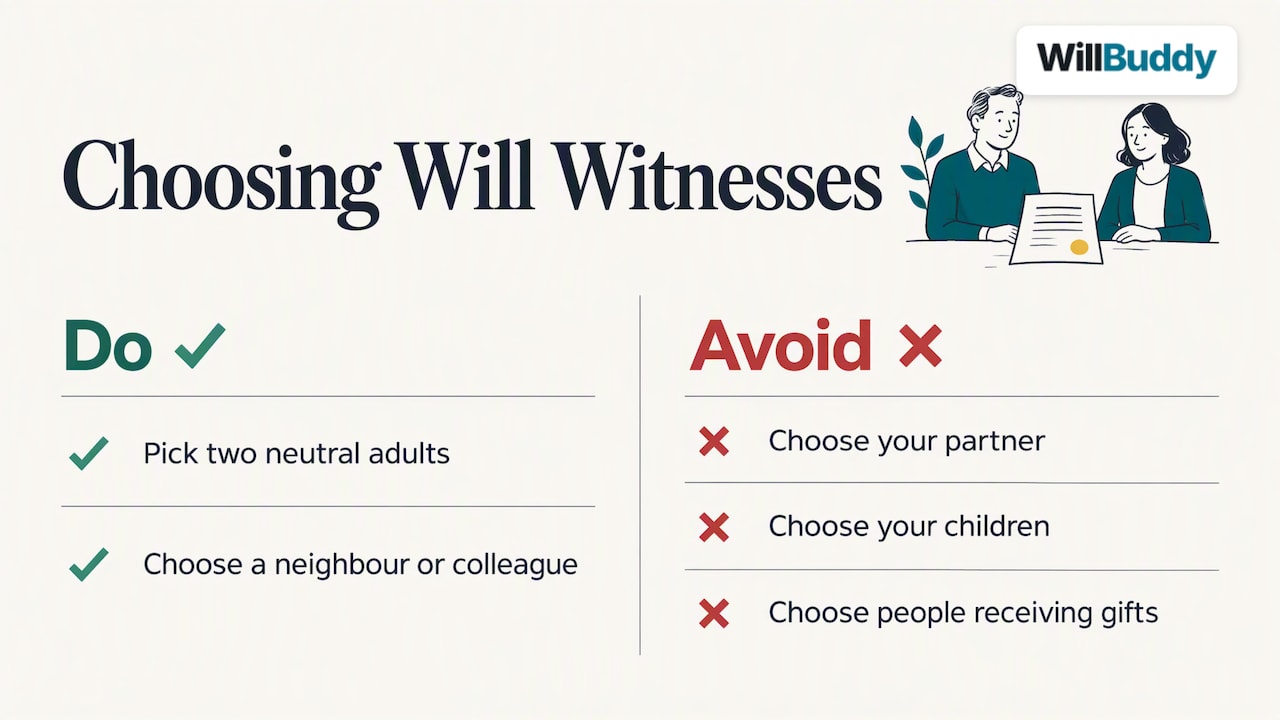
- Use two adult witnesses who watch you sign. Witnesses should not be people who get something under the will.
- If you have children under 18, name a guardian in your will. Without a valid will, a court may have to decide.
- See a lawyer if you have a blended family, a business or trust, assets overseas, or a likely contest.
- Review your will every five years and after big life changes.
Is it legal to make your own will in Australia?
Yes. A will is a legal document that sets out what happens to your assets when you die, including how they are shared and who looks after children under 18, according to Moneysmart. The law cares about the form of the document, not about who prepared it.
That said, official bodies are careful in their wording. Moneysmart says a low-cost will kit is an option, but that you should have a solicitor or the Public Trustee check an online kit. It warns that a will not done properly may be invalid. That is a fair warning, and it is why this guide spends so much time on the details.
So the honest answer to "can you write your own will?" is yes, and the risk sits in the detail. A simple situation with a clear plan is where a do-it-yourself will works best. A complicated situation is where mistakes cost the most.
This is general information, not legal advice. Wills law is made by each state and territory, so the exact rules differ. We name the state where it matters.
What makes a will valid
The core rules are similar across Australia. Check the detail for your own state or territory.
It must be in writing
In NSW, a will must be in writing (Succession Act 2006 (NSW) s 6). The NSW Government explains the basics. You sign it yourself. If you are physically unable to sign, another person can sign for you at your direction and in your presence.
It must be signed and witnessed
The NSW Government says a will must be witnessed by two adults who are present when you sign. Witnesses should not be beneficiaries: the NSW Succession Act 2006 sets out the formal requirements (s 6), and under s 10 a gift to a witness is generally void unless an exception applies. South Australia now sets its own rules in the Succession Act 2023, which replaced the Wills Act 1936 from 1 January 2025, including how a will must be signed and witnessed.
The witness rule trips people up. Tasmania Legal Aid says witnesses must not be beneficiaries or the maker's spouse. If they are, they can lose their entitlement under that will. The rule differs between states, so the safe choice everywhere is independent witnesses. Pick two neutral adults, such as a neighbour or a colleague, and not your partner, your children or the people you are leaving gifts to.
Follow the signing routine
Victoria Legal Aid gives a clear example. When you and the witnesses are together as the will is signed, sign at the foot of each page and use the same pen. It is a small habit that removes doubt later.
Remote witnessing is not the default
Some jurisdictions allow witnessing over an audio-visual link under specific procedures, such as having a lawyer or justice of the peace act as a witness, according to Victoria Legal Aid. The rules differ by place and are not a casual shortcut. If you cannot be in the same room as two witnesses, check your state's official guidance first or ask a lawyer.
Quick state check
| What to check | Why it matters | Where to look |
|---|---|---|
| Number and type of witnesses | Two adults who watch you sign is the usual pattern | Your state's legal aid or government wills page |
| Who can witness | Beneficiaries and spouses can lose their gifts | Your state's legislation |
| Where to sign | Some guides tell you to sign every page | Your state's legal aid page |
| Remote witnessing | Allowed only under set procedures in some places | Your state's official guidance |
Eight steps to write your own will
The NSW Government lists the basics: list your assets, choose an executor and beneficiaries, decide on gifts, and consider a guardian for children under 18. Here is that process in a working order. We also cover it in our guide to making a valid will in Australia without a lawyer.
- List what you own. Think of your home, savings, car, super details, shares, and personal items with real or sentimental value.
- Choose your executor. This is the person who carries out your will. More on this below.
- Choose your beneficiaries. These are the people or groups who receive your assets.
- Decide on gifts. You can leave set sums of money or specific items. Then decide what happens to the rest of your estate, which is called the residue.
- Name a guardian if you have children under 18. Add a back-up choice.
- Write it out in the right form. Type or print it, with clear wording and no gaps.
- Sign it with two witnesses. Follow your state's rules on who can witness and how.
- Store it safely and tell people. The NSW Government advises telling your executor, beneficiaries and family where it is.
Choosing an executor
Your executor deals with your estate after you die. The NSW Government says to choose someone who understands the legal, financial and taxation responsibilities and who can stay neutral in disputes.
In practice, ask yourself a few things:
- Are they organised and willing to do the paperwork?
- Are they likely to outlive you and stay in Australia?
- Can they stay calm if family members disagree?
- Have you asked them, and have they said yes?
Name a back-up in case your first choice cannot act. Some people choose a professional or a public trustee body instead of a family member. That can suit people whose family is spread out or in conflict, but it comes with fees, so weigh it up.
Guardians for children under 18
For many parents, this is the whole reason to write a will. You can nominate a guardian in your will for children under 18. The NSW Government recommends doing it so your wishes are clear if both parents die.
Here is what the NSW Government says happens without one. If both parents die and no guardian is appointed under a valid will, anyone with an appropriate relationship to the children can apply, and a court decides. If the surviving parent objects to your appointment, the guardian you named may need to apply to the court.
So your choice is strong guidance, but it is not a promise that nobody can challenge it. A clear, valid, properly signed will gives your choice the best footing.
Tips for choosing:
- Think about values, health, age and where they live.
- Talk to the person first.
- Name a second choice.
- If you and your partner disagree, work it out before you write it down.
Our guide to minor children and guardianship in wills goes through wording, back-ups and what to do if parents disagree. If you want money held for your children until they are older, read about testamentary trusts for children, and think about getting advice on how a trust should work.
What happens if you do not have a valid will
Anything not captured by your will is dealt with under intestacy laws, according to the NSW Government. These are fixed rules set by your state or territory. They decide who gets what based on family relationships, not on what you wanted.
For a parent with young children, that can mean a court decides who looks after them, and the law decides how your assets are split. The ADF Financial Services Consumer Centre also notes that a valid will makes things easier for loved ones at an already hard time.
Mistakes that can sink a homemade will
Most problems are about form, not intention. Watch for these.
Witness problems
A witness who is also a beneficiary can lose their gift. A will signed with no witnesses, or with witnesses who did not see you sign, may be at risk. Do the signing in one sitting, with everyone in the room.
Missing the residue
People list gifts, then forget to say who gets everything else. The NSW Government says to decide what happens to the residue of your estate. If you skip it, part of your estate may fall into intestacy.
Unclear wording
"My car to my niece" is fine until you own two cars. Be specific. Use full names. Say who you mean.
Forgetting that some assets sit outside your will
Super and jointly held property often follow their own rules and may not pass under your will. Check how your super fund handles nominations, and think about advice if the amounts are large. The NSW Government warns that DIY kits often lack guidance on complex areas such as blended families, superannuation and taxation, which can lead to errors.
Not updating it
A will made ten years ago may name an executor who has died or a guardian who has moved overseas. Moneysmart lists marriage, divorce or separation, having children, a major financial change, or the death of someone named in the will as times to update.
Losing the document
Store it safely, and tell someone you trust where to find it. A perfect will nobody can find does not help.
When to see a lawyer instead
A do-it-yourself will suits plain situations. Get legal advice if any of these apply:
- Blended family. Children from different relationships, step-children, or a new partner can make your wishes harder to carry out fairly.
- A business or a trust. Business interests and family trusts have their own rules that a standard will may not cover.
- Assets overseas. Property in another country may be governed by that country's law.
- A likely contest. If you expect someone to challenge the will, a lawyer can help you plan for it.
Moneysmart also says to get legal advice if you are unsure. That is a good test. If you feel stuck on a point, ask someone qualified rather than guessing. A lawyer or your state's public trustee can answer questions about your situation, which a general guide cannot.
Where an online will fits
An online will tool asks you questions and builds the document for you. That cuts the risk of leaving things out and keeps the layout tidy. It does not remove the need to sign and witness the will properly. You still print it, sign it and have it witnessed by the right people in your state or territory.
What to look for in any online will tool:
- Wording that suits your state or territory.
- Plain questions you can answer in your own time.
- The chance to read the whole will before you pay.
- Clear privacy practices for your personal details.
- Easy updates when your life changes.
Draft your will with WillBuddy
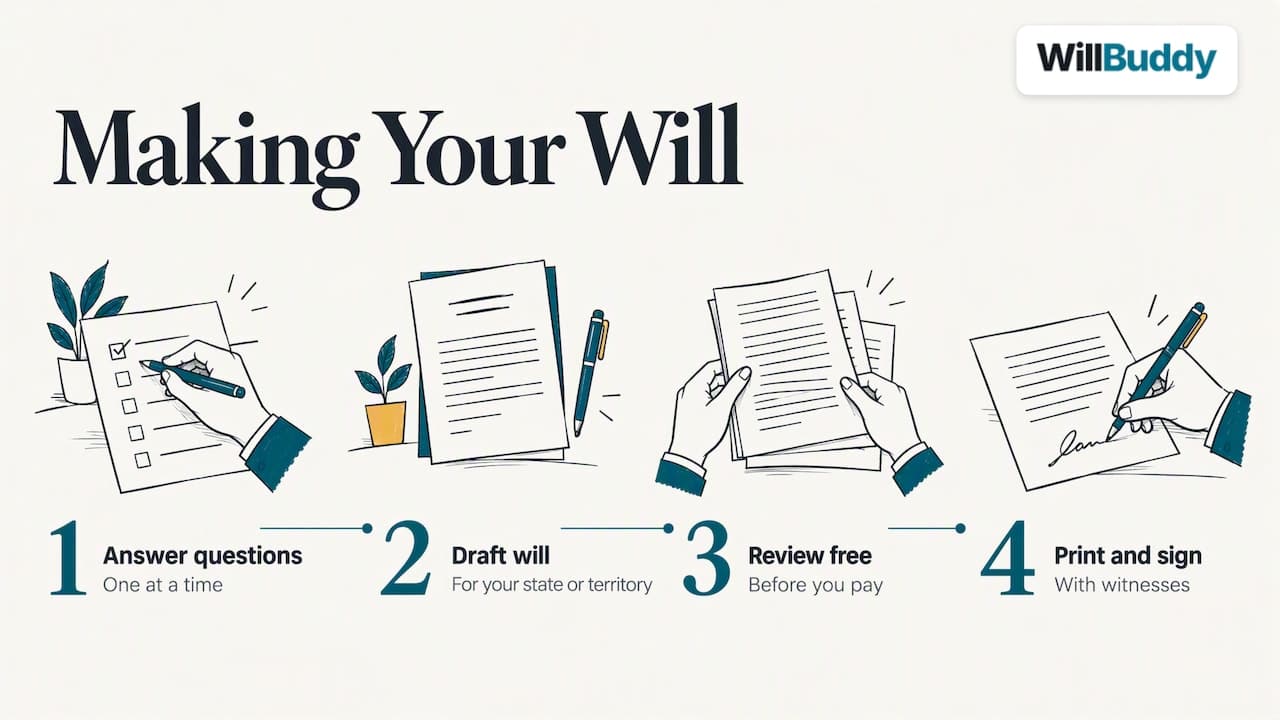
WillBuddy is built for Australians who want a plain, low-cost way to make a will. You answer simple questions, one at a time. We draft a will for your state or territory, covering guardians for your children, executors, who gets what, gifts, funeral wishes and pets, and anyone you want to leave out.

You can read every word of your will free before you pay. When you are happy, you print it and sign it with witnesses. Annual access lets you store your will securely, download and print it, and make up to 50 AI-assisted edits a year as life changes. We encrypt your personal data and we do not sell it. See the current plan on our pricing page, or look around our homepage.
WillBuddy is not a law firm and does not give legal advice. If you have a blended family, a business or trust, assets overseas, or expect a contest (for example because you plan to leave someone out), speak to a lawyer first.
Keeping your will up to date
The NSW Government suggests reviewing your will every five years and whenever something significant changes. Moneysmart's list of triggers is a useful checklist:
- You marry, divorce or separate.
- You have a child.
- Your finances change a lot.
- Someone named in your will dies.
Also review it if your executor or guardian moves away, becomes ill or no longer suits the role. When you change a will, make sure the change is done properly and signed and witnessed as required. Do not scribble changes on a signed copy. Replace the document, and tell your executor where the new one is.
FAQ
Can you write your own will in Australia?
Yes. There is no rule that a lawyer must write it. The will needs to be in writing, signed, and witnessed in line with your state or territory's law. Moneysmart advises having an online kit checked by a solicitor or the Public Trustee, because a will not done properly may be invalid.
Are DIY wills legal in Australia?
A DIY will is valid if it meets your state's formal rules and reflects your wishes. The risk is in mistakes, such as a witness who is also a beneficiary, or wording that leaves part of the estate unclear. Complex situations carry more risk and deserve legal advice.
Who can witness my will?
Use two adults who watch you sign. They should not be beneficiaries or your spouse. Tasmania Legal Aid says witnesses who are beneficiaries lose their entitlements under that will. Check your own state's rules before you sign.
What happens to my kids if I die without a will?
If both parents die and no guardian is named in a valid will, the NSW Government says anyone with an appropriate relationship can apply, and the Family Court decides. Naming a guardian in your will tells the court who you would want. Other states have their own guidance, so check yours.
How often should I update my will?
Review it about every five years, and after big changes such as marriage, separation, a new child or the death of someone named in it. Keep the latest signed copy somewhere safe and tell your executor where it is.
Sources
Show the 8 sources
- Wills and powers of attorney, Moneysmart
- Learn about wills, NSW Government
- DIY will kits: buyers beware, NSW Government
- Succession Act 2006 (NSW)
- Succession Act 2023 (SA)
- Wills, making a will, Tasmania Legal Aid
- Making a valid Will, Victoria Legal Aid
- Have a will, ADF Financial Services Consumer Centre
Start your will free at willbuddy.com.au and read it before you pay.
Recommended
For the one who gets things sorted
Now write yours, with your family's names in it
Plain questions about your family, one at a time, and WillBuddy drafts a will for your state. Until you sign one, the law in your state or territory decides who gets what. Read every word free, with no card. You pay only if you want to print it.
Start my will freeLast updated 29 October 2026.
This article is general information only and is not legal advice. It is our best interpretation of the law as at 29 October 2026. WillBuddy is not a law firm, and it never replaces advice from a lawyer or solicitor. Laws change and differ between states and territories, so for your own circumstances, please get legal advice.