Print Your Will at Home: How to Do It Properly
General information, not legal advice.
On this page
- TL;DR
- Is a will printed at home legal in Australia?
- What you need before you print
- How to print a will, step by step
- Signing a will at home: the steps
- Who can be your witness?
- Common mistakes with a home-printed will
- Printed will kit or online will: what is the difference?
- Printing your will with WillBuddy
- Naming guardians in a printed will
- When to see a lawyer instead
- After you sign: keep it safe
- FAQ
- Next step
- Sources
- Recommended

Quick answer
You can print your will at home in Australia. A printed will is a normal will. What makes it valid is not the printer. It is how you sign it, who watches you sign it, and whether the document says what you mean. This guide walks you through printing, signing and witnessing, and flags where state and territory rules differ.
This is general information only, not legal advice.
TL;DR
- A will printed at home can be valid. Under state and territory law it must be in writing, signed by you, and witnessed by two witnesses who are present at the same time. Use adults.
- Print the whole will before anyone signs. Do not sign a blank page or a single signature page on its own.
- Your witnesses must watch you sign, then sign in front of you. Pick people who are not beneficiaries, because some states treat that badly.
- See a lawyer if you have a blended family, a business or trust, assets overseas, or a likely contest.
- WillBuddy lets you read your full will free before you pay, then print it and sign it with witnesses.
Is a will printed at home legal in Australia?
Yes, as long as it meets the formal rules in your state or territory. Those rules sit in each jurisdiction's own legislation. The Northern Territory Government's will guide sums up the common core: the will is in writing, you sign it (or someone signs at your direction), and two adult witnesses are present together. The witnesses then sign in your presence.
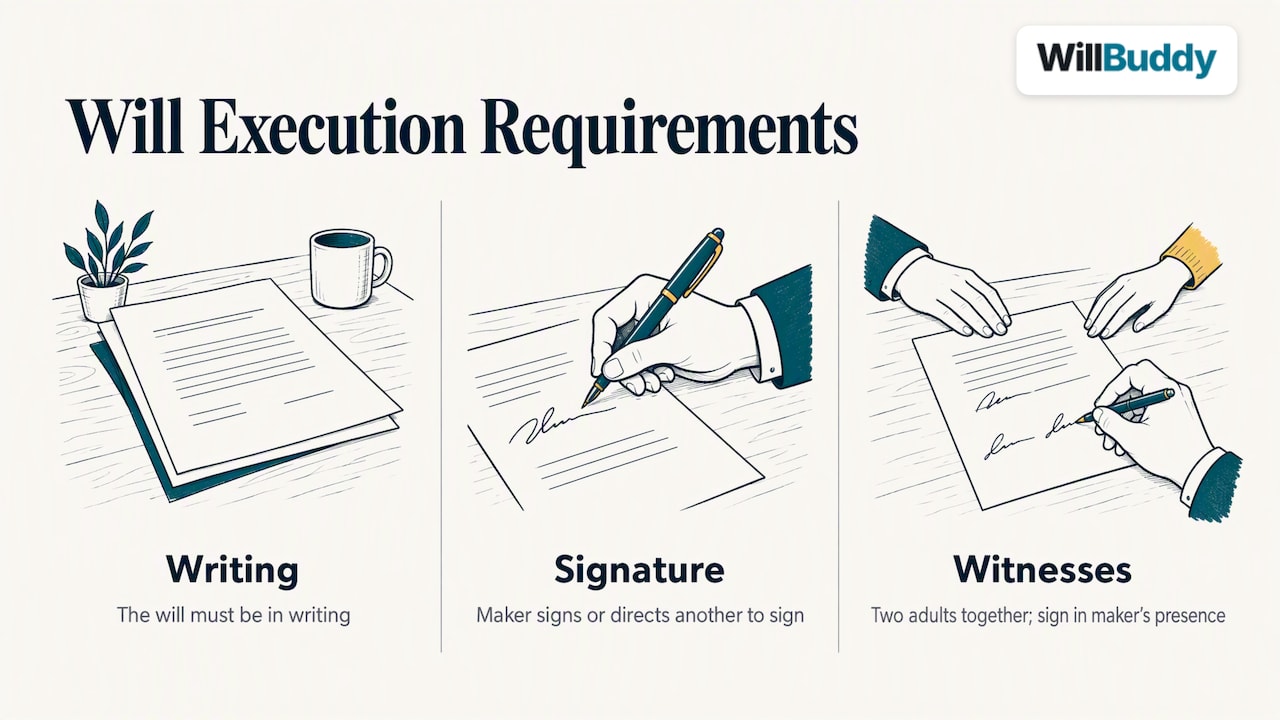
The law does not care whether the words were handwritten, typed or printed. In NSW, section 6 of the Succession Act 2006 sets out how a will must be executed. In the ACT, the equivalent is in the Wills Act 1968. Other states have their own Acts with similar steps.
So the real question is not "can I print it?" It is "will it be signed and witnessed correctly, and does it cover what I own and who I love?"
What you need before you print
Get these ready first. It saves you reprinting.
- A printer and enough paper. Plain white A4 is fine. Print single or double sided, but keep the pages in order.
- A blue or black pen. Use the same pen for every signature and every initial. Mismatched pens are listed among the errors that cause problems for signed wills.
- Two adult witnesses. Line them up before you print, not after.
- A stapler or folder. Keep the pages together as one document.
- Your final decisions. Guardians, executors, gifts and who gets the rest of your estate.
The last point matters most. Do not print a draft you are unsure about. Read it first, change what needs changing, then print the final version.
How to print a will, step by step
- Finish and read the whole will on screen. Check names, spellings, relationships and every gift. Read it slowly, start to end.
- Print every page in one go. One printing session keeps formatting, page numbers and wording consistent.
- Check the page count. If the footer says "Page 1 of 7", make sure you hold seven pages.
- Do not make handwritten changes. If you spot an error, fix it on screen and reprint the whole will. Handwritten crossings out and initials can cause trouble. The SA Law Handbook lists incorrectly initialled changes as a risk.
- Keep the pages together. Staple them or hold them in a folder until signing is done.
- Do not sign yet. Signing happens in front of your witnesses, not before.
If you later need to change your will, treat it the same way: edit, reprint the full document, and sign it again with witnesses. Do not scribble on the old copy.
Signing a will at home: the steps
You can do this at your kitchen table. It takes about ten minutes. What matters is the order.
- Gather yourself and both witnesses in the same room at the same time.
- Tell the witnesses this is your will. They do not need to read it. They do not need to know what it says.
- Sign the will in front of both witnesses. Many people also initial each page, as a good habit.
- While you are all still there, the first witness signs in front of you and the other witness.
- The second witness signs in front of you and the first witness.
- Each witness prints their full name and address next to their signature.
- Date the will if the document asks for it.
The core rule from the NT guidance is that the witnesses must be there together when you sign, and that they sign in your presence. Both of those things go wrong more often than people expect. A witness who pops in later to sign "on behalf of" the first one is a classic mistake.
For a deeper look at the process, see our guide to who can witness a will and how the signing works.
Who can be your witness?
Use adults, aged 18 or over. The Acts we checked set no minimum age for witnesses, but an adult is the safer choice because they may later need to explain what happened. The Queensland Public Trustee also says a witness should not be someone who benefits under the will.
Here is where state rules differ, so check yours:
| Question | What the sources say |
|---|---|
| Can a beneficiary witness? | In Tasmania, Legal Aid warns that a witness who is a beneficiary, or the spouse of one, risks losing their gift (see section 12 of the Wills Act 2008 (Tas)). In South Australia, the SA Law Handbook says a beneficiary or their spouse or domestic partner may witness under section 13 of the Succession Act 2023 (SA), though it is still better to avoid it. |
| How many witnesses? | Two witnesses, present at the same time when you sign, in the jurisdictions covered above, including NSW, the NT, Queensland and SA. |
The safe approach in every state is the same. Choose two adults who get nothing under your will and are not married to anyone who does. Neighbours, friends from work or a colleague all work. Do not use your partner, your adult kids or your executor if they are also beneficiaries.
Our page on who genuinely qualifies to witness goes through the options in more detail, and our state-by-state witnessing notes show where the rules split.
Common mistakes with a home-printed will
Most problems are small, avoidable and expensive. The SA Law Handbook points to improper witnessing, wrongly initialled changes and mismatched pens as things that can invalidate a will and lead to costly court challenges.
Watch for these:
- Signing before the witnesses arrive. Sign in front of them.
- Witnesses signing in another room. They must sign in your presence.
- A beneficiary as witness. It can cost that person their gift in some states.
- Pages swapped or reprinted separately. Print the final version once, as one set.
- Handwritten edits after printing. Reprint instead.
- No fixed place for the original. A will nobody can find does little good.
- Never updating it. MoneySmart notes that life events such as marriage, divorce or a new child can affect an old will.
Our article on common witnessing mistakes covers more of these.
Printed will kit or online will: what is the difference?
A paper kit gives you a form to fill in by hand. Australia Post lists will kits at low prices. Kits are legal to use, but they come without personal legal advice.
The weakness of a paper kit is the fixed form. You fill pre-set fields, and it can be hard to tailor wishes such as who looks after your kids, what happens to a pet or who is left out. Handwriting mistakes also mean starting over.
An online will tool works differently. You answer questions, the tool builds the document for your state, and you print the finished pages. There is no handwriting to misread. Either way, the signing rules are identical. The printout is only as good as the signing.
Want the wider picture? Read our guide to will kits in Australia and their alternatives.
Printing your will with WillBuddy
WillBuddy is built for people who want a straightforward will they can print at home. Here is how it works:
- You answer plain questions, one at a time.
- WillBuddy drafts a will for your state or territory.
- You read every word for free before you pay.
- You print the will, then sign it with witnesses.
You can name guardians for your children, choose executors, set out gifts and who gets the rest of your estate, add funeral wishes, include pets and leave someone out. The annual plan gives you secure storage and up to 50 AI-assisted edits a year, handy when life changes. When you change something, you reprint the full will and sign again with witnesses. You can see the current cost on the WillBuddy pricing page.
We encrypt your personal data and we do not sell it. You can try WillBuddy and read your will before you commit.
Naming guardians in a printed will
Many parents make a will mainly to name who would care for their kids. That is a good reason. Be aware of how it works, though. Tasmania Legal Aid is among the sources that say a will can nominate guardians. A court can still decide what is best for the children if there is a dispute about where they live and who cares for them, but it will consider your written choice.
So write your choice down clearly. Talk to the person first. Consider naming a backup. Then make sure the will is signed and witnessed correctly, so your wishes are on the record.
When to see a lawyer instead
An online will suits straightforward situations. The NSW Government advises that more complex estates call for legal advice. Talk to a lawyer if any of these apply:
- You are in a blended family.
- You own a business or have a trust.
- You have assets overseas.
- A challenge to your will is likely.
The Legal Services Commission of South Australia says the safest route is a private lawyer, who can assess your capacity, check the formalities and give advice a template cannot. Cost matters too. The NSW Trustee and Guardian also prepares wills for a fee, with free options for some eligible pensioners, according to the NSW Government.
If you are unsure which group you fall into, ask a lawyer before you sign.
After you sign: keep it safe
A signed will is only useful if your executor can find it. Do this once the signing is done:
- Keep the original signed pages together. Do not remove staples.
- Store it somewhere safe and dry, such as a fireproof box or with a trusted professional.
- Tell your executor where it is.
- Keep a copy, clearly marked as a copy.
- Diarise a yearly check, and review after marriage, separation, a new child or a big change in assets.
Do not write on or attach notes to the signed original. Any change means a new will, printed and signed again.
FAQ
Can I print my own will at home?
Yes. Printing is not what decides validity. What matters is that the will is in writing, you sign it, and two adult witnesses watch you sign and sign in your presence. Check the rules for your state or territory before you sign.
How do I sign a will at home?
Bring both witnesses into the same room. Sign the will in front of them, then have each witness sign while you and the other witness watch. Each witness should add their name and address. Use the same pen throughout.
Can my partner or my children witness my will?
It is best to avoid it. Some states, such as Tasmania, warn that a beneficiary witness, or their spouse, may lose their gift. South Australia is more relaxed, but it is still wiser to use two independent adults.
Are Australia Post will kits legal?
Yes, will kits are legal to use. They do not include personal legal advice, and errors in signing or witnessing can still cause problems. For anything complicated, such as a business, a trust or overseas assets, speak to a lawyer.
Can I change a printed will by hand?
It is risky. Handwritten changes and incorrect initials are a known source of disputes. The cleaner route is to edit the will, reprint the whole thing and sign it again with two witnesses.
Next step
Start your will free at willbuddy.com.au and read it before you pay.
Sources
Show the 11 sources
- Make a will, NT Government
- Succession Act 2006 (NSW)
- Wills Act 1968 (ACT)
- Wills Act 2008 (Tas)
- Signing and witnessing a will, SA Law Handbook
- Frequently asked questions about wills, Queensland Public Trustee
- Wills, making a will, Tasmania Legal Aid
- Wills and powers of attorney, MoneySmart
- Prepare Your Own Legal Will Kit Pack, Couples, Australia Post
- Learn about wills, NSW Government
- Making a will and getting legal help, Legal Services Commission of SA
Recommended
For the one who gets things sorted
Now write yours, with your family's names in it
Plain questions about your family, one at a time, and WillBuddy drafts a will for your state. Until you sign one, the law in your state or territory decides who gets what. Read every word free, with no card. You pay only if you want to print it.
Start my will freeLast updated 24 October 2026.
This article is general information only and is not legal advice. It is our best interpretation of the law as at 24 October 2026. WillBuddy is not a law firm, and it never replaces advice from a lawyer or solicitor. Laws change and differ between states and territories, so for your own circumstances, please get legal advice.