How to Update Your Will After a Divorce in Australia
General information, not legal advice.
On this page

Quick answer
Divorce does not cancel your will. In most states, it cancels only the gifts and appointments that name your former spouse. Everything else stays in force. So if you want your estate, your executor and your children's guardian to reflect your life now, you need to make a new will. This guide explains what changes by law, what does not, and how to fix it in a few steps.
This is general information, not legal advice.
TL;DR
- A divorce order generally cancels gifts to your ex-spouse and their appointment as executor or trustee. The rest of your will stays valid.
- Separation alone changes nothing. Your old will applies in full until the divorce order takes effect.
- Powers of attorney and enduring guardianship are separate documents. In some states, such as NSW, a divorce does not automatically cancel them.
- Make a new will that names a new executor, a backup, a guardian for your children and who gets what.
- Rules differ by state and territory. See a lawyer if you have a blended family, a business or trust, assets overseas or a likely contest.
What divorce does to your will
Many people assume a divorce wipes the slate clean. It does not.
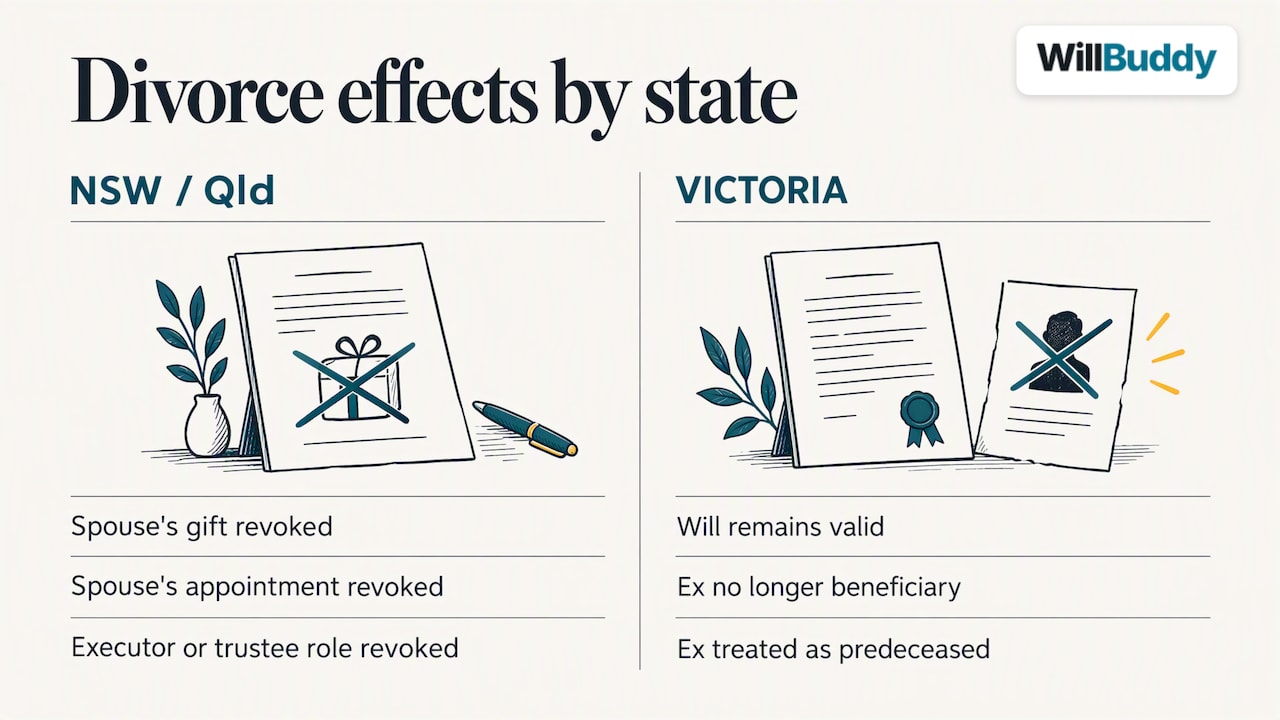
Take New South Wales. Section 13 of the Succession Act 2006 (NSW) says a divorce revokes a gift to the former spouse and the appointment of that person in the will. Queensland has a similar rule in section 15 of the Succession Act 1981 (Qld). Legal Aid NSW explains that, unless your will says otherwise, the divorce order cancels provisions that make a gift to your spouse or appoint your spouse as executor or trustee.
In Victoria, LawHub says a divorce does not revoke a will. The will is still valid, but the ex-spouse is no longer a beneficiary, and the will is read as though they died before you.
That last idea matters. The law treats your ex as if they had already died. Your will then works around them. But it works around them using whatever your old document says, and your old document may not say much.
An example of how it plays out
Say your will leaves everything to your husband. It names him as executor. It says nothing else. You divorce and never update it.
The gift to him is cancelled. So is his role as executor. Now the will has no one to receive the estate and no one to run it. A court may need to appoint an administrator, and your estate may be shared under intestacy rules instead of by your choice. That can cost your family time and money.
This is the gap that catches people out. The law removes your ex. It does not choose a replacement for you.
Rules differ by state and territory
The broad pattern is similar across Australia, but the detail is not. Each state and territory has its own Wills or Succession Act, so do not assume the NSW or Queensland wording applies to you. Some states also have exceptions. In Queensland, for example, a former spouse can stay on as trustee of property left on trust for beneficiaries that include their children. Check your own state's legislation, or ask a lawyer, before you rely on any one rule.
Separation is not divorce
This is the most expensive misunderstanding.
You must be separated for 12 months before you can apply for a divorce. The NSW Government notes this in its guidance on changing your relationship status. The Family Law Act 1975 sets out when a divorce order takes effect.
Until that date, you are still married in the eyes of the law. Your old will stays in full force. If you die during that time, your estranged spouse can still receive everything you left them and can still act as your executor.
That window can last a year or more. So you do not need to wait for the divorce. Many people update their will soon after separating.
Two cautions:
- Your spouse may be able to make a claim on your estate while you are still married, whatever your new will says. If you want to change what they receive, speak to a lawyer first.
- If property settlement is still being worked out, a lawyer can tell you how a new will fits with that process.
What a divorce does not fix
The automatic rules cover a narrow list of things. Several important arrangements sit outside them.
Powers of attorney and enduring guardianship
An enduring power of attorney lets someone manage your money if you lose capacity. An enduring guardian makes health and lifestyle decisions for you. Neither is part of your will.
Legal Aid NSW advises that in NSW these appointments are not automatically cancelled by a divorce. If your ex-spouse is your attorney or enduring guardian, they may keep that authority until you formally revoke it. Other states differ. In Queensland, a divorce revokes an enduring document to the extent it gives power to the former spouse.
Wherever you live, check these documents. An old one could leave your ex in charge of your finances or medical care.
A will does not revoke these documents. You need to do it separately, using the process in your state. Your state's public trustee, legal aid service or a lawyer can point you to the right forms.
Other things to check
A will only controls assets that are in your name alone. Many things pass outside it. Go through this list:
- Superannuation: your fund may hold a binding or non-binding nomination. Check who is named and update it.
- Life insurance: the named beneficiary pays out regardless of your will.
- Jointly owned property: this usually passes to the surviving owner, not under your will.
- Company or trust arrangements: these have their own rules. See a lawyer.
- Bank accounts held jointly: the same survivorship rule usually applies.
Updating your will while your super still names your ex is a common half-fix.
Guardians for your children
A will can name a guardian for your children if both parents have died. Your ex may have been the obvious choice, or it may have been assumed that the other parent would simply step in.
In NSW and Queensland, a divorce also cancels a will's appointment of your former spouse as guardian, unless the will shows a different intention. The detail can differ in other states, so do not leave it to chance. Name your wishes clearly in a new will.
It also helps to understand the limits. Parenting arrangements are dealt with separately from estate planning. The Attorney-General's Department explains that parents who agree can formalise arrangements through parenting orders, and that family relationship services can help. A guardian named in your will carries real weight, but a court always looks at what is best for the child if there is a dispute.
If you share care of your children with your ex, the other parent will usually be the first person to look after them if you die. A guardian named in your will matters most when that parent cannot or will not take on the role. Our guides on guardians and trusts for minor children and on choosing the right guardian cover this in more detail, including what to do if you and your ex disagree about who should care for the children.
Should you update the will or make a new one?
You have two options.
- A codicil. This is a short document that changes part of an existing will. It suits one small change.
- A new will. This replaces the old one completely.
After a divorce, a new will is usually the cleaner choice. You are likely changing several things at once: who gets your estate, who runs it, who looks after your children. A patchwork of changes can become confusing and invite disputes. A new will states that it revokes all earlier wills, which removes doubt.
We explain the difference in more detail in our guide to updating or changing a will.
Steps to update your will after a divorce
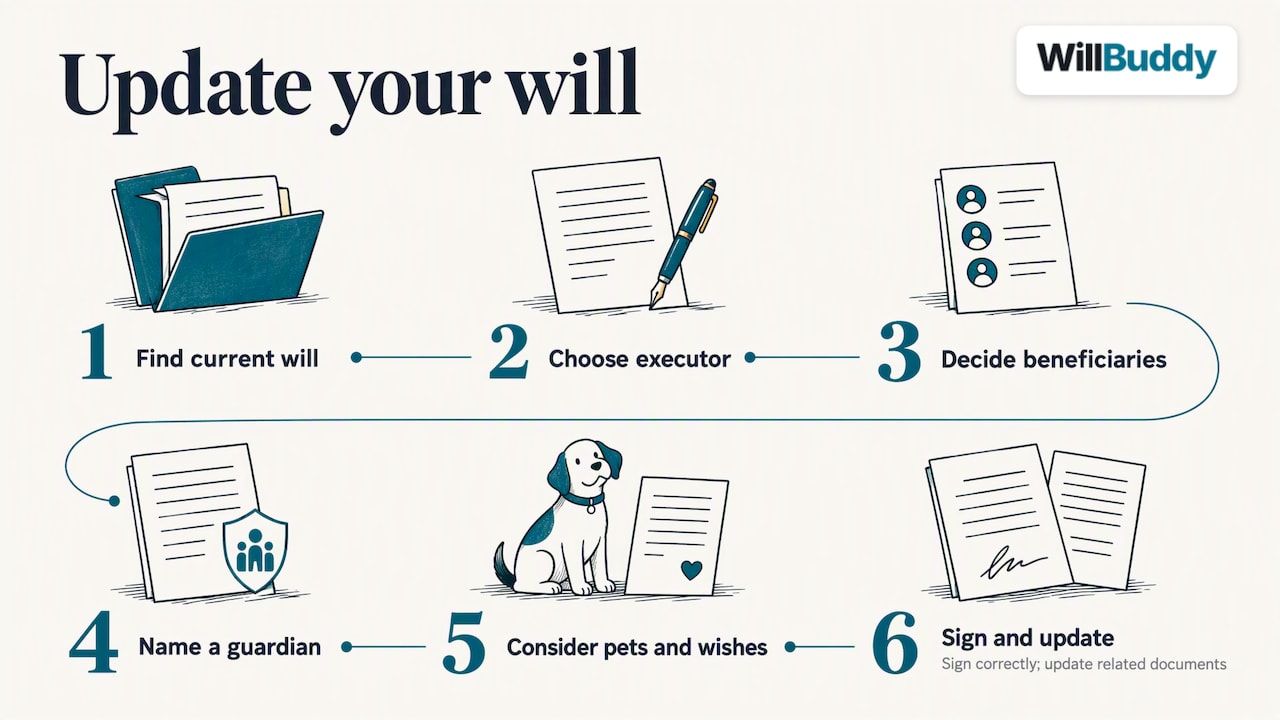
1. Find your current will
Read it again. Note every place your ex appears: as a beneficiary, executor, trustee or guardian. Also note who else is named, and whether those people are still right.
2. Decide who runs your estate
Choose an executor you trust to be organised and fair. Name a backup in case your first choice cannot act. Many people choose an adult child, a sibling or a close friend.
3. Decide who gets what
Think about your children, other family, friends and charities. If your children are young, decide at what age they should receive their share. You can also set up a trust in your will to hold money for them until then. Our guide to testamentary trusts explains how that works.
4. Name a guardian for your children
If you have children under 18, pick a guardian and a backup. Talk to them first. Choose someone whose values and home you trust. Wording a guardian appointment clearly helps avoid arguments later.
5. Think about pets, funeral wishes and exclusions
You can say who should care for a pet and what kind of funeral you want. You can also name people you do not want to benefit. Exclusions can be complex and may be challenged, so take advice if this is likely to be disputed.
6. Sign it properly
A will generally needs to be in writing, signed by you and witnessed by two adults who are present together when you sign. Witnesses should not be people who receive a gift under the will. Each state sets its own formal requirements, so follow the rules where you live.
7. Revoke or update your other documents
Change your enduring power of attorney and enduring guardian if they name your ex. Update super and insurance nominations. Store everything in one place and tell your executor where it is.
When to see a lawyer instead
An online will suits a straightforward situation. Get advice from a lawyer if any of these apply:
- A blended family. Children from different relationships raise fairness and claims issues.
- A business or trust. Ownership and control can be complicated.
- Assets overseas. Other countries have their own succession rules.
- A likely contest. If someone may challenge your will, you need professional advice on how to protect your wishes.
- An unfinished property settlement. What you can leave depends on what is still being decided.
The Attorney-General's Department also notes that the family law system has been changing. See its pages on family law changes from June 2025, and on family violence and family law. If your case is in progress, ask your family lawyer how the rules apply to you.
Making the new will with WillBuddy
WillBuddy is built for this moment. You answer plain questions, one at a time. We draft a will for your state or territory, so the wording fits where you live. You can read every word for free before you pay. When you are happy, you print it and sign it with your witnesses.
Life keeps changing, and so can your will. The plan is $39 a year and includes 50 AI edits a year, plus secure, encrypted storage of your will in Australia while your plan is active. We never sell your information to third parties for their marketing. You can see the plan on our pricing page.
Common mistakes after divorce
- Waiting for the divorce order. Your old will works against you during separation.
- Assuming the will is void. It is not. Most of it still applies.
- Forgetting the backup executor. If your first choice cannot act, the court may step in.
- Leaving the power of attorney unchanged. This is the one that surprises people most.
- Not updating super. Super does not follow your will, so an old nomination can send it where you no longer intend.
- Signing without proper witnesses. An invalid will may not be accepted.
- Never reviewing it again. New partners, new children and new assets are all reasons to look again.
FAQ
Does divorce cancel my whole will?
No. LawHub says a divorce does not revoke a will in Victoria. In general, it removes gifts to your former spouse and their appointment as executor or trustee, and the rest of the will stays valid. You still need to update it so it matches your wishes.
Does separation affect my will?
No. Separation has no effect on your will. Until a divorce order takes effect, you are legally married and your ex can still benefit under your old will. If you separate, it is wise to update your will straight away.
Can my ex still make decisions for me after divorce?
Possibly. Legal Aid NSW advises that in NSW, powers of attorney and enduring guardianship are not automatically cancelled by divorce. In Queensland, a divorce revokes an enduring document to the extent it gives power to your former spouse. Rules differ by state, so check yours, and revoke and replace any that still name your ex.
Do I need a new will or just a codicil?
For one tiny change, a codicil can work. After a divorce you will usually change several things, so a new will is simpler and clearer. It also states that your earlier wills are revoked.
What if I have young children?
Name a guardian and a backup in your new will, and think about a trust to hold money for them. A court always puts the child's best interests first, so your wishes carry great weight but are not the final word.
Start your will free at willbuddy.com.au and read it before you pay.
Sources
Show the 10 sources
- Succession Act 2006 (NSW)
- Succession Act 1981 (Qld)
- Family Law Act 1975 (Cth)
- Powers of Attorney Act 1998 (Qld)
- Legal Aid NSW: After your divorce hearing
- LawHub Victoria: Marriage, divorce and wills
- NSW Government: Changing your relationship status
- Attorney-General's Department: Parenting arrangements for children after separation
- Attorney-General's Department: Family law changes from June 2025
- Attorney-General's Department: Family violence and family law
Recommended
For the one who keeps the family covered
Life changed? Make a will that fits your family now
WillBuddy writes a new will from plain questions about the family you have now, for your state. Once it's signed and witnessed, it replaces your old will, so include everything you still want. Read every word free, with no card. You pay only if you want to print it.
Start my will freeLast updated 18 October 2026.
This article is general information only and is not legal advice. It is our best interpretation of the law as at 18 October 2026. WillBuddy is not a law firm, and it never replaces advice from a lawyer or solicitor. Laws change and differ between states and territories, so for your own circumstances, please get legal advice.