Updating Your Will After an Inheritance, a New Home or a Baby
General information, not legal advice.
On this page

Quick answer
If you have inherited money or property, your existing will does not change by itself. It keeps saying what it said the day you signed it. The safest fix is usually to make a new will that reflects your life now. You can draft one online in one sitting, then sign it in front of your witnesses. This guide covers what to check after an inheritance, after buying property and after a new baby. It is general information only, not legal advice.
TL;DR
- An inheritance, a new home or a baby does not update your will automatically. You have to do it.
- A significant change in assets, or the birth or adoption of a child, are standard reasons to review your will, according to Legal Services Commission of South Australia.
- For most changes, making a new will is safer than adding a codicil (a short amendment), because a new will cancels the old one.
- New parents can name a guardian for their children in their will. Check who gets the assets and who looks after the kids.
- Your new will must be signed and witnessed to Australian state or territory rules. Ask a lawyer if you have a blended family, a business or trust, overseas assets or a likely contest.
Why an inheritance should make you look at your will
A will is a snapshot. It records who gets your assets, who looks after your children and who carries out your wishes (your executor). When you inherit, your assets change. Your will may not match them any more.
The Legal Services Commission of South Australia lists a significant change in assets, such as buying or selling a house, or the birth or adoption of children as reasons to update a will. It also suggests a review every couple of years.
Here is a simple example. Say your will leaves "everything" equally to your partner and two children. Then a parent dies and leaves you a house. Under your old will, that house now sits in your estate and passes the same way. That might suit you. Or you might want it to go to your children only, or to be split with a sibling who cared for your parent. Nothing happens unless you write it down.
If you have no will at all, the law of your state or territory decides who inherits. That is called intestacy. The result may not be what you would choose. An inheritance is a good moment to fix that.
What to review after you inherit
Work through these questions before you change anything. Write the answers down. They become your instructions.
1. What did you actually receive?
Cash, shares, a property, a share in a property, or a mix? Each is handled differently in a will. A house is usually left as a specific gift or as part of the "residue" (everything left after specific gifts and debts). Cash can be split by percentage, which is easier to keep up to date.
2. Who should get it?
Your old will may leave everything to one person. Do you now want a different split? Do you want to leave something to a charity, a friend or a grandchild? Is any beneficiary now too young to manage money? You can say what happens if a beneficiary dies before you.
3. Are your executors still right?
Your executor collects assets, pays debts and hands out the estate. A bigger estate is a bigger job. Check that the person you named is still willing, able and fair to everyone involved. Name a back-up too.
4. Are your guardians still right?
If you have children under 18, check the people you chose to care for them. Circumstances change. Health, location and relationships all move on.
5. Do your relationships match your will?
In South Australia, marriage or starting a registered relationship automatically revokes a will unless the will was made with that relationship in mind. Every other state and territory also has a rule that marriage revokes an earlier will, with exceptions that vary, such as a will made in contemplation of the marriage. Divorce also has effects. In New South Wales, section 13 of the Succession Act 2006 says divorce generally revokes gifts to a former spouse and their appointment as executor, trustee or guardian, unless the will shows a different intention. There is a narrow exception for a former spouse named as trustee of property left for beneficiaries that include their own children. Rules differ between states and territories, so do not assume your state works the same way.
6. Do you have assets outside your will?
Some assets do not pass through a will, such as jointly owned property and, often, superannuation. We cover that below, because it matters for property.
If you want a full checklist beyond this article, our estate planning checklist for Australians is a good next read.
Update your will after buying property
Buying a home does not update your will either. Victoria Legal Aid lists buying a significant asset or investment as a reason to make a new will.
Three checks matter most.
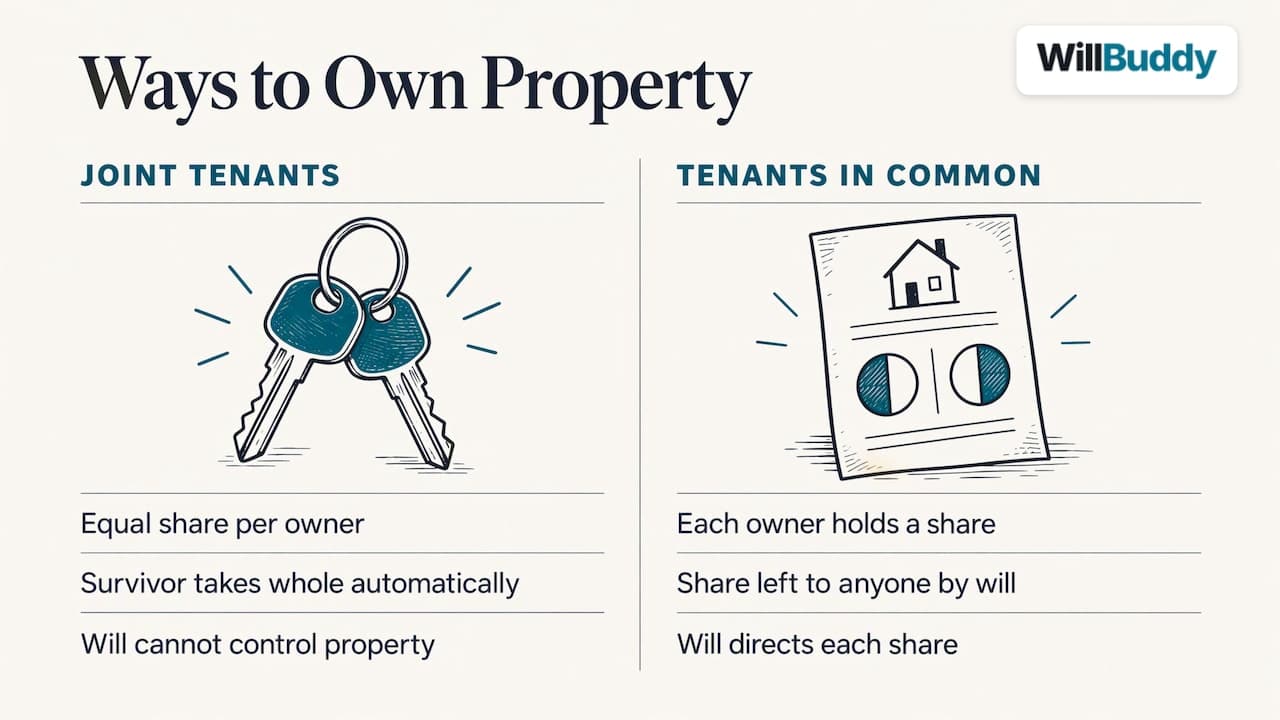
How is the property owned? There are two common ways to hold property with someone else. As joint tenants, each owner has an equal share and, when one dies, the survivor takes the whole property automatically. Your will does not control it. As tenants in common, each owner holds a share that they can leave to anyone in their will. Check your title documents. If you thought your will decided who gets your home, this is the check that matters most.
Does your will name the home? If an older will gives a specific gift, such as "my unit at [address]", that gift usually fails if you sell the unit. Wording based on percentages of the estate holds up better as your assets change.
Is there a mortgage? A will passes on what you own, and a mortgage does not disappear when you die. Unless your will says how the loan is to be paid, the person who receives a mortgaged home may take it with the loan still attached. Think about whether they could afford to keep it. You may want to speak to your lender or a financial adviser about insurance and repayments.
If you have inherited a house and plan to sell or rent it out, a real estate cleaning checklist can help you plan the preparation. Then come back to your will and decide who should receive the sale proceeds if something happens to you.
Update your will after a baby
A new baby is the most common reason parents finally make a will. It is also the most important one for guardianship.
Name a guardian
Wills can appoint a guardian for children under 18 or still dependent. Tasmania Legal Aid says wills are mainly meant to deal with property, so your executor does not necessarily need to follow those directions. But if a court is asked to decide where your children live and who their guardian is, it will take the wishes in your will into account. So naming someone is worth doing.
Legal Aid Queensland explains that a testamentary guardian can make long-term decisions, such as about education or religion. The guardian only has daily care of the child if the other parent has died and there are no court orders. If the other parent is alive, the guardian shares responsibility with them. A parent can also apply to the Supreme Court to cancel the appointment.
That tells you two things. First, a guardian clause is a back-up for the worst case, not a custody plan for today. Second, talk to the person first. Make sure they will say yes.
Decide who gets your assets
Many parents leave everything to their partner, and then to the children if the partner has died. Think about the second step. A young child cannot hold property directly. You can set the age at which they receive their share. Think about who manages the money until then.
Check your executor
It is common to name your partner as executor. Also name a back-up in case you both die together.
Check super and insurance
Superannuation and life insurance often have their own beneficiary forms. They may not follow your will. After a baby, check these forms with your fund and insurer, so the money goes where you intend.
We have a free state guide if you want the basics: see our Queensland will guide, South Australian will guide or ACT will guide.
New will or codicil: how to make the change
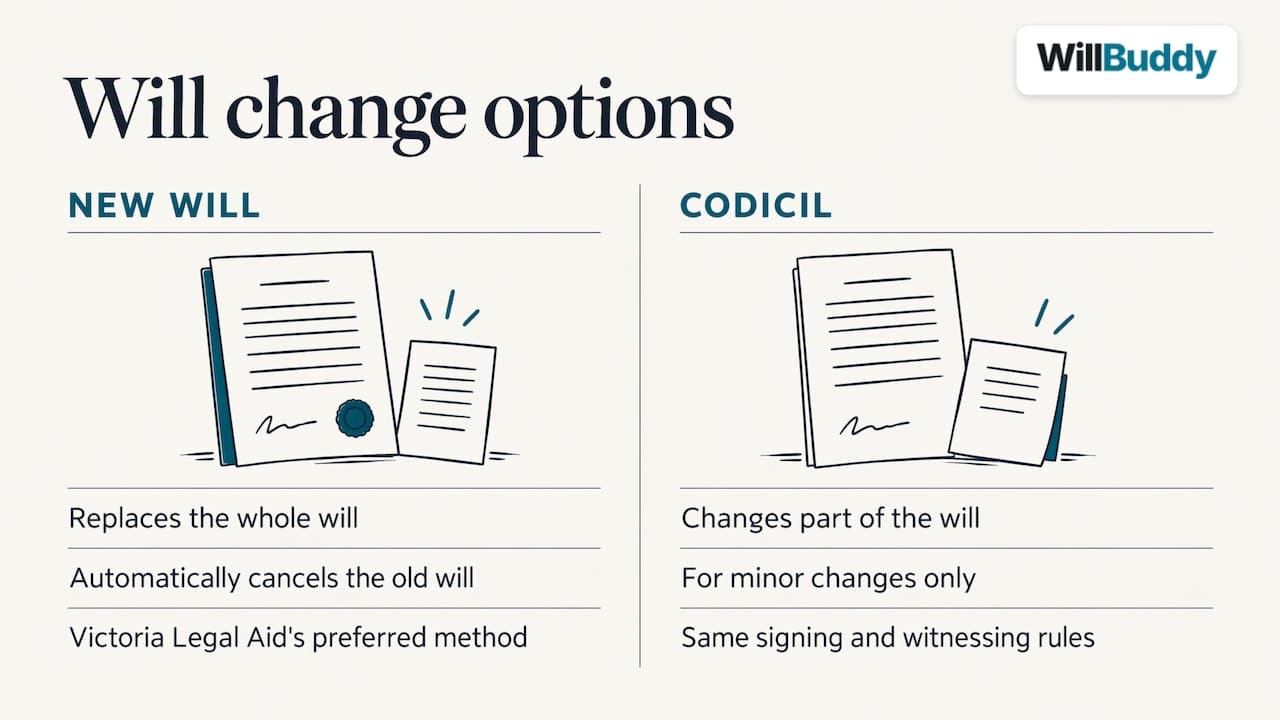
A codicil is a short document that changes part of your will. A new will replaces the whole thing.
Victoria Legal Aid says the best way to change a will is to make a new one, which automatically cancels the old one. It says codicils are for minor changes only and can be invalid if they cause confusion or contradict the original will. A codicil must also meet the same signing and witnessing requirements as a will.
An inheritance, a house or a baby is not a minor change. Each can shift who gets what, who is in charge and who looks after your children. A new will keeps everything in one clear document. For more on the choice, see codicil versus new will and our guide to updating or changing a will.
Sign and witness it properly
A new will that is not signed correctly can fail. In Tasmania, for example, section 8 of the Wills Act 2008 (Tas) requires a will in writing, signed by you, with your signature made or acknowledged in front of two witnesses present at the same time, who then sign in your presence. Under section 12 of the same Act, a gift to someone who witnesses the will is generally void unless an exception applies. Not every state has that rule, but using two adult witnesses who receive nothing under the will is the safe course everywhere.
The ACT's Wills Act 1968 sets a slightly stricter version of the core rule in section 9: a written will, signed at the foot or end, with the signature made or acknowledged before two or more witnesses present at the same time, who each sign in front of you and each other. Other states and territories have their own legislation, so check the rules for where you live. Our guide on who can witness a will goes through it state by state.
Do not rely on e-signing
Electronic signing and online witnessing of wills are not available everywhere. The Victorian Department of Justice says wills can be signed electronically and witnessed by audio-visual link in Victoria, but everyone involved must be in Victoria at the time and a special witness is needed. The Law Society of Tasmania's 2023 review found other jurisdictions are more limited, and that the ACT, Tasmania, South Australia, Western Australia and the Northern Territory did not allow electronic signatures or remote witnessing for wills. Rules can change, so the simple route is to print your will and sign it in person with two adult witnesses.
Cancel the old one the right way
Making a new will that says it replaces earlier wills is the clean way. If you destroy an old will without a replacement, intestacy laws decide who inherits. Keep the new will somewhere safe and tell your executor where it is. See our guide to revoking a will for more.
How WillBuddy fits in
WillBuddy asks you plain questions one at a time and drafts a will for your state or territory. You can read every word of it free before you pay. Then you print it and sign it with your witnesses. It covers guardians for children, executors, how your estate is shared, gifts, funeral wishes and pets.
The annual subscription includes up to 50 AI-assisted edits a year, so you can update your will when a new baby, a house or an inheritance arrives. Your will is stored securely in Australia, your personal data is encrypted and we never sell it. You can see the plan on our pricing page.
When to see a lawyer
An online will suits many people with straightforward affairs. Talk to a lawyer if any of these apply:
- You have a blended family, such as children from earlier relationships.
- You own a business or have a trust.
- You have assets overseas.
- You think someone is likely to contest your will.
These situations carry extra risk, and personal advice is worth having. Our simple will guide explains what a simple will covers.
FAQ
Do I have to update my will after I inherit?
No law forces you to. But your old will will treat the inheritance as part of your estate, whether or not that suits you. If you want it to go to different people, you need to change your will. A significant change in assets is a standard reason to review.
Does buying a house update my will automatically?
No. Your will only changes when you make a new one or a valid codicil. Also check how you own the property. A jointly owned home may pass to the surviving owner regardless of what your will says.
Does having a baby cancel my will?
In general, a birth does not cancel a will, but your will may not mention the child or name a guardian. Marriage revokes an earlier will in every Australian state and territory, with exceptions that vary, such as a will made in contemplation of the marriage. Check the rule for your state or territory, and review your will after any birth or adoption.
Should I use a codicil or make a new will?
For a major change, a new will is the safer choice. Victoria Legal Aid says it automatically cancels the old will, and that codicils are for minor changes only. A codicil also needs signing and witnessing like a will.
Where should I keep my will?
Keep the signed original somewhere safe and tell your executor where to find it. A will does not need to be lodged or recorded anywhere to be in force, according to the Legal Services Commission of South Australia. It is valid from the moment it is properly signed and witnessed.
Sources
Show the 9 sources
- I have a will. Now what? Legal Services Commission of South Australia
- Changing a Will, Victoria Legal Aid
- Wills, making a will, Tasmania Legal Aid
- Who will look after my children if I die? Legal Aid Queensland
- Wills Act 1968 (ACT)
- Wills Act 2008 (Tas)
- Succession Act 2006 (NSW), section 13
- Electronic signing and online witnessing, Victorian Department of Justice
- Post Pandemic Use of Electronic Signatures and Remote Witnessing, Law Society of Tasmania
Start your will free at willbuddy.com.au and read it before you pay.
Recommended
For the one who keeps the family covered
Life changed? Make a will that fits your family now
WillBuddy writes a new will from plain questions about the family you have now, for your state. Once it's signed and witnessed, it replaces your old will, so include everything you still want. Read every word free, with no card. You pay only if you want to print it.
Start my will freeLast updated 19 November 2026.
This article is general information only and is not legal advice. It is our best interpretation of the law as at 19 November 2026. WillBuddy is not a law firm, and it never replaces advice from a lawyer or solicitor. Laws change and differ between states and territories, so for your own circumstances, please get legal advice.