Moved State? How to Update Your Will in Australia
General information, not legal advice.
On this page
- TL;DR
- Does moving state invalidate your will?
- Why a move is still a good time to review
- What to check after you move
- If you own property in more than one state
- Codicil or new will?
- Why draft the new will for your new state
- A step-by-step way to update your will after moving
- When to see a lawyer
- How WillBuddy fits
- FAQ
- Sources
- Recommended

Quick answer
Moving interstate does not cancel your will. But it is a strong prompt to check it, and the simplest safe update is usually a new will for your new state that replaces the old one. A new will, signed with witnesses, automatically revokes earlier wills. Do it soon after you settle in, while the details are fresh.
This is general information only, not legal advice.
TL;DR
- Your will usually stays valid after you move. South Australian law says a change of home state does not revoke it, and New South Wales law says it does not change how the will is read.
- Review it anyway. Executors, guardians, property and gifts often change when you move.
- Never scribble changes on a signed will. Make a codicil or, more simply, a new will.
- Wills law differs by state and territory, so draft the new will for the state you now live in.
- See a lawyer if you have a blended family, a business or trust, assets overseas, or a likely contest.
Does moving state invalidate your will?
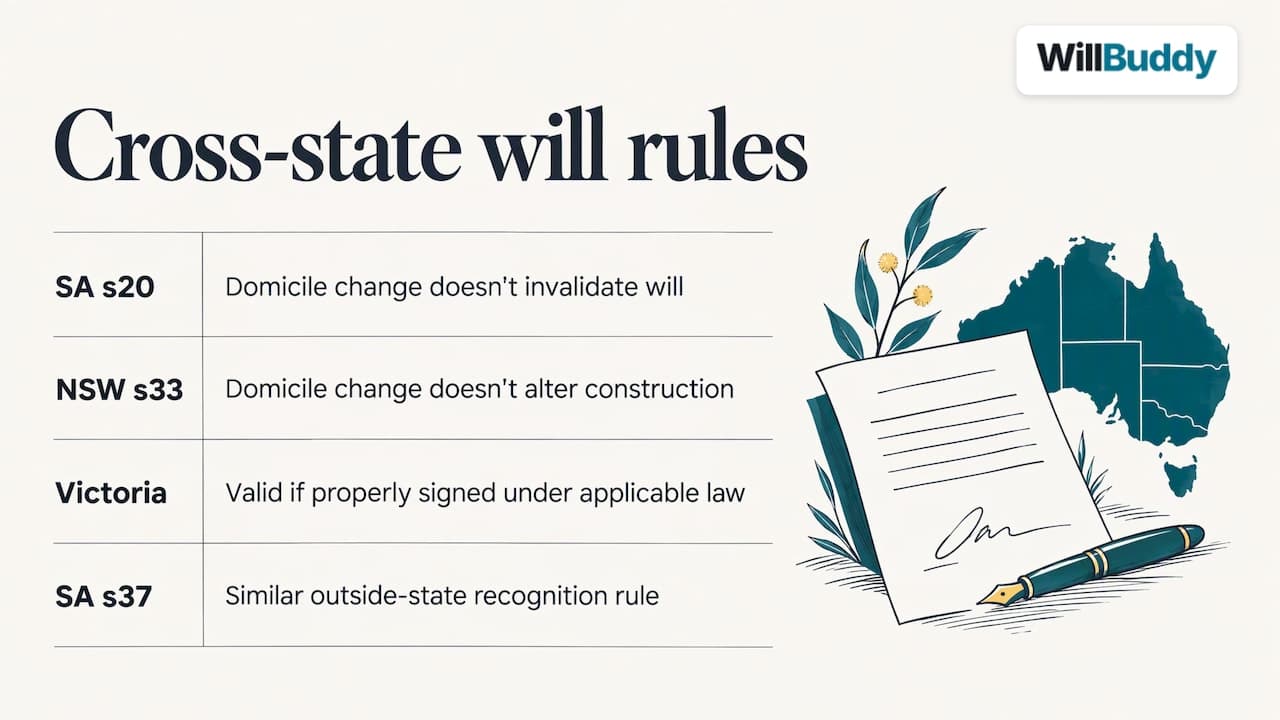
No. In South Australia, section 20 of the Succession Act 2023 says a change of the testator's domicile after making a will does not revoke or invalidate it. Domicile is, roughly, the place you treat as your permanent home. The testator is the person who made the will.
New South Wales has a similar rule. Section 33 of the Succession Act 2006 says a change of domicile after signing does not change how the will is construed. Construed means how the words of the will are read and understood.
Wills made in another state are also generally recognised. Victoria's LawHub says a will signed outside Victoria is valid in Victoria if it was properly signed under the law of the place where it was made, or where the will-maker lived or was domiciled at signing or death. South Australia's Succession Act 2023 has a similar rule in section 37.
So your old will probably still works. The real question is whether it still fits your life.
Why a move is still a good time to review
A move rarely happens alone. It often comes with a new relationship, a sale or purchase, or a change in who lives nearby. Government guidance lists changes like these as reasons to look at your will again.
The South Australian Law Handbook advises reviewing a will every few years and after major life events. It includes a move by an executor or beneficiary, a new or ended relationship, the birth or adoption of children, big changes to your assets, and retirement.
The NSW Government suggests a review every five years. It also names marriage, children, money changes, separation or divorce, moving overseas, and the death of a beneficiary or executor.
Moneysmart also says to keep your will up to date when your situation changes, store it somewhere safe and tell someone you trust where to find it.
A move can also change how well your plan works in practice. The people you named may now live a long way from your family. Your new home may be your biggest asset. Your will may not mention it at all.
What to check after you move
Work through this list with your current will in hand.
1. Your executor
The executor is the person who carries out your will. The Queensland Public Trustee explains your executor is responsible for administering and distributing your estate after you die. That often means applying for probate, finding the beneficiaries, sorting out tax and paying debts. Probate is the court's formal approval of a will.
Ask yourself:
- Does your executor still live nearby, or have you both moved?
- Are they still willing and able to do the job?
- Do you have a back-up named in case they cannot act?
Distance is not a legal barrier, but it makes the job harder. Many people name someone who can easily reach the family and the paperwork.
2. Your guardian for children
If you have children under 18, a will is where you name who you want as their guardian. The NSW Government says the guardian takes on longer-term decisions about education, values, religion, health and lifestyle, and you should talk to your choice first.
After a move, ask:
- Does your chosen guardian live in the same state, or have they moved too?
- Would your children need to change schools or cities if the guardian took over?
- Has the guardian's own situation changed?
Parents who want more detail can read our guides on how to word guardian appointments and on guardians and trusts for minor children.
3. Your property and gifts
If you sold a home and bought another, check that any gift in your will still makes sense. A will that leaves "my house at [old address]" to a child may no longer describe anything you own. Wording such as "my home" or a share of the whole estate can be clearer. Think about bank accounts, vehicles and super too. Make sure the people you named in those places still match your wishes.
4. People and pets
Check every name. Have relationships changed? Have any beneficiaries died? Do you want to add a new child, a partner or a pet carer? Do your funeral wishes still match what you want?
5. Where the will is kept
Unpacking is when documents go missing. The NSW Government warns that a will kept at home can be lost, damaged or stolen. If it cannot be found, assets may not be shared as you intended and extra legal costs can follow. Decide where the signed copy lives and tell your executor.
If you own property in more than one state
Many people keep an investment property or land in their old state after they move. Probate is usually applied for in the state where the person lived and where most assets are. The Supreme Court of NSW explains that a grant from one state can often be recognised in another by resealing it. In NSW, that is under section 107 of the Probate and Administration Act 1898.
That means separate probate in every state is not always needed. But the rules and steps differ by place, and your executor will have to follow them. Keep a clear list of what you own and where. If you own assets overseas, see a lawyer. Foreign property can follow different rules.
Money you have inherited or expect to inherit may also need a fresh look after a big move. This piece on inheritance planning considerations covers tax, Centrelink and other points to think about.
Codicil or new will?
Once a will is signed, you cannot just cross things out or write new clauses on it. The South Australian Law Handbook says a signed will cannot be altered that way unless the changes are signed in the same way as a will. Tasmania Legal Aid says the same: such alterations have no effect.
You have two safe options.
A codicil. This is a short document that changes part of your will. It must meet the same signing rules as a will and should refer to the original will and its date. A codicil suits one small fix. After a move, you often have several changes, and a stack of codicils can get confusing. Our guide to proper execution requirements explains how to sign one.
A new will. The SA Law Handbook says a new will automatically revokes earlier wills and is often the simplest way to update. Tasmania Legal Aid agrees that an entirely new will may be easier. One clean document is also easier for your executor to follow. See our practical examples of when each approach fits.
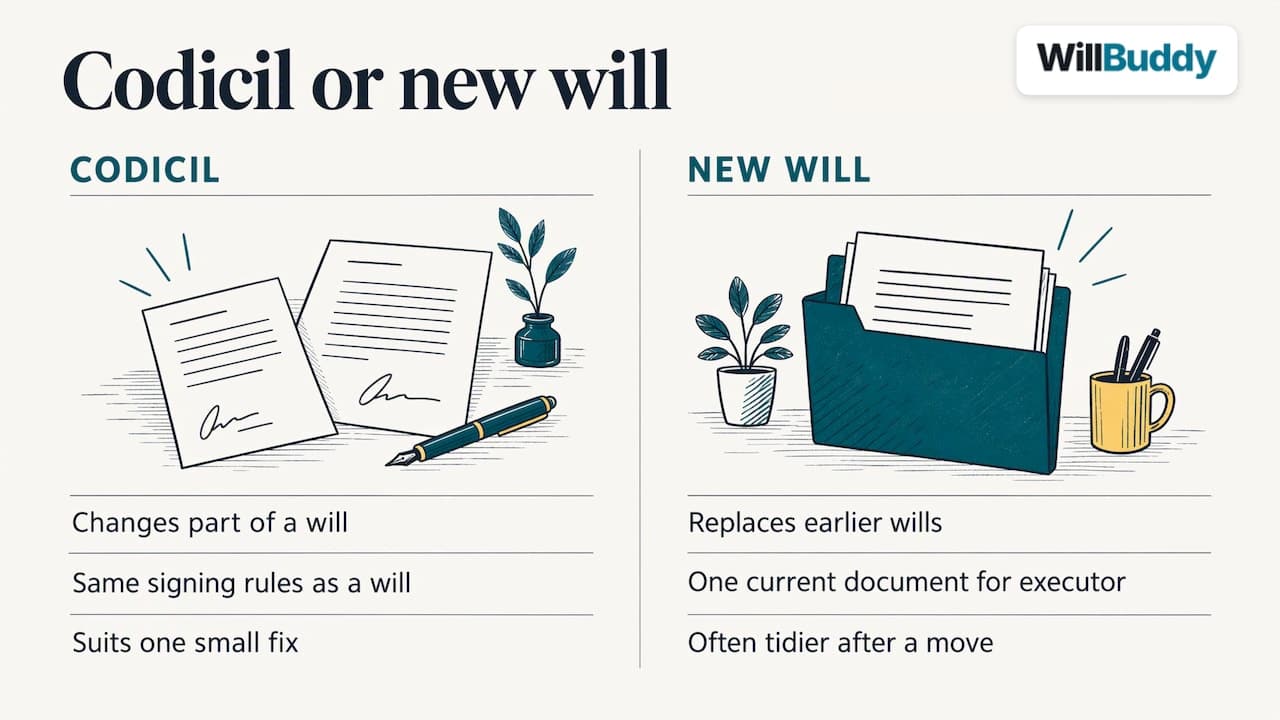
After a move, a new will for your new state is usually the tidier choice. It gives you one current document that matches your life.
Why draft the new will for your new state
Succession law is made state by state and territory. Your old will is likely still valid, but a will drafted for the state where you now live uses that state's rules. That includes how it must be signed and witnessed.
Laws also change. South Australia is one example. Its Succession Act replaced three older laws on 1 January 2025. The Legal Services Commission of SA says it applies to new and existing wills, and that existing valid wills do not need to be remade. Even so, a refresh when you move is a chance to make sure the document reflects your life and your state's current law.
If you moved to Western Australia or South Australia, our free guides cover the basics: the WA will guide and the SA will guide.
A step-by-step way to update your will after moving
- Find your current will. Read it from start to finish. Note who is named as executor, guardian and beneficiary.
- List what has changed. Think about your address, assets, relationships, children, and the people you named.
- Decide on a codicil or a new will. For more than one small change, choose a new will.
- Draft the new will for your new state. Name your executor and a back-up, your guardian for any children under 18, how your estate is shared, and any gifts, pets or funeral wishes.
- Sign it properly. Print it and sign it with witnesses, following your state's rules. An unsigned or wrongly signed will may not be valid.
- Store it safely. Tell your executor where it is. Keep one clear, current copy.
- Destroy or clearly mark the old will as replaced. A new will revokes the old one, but you avoid confusion by removing old copies once the new will is signed.
When to see a lawyer
An online will can suit people with straightforward wishes. See a lawyer instead if:
- you have a blended family, such as children from earlier relationships;
- you own a business or use a trust;
- you have assets overseas;
- you think someone is likely to contest your will.
These situations carry extra risk, and tailored advice is worth it.
How WillBuddy fits
WillBuddy asks you plain questions one at a time and drafts a will for your state or territory. You can read every word of it free before you pay. Then you print it and sign it with witnesses.
For people who have just moved, that means a new will for the new state without a long appointment. Annual Access ($39 a year) includes 50 AI edits a year, so you can adjust the will as life changes, such as a new address, a new child or a new executor. Your will is stored encrypted in Australia, and we never sell your data. See the Annual Access plan and price.

You can try the process through the WillBuddy home page.
FAQ
Is my will still valid if I move to another state?
Usually yes. South Australian law says a change of domicile after signing does not revoke the will or change how it is read, and NSW law says it does not change how the will is read. A review is still wise, because your circumstances have probably changed.
How soon should I update my will after moving?
There is no set deadline in the sources above. Government guidance says to review after major life events, and a move often comes with several. Doing it within a few months of settling in is a sensible habit.
Can I just write the changes on my old will?
No. Alterations written on a signed will have no effect unless they are signed in the same way as a will, as the South Australian Law Handbook explains. Use a codicil or make a new will.
Do I need a separate will for each state where I own property?
Not necessarily. A grant of probate from one state can often be resealed in another. The steps vary by state, and overseas assets need a lawyer.
Does my guardian choice need to change if we move?
Not automatically. But check whether your chosen guardian is still close, willing and suited to the role. The NSW Government says you should discuss the role with the person you choose.
Sources
Show the 11 sources
- Succession Act 2023 (SA) s 20
- Succession Act 2006 (NSW) s 33
- Succession Act 2023 (SA), current version
- Wills made interstate or overseas, Victorian LawHub
- Updating a will, South Australian Law Handbook
- Wills and powers of attorney, Moneysmart
- Learn about wills, NSW Government
- Let's talk about Wills, Queensland Public Trustee
- Applying for a reseal of a Grant, Supreme Court of NSW
- The new Succession Act factsheet, Legal Services Commission of SA
- Wills, making a will, Tasmania Legal Aid
Start your will free at willbuddy.com.au and read it before you pay.
Recommended
For the one who keeps the family covered
Life changed? Make a will that fits your family now
WillBuddy writes a new will from plain questions about the family you have now, for your state. Once it's signed and witnessed, it replaces your old will, so include everything you still want. Read every word free, with no card. You pay only if you want to print it.
Start my will freeLast updated 19 November 2026.
This article is general information only and is not legal advice. It is our best interpretation of the law as at 19 November 2026. WillBuddy is not a law firm, and it never replaces advice from a lawyer or solicitor. Laws change and differ between states and territories, so for your own circumstances, please get legal advice.