Paying for a Funeral From the Estate in Australia
General information, not legal advice.
On this page
- TL;DR
- Who pays for the funeral
- Why funeral costs come first
- What if the estate has no money yet
- Step by step: the first two weeks
- How much does a funeral cost
- Read the quote carefully
- Does the government help with funeral costs
- When the estate cannot cover the bill
- How a will makes this easier
- Make your will with WillBuddy
- FAQ
- Sources
- Recommended
Quick answer
In Australia, funeral costs are usually paid from the deceased person's estate, and they come ahead of almost every other debt. The catch is timing. The estate's money is often locked up until probate is granted, so someone often has to cover the bill first. That person can usually claim the money back from the estate.
This guide explains how it works, what to do in the first week, and where state rules differ. It is general information only, not legal advice.
TL;DR
- Reasonable funeral costs are paid from the estate before other debts and before beneficiaries receive anything.
- The person who arranges the funeral is legally responsible for the bill. If the estate has the money, they can be repaid from it.
- Some banks will pay a funeral director directly from the deceased's account before probate. Ask early, and keep every invoice.
- Check for a prepaid funeral, funeral bond or insurance before you sign anything. Ask for an itemised quote.
- A current will that names an executor and records funeral wishes takes pressure off your family.
Who pays for the funeral
The law starts with the person who organises the funeral. Legal Aid NSW explains that this person is legally responsible for paying. If there is enough money in the estate, the funeral expenses are paid from it.
In most cases the organiser is the executor, the person named in the will to carry out the deceased's wishes. In NSW, the executor's guide from the NSW Government says the executor is responsible for arranging and paying for the funeral, plus costs such as a headstone or plaque.
If there is no will, or the executor cannot or will not act, a close relative often steps in. The same rule applies. Whoever signs the contract with the funeral director is the one the director will chase.
So the question is not only "does the estate pay". It is "who pays first, and how do they get the money back".
Why funeral costs come first
An estate often has more than one debt. There may be a credit card, a car loan, tax and legal costs. The law ranks them.
The South Australian Law Handbook on payment of debts sets out the order the executor must follow when paying from the estate:
- Funeral expenses
- Testamentary (legal) expenses
- Statutory obligations, such as tax
- Any other debts
That is why an unsecured creditor, such as a credit card company, cannot jump the queue ahead of a reasonable funeral bill. It also means beneficiaries are paid last. Gifts under the will only come from what is left after these costs.
The word "reasonable" matters. Estates are expected to cover a sensible funeral, not an unlimited one. If a will leaves very little and the family wants a lavish service, the difference may have to come from the family.
The exact legislation differs between states and territories. The ranking above is from South Australian guidance. If your matter is in another state, check that state's own guidance or ask a lawyer.
What if the estate has no money yet
This is the most common problem. The bank account is frozen or unavailable, and the funeral director wants payment.
There are three usual paths.
Ask the bank to pay the funeral director directly
Legal Aid NSW notes that the bank may release some funds from the deceased's account to pay for the funeral. You will need to give the bank your identification, and it may also ask you to complete forms and provide a copy of the death certificate, the will or the funeral director's invoice. Some banks do this before probate is granted, but each bank sets its own process and limits, so ring the bank early and ask what it needs.
We cover this in more detail in our guide to estate bank accounts and funeral funds before probate.
Pay it yourself and claim it back
If you can afford to, you can pay the bill and be repaid from the estate later. The NSW Government's guide to arranging a funeral lists the questions to ask first, including whether there is enough money in the deceased person's bank account.
To claim the money back, you need proof. Keep every invoice and receipt. Do not rely on memory later.
Be realistic about the risk. If the estate turns out to have little money, you may not get everything back. That is why it helps to look at the estate's likely assets before you commit to a large spend.
Look for money set aside for the funeral
Before you pay anything, check whether the person already made arrangements. Moneysmart suggests checking for instructions about the funeral. These may be in the will or with other important papers. Look for:
- A prepaid funeral plan
- A funeral bond
- A life insurance policy that pays towards funeral costs
- A prepaid grave or plot
Any of these can cut or cover the cost. Find them before you sign a new contract, not after.
Step by step: the first two weeks
Here is a simple order of work for an executor or family member.
- Find the will and any funeral instructions. They may be at home, with a lawyer, or stored online. Funeral wishes in a will are not always legally binding, but they guide the family.
- Check for prepaid arrangements. Look for plans, bonds and insurance.
- Get itemised quotes. Ask more than one funeral director for a written breakdown.
- Ask the bank about direct payment. Take the death certificate, invoice and ID.
- Decide who pays up front. If it is you, keep every receipt.
- Note the costs for the estate accounts. You will list them when you finalise the estate.
- Apply for probate if needed. Many assets cannot be touched without it.
After probate or letters of administration are granted, the executor collects assets and clears debts. The State Library of NSW has a plain guide to what happens after the grant. Reimbursing the funeral payer is part of that stage.
How much does a funeral cost
Prices vary a lot by provider, location and the type of service. Official pages give a rough guide, and the figures are dated.
The Queensland Government's page on pre-planning a funeral cites industry data from 2020. On that data, a direct cremation averaged about $3,500, a standard funeral about $8,000, and premium funerals started around $15,000.
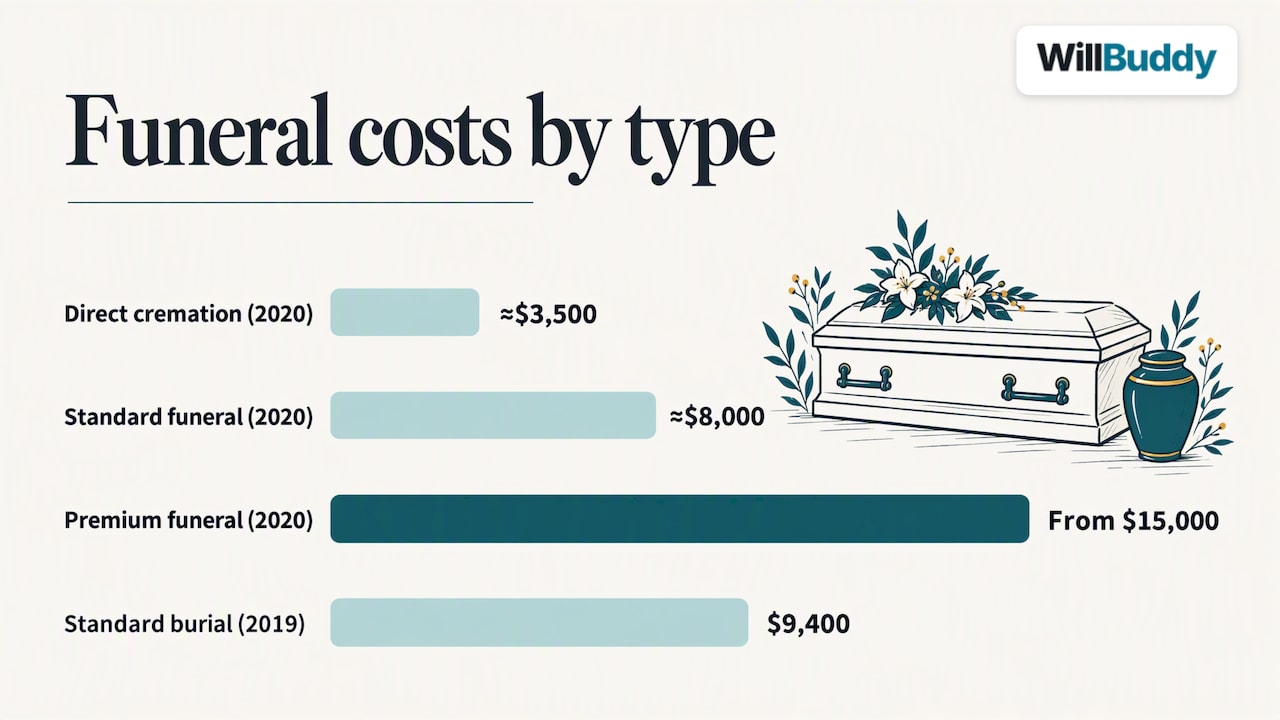
Cemeteries & Crematoria NSW says cremation can be significantly cheaper than burial. It also quotes 2019 research that put the average standard burial and funeral at $9,400.
These numbers are several years old. Treat them as a ballpark only, and get current quotes for your area.
| Type of funeral | Rough average (Queensland Government, 2020 industry data) |
|---|---|
| Direct cremation | About $3,500 |
| Standard funeral | About $8,000 |
| Premium funeral | From about $15,000 |
Costs in the estate can also include a headstone or plaque, a grave or plot, flowers, a celebrant and death certificates. Your executor should add them all up before estimating what is left for beneficiaries.
Read the quote carefully
Advertised prices can mislead. The ACCC has taken action over advertised funeral pricing. In one case, the ACCC alleged a provider misled consumers on pricing with "from" prices that did not reflect what most customers paid.
So do these things:
- Ask for the full price, not the starting price.
- Ask what is included and what is extra.
- Compare two or three providers on the same basis.
- Do not sign until you have read the breakdown.
Cemeteries & Crematoria NSW notes that in NSW funeral directors must give a written, itemised quote. Rules differ elsewhere, so ask for one wherever you are.
You also do not have to use a funeral director. Moneysmart says there is no legal requirement to use one, and some families arrange a funeral themselves. Check your state's rules on transporting the body, cremation paperwork and cemetery requirements first.
Does the government help with funeral costs
There is no single national funeral payment. Help depends on who you are and what the person who died received.
Services Australia says the payments you may get depend on your circumstances, your relationship to the person who died and when you tell them about the death. Contact them early.
Some states have their own schemes. In South Australia, Funeral AssistanceSA helps people in hardship. It has asset limits, including a limit on the value of the deceased's estate. Check the page for the current limits before relying on it.
If you live in another state or territory, ask your state government or local council what is available.
When the estate cannot cover the bill
Sometimes there is not enough money. A few things to know:
- Reasonable funeral costs come first among the estate's debts, so unsecured creditors do not take priority.
- If the estate is small, the funeral bill may use most or all of it.
- The person who signed the contract may be left to cover the gap.
- Talk to the funeral director early. Choosing a simpler service can reduce the bill.
If the estate looks insolvent, or you are unsure, speak to a lawyer or your state's public trustee before you pay large amounts.
How a will makes this easier
Most of the stress around funeral costs comes from missing information. Nobody knows who is in charge, what the person wanted, or where the money is. A clear will fixes much of that.
A will can:
- Name an executor, so the right person has authority to act.
- Record funeral wishes, such as burial or cremation. Our guide to funeral wishes in an Australian will explains the wording and the limits.
- Show who gets what, so the executor can see what is left after costs.
- Name guardians for children, which matters if both parents die.
A separate note about wishes. Writing them in the will is useful, but wills are sometimes read after the funeral. Tell your executor and family in person as well, and keep a copy of your wishes with your important papers.
It also helps to think about who will be your executor. The role can involve out-of-pocket costs and a lot of paperwork. If you want to know what an executor can be paid, see our guide to executor fees in Australia. For a general overview of how executor and trustee roles work in another country, a US explainer on executors and trustees shows how different the terms can be. US rules are not Australian law, so use it for background only.
See a lawyer if your family is blended, you own a business or have a trust, you hold assets overseas, or you think someone may contest the will. Those situations can complicate who pays and who gets what.
Make your will with WillBuddy
WillBuddy is an online platform that drafts a will for your state or territory. You answer plain questions one at a time. You name your executor, guardians for your children, your gifts and your funeral wishes. You can read every word of your will for free before you pay. When you are happy, you print it and sign it with witnesses.
An annual subscription lets you update your will as life changes, with up to 50 AI-assisted edits a year, plus secure storage. See the Annual Access plan and current price.
FAQ
Can the estate pay for the funeral before probate is granted?
Sometimes. Banks may release money from the deceased's account directly to a funeral director if you provide the death certificate, the invoice and your ID. Each bank has its own process, so ring early. If the bank will not release funds, the person arranging the funeral may need to pay and claim it back later.
Do I get my money back if I pay for the funeral myself?
Usually, yes, if the estate has enough money. Funeral costs rank ahead of other debts, so you are repaid early. Keep all invoices and receipts as proof. If the estate is small or insolvent, you may not recover everything.
Am I responsible for the funeral bill if I am not the executor?
The person who organises the funeral is legally responsible for paying, according to Legal Aid NSW. If you sign the contract, the bill is yours first. Read the contract carefully and ask who will be reimbursed from the estate.
Does the Australian Government pay for funerals?
There is no general national funeral payment. Services Australia may offer some help depending on your relationship to the person, their payments and your circumstances. Some states, such as South Australia, run hardship programs. Check your state's rules.
Can a will say how the funeral should be paid for?
A will can record funeral wishes and name an executor. It does not create money. If you want the cost covered, consider a prepaid plan, a funeral bond or insurance, and tell your executor where the papers are. A lawyer can advise on your situation.
Start your will free at willbuddy.com.au and read it before you pay.
Sources
Show the 12 sources
- Paying for the funeral, Legal Aid NSW
- Acting as an executor, NSW Government
- Payment of Debts, Law Handbook (South Australia)
- A guide to arranging a funeral, NSW Government
- Losing your partner, Moneysmart
- After the Grant of Probate or Letters of Administration, State Library of NSW
- Pre-plan your funeral, Queensland Government
- Take my first steps to plan, Cemeteries & Crematoria NSW
- ACCC media release on funeral pricing
- What help there is when an adult dies, Services Australia
- Funeral AssistanceSA, SA Government
- Executor vs. Trustee in the U.S.
Recommended
For the one who checks before they pay
See your whole will before you spend a cent
Put off by the cost? Until you have a will, the law in your state or territory decides who gets what. WillBuddy drafts yours for your state from plain questions about your family. Read every word free, with no card. You pay only if you want to print it. A solicitor gives personal legal advice; WillBuddy doesn't.
Start my will freeLast updated 22 October 2026.
This article is general information only and is not legal advice. It is our best interpretation of the law as at 22 October 2026. WillBuddy is not a law firm, and it never replaces advice from a lawyer or solicitor. Laws change and differ between states and territories, so for your own circumstances, please get legal advice.