Guardianship in a Will in NSW: Naming Who Raises Your Kids
General information, not legal advice.
On this page
- TL;DR
- What a testamentary guardian is
- What a guardian does in practice
- How to choose a guardian
- Talk to your choice first
- What the appointment does not do
- If the other parent is alive
- If you name no guardian
- Protect the inheritance with a trust
- Recent changes to family law
- How to name a guardian in your will
- Keeping your will up to date
- Start your guardian clause with WillBuddy
- When to see a lawyer
- FAQ
- Sources
- Recommended

Quick answer
If you live in New South Wales and have a child under 18, your will is where you name the person you want to raise them if you and the other parent both die. That person is called a testamentary guardian. You can name them in a will you draft online, as long as it is signed and witnessed properly. Our tool, WillBuddy, asks you plain questions one at a time, drafts a will for your state, and lets you read every word free before you pay.
This guide is general information, not legal advice. It explains what the NSW rules say, what a guardian clause can and cannot do, and how to word your choice so it is clear.
TL;DR
- A parent of a child under 18 can name a guardian in their will. In NSW the power comes from section 14 of the Guardianship of Infants Act 1916.
- The nomination is not binding. The person you name should agree, and can refuse to act. A court can appoint someone else if that better serves the child.
- If the other parent is alive, they are usually the first carer. Your appointed guardian may act jointly with them, or apply to court if there is an objection.
- A guardian is not the same as a trustee. Use a trust in your will to protect the child's inheritance.
- See a lawyer if you have a blended family, a business or trust, assets overseas, or expect a contest.
What a testamentary guardian is
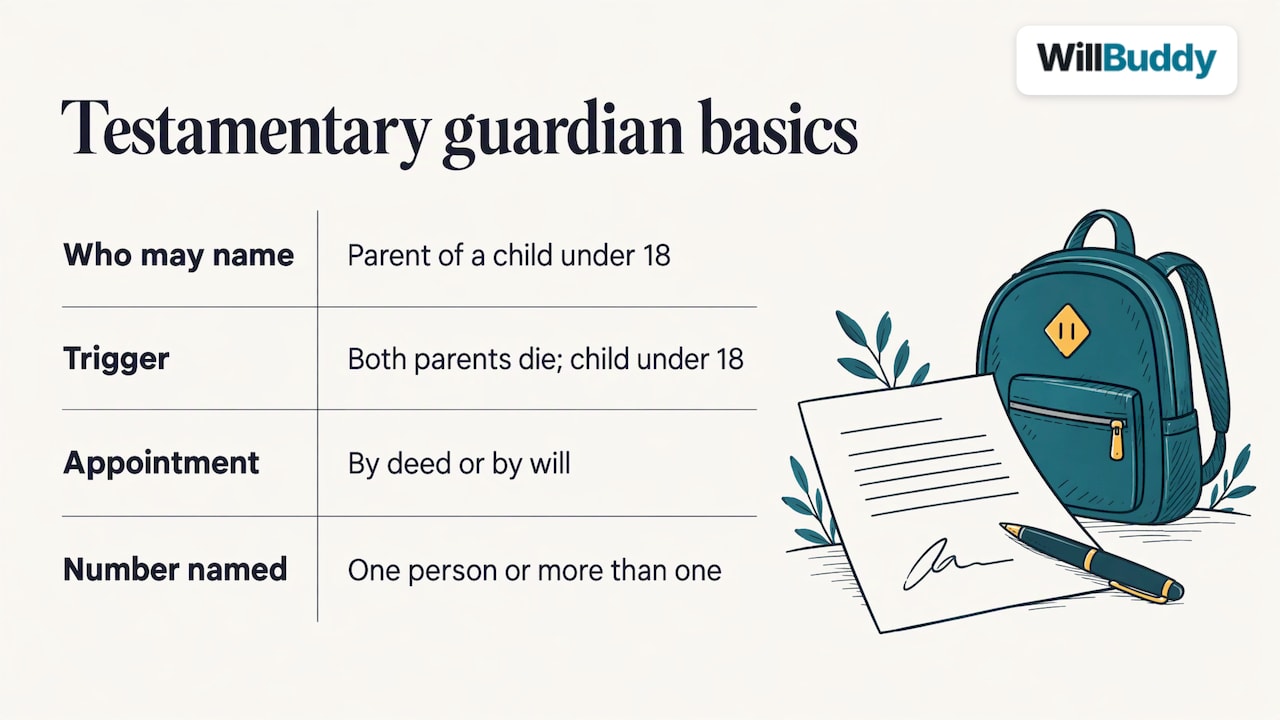
A testamentary guardian is a person you choose in your will to care for your child after you die. The name comes from "testament", an old word for will.
The NSW Government's wills guide says a parent of a child under 18 may nominate a guardian in a will, to care for the child if both parents die while the child is under 18. The key words are "both parents". For most families, the clause is a backup plan for the worst case.
The law behind it is short. Section 14(1) of the Guardianship of Infants Act 1916 (NSW) lets a parent appoint any person as the child's guardian after the parent's death, by deed or by will. A will is the usual choice because most parents are already making one.
You can name one person or more than one. Legal Aid NSW says a parent can name one or more people. Many couples name a married or de facto pair who would raise the child together.
What a guardian does in practice
The NSW Government describes a guardian's role as the longer-term decisions in a child's life: education, values and religion, health and lifestyle. Think of the choices about which school your child attends, how they are raised, and what medical care they get.
The guardian is not automatically the person who manages money. That is a separate job, covered below.
Guardianship also has an end point. Legal Aid NSW says a testamentary guardianship ends when the child turns 18 or when a court removes the guardian.
How to choose a guardian
This is the hardest part of the will for most parents. It is an emotional decision, not a legal one. A few practical questions help.
- Values. Would this person raise your child in a way you would be comfortable with?
- Age and health. Will they be able to care for a child for years?
- Location. Would your child have to move interstate, change schools or leave friends? A guardian nearby may cause less upheaval.
- Their own family. Do they already have children, and would your child fit in with them?
- Money and time. Can they cope with the extra load, with or without financial help from your estate?
There is no right answer. It is common to choose a grandparent, an aunt or uncle, or a close friend. You can also name a back-up in case your first choice cannot act.
Our longer guide on choosing the right guardian goes through these questions in more detail.
Talk to your choice first
Both Legal Aid NSW and the NSW Government say the same thing: talk to the person before you name them.
Legal Aid NSW suggests discussing your hopes for your child's care, education, and religious and cultural upbringing with them and the family. The NSW Government adds living arrangements, access to financial support, and whether to set up a trust in the will.
There is a legal reason for this, too. Legal Aid NSW says the proposed guardian should agree and can refuse to act. If you name someone who never knew, they may say no at the worst possible time.
A short conversation covers most of it:
- Ask if they are willing to take on the role.
- Tell them what you value for your child's upbringing.
- Explain how you plan to provide money, for example through a trust.
- Ask if they would want a back-up named, and who.
What the appointment does not do
Parents often assume that naming a guardian settles everything. It does not, and it helps to know the limits.
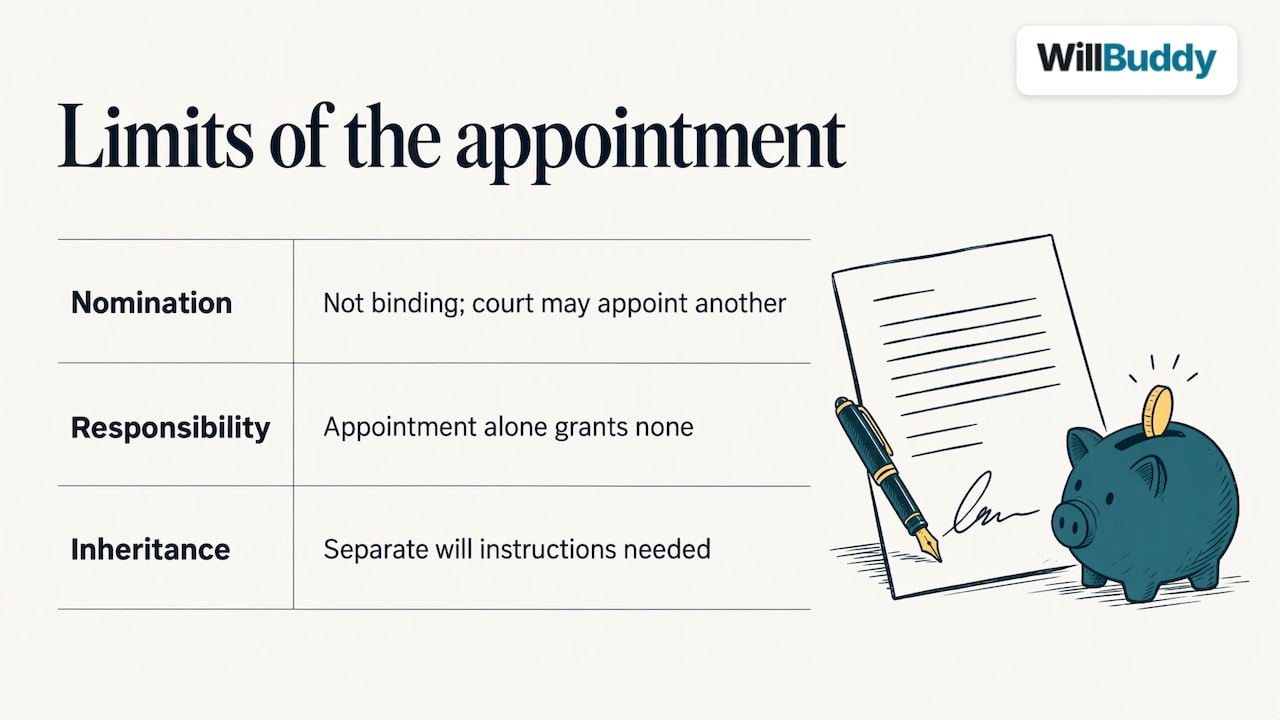
It is a strong wish, not a binding order. Legal Aid NSW describes the nomination as not legally enforceable. A court can consider your wishes but may appoint someone else if that better serves the child's best interests. It can also remove a guardian and appoint a replacement on the same basis. In plain terms, the court's test is what is best for your child, not what is written in the will.
It does not by itself give parental responsibility. Legal Aid NSW says the appointment alone does not give the testamentary guardian parental responsibility. A court order can give or remove that responsibility. This is a technical point, but it is the reason a clear, well-supported appointment matters. Your guardian may need to apply to a court to have their role formally recognised.
It does not move money. Naming a guardian says who cares for the child. It says nothing about who holds and spends the inheritance. That needs separate instructions in your will.
None of this makes a guardian clause pointless. A written, signed choice is the clearest evidence of what you wanted. Without it, the people who love your child may disagree, and a court starts from nothing.
If the other parent is alive
This is the case many parents do not think about. The guardian clause is aimed at both parents dying. If you die and the other parent survives, the child normally stays with them.
The NSW Government says an appointed guardian may act jointly with the surviving parent. If that parent objects, the appointed guardian may apply to court.
Section 14(4) of the Guardianship of Infants Act 1916 (NSW) sets out what happens next. The appointed guardian may apply to the court if the surviving parent objects, or if the guardian considers that parent unfit to have custody of the child. The court can then:
- refuse to make an order, so the surviving parent stays sole guardian,
- order that the appointed guardian act jointly with the surviving parent, or
- make the appointed guardian the sole guardian.
If the court makes a sole-guardian order, section 14(4) also lets it decide custody and the surviving parent's access with the child's welfare in view. It can require the surviving parent to contribute to maintenance according to their means.
So the clause can matter even where one parent survives. But it is the court that decides, and the child's welfare comes first. If you and the other parent separated, or you have concerns about their ability to care for your child, speak to a family lawyer. That situation is beyond what a simple online will is built for.
If you and your partner disagree about who the guardian should be, our guide on what to do if parents disagree on a guardian is a good place to start.
If you name no guardian
If both parents die and no guardian is named in a valid will, the question does not disappear. The NSW Government says an appropriately connected person may apply, and the Family Court decides who will be guardian.
Legal Aid NSW says a surviving parent, a testamentary guardian or another person such as a family member can apply for parenting orders when there is a dispute about who is responsible for a child.
That can mean delay, cost and strain on relatives who are already grieving. A clear clause gives everyone a starting point. It is one of the simplest ways to lower the chance of a family fight.
Protect the inheritance with a trust
A child under 18 cannot manage a large sum of money. Even with a loving guardian, you may not want them to control your child's inheritance, or want your child to receive everything at 18.
The NSW Government says a will can appoint a trusted guardian and protect the child's inheritance with a trust. A testamentary trust is a trust that starts when you die, under the terms in your will. A person you choose, called a trustee, holds the money and uses it for the child.
There are a few choices to make:
- Who is the trustee? It can be the same person as the guardian or someone different. Splitting the roles can give a useful check.
- What can the money be used for? For example, school fees, health costs or living expenses.
- At what age does your child receive the rest? Some parents pick 18, others pick 21 or 25.
Our guides on testamentary trusts for children and choosing a trustee explain the options in plain language.
Recent changes to family law
The federal parenting laws changed on 6 May 2024. The Attorney-General's Department's fact sheet for family law professionals says the Family Law Amendment Act 2023 changed the parental responsibility framework and the best-interests factors courts use.
For you, the point is practical. When a court looks at your child's care, it uses a best-interests test, and your will is one piece of evidence about what you wanted. Keep your will current so it reflects your real wishes.
How to name a guardian in your will
The steps are simple. Here is how it works, and where it can go wrong.
- Decide on your first choice and a back-up. Write down names, relationships and where they live. A missing back-up is a common gap.
- Talk to them. As above, they should agree, and they can refuse to act.
- Use their full legal name. Add their relationship to your child, so there is no doubt about who you mean. A nickname or "my sister" alone can cause confusion if you have more than one.
- State the appointment clearly. Say that you appoint the person as guardian of your children if both parents are dead or unable to act. Our guide on how to word guardian appointments shows the kind of wording to look for.
- Set up money separately. Decide who holds your child's inheritance and under what terms.
- Sign with witnesses. A will must be signed and witnessed properly to be valid. In NSW, the usual rule is that you sign in front of two witnesses, who also sign. Witnesses should not be people who receive something under the will.
- Store it and tell people where it is. A will nobody can find does not help your child.
With WillBuddy, you answer plain questions one at a time, including who you want as guardians for your children, who your executors are and how your estate is shared. The will is drafted for your state or territory. You read every word free, pay only when you want to print it, then sign it with witnesses.
Keeping your will up to date
Guardian choices change. A friend moves overseas. A grandparent's health declines. You have another child. A separation or a new partner changes who should care for your children.
A will that names someone who can no longer act leaves a gap. It is worth a review after any major life event, and every few years even if nothing seems to have changed.
Start your guardian clause with WillBuddy
WillBuddy is an online will platform for Australians. You answer plain questions about your children, the guardians you want to name, your executors and your gifts, and it drafts a will for your state or territory. You can read the whole will free, and you pay only when you want to print it.
Our annual subscription is $39 a year and includes up to 50 AI-assisted edits a year, so you can update your guardian choice when your life changes. Your will is stored encrypted and we never sell your data. See the Annual Access plan for details.
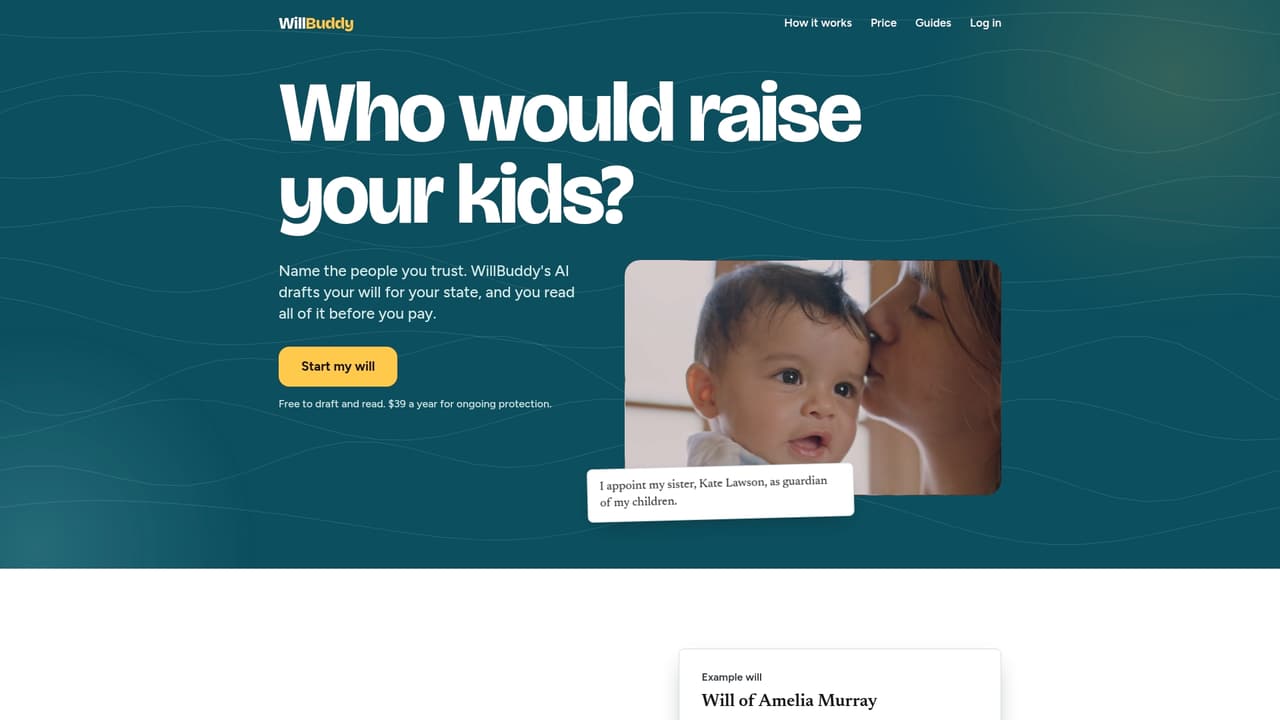
If you want to start now, you can begin your will on WillBuddy and see how the guardian questions look.
When to see a lawyer
An online will suits many families with straightforward circumstances. Talk to a lawyer if any of these apply:
- You are in a blended family, with children from more than one relationship.
- You own a business, or hold assets in a trust.
- You have assets overseas.
- You think someone is likely to contest your will.
- You and the other parent are separated, or you have concerns about their ability to care for your child.
These situations raise questions about parenting orders, property and family disputes that need advice about your own facts. The special situations section of our guide lists more of them.
FAQ
Can I name a guardian for my child in my will in NSW?
Yes. A parent can appoint a person as guardian of their child after the parent's death, by will or by deed, under section 14 of the Guardianship of Infants Act 1916 (NSW). The NSW Government's guide says it applies to a child under 18 if both parents die.
Is a guardian named in my will legally binding?
Not in the way many parents expect. Legal Aid NSW describes the nomination as not legally enforceable, and the person named can refuse to act. A court can also appoint someone else if that better serves your child's best interests. Your clear, written wish is still strong evidence of what you wanted.
What if the other parent is still alive?
The surviving parent will usually care for the child. Your appointed guardian may act jointly with them. If the surviving parent objects, the guardian may apply to court, and the court decides based on the child's welfare.
Who looks after my child's money?
Not automatically the guardian. You can use your will to set up a trust and name a trustee to hold the inheritance. You can choose the same person as guardian or a different person, and set the age at which your child receives the rest.
What happens if I do not name a guardian?
If both parents die and no valid will names a guardian, a person with a proper connection to the child can apply, and the Family Court decides who will be guardian. That can take time and cause stress for the family.
Sources
Show the 6 sources
- Guardianship of Infants Act 1916 (NSW), section 14
- Learn about wills, NSW Government
- Plan for your children's future with a Will, NSW Government
- Making a will, Legal Aid NSW
- Parenting after separation, Legal Aid NSW
- Family Law Amendment Act 2023: Fact Sheet for Family Law Professionals, Attorney-General's Department
Start your will free at willbuddy.com.au and read it before you pay.
Recommended
For parents who plan ahead
Say who you'd want to raise your kids, in writing
Your will is where you can name a guardian for your children under 18, in case both parents die. It's best if both parents name the same person. WillBuddy asks who you'd trust, a backup, and the age they get their share, then drafts your will for your state. Read every word free, with no card. You pay only if you want to print it.
Start my will freeLast updated 27 November 2026.
This article is general information only and is not legal advice. It is our best interpretation of the law as at 27 November 2026. WillBuddy is not a law firm, and it never replaces advice from a lawyer or solicitor. Laws change and differ between states and territories, so for your own circumstances, please get legal advice.